



Abstract
Femicide is defined as the killing of a woman by a man because she is a woman. The incidence of femicide has increased over the past few years and accounted for 30.9% of all homicides in 2011 in Italy. Certain features are usually present including asphyxiation as the mechanism of death, an intimate partner as murderer, and a history of sentimental relationship between the victim and the offender. In this paper, we analyse the Italian experience of femicide comparing it with the international scenario. We present four cases of femicide showing peculiar mechanisms of death resulting from various methods of asphyxiation. In all the cases, there had been a relationship between the victim and the offender. We discuss the mechanism of asphyxiation used to kill the women, emphasizing the necessity of a careful evaluation of all data available to reach the correct conclusion in atypical cases of femicide.
Introduction
Femicide is broadly defined as the killing of women. The aim of this definition is to focus the attention of politicians on the murders of women. In 1992, femicide was defined as “the killing of women committed by a man by virtue of the fact that they are women, emphasizing the social aspects of the violent act”. 1 In the 1990s, several terms were used to describe the murder of a woman that occurred within a relationship or cohabitation, including spousal homicide and family-related homicide.2,3 Wilson and Daly 4 stated that a controlling attitude and a strong possessiveness of the victim usually typified the offender, and an intimate partner relationship between the victim and the offender is required for intimate partner homicide.5–7
A total of 2061 incidences of femicide were recorded in Italy between 2000 and 2011. Of these 2061 incidents of femicide, 1459 were committed inside the victim’s house or during relationships and 967 of these 2061 were committed by the husband, intimate partner or ex-boyfriend. In 2011, a woman was murdered every three days in Italy,8,9 and femicide represented 30.9% of all homicides. According to Italian research performed in 1982, 10 femicide was strongly related to the woman’s relationship with the murderer, and the most common reason for murder was passion, jealousy, possessiveness, or the inability to accept the loss of the partner. Cold steel weapons were the most common (43.1% of cases), and asphyxiation was used in 5.2% of cases in Italy. Research in the United States in 2005 showed that 30% of femicide cases were committed by an intimate partner, 7 and in 80% of these incidents, the women were killed inside their homes by their partners.11,12
In this report, we present four cases of femicide that were committed by the victims’ partners using asphyxiation. In addition, we analyse the Italian scenario of femicide, comparing it with international scenarios.
Case 1
A 32-year-old white female was found dead among some bushes in farmland. At the crime scene, there were several bruises and signs of neck compression on the victim’s face (Figure 1). At the postmortem examination, there were multiple bruises on the head. Upon reflecting the scalp, widespread areas of haemorrhage were exposed, and upon entering the cranial cavity, there was a mild subarachnoid haemorrhage. There was a haemorrhage of each fascial plane of the neck, and several haemorrhages were observed and histologically confirmed on the thyroid cartilage (Figure 2). Death was due to strangulation and suffocation. The murder was committed by the victim’s lover in a fit of jealous rage that was triggered by a sense of inferiority to a former boyfriend. The quarrel began after the victim said she did not want to start a relationship with the man. The man began to beat the victim violently, and then tightened one hand around her neck and used the other hand to close her nasal orifices.
Several bruises on the face. Haemorrhage of each fascial plane of the neck.
Case 2
A 23-year-old black female was found dead in her residence, under her bed. At the crime scene, there were several signs of neck compression, bilateral subconjunctival haemorrhage (Figure 3), and bruises and abrasions on the submental region. At the postmortem examination, there was a massive haemorrhage of the internal mucosa of the larynx (Figure 4), suggesting the combined action of suffocation and strangulation. The murder was committed by a male offender who began to beat the victim after he had asked her to marry him and she refused. After the murder, the offender went to the police station and confessed, declaring that he had strangled the victim using the wire of an electric iron.
Bilateral subconjunctival haemorrhage. Massive haemorrhage of the internal mucosa of the larynx.

Case 3
A 40-year-old white female was found dead, partially buried in farmland. At the postmortem examination, there were several bruises on the head and some linear-shaped abrasions on the wrists. The mouth was sealed by scotch tape on top of a handkerchief (Figure 5). On the neck there was a sealed rope, suggesting strangulation. Under the rope, there was a concentric linear-shaped abrasion (Figure 6). The feet were tied together by an additional rope. The cause of death was asphyxiation due to a dual mechanism of strangulation by rope and suffocation by handkerchief sealed by scotch tape on the mouth. Upon reflecting the scalp, a massive subgaleal haemorrhage was exposed, particularly on the right parietal-temporal region. On the abdomen and lower limbs, there were several abrasions that showed no signs of vitality, suggesting that the body of the victim had been moved from the place of death to the place of discovery. These findings suggest that the asphyxiation was preceded by an act of aggression, and loss of consciousness of the victim who had been stunned by a large section of a blunt instrument, probably a shovel. The dead body was then moved to farmland where it was partially buried. The victim was identified as a prostitute and the offender was her “protector”, who considered the woman to be his property. When he discovered that the woman had started a relationship with one of her customers, he perceived that he had lost control of the woman and killed her. After the homicide, the man was diagnosed with severe mental illness, including coprophagia, and was admitted to a psychiatric hospital.
Mouth sealed by scotch tape on top of a handkerchief. Strangulation mark on the neck.

Case 4
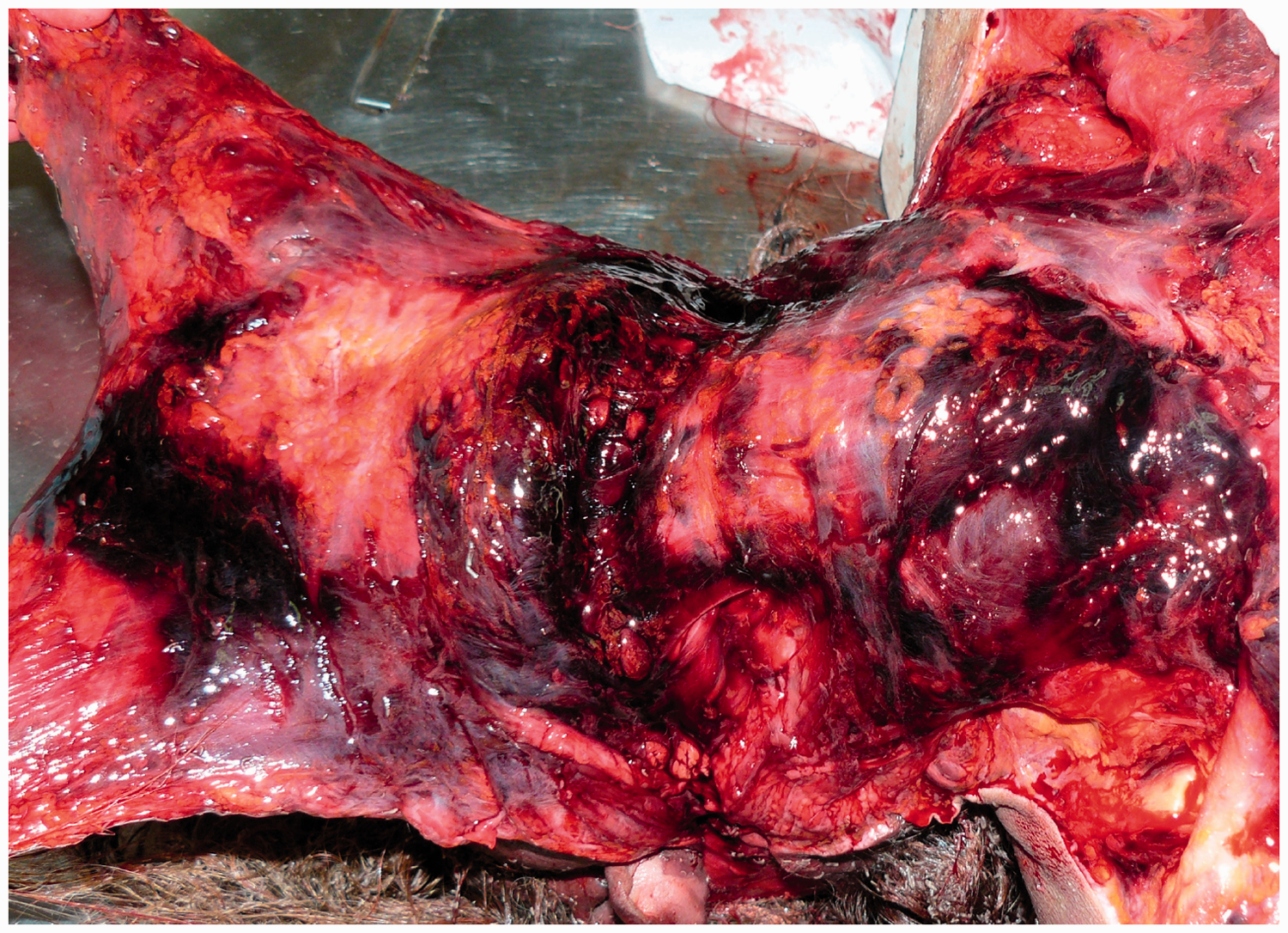
A 60-year-old white female was found dead inside her home lying on the bed. The wrists were bound together by a sock. At the external examination, there were several abrasions on the posterior side of the cheek and on the left submental region (Figure 7). Multiple small oval-shaped bruises were present on the neck, suggesting compression by fingertips. There were several pinpoint bruises on each eyelid and subconjunctival area (Figure 8). The mouth was sealed by 10 white handkerchiefs that went deep inside the oral cavity up the epiglottis. There was a large bruise on the internal surface of the lower lip, and a bruise and laceration on the tip of the tongue. Upon dissecting the soft tissues of the neck, a widespread area of haemorrhage was evident, involving soft tissues, fascial planes, and organs. There were multiple bruises on the larynx and the left pulmonary parenchyma. Rib fractures had caused right hemothorax and laceration of the left lobe of the liver, resulting in mild hemoperitoneum. Autopsy findings suggested asphyxiation due to a combination of suffocation, strangulation, obstruction of the airway, and thorax compression.
Abrasions and bruises on the neck and face. Several pinpoint bruises on each eyelid and subconjunctival area.

During the event, the victim was in a supine position and the offender was above her. The obstruction of the airway was due to the use of 10 white handkerchiefs that were placed in the mouth when the victim was already unconscious. According to police records, the offender was the victim’s husband. After the homicide, the murderer left the residence and was untraceable for one day. Once caught, he explained that he had discovered that his wife betrayed him, and that the assault on his wife was triggered by anger and humiliation.
Discussion
According to systematic research requested by the World Health Organization (WHO), and performed by Stöckl et al. 13 using the most important scientific databases (Medline, Global Health, Embase, Social Policy, and Web of Science), 13.5% of homicides were found to have been committed by the intimate partner of the victim. Femicide was six times more common than homicides with a male victim (38.6% vs 6.3%). Almost one in every seven homicides and one third of femicides are committed by an intimate partner where the relationship between the victim and the offender was characterized by multiple violent episodes. In the United States, the ratio of female to male victims of homicide by an intimate partner is approximately 45:5, 14 and in the United Kingdom it is 54:5. 15
In Italy, from 1990 to 2006, the yearly number of total femicides averaged at about 180–190 cases. In 2005, the rate of femicides reduced to 4.39 per million women. According to EURES 1125 femicides were committed in Italy between 2000 and 2005, with a mean number of 187.5 femicides per year. 16
Femicide is a growing phenomenon in Italy, notwithstanding that the rate of femicide in Italy is lower than in other countries in the world.17–19 According to 2012 United Organization (UO) records, the murder of women is less common in Italy than in any other European country. 20 According to the Spanish Centre “Reina Sofia” research, in 2003 among European countries, the UK, Spain, Germany, Austria and Denmark report higher femicide rates than Italy. In fact, Italy has only 6.5 femicides per million women. The European countries with the highest rate of femicide are the former Soviet Union republics, such as Estonia, Hungary, Romania and Slovakia. 21
Most femicides are carried out while the couple are in a relationship characterised by incidences of repeated violence against the victim by her partner.22–24 In 2006, of 2,938,000 women in Italy, 14.3% were involved in a relationship and experienced at least one act of physical or sexual violence committed by their husband, cohabiting partner, or boyfriend. 25
According to research performed by Iezzi, 26 in Italy most victims of domestic femicides are killed by their husband or live-in partner; 15.8% by their ex-husband or ex-partner and 12.7% by their son or daughter. Totally, couple-femicides (or intimate femicides) (i.e. women killed by their partner, husband, ex-partner, or ex-husband) are 66.7% of total domestic femicides. 92.4% of victims of a domestic femicide are killed by a man and only 7.6% by another woman. There is no relationship between the size of the city and where a woman is killed. In both family homicides and femicides occurring in Italy, the killer was usually a man (80.5% and 92.8%, respectively).
The Convention of Istanbul 27 was established in 2011 to reduce violence against women and domestic violence generally and to establish an international shared strategy in the battle to prevent violence against women, protect female victims, and enable criminal prosecution of offenders, removing any gender-based discrimination that exists. According to the Convention of Istanbul, violence against woman is a violation of human rights and constitutes sex discrimination. The document was ratified in Italy on 19 June 2013; however, signatures from five other States of the European Union are necessary to make the Convention effective.
The femicide cases we have reported here are typical and exhibit the most common features described in the literature.28–30 In all four cases, there was a prior relationship between the offender and victim and all the homicides took place after the victim had decided to leave the relationship, which provoked rage in the partner. All the killings included a combination of asphyxiation mechanisms, compatible with those described in scientific literature.31,32 According to research performed in India, South Africa, and Finland, 10–20% of femicides are carried out by asphyxiation, suggesting that this is usually the chosen method while in Italy asphyxiation is used in 5.2% of cases.33–35
Femicide in Italy is an important phenomenon, but it is less common than in any other European country. Statistics show that when a woman is killed, the perpetrator is often a man who has been intimately involved with her. Asphyxiation is a commonly used means of femicide in several countries, but the literature demonstrates that it less common in Italy, notwithstanding that our last four cases were all carried out by a combination of mechanisms of asphyxiation, suggesting there is a need to re-evaluate this type of murder. A new innovative law was enacted by the Italian Government very recently, identifiable as Law n°119 15.10.2013. This law concerns new rules to fight gender-based violence in order to prevent femicide and protect victims.
The crime scene, autopsy findings, and personal history of the victim and the partner of the victim need to be carefully documented and analysed in order to achieve an accurate reconstruction of the homicide. The motive and psychological aspects and the relationship between the victim and the aggressor are important factors that can assist the investigation, the identification of the murderer, and closure of the case.