




Abstract
Injury or death by strangulation, unless otherwise explained, is almost always homicidal. Accidental strangulation may occur but only very rarely. We present such a case of accidental strangulation and survival in a motorbike pillion rider. A long scarf (dupatta) clad woman, sitting at the back of a two wheeler motorbike, fell after her long scarf got caught in the back wheel. The lady was first taken to a local clinic and then later was referred to a hospital for a suspected spine injury where she made an uneventful recovery. This case report exposes the precarious position of women pillion riders wearing a long scarf and emphasizes the need for extra caution and the need for wheel guards on spoked wheels in particular.
Keywords
Introduction
Accidental strangulations are quite rare compared with homicidal strangulations. Many textbooks have described the possibility of self-strangulation in various scenarios. Fewer case reports of accidental strangulation are published. Such instances include but are not limited to the umbilical cord wrapping around the fetus and strangling the baby in utero, children accidentally strangling themselves while playing with ropes, clothes worn around the neck getting entangled in rotator machines, or an intoxicated person getting strangled by his own necktie if it is too tight.
Incidents of accidental strangulation due to clothes getting stuck to the wheels of vehicles such as cars, cycle rickshaws and two wheelers are also reported. The most famous incident was the tragic death of a dancer, Isadora Duncan, whose long scarf got caught in the wheels of a car in the late 1920s. 1 Thereafter, the accidental entrapment of clothes in motor vehicles was called “Isadora Duncan Syndrome” or the “Long Scarf Syndrome”.
The dupatta is a long scarf loosely worn around the neck by women in the Indian sub-continent. This long scarf may get entrapped in the open spokes of vehicles such as bicycles, cycle rickshaws, motorbikes, and bullock carts. This is why most cases related to the “Isadora Duncan Syndrome” are found in this part of the world. We report one such incident where a lady, who was a pillion rider of a two wheeler motorbike, survived without any serious injury.
Case report
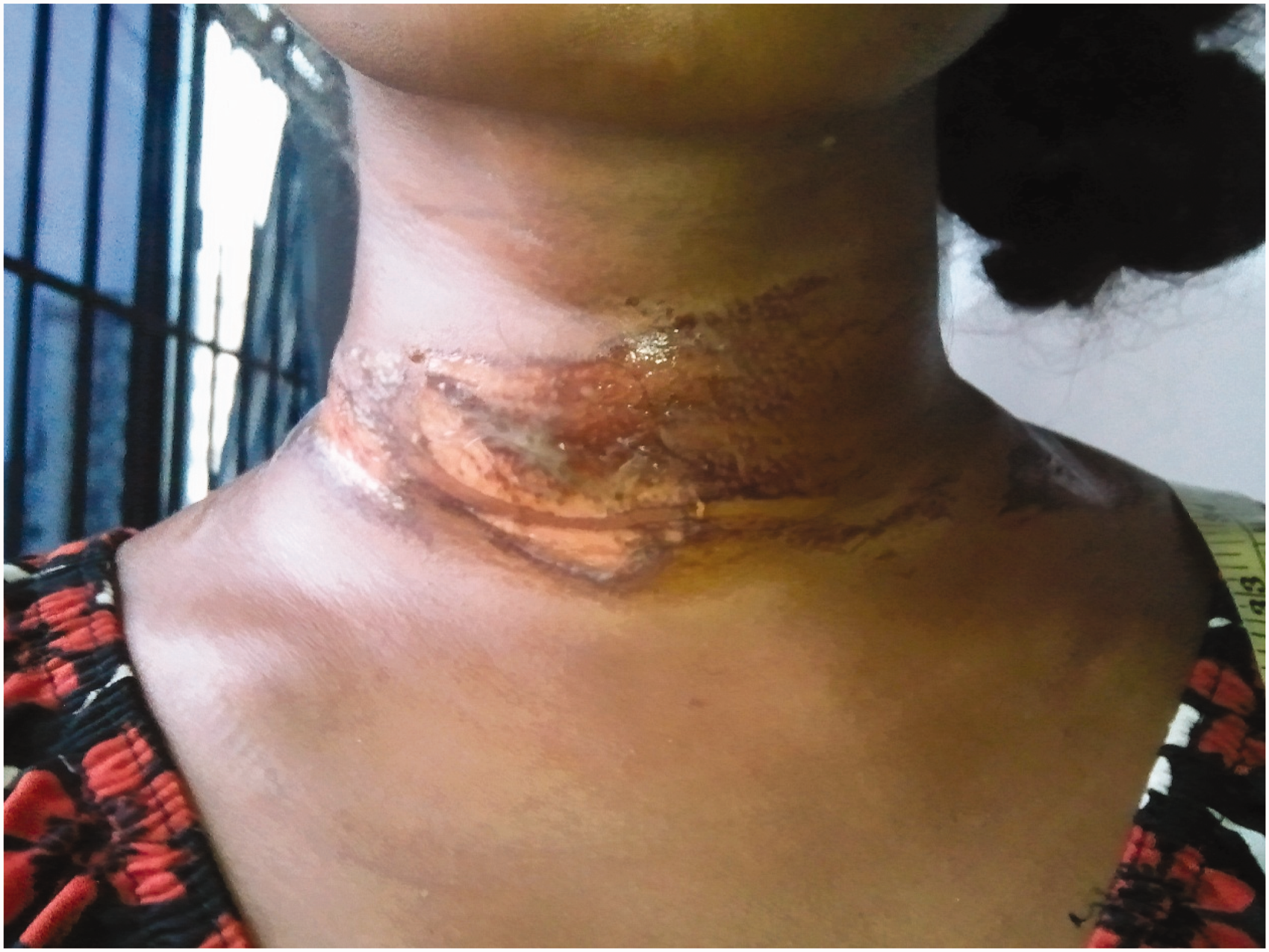
A 24-year-old lady was brought to the emergency department of a hospital in Mangalore, India, with a history of a fall from a motorbike after her long scarf (‘dupatta’) got trapped in the rear wheel (Figure 1). She was the pillion rider. Her long scarf was entangled in the open spokes of the rear wheel of the motorbike which caused her to be strangled and fall off. She had a momentary loss of consciousness. After receiving first aid at a local clinic, she was referred to the hospital for suspected spinal injury. She had mild dyspnoea and dysarthria on presentation to the hospital. A horizontally placed pressure abrasion (ligature mark) was present on the front of the neck (Figure 2) extending to the nape of the neck. Abrasions were also present on the front of the left knee, outer aspect of the right buttock, and the inner aspect of the left elbow. She was managed conservatively and discharged subsequently with an uneventful complete recovery.
Simulation of a case demonstrating the hazard of the “dupatta.” Frontal view of the ligature mark on the neck.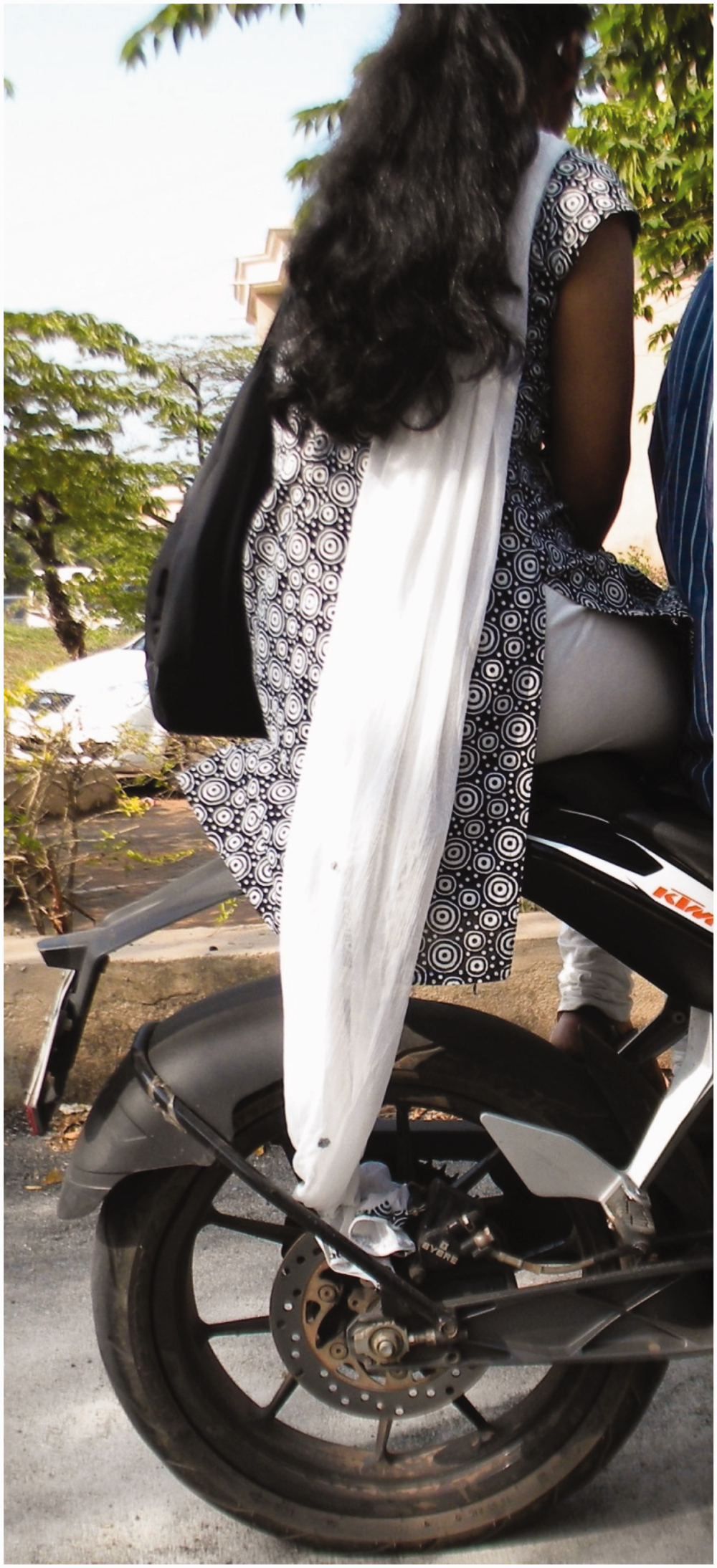
Discussion
Survival after an accidental strangulation involving a motorbike is uncommon. A case of a girl travelling on a bullock cart getting accidently strangled and surviving in spite of sustaining severe neck injuries, 1 and a very different case in which a student in Edinburgh sustained a laryngeal rupture from strangulation with a scarf while travelling on a cycle rickshaw 2 have been reported. The authors stated that despite severe laryngeal trauma and carotid artery damage, the patient recovered with no permanent neurological deficits. 2 By contrast with these two patients who did sustain significant injuries, the patient in our case we report here presented with only superficial abrasions.
Fatal cases of accidental strangulation are reported in the literature. In one case a girl who was a pillion rider on a bicycle died due to unilateral and incomplete strangulation. 3 A second case was of a 40-year-old lady who was brought in dead to a hospital after she was accidentally strangled while travelling in a cycle rickshaw. 4 A third case of accidental strangulation was of a 50-year-old lady, who was brought in an unconscious state to a hospital and died within 16 hours of admission. 5 Another case related to a 13-year-old girl who suffered a cervical spine injury as a result of accidental strangulation involving a bullock cart. 6 One case was related to a saree (a traditional dress worn by Indian women) getting entrapped in the rear wheel of a two wheeler. 7 Another case was about a 15-year-old female pillion rider who sustained a fatal cervical spine injury as a consequence of accidental strangulation by her “dupatta” getting stuck in a wheel. 8 A 10-year retrospective autopsy study in East Delhi showed a total of three accidental ligature strangulation cases involving cycle rickshaws. 9
In order to prevent such tragic incidents from occurring during travel on the road, it is important that the Government gives strict instructions to bike manufacturers to incorporate a protection guard on all their models (Figure 3). Generally, these protection guards are not provided by the manufacturer and are fitted by the owners later on. Not all bicycle owners do so. Restrictions should be placed on the sale of bicycles without an inbuilt rear wheel protection guard. Bicycles without such an apparatus should not be permitted to be insured and insurance is compulsory to run any vehicle. In addition, people should be warned against the dangers of such easily preventable accidental incidents. The need to take extra care while travelling on a motorbike should be emphasised.
10
A two wheeler motorbike with a protection guard (saree guard) and a completely covered chain.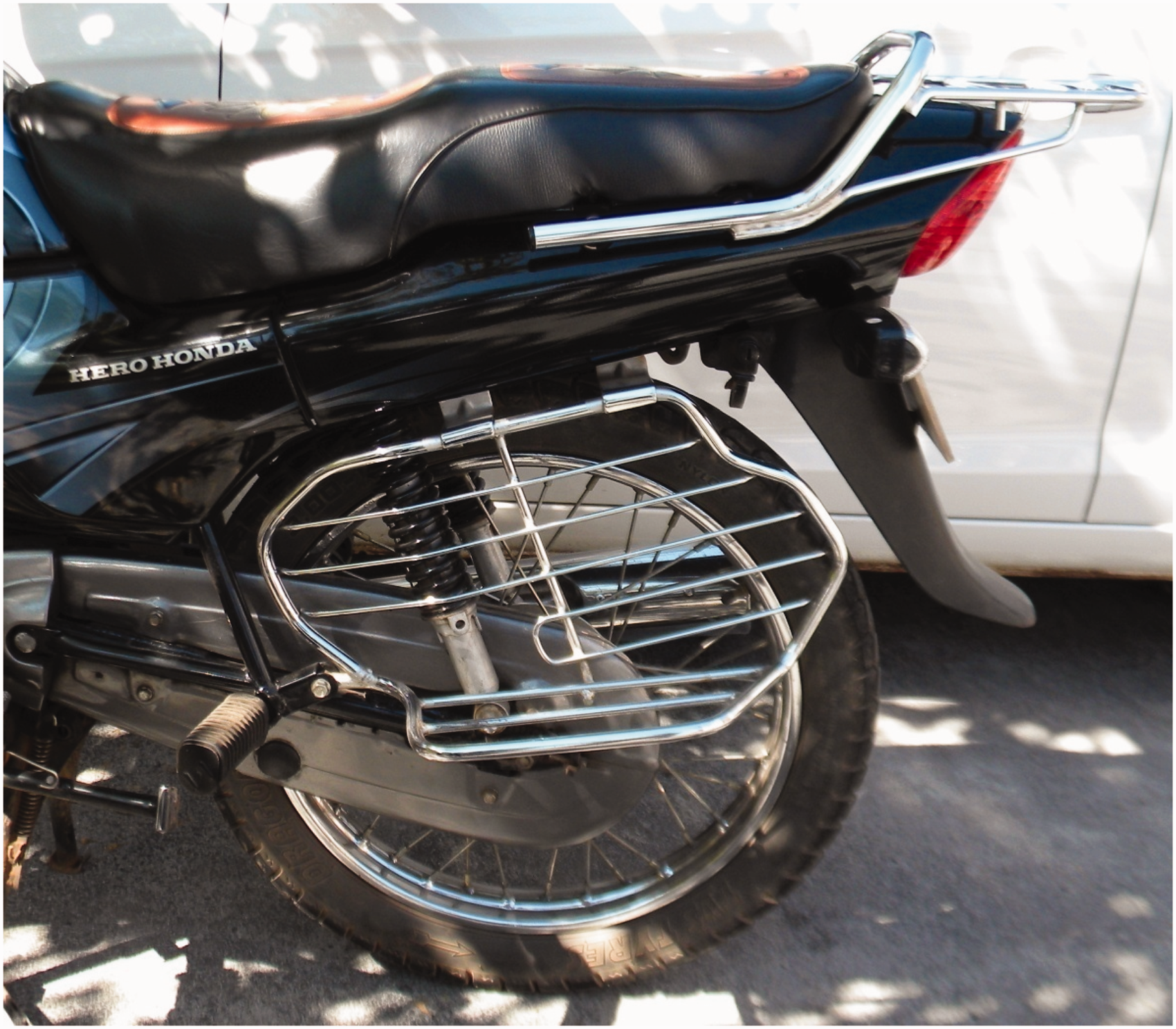
Footnotes
Declaration of conflicting interests
The authors declared no potential conflicts of interest with respect to the research, authorship, and/or publication of this article.
Funding
The authors received no financial support for the research, authorship, and/or publication of this article.