



Abstract
Snakebites are an important cause of death in rural and suburban India. Most of these deaths occur due to envenomation. The incidence of snake bite is highest in developing countries with the most common site of such bites in the lower limbs. Here, we present a case where a 12-year-old boy had been bitten on his face which is an unusual site and as a consequence the treating doctor failed to make the correct diagnosis promptly and the boy died.
Keywords
Introduction
Snakebite remains an important cause of accidental death in modern India. 1 Snakebites are reported in virtually every part of the world. Indian statistics reveal about 200,000 bites, of which nearly 15,000 end in death. 2 Common venomous snakes found are the Common Cobra (Najanaja), Krait (Bungurauscaeruleus), Russell’s viper (Daboiarusselii), and Saw Scaled Viper (Echiscarinatus). These are known as the “big four” of India. Their habitats are widely distributed across the country. There are also other venomous snakes in India, such as the King Cobra (Ophiophagushannah), Hump-nosed Pit Viper (Hypnalehypnale), and Banded Krait (Bungurausfaciatus) in India. However, the distribution of these snakes is limited to particular geographic regions. 3
The incidence of snakebite rises substantially in the monsoon season. The case being reported occurred during this season. Conventional Indian textbooks do not discuss the common bite sites in great detail. Snakebite is not a common problem in the West, and hence discussion on snakebite poisoning is scarce in western books on toxicology. However, Wallace does mention common sites chosen by venomous snakes, and mentions that the trunk and face are affected in few cases. 4 Here, we report a case of a snake bite to the face.
Case report
A 12-year-old boy while sleeping outside the Dhaba, a roadside restaurant, on the floor was bitten on the left cheek. Later, he developed itching over the bitten area and was uncomfortable. Next morning, he went to his home and consulted a local doctor who could not come to a conclusion. As the condition worsened, he was referred to Basaveshwara Medical College and hospital where antivenom treatment was started, but the boy died the same evening. As the bite was in an unusual site and he was bitten while sleeping outdoors, the local doctor failed to consider snakebite as the cause, and because of the delay in recognizing the signs and symptoms of snakebite toxicity, the boy lost his life.
External findings
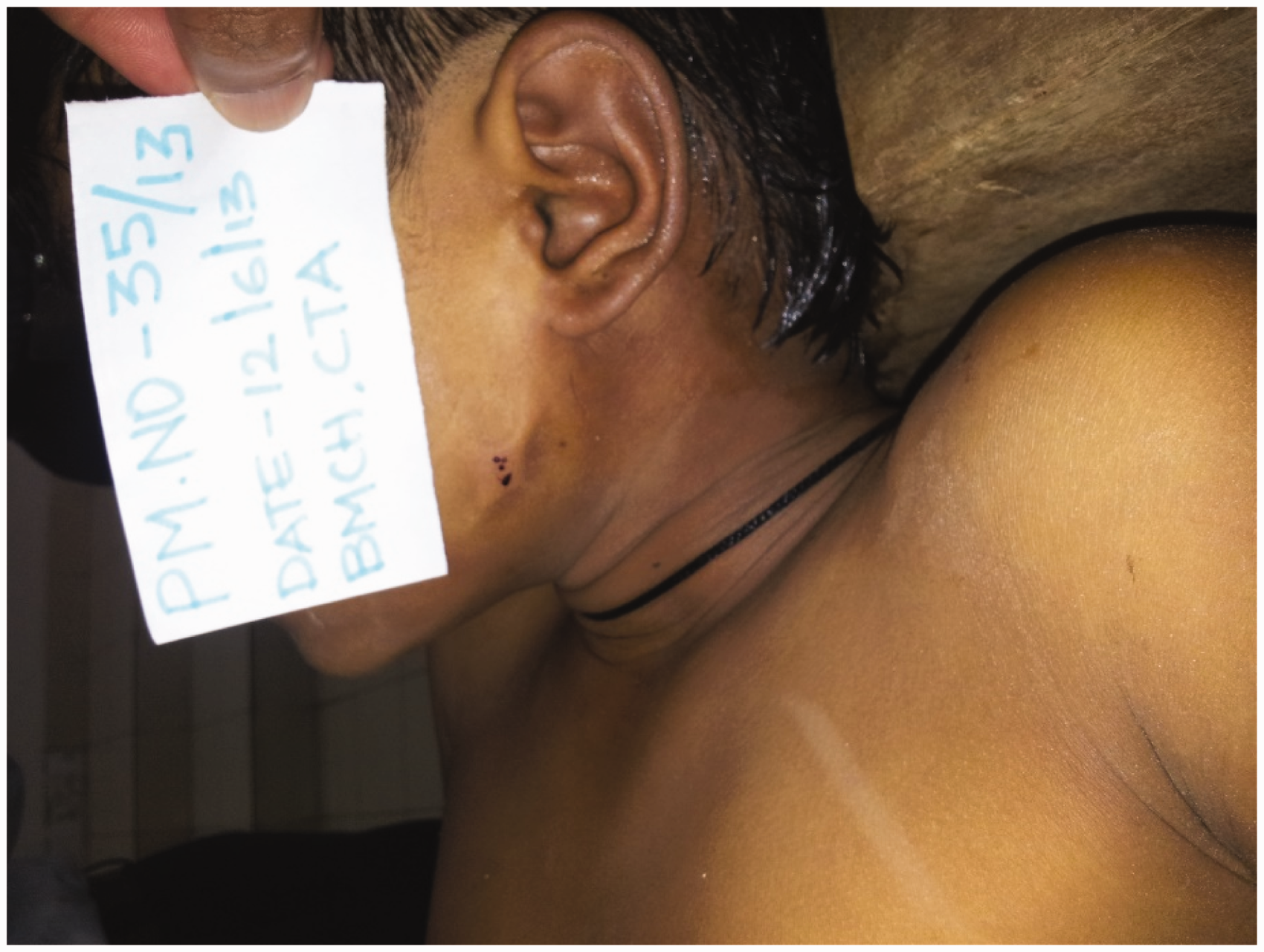
Two pinhead-sized puncture marks over left cheek just above the lower border of the mandible (Figures 1 and 2).
Internal findings
All organs were congested.
Cause of death
Death was consistent with the snakebite poisoning.
Snake bite area over left middle part of mandible. Bitten area showing bleeding spots after squeezing.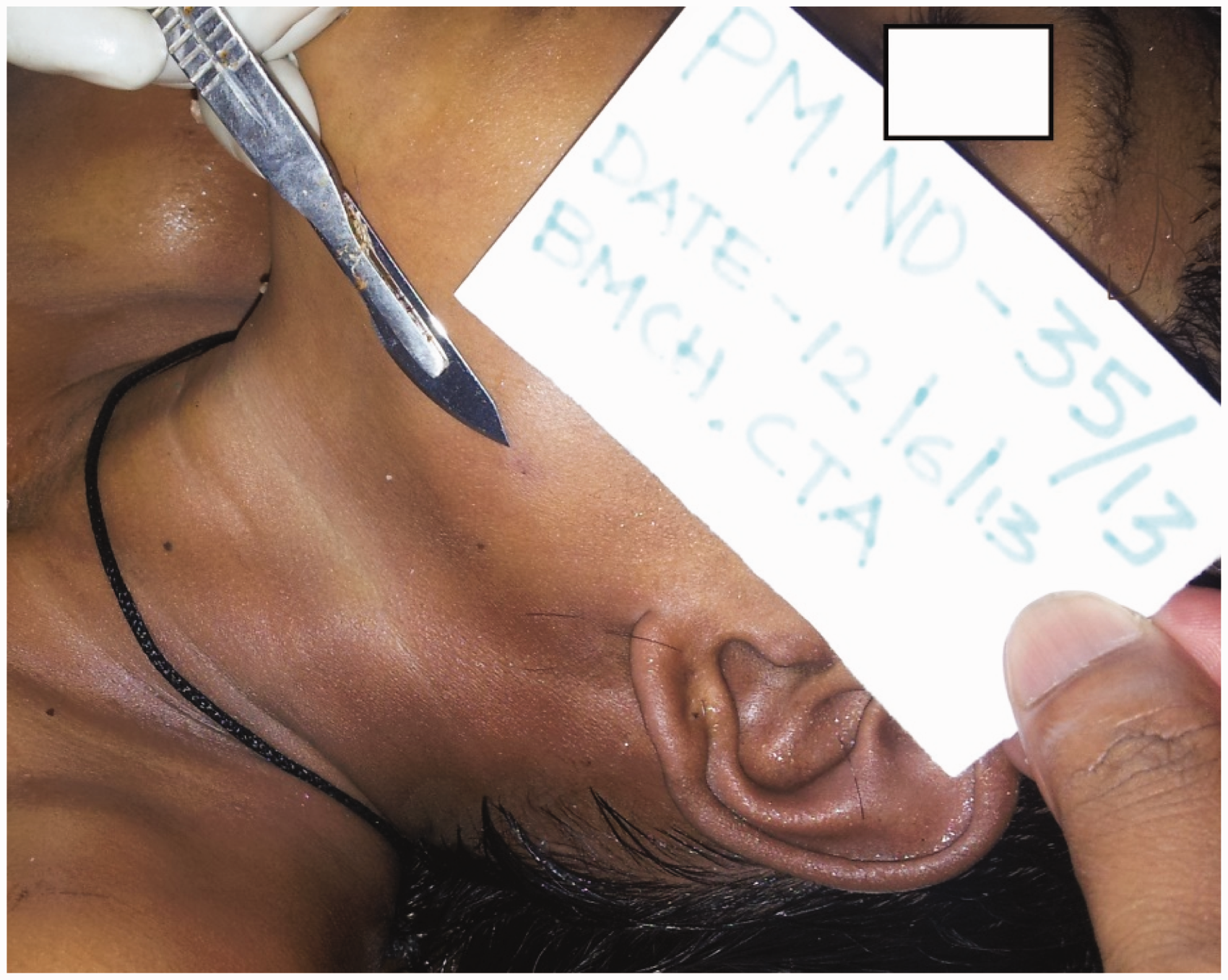
Discussion
As many cases of snakebite occur outdoors among farmers, it is understandable that a person working in a field is more likely to get bitten on the exposed or peripheral parts of the body. In most cases, snakebites occur on the limbs, and this is the basis for the precautions suggested to prevent snakebite, viz., the use of boots, thick trousers, and gloves to protect the limbs, while working outdoors. 4
Snakebite is a frequently encountered problem in rural India; it is seen infrequently in urban areas. Common neurotoxic snakes in India include Cobra (Najanaja) and Krait (Bungaruscaeruelus). Abdominal pain, the cardinal symptom of krait bite, can precede neurological symptoms by several hours. Krait bites are commonly reported between 2 a.m. and 3 a.m., and those sleeping on the floor are at greater risk. Paucity of local tissue reaction, as seen in our patient, is a typical feature of Krait bites. 5
There are few cases where the bite site chosen by the snakes was different. Satar et al. 6 reported a case where the bitten area was on the vertex of the head, and in another case Gupta et al. 4 reported the occurrence of a bite over the scalp, which was hidden by hair and after opening of the scalp ecchymosis and edema was found in the inner layer of the scalp along with two bite marks over the external surface. Kao and Talun 7 reported a case where a snake charmer presented to an emergency department with a snakebite on the tongue. Arshad et al. 8 and Babata 9 reported a snake bite on the scrotum; in a similar case, a Taiwanese man was bitten by a snake on the scrotum while he was using a plastic latrine. 10 Crane and Irwin 11 reported a case where a snakebite was on the glans and in a newspaper report, it was reported that 12 a man’s penis was bitten by a snake as he went to the toilet to relieve himself.
Conclusion
Thorough external examination should be made, including the search for the bite marks at rare sites, in suspected cases of snakebite poisoning. Clinicians and forensic experts should be aware of unusual sites of snakebites in order to diagnose snakebite toxicity early and in giving a cause of death during postmortem examination.
Footnotes
Declaration of conflicting interests
The author(s) declared no potential conflicts of interest with respect to the research, authorship, and/or publication of this article.
Funding
The author(s) received no financial support for the research, authorship, and/or publication of this article.