




Abstract
While abdominal stabbings are frequently associated with homicides, abdominal self-stabbing is uncommon and poses a challenge for the investigators. In cases of sharp force trauma, the presence of hesitation cuts over the neck and extremities help to distinguish self-inflicted injuries from homicides. Hesitation cuts are not associated with self-inflicted sharp force injuries to the abdomen, and thus are of limited use in distinguishing suicidal from homicidal abdominal stab wounds. In this study, we present a case of self-inflicted abdominal stabbing along with a detailed review of literature to help elucidate such cases.
Introduction
Patients with penetrating abdominal trauma are not uncommon hospital admissions. Penetrating abdominal wounds by sharp cutting instruments are medical emergencies, and the primary concern for a doctor in such cases is to save the patient’s life. From a legal point of view, any penetrating abdominal injury is a medico-legal case, thus eliciting a detailed history and ascertaining how the injury was inflicted is important. Stab wounds over the chest or abdomen are usually viewed with a suspicion of homicide, and while abdominal stabbings are frequently associated with homicides, abdominal self-stabbing is uncommon.
Case report
A 52-year-old male was brought to the emergency room (ER) of Manipal Teaching Hospital with a stab wound and a weapon in situ (Figure 1). The entry wound was a penetrating-incised wound, situated about 2.5 cm below left the costal margin 3 cm lateral to midline, directed backwards and to the left. There was no abrasion or bruising at the wound margin which was horizontally oriented. The T-shirt the patient was wearing was rolled up to the nipples and undamaged. The abdomen was smeared with blood oozing from the wound. No exit wound was present. The police were informed, and the case was registered as medico-legal. The history provided by the victim’s attendants was that the victim used to drink local homemade arrack regularly. That led to frequent quarrels between the victim and his family members. On the afternoon of the incident, after an argument, he grabbed a knife and stabbed himself while under the influence of alcohol. He was then taken immediately to a nearby health-post from where he was referred to the Manipal Teaching Hospital.
Self-stabbing using a kitchen knife that penetrated the abdominal cavity, and radiographs showing the location of blade in the abdominal cavity.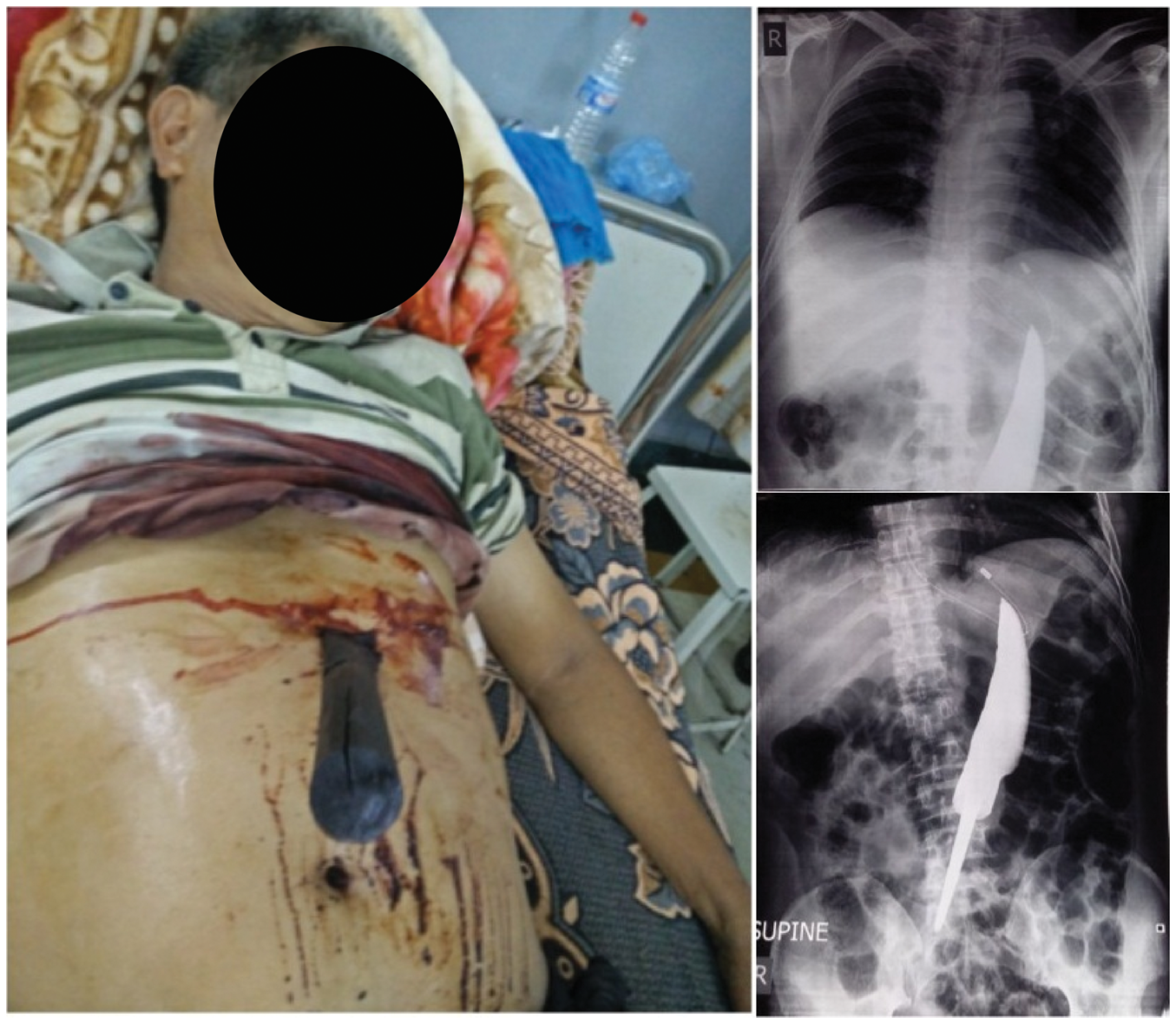
The victim was writhing with pain with every inspiration. A quick assessment of the patient was undertaken and IV lines were secured. Imaging was carried out which revealed minimal fluid in the hepatorenal pouch and also in right iliac fossa. Emergency exploratory laparotomy was undertaken under general anaesthesia with intermittent positive pressure ventilation. It was observed that the pointed tip of the weapon had pierced the lateral margin of the left lobe of liver reaching up to the omentum, but the omentum was intact. The Morrison’s pouch had a collection of about 100 ml of blood. About 50 ml of clotted blood was present in the area adjacent to liver injury. Spontaneous bleeding was noted from the injured liver. No injury was noted in the spleen, small bowel, large bowel or mesentery. The weapon was removed carefully from the body cavity, and peritoneal lavage and drainage was undertaken. The surgical incision was closed in layers and the skin stapled at the end of surgery.
The weapon recovered from the body was a metallic knife with a wooden handle. The metallic black blade was heavily smeared with blood. The total length of the knife was 30.5 cm with the blade measuring 15.4 cm. The maximum breadth of the blade was 3.2 cm at its base gradually tapering into a pointed tip; one edge of the knife was sharp. The weapon recovered at surgery was handed over to the police.
Discussion
A penetrating wound present over the abdomen always raises a suspicion, as to how it was inflicted. It is vital to distinguish between self-inflicted and homicidal stab wounds considering the well-researched forensic perspectives.
Hospital-based studies of self-inflicted penetrating abdominal injuries show that these injuries are characteristically non-lethal1–3; this is in contrast with the autopsy studies on completed suicides that are obviously highly lethal. 12 Eye-witnesses' accounts and circumstantial evidence are vital when giving an opinion on the manner of injury infliction. Information about the characteristics of abdominal stabs in relation to the way they were inflicted would help doctors and law enforcers when giving an opinion in suspicious cases.
In the reported case, a 52-year-old male with a single stab wound in his upper abdomen, inflicted by a knife during afternoon hours in his own house with the weapon in situ was brought to the ED. The horizontal axis of the thrust of the weapon could be observed in the bare skin which was exposed by the undamaged rolled-up T-shirt. The smell of alcohol in his breath was obvious. Detailed examination of the victim along with circumstantial evidence and history provided by his family members confirmed the sequence of events in the case.
Footnotes
Declaration of conflicting interests
The author(s) declared no potential conflicts of interest with respect to the research, authorship, and/or publication of this article.
Funding
The author(s) received no financial support for the research, authorship, and/or publication of this article.