




Abstract
Discrimination on cultural and ethnic grounds is a crime in Nepal. [Caste Based Discrimination and Untouchability (Offence and Punishment) Act, 2068 (2011)*
There are two different dates which reflect the Bikram Sambat which is the official Hindu calendar in Nepal. This calendar is 57 years ahead of Gregorian calendar. For example, 19 August 2017 AD is 03 Bhadra 2074 Bikram Sambat. Thus, the date 2068 is in Bikram Sambat, 2011 is per Gregorian calendar which is unofficial so kept in parenthesis. This text is available online from: http://www.ilo.org/aids/legislation/WCMS_190732/lang–en/index.htm.
Introduction
Pact suicide occurs when two individuals in a relationship plan to end their lives together by an act of suicide. 1 Pact suicide differs from dyadic death which is a combination of homicide and suicide. 2 In pact suicide, the victims agree to die for a particular reason by a preconceived method. 3 Most often they are consorts, lovers, friends or family members. 4 Such a case was encountered by a medical examiner working in rural Nepal. The dead bodies of a young man and woman were taken to the mortuary after they were found below the highest suspension bridge in the country which stands at 166 m. The bodies were found 50 m apart in pools of blood in tussock grassland. A bag later recovered from the bridge contained camping tents, hiking gear, mobile phones and wallets which were used to identify the victims and inform their families and revealed that they were lovers.
Case report
The bodies of male and female young adults in their mid-20s, both moderately built and nourished, measuring 155 cm and 153 cm, respectively, underwent post-mortem examination following the investigating officer’s requisition. Rigor mortis was present over all extremities and hypostasis was indiscernible due to loss of blood. A tattoo mark, circumferentially present around her left forearm, 4.5 cm below left elbow joint provided corroborative evidence to identify the female victim given that facial recognition was nearly impossible due to crush injuries distorting the contour of her head and face. These were made worse due to missing pieces of skull vault and sinuses (Figure 1). Blood oozed out from the nose and mouth of both victims.
Body of the female victim who had distorted contour of head and face and also lacerated left trunk present exposing underlying protruded and mud-smeared internal organs.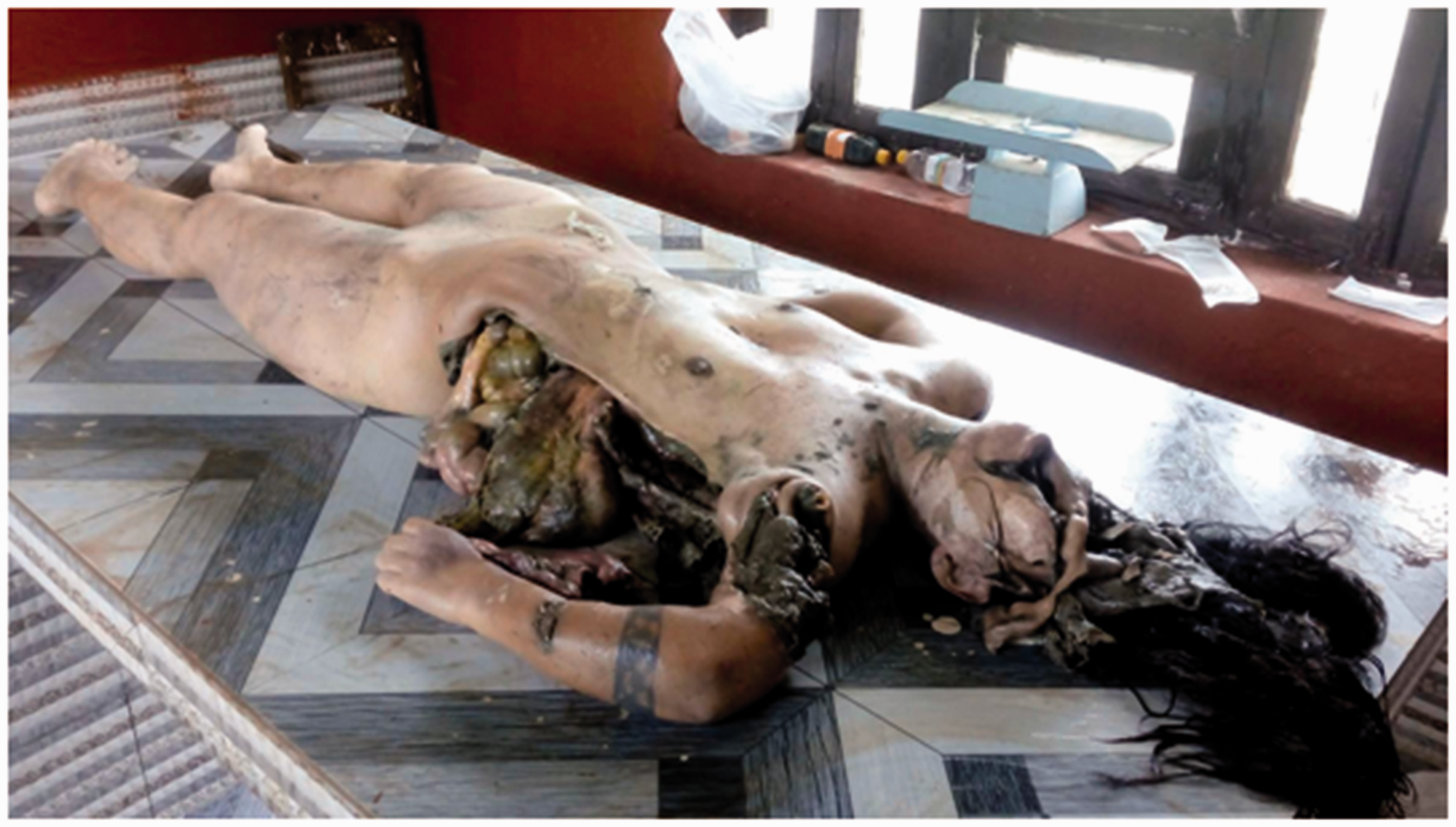
Most of the male victim’s injuries were on the right side of the body. Right humerus was fractured on its lower one-third along with fracture deformity of right radius and ulna at multiple places. A 12 × 8 cm cavity deep laceration was present on right lumbar region exposing underlying mud smeared omentum, intestines, portion of lacerated dome of liver and right kidney. Outer aspect of right thigh on its upper one-third was lacerated (8 × 2.5 cm) muscle deep with underlying fracture of femur and dislocation of right hip joint. There was extrusion of brain substance from the cranial cavity; however, facial recognition was possible unlike the female victim (Figure 2(a)). First lumbar vertebra was fractured. Right tibia was fractured on its mid one-third. Chest was deformed with multiple underlying fractures of 1st to 8th ribs including clavicles on both sides and underlying was 120 ml of collection of blood resulting from multiple lacerations of both lungs and heart, as heart too was lacerated throughout its anterior length moreover on right side. Perineum was lacerated deep into the abdominal cavity (Figure 2(b)). Intestines were contused and lacerated at multiple places.
(a) Extrusion of cranial contents in male victim. (b) Perineum laceration cavity deep into the abdominal cavity.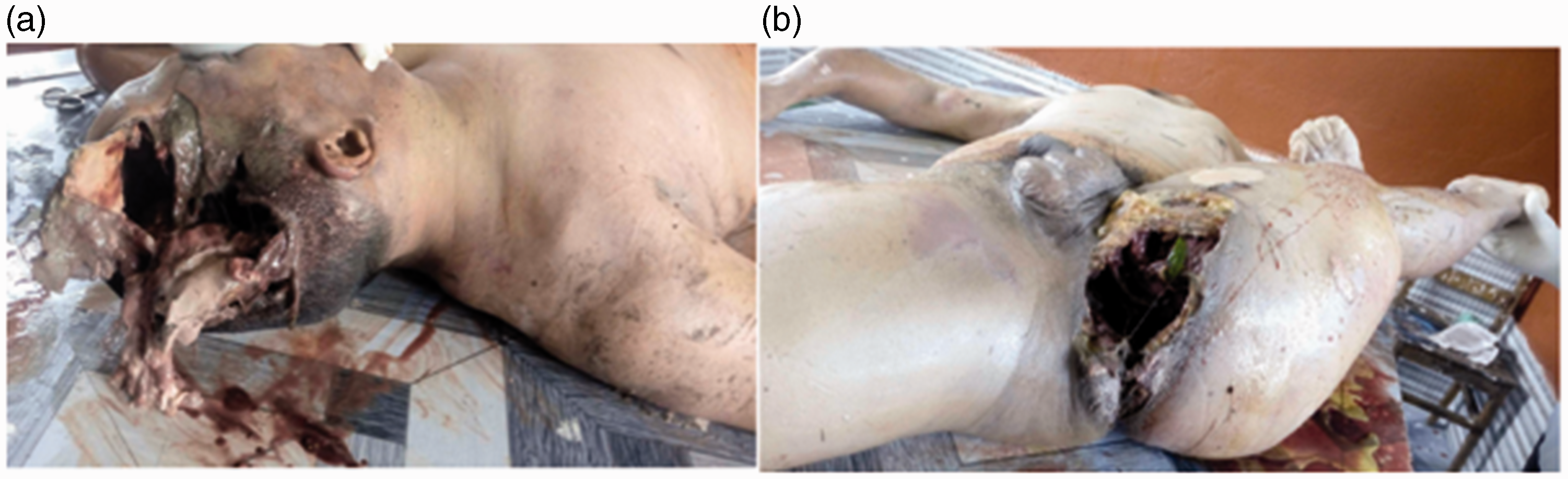
The analysis of injury pattern in the female victim was surprising as most injuries were confined to the left side of her body. A 31 × 10 cm cavity deep laceration extending from axilla to iliac crest covering entire lateral length of left side of the trunk was present exposing underlying protruded and mud smeared lungs, liver and intestines (Figure 1). Left anterior arm (deltoid region) was lacerated (14 × 8 cm) exposing underlying fracture of left humerus. Dorsal aspect of left upper forearm revealed laceration (6.5 × 2 cm) with underlying fracture of left radius and ulna. Somehow, pattern of injury varied in lower extremities. Unlike expected from previous case, fractures and dislocations of lower limbs in female victim was present on right side. Fracture of tibia and fibula on its mid one-third, fracture deformity of right knee and dislocation of right hip joint were exception to the apparent pattern. Right shoulder was dislocated. Rib cage was deformed with multiple fractures of all ribs at multiple places. Portion of left lungs was smeared with mud and sand particles. Heart was pulverised. Multiple contusions were present all over the body in both the cases and internal organs were pale on cut section.
Discussion
The couple who were in a lover’s relationship jumped off the same bridge and ended their lives together but suffered a very different pattern of injuries. The injuries in the man were mostly on the right side of the body whereas the woman’s were mainly on the left side of the body. Although the injuries sustained were consistent with a simultaneous fall from height, the distribution of their injuries differed due to the orientation of the body during the fall, intervening objects, landing surface and body mass of the deceased, which played a vital role in determining the pattern of injury. 5
Different methods have been used by couples when committing pact suicides and include drowning with bound wrists, hanging from a tree using two independent ropes, poisoning with bottled gas and a fall from height with bound wrists.3,6–8
In the present case, the couple may have intended to jump off the bridge into the river at around 10 pm and hurried for fear of being stopped or rescued. The jump may have been miscalculated because it was made in darkness; they ended up lying dead on the river bank. It was not possible to tell from their injuries whether they jumped together or one after another. Literature reports a suicide pact between a husband and wife who jumped at the same time with bound wrists from a 12 m high four-storey building and ended up with a different distribution of injuries. 6
Nepal is a secular country and the constitution bans all forms of caste-based discrimination and the government has encouraged couples with cash prizes who are/were willing to enter into inter-caste marriages. However, Nepalese society still regards inter-caste marriage as a social taboo. People in relationships/married outside their caste and ethnicity are discriminated against to such an extent that they are forced to leave their homes and their community. Although the actual cause of suicide in the present case could not be certain, the preliminary police investigation suggests an inter-caste relationship between the couple led them to end their lives. Such incidents are not uncommon and frequently covered by the media.9,10
Literature suggests pact suicide is rare, but when the pact occurs it is most common between adolescent to young women and men.1,7,11–13 A study on suicide pacts in England and Wales between 1988 and 1992 revealed four male–male pairs and two female–female pairs out of 62 pairs in suicide pacts. 13 During a seven-year retrospective study on pact suicide conducted in France, it was observed that all the victims in the suicide pacts were aged over 71 years. 14
The means of death are carefully planned by the victims, usually by the male instigator, who perceives a threat maintaining closeness in the over dependent relationship.1,12,13,15 The selected suicide method for suicide is carefully chosen to minimise the chances of survival. In the present case, the couples might have chosen the tallest suspension bridge in the country underneath which a deep river was flowing. The water level in the river was higher than normal due to the on-going monsoon.
Conclusion
Although caste-based discrimination in Nepal is a criminal offence, it is still widespread, social stigma and ostracism was the reason behind the untimely demise of this young couple. Had any of the victims’ family recognised the potential danger of a suicide pact by the couple if they were forcibly separated, their deaths could and should have been prevented. An awareness campaign and mass education will help to uproot this deep-rooted social stigma. Psychological autopsies should be conducted in cases of solitary suicide and pact suicides to identify the cause and risk factors of suicide which is still rare in Nepal.
Footnotes
Declaration of conflicting interests
The author(s) declared no potential conflicts of interest with respect to the research, authorship, and/or publication of this article.
Funding
The author(s) received no financial support for the research, authorship, and/or publication of this article.