




Abstract
Excessive use of online technology brings with it the risk of problematic digital behaviour like over-use of social media, online gambling, webinar fatigue, digital burnout, and in extreme cases doom surfing, and doom scrolling. In addition, digital failures can cause significant mental health distress to people, and unhealthy interactions on social media can also lead to deviant behaviour such as cyber bullying and cybercrime. This paper discusses the various vulnerabilities an individual is predisposed to on the internet, and highlights the importance of “Digital Resilience”. Digital resilience is a new concept which refers to the learning, recovery, and bouncing back process after having negative or adverse experiences online. A comprehensive and holistic model to introduce Digital Resilience to everyone through a multitier approach that includes Individual, Societal, and Community intervention is formulated and elaborated. The importance of addressing these concerns from both a psychological and legal perspective is also discussed.
Introduction
Technology is the easiest and most important means of communication in today’s day and age but along with the pros there are cons. In this last year (of Covid-19), there has been a 35% increase in the consumption of news through digital platforms, and a 47% increase in the use of social media. 1 Notwithstanding immense positive effects, the excessive use of and dependence on online platforms caused people to become addicted to online use, and in some cases has led to an increase in such phenomena as “doom surfing” and “doom scrolling”. 2 Doom surfing and doom scrolling are new terms for the phenomenon of continuous online surfing of information that is sad, distressing, and depressing. Increased use of technology has also led to a spike in rates of webinar fatigue, and digital burnout, due to the difficulty of maintaining clear work-life boundaries. People who use the internet for more than 3 h a day were also found to be more vulnerable to cyberbullying; 28% of people who were on the internet for more than 4 h were found to have experienced cyberbullying. 3 Though cyberbullying has been prevalent for a number of years, reports show that it has increased recently.4 Due to the negative impact of excessive online use and dependence, interventions and educational programmes have evolved to sensitise the users regarding benefits of digital hygiene. Researchers are also working on enhancing the digital resilence of users to achieve the goals of digital hygiene and cyberliteracy to avoid cyber crimes. “Digital Resilience” refers to the ability to cope with negative experiences that occurs online.5 Though this concept has been discussed for organisations, as the use of online platforms continues to grow fast and the internet is pervading almost all aspects of a person's life, it is appropriate to consider its relevance for individual users. There is a need to inculcate various strategies and techniques to enable individuals to build digital resilience and to understand mediating psychological concerns to enhance digital resilience.
Pathways for digital concerns
As using and being on the internet can be anonymous, involves no face-to-face interaction and has no geographical limitations, internet use can lead to disinhibited behaviour, can include expression of their sexual preferences, and negative and aggressive emotions. 6 The internet can help people who are shy, lonely, and socially anxious to express themselves.7,8 It can also lead to behavioural disinhibition by individuals with conduct disorder and neuroticism.9,10 Reduced inhibition can result in deviant actions due to anonymity 11 and the subsequent creation of an “online self” which may be different from their “real self”. This can lead to less secure attachment patterns, and reduced depth in relationships, which in turn may lead to increased anger and frustration if things do not go as expected, due to the lack of real social interaction. 12 In certain cases, increased disinhibition and reduced self-control lead to excessive online aggression, and cyberbullying, 13 with adverse consequences, which can impact on an individual’s cyber wellbeing.
Deviant use of technology
Due to the anonymity and easy accessibility of the internet, many individuals face common mental health concerns arising from their digital interactions and relationships. One in four adolescents see morphed images and videos, and half of them fail to report these incidents to legal agencies. 3 Cybervictimisation is usually associated with fear and stress, 14 which can lead to depression and affective disorders, anger, and embarrasment in adolescents.15,16
Patterns of use
Doom scrolling occurs when an individual engages in a continuous process of searching for negative information on the internet, which subsequently leads to a negative mental state. 2 It can lead to intense anxiety, fear, and feelings of distress, and can further impact an individual’s sleep schedule and appetite. Doomscrolling and doomsurfing can cause an individual to get into a cycle of searching desperately to fill in gaps of information, only to feel more anxious and distressed, further propagating online searching behaviour. When individuals are anxious, and experience low mood and distress, they often spend excessive time on digital platforms. 17 Hence, excessive time spent on digital platforms can lead to a range of mental health concerns like anxiety, panic, and worry.
Digital failure
Excessive reliance on online technology can lead to negative emotions, when access to digital resources is not available or obstructed. This can result from digital crashes, breakdowns, and restricted internet access which in turn can lead to negative emotions and behaviour including, anxiety, panic, worry, lower self-esteem, frustration, irritability, and aggression,18,19 all of which may adversely affect interpersonal relationships with family members, friends, and colleagues, and create lifestyle issues 20 with feelings of “Fear of Missing Out” (FOMO), leading to increased frustration and aggression.
Webinar fatigue
The role of “FOMO” in digital behaviour has been evident during the Covid-19 pandemic, with people engaging in excessive digital interactions causing work-life imbalance with “Webinar Fatigue” a factor. Individuals are pressured to attend meetings, webinars, and online sessions excessively, due to peer pressure, the perceived stress to up-skill, and also “fear of missing out”. This too results in increased distress, 21 self-esteem and confidence issues, and generally adversely affects a person's physical and mental wellbeing and may lead to Digital Burnout, 22 a concept that has gained popularity through the pandemic.
Digital burnout
The levels of digital use have significantly increased through the pandemic. 22 Whether for entertainment, hobbies, work, or even academic study, the primary source of information consumption is from digital sources. This has led to information overload by the media, and news, along with increased stress due to online interactions combined with feelings of tension and anxiety. 22 Increased use of digital media for work has also led to symptoms of burnout, like increased negativity, cynicism, and reduced productivity and satisfaction.
Neuropsychology of excessive use of online technology
Cognitive control and cognitive flexibility are usually said to be executive functions which are higher order functions of the brain; the main executive functions are said to be cognitive inhibition (cognitive control), cognitive flexibility (shifting mental set), delay gratification, goal oriented behaviours, decision making, and working memory. 23 Executive functions are usually localised to the brain area of “prefrontal cortex”, and specifically to the “dorsolateral prefrontal cortex”. Imaging studies have shown activation mainly in frontal cortex, anterior cingulate cortex and parahippocampal regions,24,25 when people with internet addiction cravings were tested on online gaming tasks. Studies have shown that excessive internet users have poor decision-making abilities, 26 choose more risky and disadvantageous choices, 27 indicating poor executive functions.
The need for digital resilience
According to Figure 1, family and community factors interact and influence the level of general resilience as well as the specific aspects of digital resilience. Both the general and specific resilience aspects can work as barriers to adverse effects of excessive online usage, such as digital burnout, cyberbullying, doom surfing, and digital failures.
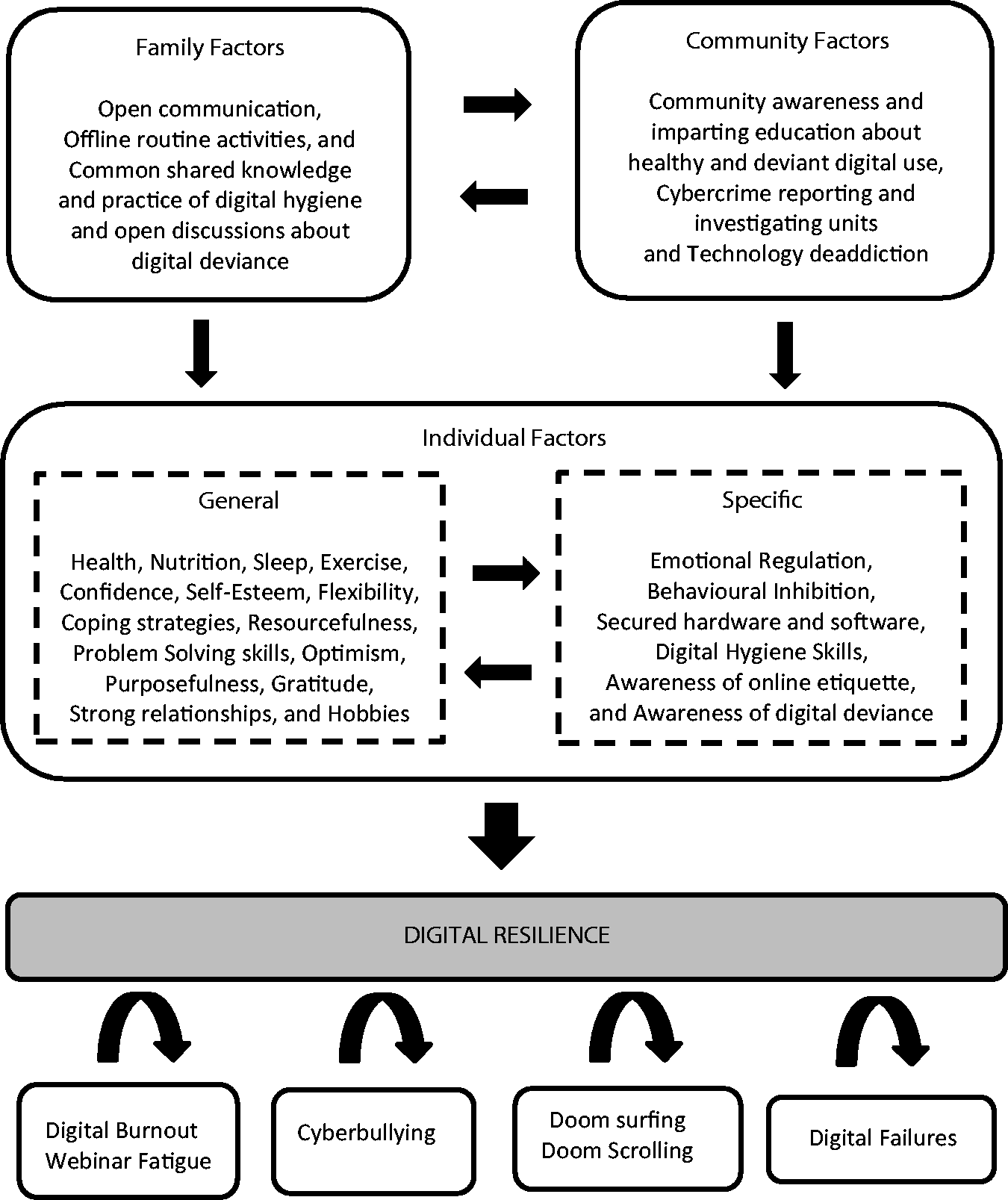
Digital resilience.
Way forward: Role of digital resilience
Digital resilience can help an individual cope with the possible negative consequences of internet use. This can facilitate better emotional regulation, allowing the person to cope with the adveristy and trauma experienced. Digital resilience can be built by ensuring a healthy support network which means making sure that the individual knows to reach out for support, and is made aware of the possible organisations that can help with negative digital experiences. Users can also engage in nourishing breaks, and schedule some offline time. Digital resilience can also be inculcated using self-care techniques like physical exercise, and lifestyle changes to incorporate hobbies, and relaxing activities.
While digital resilience can be built from a young age among children and adolescents, it can also be encouraged on a familial and community level by increasing awareness through more programmes, and by psychoeducating communities on the techniques that can be applied to increase support networks. 28 A healthy support network is not only built with increased awareness regarding the mental health implications of cyberbullying, but also its legal implications. Increased public literacy through intervention can help address the looming concerns of cyberbullying. Awareness regarding the policies in place can enable an individual to find help in cases of cyber victimisation, and will also discourage its perpetrators from engaging in cyberbullying and crime.
While it would be ideal to encourage the incorporation of digital resilience strategies and techniques within the curricula of student education, some adults are still grappling with the struggle of their own digital personas and work. Employers can encourage appropriate sessions to psychoeducate individuals on work-life balance, emotional regulation, and strategies to emerge from trauma and negative emotions elicited by excessive digital use. This can subsequently help break the cycle of digital burnout, and negative digital experiences, and promote positive affective expression and digital hygiene. The result would ensure healthy future usage of digital devices and address prevalent phenomena like digital burnout, doomscrolling, cyberbullying and victimisation, and even unhealthy forms of online research. We need to encourage more dialogue and research on ways in which digital resilience can be systemically integrated into organisations to promote healthy usage of technology.
Footnotes
Declaration of conflicting interests
The author(s) declared no potential conflicts of interest with respect to the research, authorship, and/or publication of this article.
Funding
The author(s) received no financial support for the research, authorship, and/or publication of this article.