




Abstract
Purpose of the study
To explore the governance regarding prescribing across the world.
Study design
We used a web-based questionnaire to ask the doctors about their prescribing practices and perception of governance in relation to prescribing. We sent the questionnaire to all doctors working in our hospital and primarily targeted doctors who had acquired their medical qualifications outside the UK to get a global view.
Results
We received 139 responses describing prescribing practices from 40 countries. More than 50% of doctors said there is no restriction in prescribing for themselves and their relatives. A third of them said that they could even prescribe controlled drugs without any restriction. 56% said that one doesn’t need a prescription to get antibiotics. When analysed by countries, 80% said that they could self-prescribe and in 50% of the countries, one could get antibiotics without a prescription.
Conclusions
In many countries there is poor governance with regards to prescribing. This is due to a lack of restrictions on prescribing (both self-prescribing and for friends/family) and the public’s ability to obtain antibiotics and controlled drugs.
Key messages
Background
The United Kingdom’s (UK) General Medical Council (GMC) has set standards for all doctors on prescribing in Good practice in prescribing and managing medicines and devices. 1 To ensure safe practice, it recommends that wherever possible, one must avoid prescribing for themselves, or anyone with whom they have a close personal relationship. 1 Likewise, doctors should not prescribe controlled drugs for themselves or someone close to them unless no other person with the legal right to prescribe is available, and emergency treatment is immediately necessary to avoid serious deterioration in health or serious harm. Whether similar guidance exists in other countries is unclear.
Prescribing practices across the world are relevant to the UK’s National Health Service (NHS) because more than a third of doctors working in the NHS are trained and qualified from countries outside the UK. 2 Without adequate induction or training on arrival in the UK, these doctors' practices may not conform with UK requirements. As there is very little data on governance mechanisms on prescribing in other countries, we undertook a survey to explore doctors' practices around the world.
Methods
We designed a web-based questionnaire of 10 questions, most with binary answers (‘yes’ or ‘no’) with an additional free-text comment section. We also asked the doctors about their perception of governance in relation to prescribing on a scale of 1 to 5 (1 – poor governance and 5 – robust governance). We sent the questionnaire to all doctors working in the departments of medicine, surgery and emergency care in our hospital. We primarily targeted doctors who had gained their medical qualifications outside the UK and requested them to disseminate the questionnaire to their colleagues to obtain a cross-sectional view from as many countries as possible.
For doctors who had qualified outside the UK, we specifically asked them to answer the questions based on the medical practice in their country of qualification. If they had migrated to another country and had spent a significant portion of their career there, we asked them to answer the questions based on the practice in the country where they have been working. The survey was kept open for 60 days.
Results
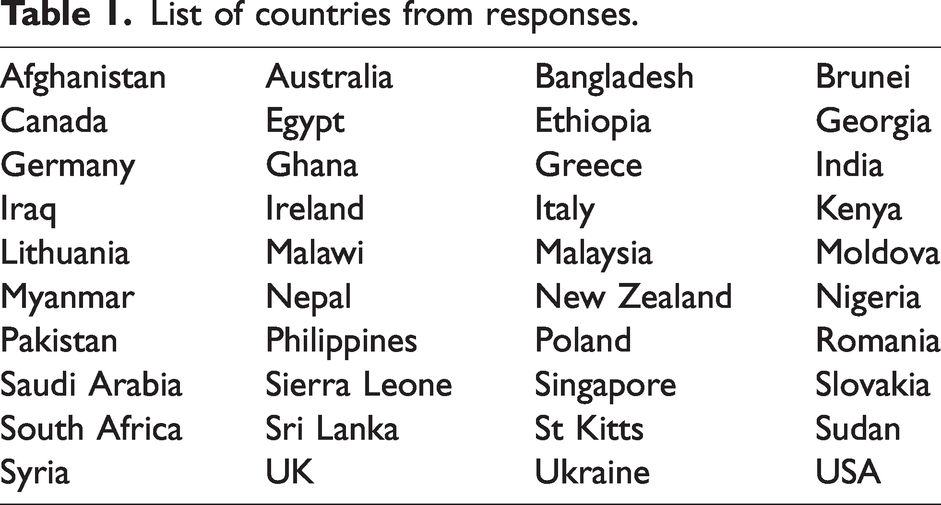
We received 139 responses describing prescribing practices from 40 countries, which are listed in Table 1. Ninety-five doctors were currently practising in the UK and 44 were practising outside the UK. The largest number of respondents had their qualifications from India (24), the UK (19), Nigeria (18), Sri Lanka (9) and Pakistan (8).
List of countries from responses.
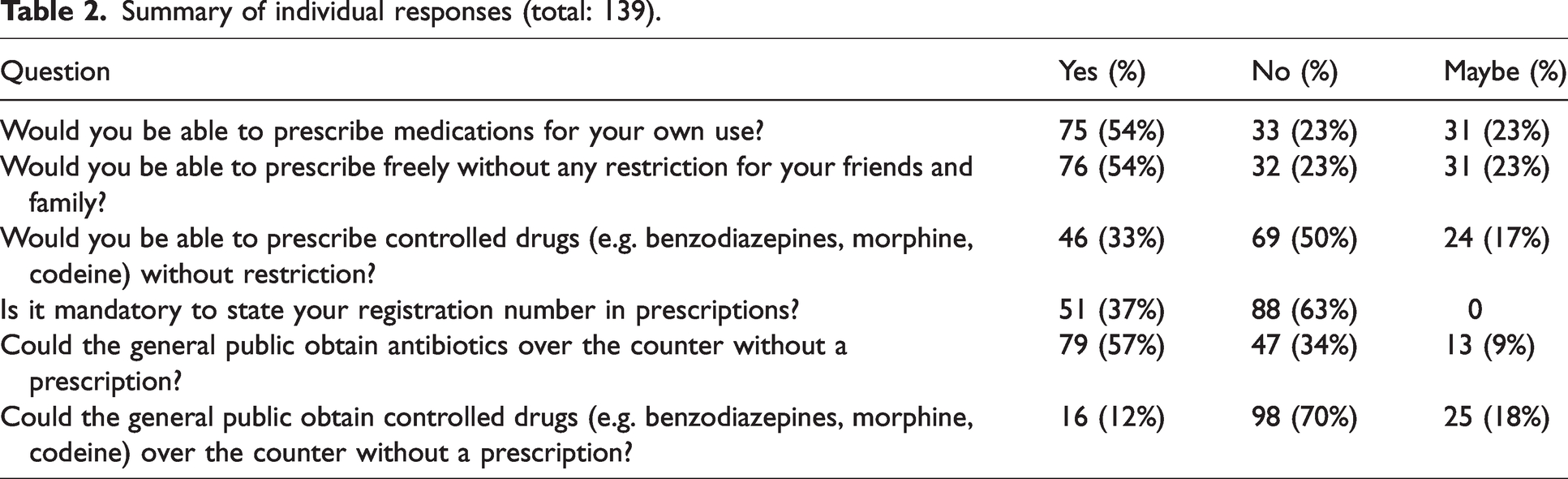
When analysed from individual responses (Table 2), more than 50% of doctors said there is no restriction in prescribing for themselves and their relatives. A third of them said they could even prescribe controlled drugs without any restriction. 56% said that one doesn’t need a prescription to get antibiotics. With regard to their perception on governance in prescribing, 50% scored below 3 (out of 5) and 50% scored 4 and above.
Summary of individual responses (total: 139).
Since analysing the results in total could be skewed by a large proportion of responses from a handful of countries, we analysed the responses from individual countries to give us greater insight into prescribing practices across the world. Surprisingly this gave a range of answers from different responders from the same country. The answers reported by countries are shown in Table 3.
Responses from individual countries (total: 40).
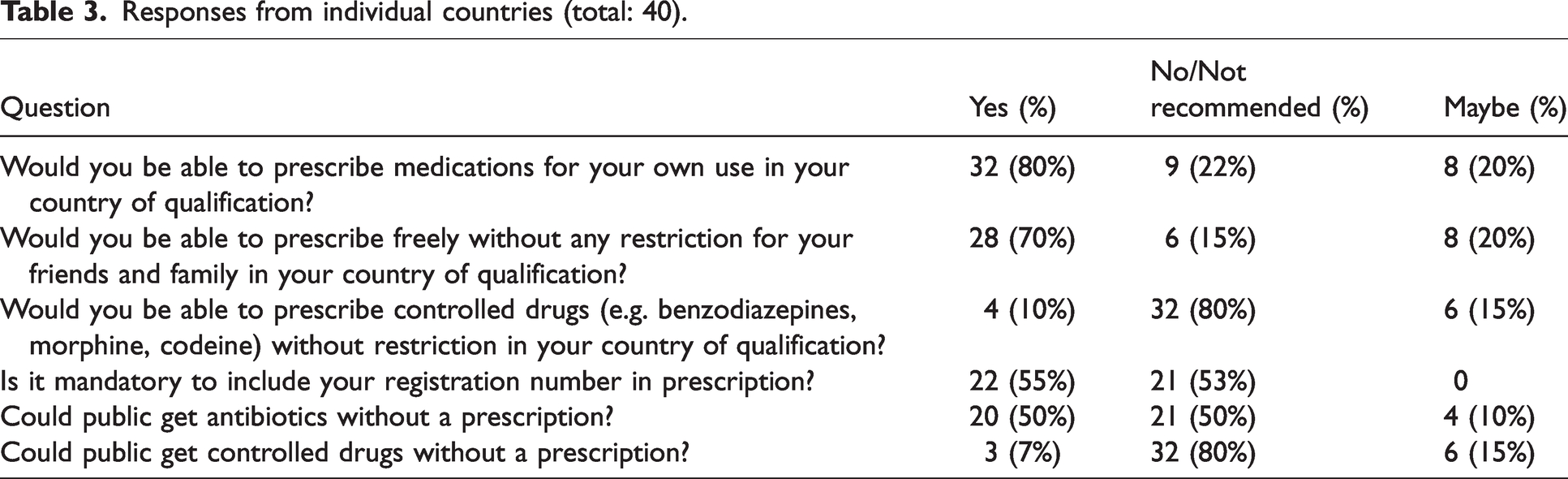
When analysed by countries, 80% said they could self-prescribe without any restriction and 70% said they could prescribe for their family and friends without any restrictions. And in 50% of the countries, one could get antibiotics without a prescription and in 7% one could even get controlled drugs without a prescription. The total number of responses is higher than 40 because of varied answers from individual responders.
Discussion
The results of our survey reported a wide variation of governance in prescribing across the world and a varying degree of perception regarding prescribing standards amongst doctors from all countries including the UK. Analysing the responses by individual countries, it was apparent that in countries from Asia, Africa and the Middle East, there was little or no restriction on self-prescribing, or prescribing for a family member, indicating poor governance. This is in keeping with the existing literature which has shown that self-prescribing is very common in many countries, especially where there is little governance on prescribing. 3 This is concerning because the dangers of self-prescribing are well recognised, and could lead to addiction, incorrect diagnosis and even a referral to the GMC for those practising in the UK. 4
It is worrying that in some countries, doctors and the public can even get controlled drugs without a prescription. Moreover, in more than half the countries it is not mandatory to include the prescriber’s registration number on the prescription. Interestingly a few respondents from the UK also stated the same, which probably reflects the practice in a hospital setting where many doctors do not write their GMC number and only write their bleep number whilst prescribing.
As for antibiotics, in 50% of the countries the general public could obtain them over the counter without a prescription, which is very concerning. Our findings are similar to the data in the literature which showed a prevalence of 62% to 98% dispensing of antibiotics without a prescription across the world.5,6 Even though it could be argued that the ease of obtaining antibiotics might decrease the demand on primary and secondary care, for instance getting rescue antibiotics in patients with infective exacerbation of chronic obstructive pulmonary disease, 7 this could potentially lead to inappropriate use, antibiotic resistance and iatrogenic infections.
The perception of what individuals perceive as a robust governance structure also showed a wide variation. For example, despite the lack of restriction on either self-prescribing or prescribing for family members and being able to get antibiotics without a prescription in many countries, many doctors from those countries felt that there was robust governance!
How does this global prescribing pattern influence prescribing practices in the UK? In a recent study, over a 12-month period, around 8% of referrals to the Medical Practitioners Tribunal Service in the UK were for offences in relation to prescription (paper in communication). Of these, more than 50% were from doctors who had acquired their primary qualification outside the UK, even though they comprise only a third of the doctors in the NHS. The nature of their offences included self-prescribing and prescribing for their family and friends using hospital prescription pads.
Prescribing is an important intervention and should be taken seriously but, in our experience, there is not enough training on the standards of prescribing in many medical schools outside the UK. A study from India revealed that a majority of prescriptions were incompletely written, and there was no uniform standard due to a basic lack of training in prescription writing and a general unawareness about the importance of writing a complete prescription. 8 Moreover, there is inadequate emphasis on this matter during doctors’ induction, especially for doctors qualified outside the UK.
The value of this survey is limited by the relatively small number of responses from all countries and most of the ten questions having binary answers. Nevertheless, it provides an interesting insight into current prescribing practices and the perception of governance mechanisms across the world.
Conclusion
This survey demonstrates a wide variation in prescription governance around the world. There appears to be a lack of restriction on self-prescribing, prescribing for one’s friends or family and the public’s ability to obtain antibiotics and controlled drugs in some countries. Also, the perception of what constitutes good governance varied widely and could explain why more non-UK qualified doctors commit offences with regard to prescriptions compared to their UK counterparts. Education and training focused on good prescribing standards is essential if prescribing practices and governance across the world are to be improved.
Footnotes
Contributions
VA: conceived the idea, developed the questionnaire, reviewed the data and prepared the manuscript. IC: developed the questionnaire and co-wrote the manuscript. PH: critically reviewed and co-wrote the manuscript.
Declaration of conflicting interests
The author(s) declared no potential conflicts of interest with respect to the research, authorship, and/or publication of this article.
Funding
The author(s) received no financial support for the research, authorship, and/or publication of this article.