



Abstract
This study compares the costs of cerebral palsy healthcare in South Africa’s private healthcare system with the lump sum compensation typically awarded in medico-legal claims. The analysis reveals that private healthcare costs for cerebral palsy, particularly within high-coverage benefit options, are significantly lower than the capitalised values awarded by South African courts. This suggests that the projections used in medico-legal claims may overestimate the true financial requirements for cerebral palsy care. The study advocates for evidence-based methodologies in medical expert witness assessments to ensure accurate and fair cost estimations, reducing discrepancies between private healthcare costs and medico-legal compensation.
Keywords
Introduction
Cerebral palsy (CP) is a group of permanent disorders affecting movement and posture, often accompanied by disturbances in sensation, cognition and behaviour. 1 It was long believed that most CP cases were caused by asphyxia during labour or shortly after birth, 2 but recent research suggests CP arises from multiple interacting factors over time. 3 MacLennan et al. 4 argue that birth asphyxia may mislead as it suggests an acute event at delivery, while ongoing fetal distress could be the true cause. Genetic mutations have also been implicated as major contributors to CP, with recent studies showing they account for over a quarter of cases in some populations. 5 In South Africa, CP is increasingly central to medico-legal claims, particularly those involving medical negligence during childbirth.
Medico-legal claims payments
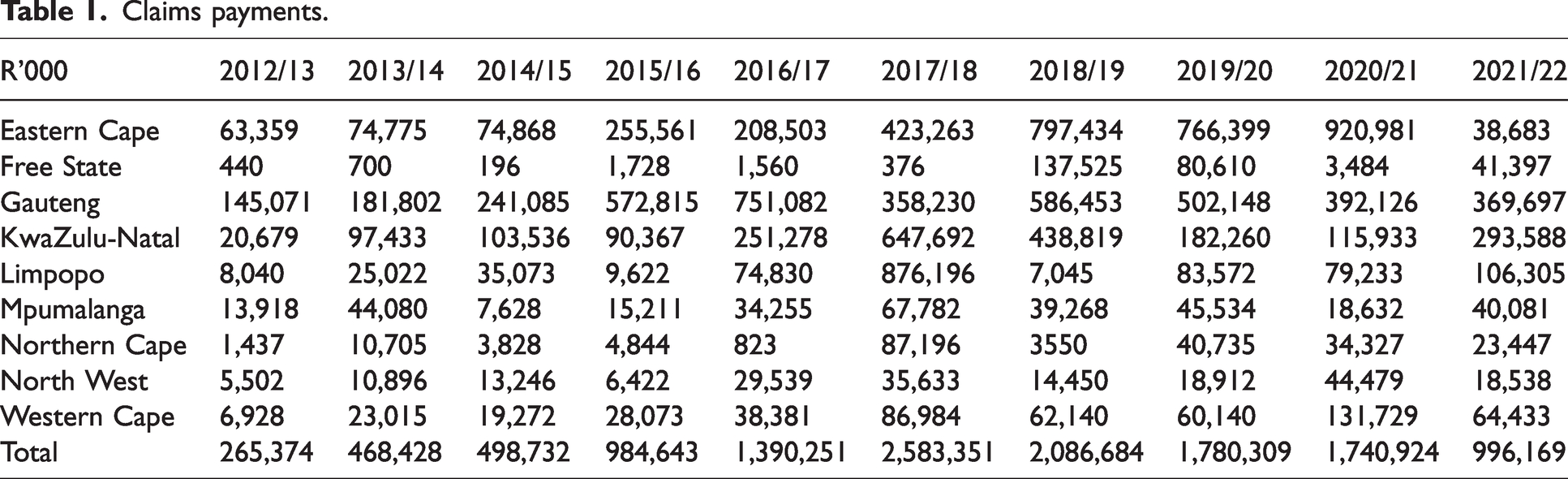
Compensation in a CP claim takes account of future loss of earnings, past medical expenses, future medical expenses and general damages. 6 Historically these have been awarded as a lump sum. Exceptions occur, as when the public healthcare defence is successfully argued. 7 Actuarial calculations are normally relied upon when calculating future loss of earnings and the capitalised value of future medical expenses. South African courts place more reliance on actuarial calculations than, for example, British courts. 8 Medico-legal claims payments made by South Africa’s nine Departments of Health (Table 1) show a substantial increase in payments from 2012/13 to 2020/21. Data in respect of the private sector is not available.
Claims payments.
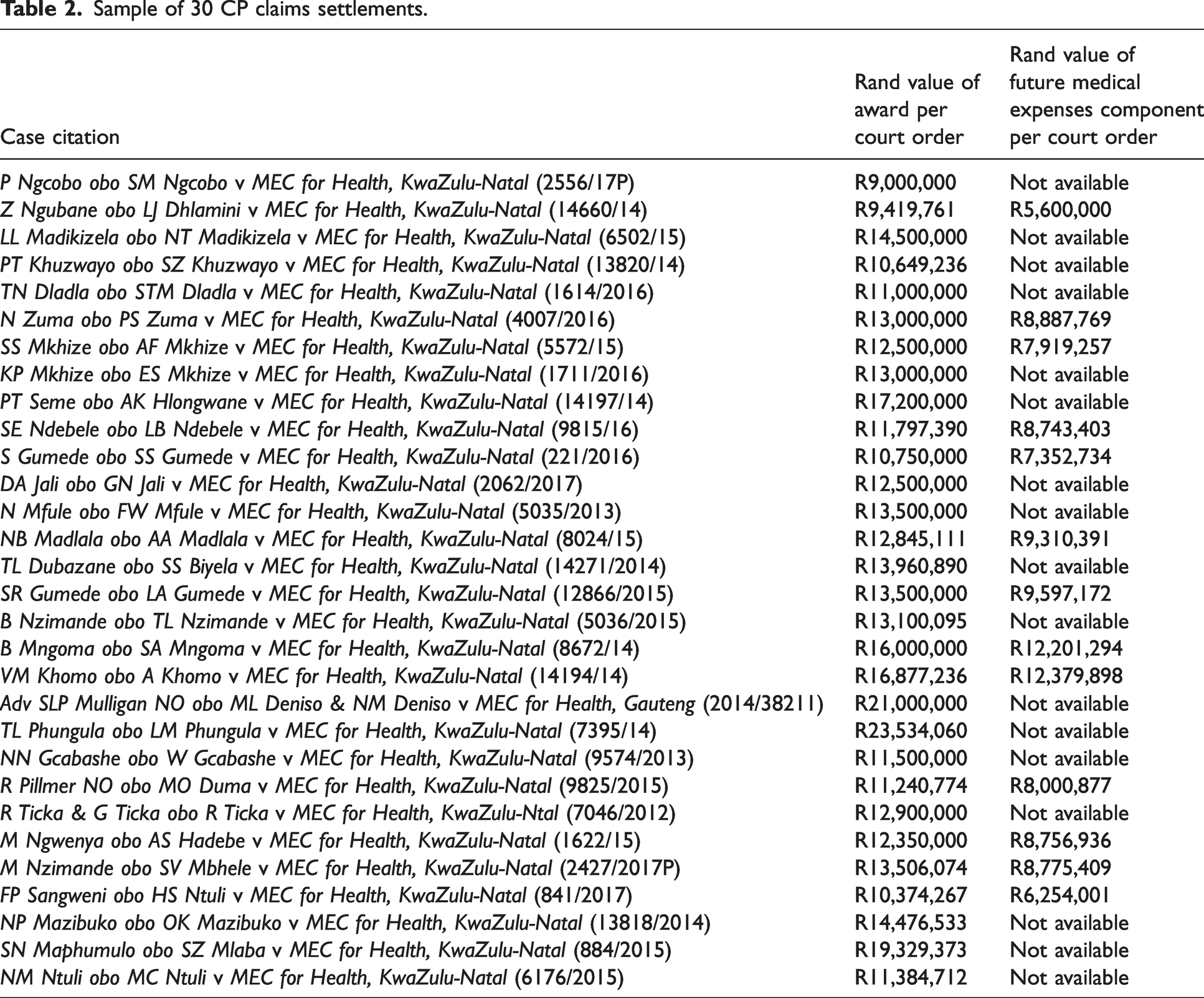
The main source of medico-legal claims payments are claims for CP. 9 A sample of 30 settlements relating to CP (Table 2) shows that future medical expenses comprise the highest component, which typically includes substantial costs to cover future caregiving and a sum for home adaptations which is not covered by private healthcare.
Sample of 30 CP claims settlements.
Medico-legal claims are currently not capped. In response to the growing medico-legal crisis in South Africa, the South African Law Reform Commission produced an issue paper in 2017 10 and a discussion paper in 2021. 11 A final report with legislative recommendations is expected within the next year.
Literature review
Estimating the cost of CP care is complex: usually this will include both direct medical costs and indirect costs. Honeycutt et al. 12 estimated the lifetime direct medical costs (including physician consultations, prescription medication, assistive devices, therapy, rehabilitation and long-term care) for CP in the United States at approximately $179,000 per person, in 2003 monetary terms. Other studies have examined the costs in various international contexts, with Kruse et al. 13 estimating lifetime healthcare costs (including hospital costs, primary healthcare costs and pharmaceutical costs) in Denmark at €66,154 for males and €65,258 for females in 2000 monetary values. Fejes, Varga and Hollódy 14 estimated the costs in Hungary to be €251,724 for care up to the age of 18 years in 2012 monetary values. These studies highlight the significant financial burden of CP care and point to varying costs based on healthcare systems and the severity of the condition.
Private healthcare in South Africa
In South Africa, about 15% of the population is covered by private medical schemes. 15 The largest is the Discovery Health Medical Scheme (DHMS), which provides a range of benefit options, including high-coverage plans such as the Executive and Comprehensive benefit options, which are commonly referred to as new generation options. These options have two risk pools. The first is a common risk pool designed to pay for major medical expenses but the second is a member-only risk pool funded by a member’s medical savings account contributions. Money in the medical savings account can be used for day-to-day health expenses and any unused funds can be transferred to the following year. Contributions to medical savings accounts are capped at 25% of the total member contribution to a medical scheme. All medical schemes are required to offer members a minimum level of benefits known as prescribed minimum benefits. These include a list of 271 conditions as well as 27 chronic diseases for which medical schemes are obliged to pay in full for the costs of diagnosis, treatment and ongoing care.
Data and methodology
Data collection
Data were requested from the DHMS through its Research Governance Committee (RGC), with ethical clearance granted by the University of the Witwatersrand (HRECNMW22/11/11). The data set spanned a ten-year period from 2012 to 2021 and included anonymised information such as gender, age, claims history, the practice type description under which a claim was made (there were 58 different practice type descriptions), and benefit options. Only claims data related to risk benefits (that is, excluding those covered by medical savings accounts) were analysed. The identification of a patient with CP was based on the World Health Organization’s International Statistical Classification of Diseases and Related Health Problems, 10th edition (ICD-10). Eligible codes from the ICD-10 included spastic quadriplegic CP (G800), spastic diplegic CP (G801), spastic hemiplegic CP (G802), athetoid CP (G803), ataxic CP (G804), other CP (G808) and unspecified CP (G809).
Claims data analysis
An analysis was made of total costs by practice type description over the period from 2012 to 2021. Thereafter, the average cost for each individual age was determined for the Executive and Classic Comprehensive benefit options, and for the remaining benefit options. The average cost was computed conditional on there being a claim in a particular year for a particular age. This is appropriate in terms of a comparison with claims in the medico-legal environment where no provision is made for a break in healthcare over the duration of the predicted lifespan of a plaintiff. Costs in each of the years were adjusted with the South African Consumer Price Index plus 3% a year to obtain 2024 monetary values. Once crude averages were constructed for each age, consideration was given to various smoothing techniques such as applying a moving average or various polynomial fits. The present value method was employed to estimate the future costs of healthcare for CP patients by discounting future expenditure to their value in 2024 monetary terms. A net discount rate of 2% per annum compound was applied to calculate the present value of lifetime healthcare costs. 16
Results
Practice type analysis
The distribution of costs by practice type (Figure 1) reveals that out of approximately R340.5 million in risk benefits claimed over 2012 to 2021, private hospital costs, physiotherapy, paediatrician costs and medical supplies accounted for 67.4% of total claims. Notably, certain practice types exhibited very low claims, such as dietician costs (0.15%), psychologists (0.06%) and urologists (0.02%).

Distribution of costs by practice type.
Claims data analysis
The Executive and Comprehensive benefit options have higher costs across all ages compared to other benefit options, reflecting their broader provisions (Figure 2). Both curves tend to peak between the ages of five and ten indicating that early childhood is the most expensive period of care for children with CP. Both benefit options show a decrease in costs after the peak, but the decline is more pronounced in the Executive and Comprehensive benefit options. Both curves show a rebound in costs after 40, possibly due to a resurgence in healthcare needs in later life in line with general trends seen in healthcare cost data by age.

Age cost curve for cerebral palsy.
The present value of healthcare costs (Table 3) was computed for childhood and adulthood.
Present value of healthcare costs in 2024 monetary values.

Discussion
Practice type analysis
The matter of MSM obo KBM v Member of the Executive Council for Health, Gauteng Provincial Government 17 provides significant insights. On the DHMS, dietician costs for all CP patients amounted to R494,593 over the ten-year period from 2012 to 2021. In the aforementioned matter dietician costs were agreed at R421,350. Dental costs and psychiatry costs agreed to in the above matter exceeded the sum of all such claims on the DHMS from 2012 to 2021. This points to significant overinflation of costs by experts.
Claims data analysis
In a comprehensive review of healthcare costs by age, Yamamoto 18 studied three different conditions including cancer, circulatory and musculoskeletal conditions. For members with musculoskeletal conditions, costs rise in the early years, stabilise during the teen years and twenties, and then begin to decrease from the age of 30 onwards. A similar pattern was found in this study. The average costs for the more expensive benefit options and other benefit options tend to converge from the age of 30 onwards. This could be indicative of less severe forms of CP that are associated with longer life expectancies and lower costs. The present value of lifetime healthcare costs under the Executive and Comprehensive benefit options were similar to those in Denmark obtained by Kruse 13 after accounting for differences in net discount rates. They are however notably less than the capitalised value of future medical expenses when inspecting South African high court rulings pertaining to CP cases (Table 2).
Conclusion
This study highlights significant discrepancies between the costs of private healthcare for CP in South Africa and the lump sum compensation awarded in medico-legal claims. The findings indicate that private healthcare costs, especially under high-coverage benefit options, are considerably lower than the capitalised values calculated for future medical expenses in court settlements. This suggests that the methodologies currently employed in medico-legal assessments may overestimate the actual financial needs for CP care. To address this disparity, the study advocates the adoption of evidence-based approaches in medical expert testimony to ensure more accurate calculation of healthcare expenses. Such reforms could promote fairer and more sustainable compensation awards which would benefit the healthcare systems in South Africa.
Footnotes
Acknowledgments
The author expresses gratitude to Lara Wayburne (Healthcare Actuary at Discovery Health) and Thushya Pillay (Healthcare Analytics at Discovery Health) for their kind assistance with the data.
Declaration of conflicting interests
The author declared no potential conflicts of interest with respect to the research, authorship and/or publication of this article.
Funding
The author received no financial support for the research, authorship and/or publication of this article.
