



Abstract
The Marriage and Civil Partnership (Minimum Age) Act 2022 made both registered and unregistered marriages of people under the age of 18 illegal in England and Wales. It came into force on 27 February 2023. This study looks at its impact on birth rates in South Asian communities in England. There has been a non-significant fall in such birth rates since the Act. However, the present system does not detect young South Asian women taken abroad to deliver their baby or the consequences of an early marriage abroad.
Introduction
The Marriage and Civil Partnership (Minimum Age) Act 2022 made both registered and unregistered marriages of people under the age of 18 illegal in England and Wales. It came into force on 27 February 2023. Now, anyone marrying someone under 18 and anyone facilitating such a marriage are committing a criminal offence and, if found guilty, will receive a custodial sentence. Its extent is not limited to England and Wales, but applies to any British citizen, resident in England or Wales, entering into such a marriage anywhere in the world.
This law will have wide ranging impacts on those communities where girls were routinely married under the age of 18 years and which originated from areas where marriage under 16 was and is accepted. This new legislation, therefore, offers added protection to young girls, whose families might be considering taking them abroad so as to arrange their marriage.
The purpose of this study was to use publicly available data to assess whether the legislation has had an impact on birth rates amongst South Asian communities in England. It has used Freedom of Information requests of public bodies, namely NHS Trusts, to provide data on birth rates. Such medical data has previously been shown to be robust. 1
Methods
Data were collected from a selection of English hospital trusts using Freedom of Information requests. The trusts were asked to provide information on the number of deliveries between 2020 and 2023 by girls/women in 3 age groups:
Under 16
16 and 17
18–24
and separately for Pakistani, Indian and Bangladeshis. The trusts approached covered the following areas:
Bradford
Wolverhampton
Sheffield
Mid Yorkshire
Leicester
Barking, Havering and Redbridge
Manchester
Bolton
East Lancashire
Barts Health NHS Trust covering East London
In 2025, those Trusts which provided a detailed breakdown in response to the Freedom of Information request were asked to provide similar data for 2024. Although children born towards the end of 2023 in November and December would have been conceived after 27 February 2023, their numbers are likely to have been small; whereas all children born in 2024 will have been conceived after that date. Consequently, the birth pattern in 2024 compared to that between 2020 and 2023 was considered likely to reflect the impact of the legislation.
The proportion of women delivering children at various ages was compared for the three communities using a z statistic. 2
Results
In the initial survey for the period 2020–2023, of 10 NHS Trusts only 4 were able to give definite numbers related to all 3 communities. The other Trusts gave numbers as ‘<5’, meaning that there may have been between 1 and 4 cases. This approach is often adopted by NHS Trusts to protect confidentiality of patients. 3 Consequently, only the four Trusts who gave specific numbers were then approached for data related to 2024 (Table 1).
Births in communities with a significant South Asian Population 2.
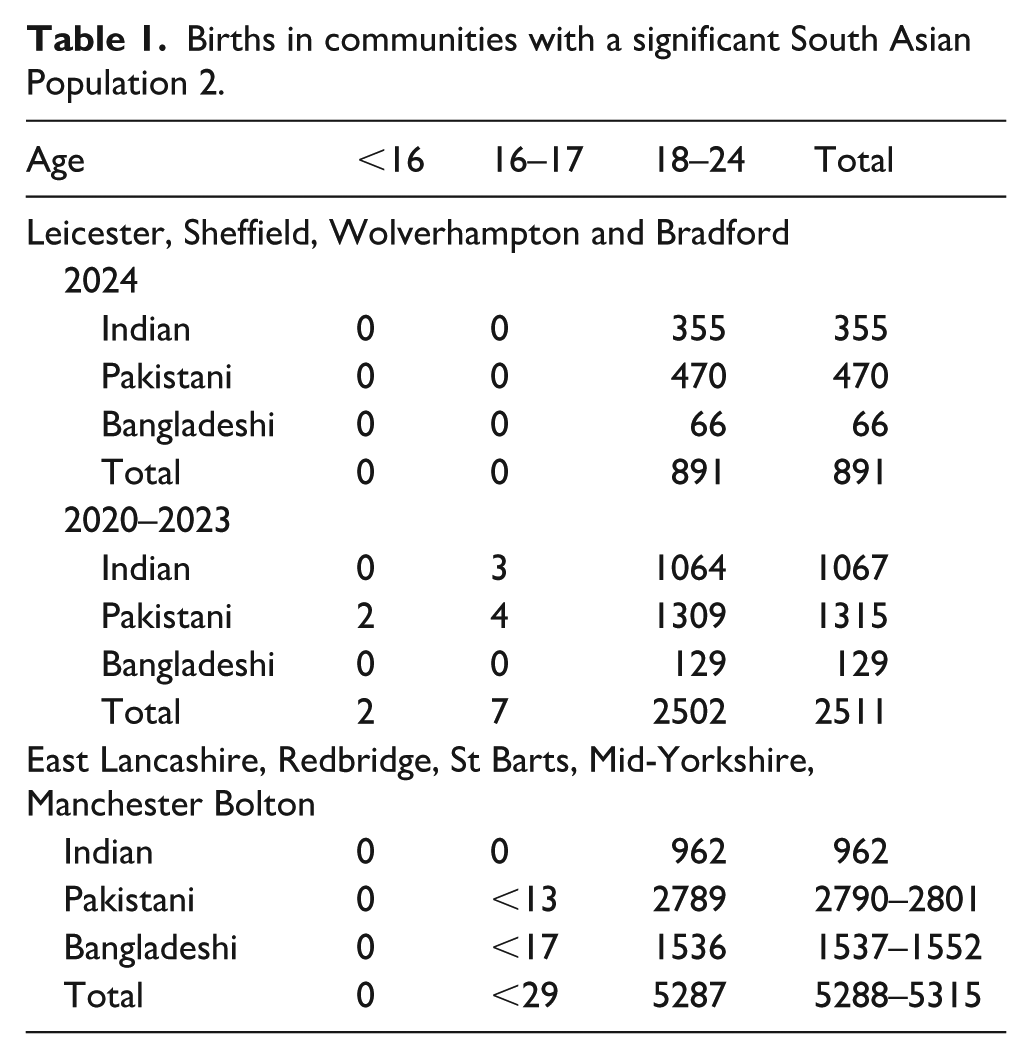
The birth pattern between the two groups during the period 2020–2023 was similar (z = −1.01; ns). When the birth patterns for 2024 were compared with 2020–2023 for Leicester, Sheffield, Wolverhampton and Bradford; the difference just failed to reach significance (z = 1.79; p < 0.07). Between 2020 and 2023 there were nine births to girls aged under 18 years. In 2024 there were no such births.
The overall birth patterns between 2020 and 2024 for the Pakistani and Indian communities were comparable; although again just failing to reach significance (z = 1.8, p < 0.07). However, the Bangladeshi community had a significantly earlier birth pattern than the Pakistani (z = −2.3; p < 0.02) and Indian communities (z = 3.4; p < 0.0006). There were about 16 such births amongst the smaller Bangladeshi community compared to about 34 in the Pakistani community and 3 in the Indian community.
So overall, there has been a non-significant fall in the number of early births with the introduction of the Marriage and Civil Partnership (Minimum Age) Act 2022.
Discussion
The purpose of the Marriage and Civil Partnership (Minimum Age) Act 2022 in England and Wales was to outlaw early marriage. The law applies to both registered and unregistered marriages, so encompassing nikahs and comparable ceremonies. However, the effective identification and policing of unregistered marriages has significant difficulties as they are contained within communities. The monitoring of births amongst girls under 18 is one potential, if belated, approach to identifying when such marriages have taken place.
The Act applies to England and Wales and this study addresses the issue in the largest minority community. Traditionally, early marriage has been accepted and promoted in South Asian cultures and early marriage is still legal in a number of the provinces of Pakistan. The issue of early marriage also has a religious aspect with some Muslims believing that it is commended as an acceptable practice. Consistent with this, early marriage and birth was commonest in the Bangladeshi community in England. Influential factors leading to early marriage in Bangladesh included education, place of residence, religion and work status. Wealth index had no significant effect on early marriage. 4 It is likely that such factors also play a role in the South Asian Diaspora and the assumption that poverty and deprivation are important factors leading to early marriage in this setting may be ill-founded.
There are significant consequences to early marriage, As Gordon Brown wrote: Early marriage is both a cause and a consequence of girls dropping out of school.
5
However, it also has an impact on girls’ long-term health and an adverse impact on the health of the children born to such a marriage. There is clear evidence that it is also associated with an increased risk of domestic abuse. 6
A major limitation in this study in England is that the data did not distinguish married and unmarried mothers. The situation is also complicated by NHS trusts potentially failing to recognise that religious, but unregistered, ceremonies, are of significantly greater importance in such communities and so not recognising that a marriage had taken place. Indeed, in the majority of cases, such marriages are never registered. This study would also miss births where the girl was taken abroad to have her delivery.
This study emphasises the need for educators and clinicians to be aware of young South Asian women returning to the UK with a child and who will consequently have come under the protection radar which was set-up by the Marriage and Civil Partnership (Minimum Age) Act 2022.
Footnotes
Declaration of conflicting interests
The authors declared no potential conflicts of interest with respect to the research, authorship, and/or publication of this article.
Funding
The authors disclosed receipt of the following financial support for the research, authorship, and/or publication of this article: This study did not receive any funding or financial support.
Patient consent
Patient consent is not required as this is publicly available and patients cannot be identified.
