




Abstract
In music education, current attention to student-centered approaches for learning affects our understanding of student assessment. This view to curriculum reform requires new perspectives for assessment. There is a need to move beyond the summative use of assessment to assign grades to examining the roles of assessment in supporting and enhancing learning. To this end, multiple roles of assessment are examined under three headings: (1) assessment of learning, (2) assessment for learning, and (3) assessment as learning.
How can music teachers use assessments as tools for increased learning? Here are some ideas.
Student assessment is integral to music teaching and learning. Music teachers are responsible for providing valid and reliable information of their students’ performances in relation to a wide variety of learning outcomes. When this information serves a summative role, such as the assignment of grades, it is denoted as assessment of learning. Teachers are also responsible for providing feedback to help students extend their understanding of musical concepts and to assist all students in enhancing their musical proficiencies. When assessment assumes this formative role, it is denoted as assessment for learning. Students are encouraged to reflect on assessment information as a way to gain personal insights into how they are performing and to enhance their perceptions of what they need to do in order to comprehend music with greater understanding and to improve their technical expertise in musical performance. When assessment takes on a role of self-reflection, it becomes assessment as learning.
Multiple Roles
The educational context emerging from the application of multiple roles for assessment, specifically, assessment for learning and assessment as learning, corresponds with constructivist perspectives for learning. Educators who endorse the psychological theory of constructivism believe that students interpret new information in relation to social interactions in their present environment and the prior knowledge and understanding they bring to learning situations. 1 Learners do not passively receive information from teachers. Rather, individuals extend their musical understanding by engaging actively with teachers and peers in collaborative communities of practice. Attention to constructivist ways of learning requires an emphasis on student-centered approaches for learning. In turn, this requires new roles for assessment as students become actively involved in the processes of assessment.
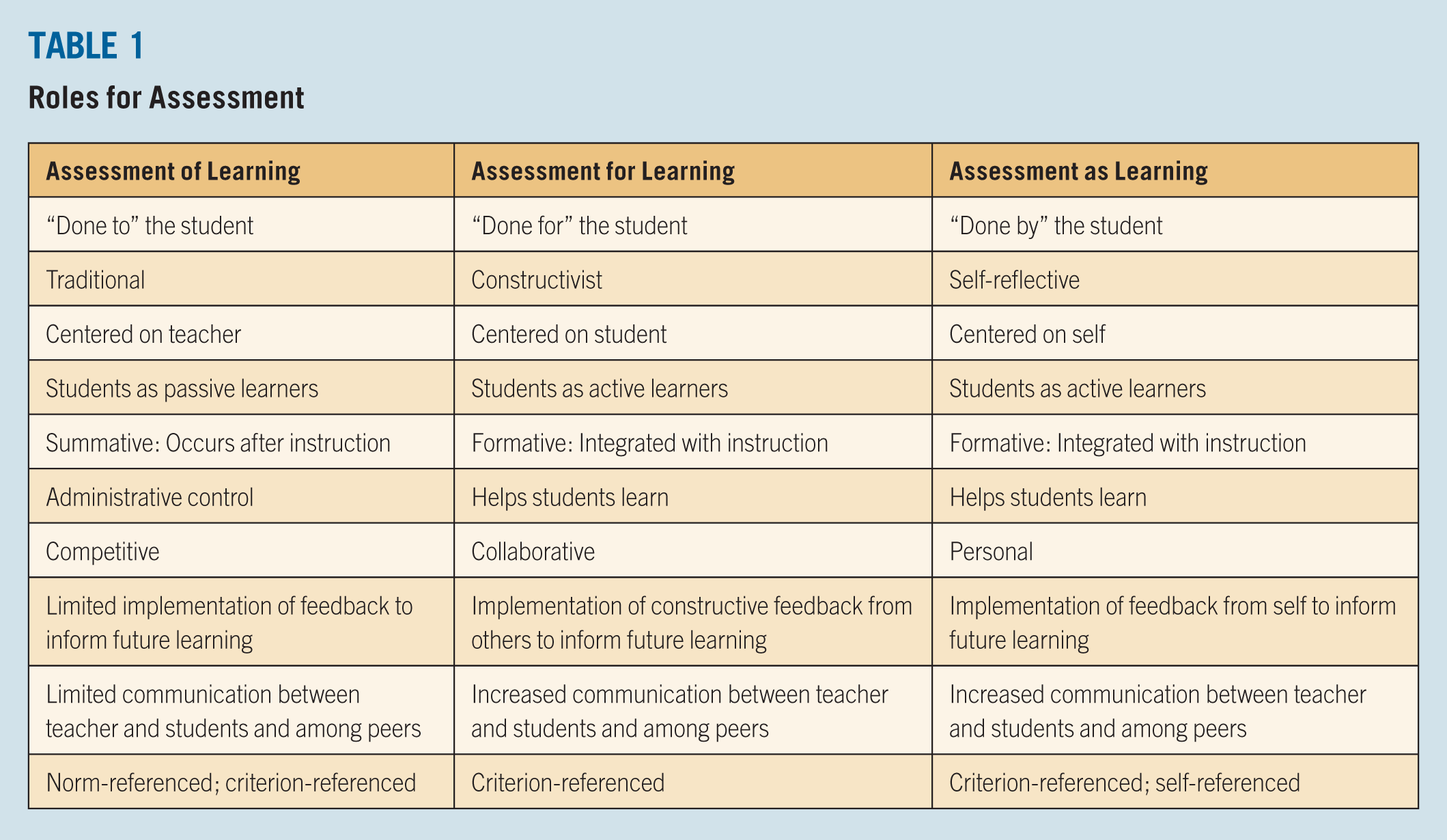
From this perspective, multiple roles of assessment are examined under three headings: (1) assessment of learning, (2) assessment for learning, 2 and (3) assessment as learning. 3 Particular attention is given to the advantages and challenges of each role for assessment within music education. Comparisons among these roles are provided in Table 1.
Roles for Assessment
Assessment of Learning
Assessment of learning is the purpose of assessment with which teachers and students are most familiar. This is the traditional function assessment plays in providing a summative profile of what students have achieved as a result of instruction. Assessment of learning is based on assessment information collected and collated by the teacher. For example, at the end of the term, a teacher might assess each singer’s tone quality using the rubric included in Figure 1. In this sense, assessment of learning is “done to” the students. It is used to provide assessment information from which teachers may fulfill their administrative responsibilities of providing evidence on which to base grades. Assessment of learning may be derived by comparing a student’s achievement to the outcomes of instruction (criterion-referenced). Assessment of learning can also be established by comparing a student’s achievement to that of his or her peers (norm-referenced). This may lead to competition among students as peers vie for the top scores.

Singing Performance Rubric
Assessment of learning is focused on the students as passive learners who accept the teacher’s evaluative judgments of their learning. There is limited discussion about the assessment process and limited use of feedback from assessment to inform future learning.
Advantages and Challenges
Assessment of learning provides a profile of students’ achievement in terms of long-term outcomes. Many students excel in testing situations such as this because they happen to be good test takers. Some students may be motivated to work toward an endpoint in the learning process when provided opportunities to present the products of their best work. This motivation may not lead to lasting engagement in music for music’s sake as it is built, in part, on extrinsic rewards wherein students who do well on assessments receive high scores. Assessment of learning does not always provide an accurate representation of students’ achievements, because individuals who become anxious in testing situations may be unable to produce their best work.
Assessment for Learning
Assessment for learning represents a constructivist perspective in which students, as active learners, use assessment feedback to extend their current levels of understanding. Teachers use the information gained through assessment to modify instruction to meet the needs of individuals. Thus, assessment takes on a formative role through its integration with instruction.
Assessment for learning is criterion-referenced. A student’s levels of attainment are never compared to those of his or her peers. Rather, a student’s achievement is related to the expected outcomes of the educational experience. Within this context, assessment becomes collaborative; it is “done with” the students. For example, when using rubrics, students may be involved in the development of the criteria by which performances will be assessed. Rather than being presented a ready-made assessment tool (for example, a checklist, a rating scale, or a rubric) the teacher guides the students in the development of this tool. In the case of rubrics, teacher and students jointly discuss the various criteria by which their performances could be assessed and choose criteria for a particular assessment. Together they describe performances at various levels of proficiency, providing models of performance (generated by students, by the teacher, or in recorded forms, such as compact discs or videos). Through this process, students learn what aspects of performance they need to attend to in preparing for the assessment and thereby gain an understanding of what they may need to accomplish to extend their current proficiencies. Thus, the development of assessment tools becomes an opportunity for learning.
Students actively engage in the assessment process by assessing model work. By so doing, they gain an understanding of how the assessment criteria are used to describe musical performances and learn how their own performances will be compared to the levels of performance defined in the assessment. Most important, active engagement with feedback information gives students experience in implementing actions to improve future performance. For example, using the sample rubric to assess student Melanie’s vocal performance (see Figure 1), the choral teacher assigns a score of 2 (developing). Using this formative information, Melanie realizes that in her upcoming practice sessions, she should focus on how to maintain a focused and clear vocal quality throughout the range of her voice. Thus, the feedback supplied through assessment for learning provides a student with guidance for future work.
Assessment for learning and assessment of learning are not mutually exclusive: information obtained from the same assessment can function in both roles. For example, Melanie uses assessment feedback to guide her practice; the teacher also uses results of this assessment when compiling grades for first-term report cards. It is important, however, that students have learning opportunities that are exclusively formative (involve assessment for learning). This gives them chances to take risks without the fear of reprisals in the form of grades.
Advantages and Challenges
Through assessment for learning, students are provided with opportunities to extend their knowledge and understanding of music and their proficiencies in music performance. As such, assessment contributes to student success. This may lead to enhanced self-esteem and increased positive attitudes toward learning. Teachers are challenged to use assessment information to enhance learning without allowing this attention to assessment to interrupt their students’ active involvement in the processes of making music.
Assessment as Learning
Assessment as learning is self-reflective. It is assessment “done by” the students. Students monitor their own learning, reflect on what they have accomplished, and use this to inform future learning as they continually strive to perform at more sophisticated levels. Students are involved in the assessment process as active learners, comparing their musical performances to the outcomes of instruction (criterion-referenced) or to their previous work to examine personal growth as musicians (self-referenced). Assessment as learning is formative. It integrates assessment and instruction with the primary purpose of helping students learn. While individuals may consult teachers and/or peers for assistance, as they become increasingly adept at assessing their own work and using the resulting feedback to improve their performance, they become less dependent on assessment information obtained from others. For example, Melanie uses the rubric included in Figure 1 as a learning tool in her practice sessions. She videotapes her performance for an upcoming concert, assesses her work, and uses the results of this self-assessment as she continues to learn. Through this process, Melanie is unsure of how to maintain a focused and clear tone quality throughout her vocal range. She shows her work to a peer mentor; they discuss how her tone quality becomes thin on specific notes and how she might use vocal exercises to focus her tone throughout her range. This conversation becomes a catalyst for understanding, showing how assessment for learning and assessment as learning may work hand in hand to help students learn. In addition, this illustrates how students learn from each other.
The assignment of peer mentors may a take a variety of forms. Peer mentors may be section leaders who, as part of their responsibilities, are charged with providing constructive feedback to others. In a multigrade context, students who have played with an ensemble for more than a year may provide mentorship to newcomers. Ultimately, it is the teacher’s responsibility for organizing peer groups in a way that will help all students realize their musical potential.
Advantages and Challenges
Students need guidance as they learn to assess their work accurately and to use this assessment information to influence future progress. Assessment as learning may occur on a continuum with students gaining facility with this process through experience. It may be expected that younger students (in elementary grades) will need assistance from their music teachers in gaining a foundation of musical understanding and proficiency from which to base their own judgments in terms of what they know and what they need to find out. As students enter high school, they may be better able to self-assess. Of course, this generalization will not hold for all students. Teachers must be vigilant in providing all students with sufficient feedback to help them on the road toward independent musicianship as they learn to teach themselves.
Throughout this process, students are empowered to take ownership of their education as they develop skills as independent musicians. Ideally, students will sustain this emphasis on self-regulated learning beyond school, leading to lifelong music making.
Gathering Information
A variety of methods are used for obtaining assessment information. The same methods for gathering assessment information are used regardless of whether the assessment is conducted primarily as assessment of learning, assessment for learning, or assessment as learning. The different roles for assessment emerge in what teachers and students do with the information obtained.
Performance assessments using checklists, rating scales, or rubrics provide a means for recording information of performance skills, such as those associated with singing or playing instruments. These assessments represent assessment of learning when the information obtained through this means becomes a part of their end-of-term grade. Performance assessments are used as assessment for learning when the results of the assessment are used primarily to provide students with feedback to use in improving performance. Performance assessments represent assessment as learning when students use them as a tool to aid the processes of self-reflection.
Portfolios are representative collections of the students’ work. A product portfolio representing the students’ best work provides evidence of assessment of learning. The process for determining the students’ best work may represent assessment for learning and assessment as learning, thereby illustrating an interrelation of these different roles of assessment. Specifically, teacher and students collaboratively develop criteria for judging the merit of individual articles (assessment for learning) following the process denoted earlier for developing rubrics. Students then assess their work in relation to these criteria (assessment as learning). A process portfolio illustrating a students’ process of learning (for example, several drafts and a final copy of a musical composition) demonstrates assessment for learning. The students’ reflections of why particular items were chosen for the process portfolios represents assessment as learning.
Narrative reports provide profiles of how students approach music and music making. Music teachers may use narrative reports as a means for describing a student’s musical performance at a terminal point in the learning process. For example, a choral educator might write narrative reports just prior to the June concert that signals the end of the school year. These reports may be integral to the reporting of a student’s work for the final report card. This use of narrative reports represents assessment of learning. In this instance, the student does not have an opportunity to incorporate this feedback into subsequent work during the school year. Thus, the narrative report falls short of its educational potential. On the other hand, if this choral teacher writes narrative reports prior to the January winter festival, students have the opportunity to discuss the report with the teacher and make plans for what they might do to improve their vocal abilities (assessment for learning). Throughout the rest of the school year, students could reflect on subsequent work by writing personal narratives describing how they view the process of their own musical growth (assessment as learning).
Rehearsal logs provide assessment information about the students’ practice sessions over a given period. These represent assessment as learning if they are used as a vehicle for self-reflection; rehearsal logs represent assessment of learning if the information reported on these logs forms a portion of the students’ grades.
Additionally, teachers use assessment as a means to monitor instruction by asking questions to gauge the students’ understanding of content information and by using these responses to adjust the learning environment to meet the immediate needs of the students. Teachers use observation to judge the students’ performance proficiencies and assist the students by providing feedback. For example, an instrumental teacher uses observation to monitor the fingerings students use to play particular notes and provides reminders for correct placement when appropriate. Through these instructional methods, teachers are already employing assessment for learning on a wide scale. The suggestions provided here represent further possibilities for integrating assessment into music teaching and learning.
Toward Lifelong Music Making
In the words of researchers Paul Black and Dylan Wiliam, “assessment in education must, first and foremost, serve the purpose of supporting learning.” 4 Current reforms in education influence how music teachers view curriculum and hzˋow they plan musical experiences for their students. The development of learning environments built on the principles of constructivism is central to these reforms. Within this context, learning is student centered.
A constructivist perspective for learning requires multiple roles for student assessment. Assessment extends beyond the summative function of assessment of learning to the formative functions of assessment for and as learning. In so doing, assessment moves beyond procedures “done to” the students to actions “done with” and “done by” students to enhance learning. Both assessment for and assessment as learning see students actively involved in their education. A key attribute to assessment for and assessment as learning is the students’ implementation of new understanding through feedback acquired from others and from self.
Rethinking the multiple roles for assessment in music education clarifies the various goals for assessment. Assessment of learning serves a summative role by providing information upon which to judge the students’ performances at a terminal point in instruction and to provide a basis for grades; assessment for learning denotes processes by which students are provided feedback with which to extend their understanding of musical concepts and to enhance their musical proficiencies; assessment as learning provides avenues by which students may reflect on their learning and, through this self-reflection, gain deeper understanding of music and music making.
Assessment of learning is ingrained in traditions of education: student assessment has long been equated with the summative function of assessment. New roles for assessment require change. Educational change of this magnitude requires time. It also depends on understanding and support from teachers, administrators, parents, and most important, students. Music teachers are already implementing many of the strategies associated with assessment for and assessment as learning. As teachers and students expand their experiences with assessment as a learning tool, students will increasingly be empowered to take ownership of their own learning. Thus, assessment has the potential to facilitate our students’ journeys toward lifelong music making.