



Abstract
Learning improvisation in music is often treated as the process of gaining skills to spontaneously perform within the conventions of a style. Alternatively, learning improvisation can offer musicians a place to explore sound as it happens in free improvisation. Within the school setting, the former approach is commonly used in the jazz programs, whereas the second approach is often implemented through creative activities. Both approaches to learning improvisation—idiomatic and free—develop important areas in the musical intelligence of learners; the former approach leads to the mastery of stylistic vocabulary, the latter fosters inventiveness. As an alternative, I conceptualize improvisation as a form of interaction. Through improvisational interaction, the material emerges from the musical dialogue that occurs among the individuals involved. To develop these interactive skills in improvisers, I propose a series of strategies that constitute the bases for an alternative approach to teaching improvisation: the eight strategies for collaborative improvisation. This article reviews the theory of improvisational interaction drawing from symbolic interactionism and features strategies for teaching improvisation as a collaborative learning practice, providing examples of how to implement this methodology in the classroom.
Getting students to improvise (and really listen to each other) is a step-by-step process that expands from copying what is heard to allowing other players to shine. Improvising in a collective setting is a form of communication that can be taught, nurtured, and developed.
Learning improvisation in music is often treated as the process of gaining skills to spontaneously perform within the conventions of a style. 1 This approach is used to teach improvisation in jazz, 2 blues, klezmer, and the common practice period through classical forms 3 such as the fugue, the fantasia, and the concerto cadenza. 4 Alternatively, learning improvisation can offer musicians a place to explore sound as it happens in free improvisation. 5 Within the school setting, the former approach is commonly used in the jazz programs, whereas the second approach is often implemented through creative activities 6 such as sound-painting and soundscaping. 7 Both approaches to learning improvisation, idiomatic and free, develop important areas in the musical intelligence of learners. The former approach can lead to the mastery of stylistic vocabulary, while the latter fosters inventiveness. Through my experience as an improviser working with professional musicians and as a teacher of improvisation working with high school and undergraduate students, I have found it necessary to conceptualize improvisation as a form of interaction. From this perspective, more important than stylistic mastery and inventiveness, the objective is to develop the ability to understand partners and make oneself understood to partners through improvisation. Through improvisational interaction, the material emerges from the musical dialogue that occurs among the individuals involved. To develop these interactive skills in improvisers, I propose a series of strategies that constitute the bases for an alternative approach to teach improvisation: the eight strategies for collaborative improvisation.
Improvisation as a form of interaction can be applied to any type of musical vocabulary because the purpose is not to recreate the sound of a particular style but rather to help students communicate through sensible units of musical discourse using whatever vocabulary they already possess. For instance, if learners are familiar with the jazz language, the strategies presented for improvisational interaction in this article can be applied over the blues form or in trade choruses over an AABA form. Similarly, if learners are fluent in the language of twentieth-century Western harmonies such as polychords, clusters, and artificial scales, the musical dialogue will use those materials. Even at a more elementary level in which learners may only be familiar with the first five notes of a major scale, these strategies can allow musicians to interact through improvisational dialogue.
Interaction in improvisation is often critical to novice improvisers. One common issue is that beginning jazz improvisers approach improvisation from their own individual relationship with music, often as an opportunity to apply recently learned material. Because of this self-centeredness, young improvisers often miss opportunities to integrate ideas from the ensemble that could construct valuable improvised music. Similarly, when immersed in the explorations of free improvisation, players tend to be more concerned with creating exotic ideas than with creating sensible material for the context of the ensemble. Although these issues of interaction are sometimes discussed in improvisation classes, interaction is rarely explored, practiced, and developed through concise exercises, strategies, and tasks that players could consciously apply in an improvisational situation. In fact, as music educator Jackie Wiggins’s research on composition and improvisation suggests, interaction and communication are intrinsic to collective improvisational practices. 8 What I propose in this article is a detailed approach to further develop these skills.
The purpose of teaching improvisation as a form of interaction is to help improvisers become aware of the possibilities to construct musical meaning collectively. Two of the “21st century skills” currently encouraged in K–12 education, 9 collaboration and communication, point to this form of interaction. To develop these collaborative and communicative skills, I have designed eight strategies for collaborative improvisation that can be implemented as the focus of an improvisation course as well as a complement to an existing model. For instance, when applied to jazz education, these strategies can help learners incorporate the “chops” and “licks” from their individual practice into the “dialogue” of the ensemble. In the case of free improvisation, these strategies can shift the focus from sound exploration to musical “conversation.” Furthermore, these strategies can also be implemented in a wider range of musical settings such as a piano duet using twentieth-century harmony, an ensemble of nonpitched percussion or a rock band using modal harmony.
The Theory
The theory of improvisation as a form of interaction has been adopted by Keith Sawyer, who, departing from his background as a jazz pianist, has conducted most of his research on improvisational theatre. To analyze improvisation in theatre, 10 Sawyer applied the theory of symbolic interactionism, 11 which proposes that in a social context, individuals interact through ascribing meaning to symbols that can be gestural, verbal, or graphic. This process occurs both ways (i.e., an individual interprets someone else’s symbols and an individual proposes symbols to be interpreted by someone else). In improvisational theatre, this type of interaction facilitates the emergence of the improvised product in the form of a sensible scene that advances a plot intelligible to the audience. 12 For the purpose of facilitating meaningful interaction that delivers a logical scene, the teaching of improvisational theatre provides participants with frames, rules, and strategies for interaction. These techniques support four basic principles: (1) Participants must not block each other, (2) participants must not contradict each other, (3) participants must only support the scene, and (4) participants must not use the scene to advance their own individual goals. 13
By way of example, when a participant takes the scene in one direction and a colleague wants to take it into another, the subjects block each other. For instance, if subject A says, “I’m hungry; let’s order a pizza,” then subject B cannot answer, “By the way, what time is the football game tomorrow?” because this response pulls the scene into a direction unrelated to the original comment. Similarly, the answer to “I’m hungry; let’s order a pizza” must not deny the statement, as in “No, you just ate,” in which case the denial prevents the plot from moving forward. The only way to advance a plot is to support the scene; using the same example, “I’m hungry, let’s order a pizza,” the answer should be along the lines of “Sure. Do you have any cash on you?” Not only does this comment agree with the proposition and offers a solution, but also it moves the action forward and presents the issue of how to pay for the meal. This is not to say that opposition to a comment cannot occur; but in that case, the opposition still needs to relate to the original proposition in order to advance the plot. For example, if subject A says, “I’m hungry, let’s order out,” subject B can reply, “We can’t keep eating out—we’re spending too much money!” Although this answer opposes the proposition, it adds a new layer of meaning to the scene (i.e., the implications of eating out frequently). Finally, a participant must not use the scene for his or her own benefit, such as realizing a plot that he or she may have planned beforehand; this, in effect, impedes constructing meaning collectively. Similarly, the use of jokes must be avoided because they make only one subject look good without necessarily advancing the plot.
Following these principles, the only way to “survive” in an improvisation is to create meaning collectively. Applying similar principles of interaction could benefit the teaching of music improvisation. The four principles for improvisational theatre just listed have great relevance to novice improvisers in music. For instance, beginning improvisers commonly engage in simultaneous musical “monologues” through undeveloped, inconsequential ideas. This lack of agreement about the direction that an improvisation can take also manifests in treating improvisation as an opportunity to apply licks and chops acquired during individual practice, regardless of whether these are relevant to the context. This last feature is analogous to the fourth principle of improvisation in theatre—using an improvisation for one’s own sake.
In themselves, these features of novice’s improvisation are not unreasonable; beginning improvisers deserve the opportunity to explore and learn from these situations. However, the question I raise is, “What could the pedagogy of improvisation do in order to address the issue of self-driven improvisation in collective settings?” I believe that the teaching of improvisation in music should take improvisational theatre as an example, creating and applying its own principles for collective improvisation.
The Approach
The eight strategies for collaborative improvisation are: (1) copying, (2) adapting, (3) contrasting, (4) punctuating, (5) highlighting, (6) supporting, (7) signposting, and (8) allowing. The first three strategies, copying, adapting, and contrasting, consist of responding to a partner’s material when sharing the predominant place of an improvisation, such as in contrapuntal improvisation or when trading solo passages. For example, if a pianist improvises along with a saxophonist, the pianist may “comment” on an idea presented by the saxophonist by identically copying one of its salient features such as the rhythm, the melodic contour, or the pitch selection. Then, the pianist responds with a musical statement that shares one aspect with the saxophonist’s. As in a conversation, this strategy implies that both improvisers “agree” on an idea.
By adapting, the second strategy, the pianist may take one element of the saxophonist’s idea and transform it. For example, if the saxophonist played an ascending arpeggio, the pianist responds with the same arpeggio but in a descending direction. This is analogous to saying, “Yes, I agree with you, but also. . .” Furthermore, the pianist can exactly reproduce the idea, adding a tag expanding on what has just been “said.” Adding a tag is another valid form of adapting.
When contrasting—the third strategy—the player “opposes a point of view.” For instance, if the saxophonist finishes a phrase with a scale run in thirty-second notes, the pianist can contrast this statement by holding a chord outside the key after the scale run, as if saying, “I don’t think so.” Many elements can be contrasted to show “disagreement,” such as register, dynamics, pitch contour, density, direction, key, tonality, and so on. Since these strategies are not style-specific, the circumstances of the ensemble may render some options more viable than others.
The next three strategies, punctuating, highlighting, and supporting, are useful when taking a backseat behind a leader improviser. Punctuation is used to frame a leader’s ideas. For example, when the leader saxophonist pauses between phrases to breathe, the pianist can insert some kicks during the rest to “wrap up” the partner’s ideas, as if adding an affirmative comment at the end of a statement as if saying, “Exactly!” Similarly, if the saxophonist’s idea sounds definitive and conclusive, the pianist can prompt the beginning of a new phrase as if adding a connective “word.” For example, the saxophonist might say, “And that’s my opinion on it,” to which the pianist adds, “So what?” This strategy can also be used to challenge the conventions of some styles pointing to new directions in improvisation. For example, it is common in jazz that the saxophone does not interfere or interact during the piano solo. Using this strategy, switching roles in the previous example, the saxophone can take active participation in the piano solo by punctuating the phrases of the pianist.
In highlighting (which is different from punctuating), the “accompanist” joins the leader in order to stress some features of his or her discourse. For example, the pianist can choose a salient feature of the saxophonist’s solo, such as the upbeat driving rhythm. By joining with this rhythm, the pianist highlights this aspect as an important feature. An interesting characteristic of this strategy is that the saxophonist may not have thought of the syncopated rhythm as a salient aspect of the phrase, but the fact that the pianist does leads to creating meaning collectively. As in verbal interaction, the other speaker may be curious about aspects of our own discourse that we might consider peripheral to the main point; these multifaceted layers of meaning reveal the richness of collectively constructed improvisation.
The next strategy is supporting, in which the player provides a platform for the leader to shine. For instance, the pianist may play a steady, unobtrusive vamp so that the saxophonist can take a solo, or the pianist can play long sustained chords for a saxophone cadenza at the end of a tune. However supporting is realized, it is essential that it occur without interfering, analogous to silently nodding one’s head in agreement when the other speaker enthusiastically engages in a narrative. This strategy is useful for providing the background that a leader or soloist needs to stand out.
The next two strategies are unique onto themselves. First, signposting consists of restating some event that has happened before in the improvisation, for example, playing a motif that occurred earlier in the piece. Structurally speaking, signposting provides coherence to an improvisation. Revisiting previous events represents an opportunity to “say” something new or add a different point of view on a topic already “discussed.” In colloquial language, we do this when saying things like, “Going back to what you said before, . . .” In improvisation, these returns to a previous concept can convey the idea of form as in ABA, rondo, or free form with recurrent episodes. I call this strategy signposting because by restating previous material, listeners can be “oriented” in the structure of a piece.
The last strategy, allowing, consists of “letting” the other improviser play. Listening without playing while other partners perform can be challenging for beginning improvisers. As a strategy, allowing can be taken literally or conceptually. If the activity is taken literally, a player might decide not to play during the beginning of an improvisation, allowing other players to realize the beginning of the piece. Thus, saving the entrance to a later stage in the improvisation can provide a refreshing element. Otherwise, taken conceptually, an improviser might decide to play a very simple background, allowing other partners the necessary time to search for and find ideas, as opposed to joining on every opportunity and filling every gap. Consequently, allowing is analogous to saying, “I’m listening—take your time.” Although in this latter example, allowing resembles supporting, it differs from it in that allowing is used even when the leadership of another player is not yet obvious; therefore, allowing is the conscious choice of not engaging.
With all eight strategies, improvisers should interact, expecting the other participants to apply the strategies too. For instance, if a pianist improvises with a drummer, the pianist’s lines should present some clear, repeated rhythms that the drummer can copy or adapt as well as punctuate or highlight. Thus, one can improvise while not only expecting partners to apply the strategies, but also stimulating partners to use them. Furthermore, the roles of leader and accompanist need not be assigned for long stretches of time, as is done in swing and bebop improvisation, where these roles remain consistent for several choruses. In those strategies that establish relationships of leader and follower, such as punctuating, these roles should change often, as in verbal conversation. This change can occur over predetermined amounts of time, such as every four bars, or at random intervals whenever improvisers feel it’s time to swap. Eventually, the random exchange starts to resemble natural dialogical interaction.
The Exercises
It is essential that the strategies be practiced individually so that the improvisers become aware of what each one can do. Providing exercises within a tight, clear, and specific framework helps improvisers embed the strategies as tools for interaction that can be used in real-life improvisation. Because the aim of strategies is that players start thinking differently, that is, collectively, the role of the teacher is to prompt students to reflect on their own decisions. Through these strategies, a player establishes a sense-making musical discourse that allows interaction with a partner or partners. Developing improvisational thinking that embraces a partner may take time. Therefore, the teacher needs to provide repeated experiences for this new form of thinking to become familiar.
As an example of how the teacher can guide this learning, let’s assume that students are working on highlighting. The teacher may ask the improvisers such questions as the following:
Was the highlighted motif the most important in that passage?
Why do you think the highlighted motif was important? Which features make this motif suitable for highlighting?
Could you have highlighted another motif from the same passage?
Was the highlighted motif: (a) rich in its features, (b) the easiest to highlight, (c) the first one that came to mind as a random choice?
Could several motifs from the passage be categorized as most outstanding, important, and less important?
Needless to say, these questions are open-ended; their purpose is to stimulate players to think and become aware of their decisions and to develop the habit of making conscious choices. For instance, in the following example, partner A improvises the excerpt given. It is a C-major triad arpeggio with a ninth as the highest note.
Example 1

Let’s assume that player B highlights the high D with the preceding and subsequent Cs:
Example 2

So, together, the parts sound like this:
Example 3
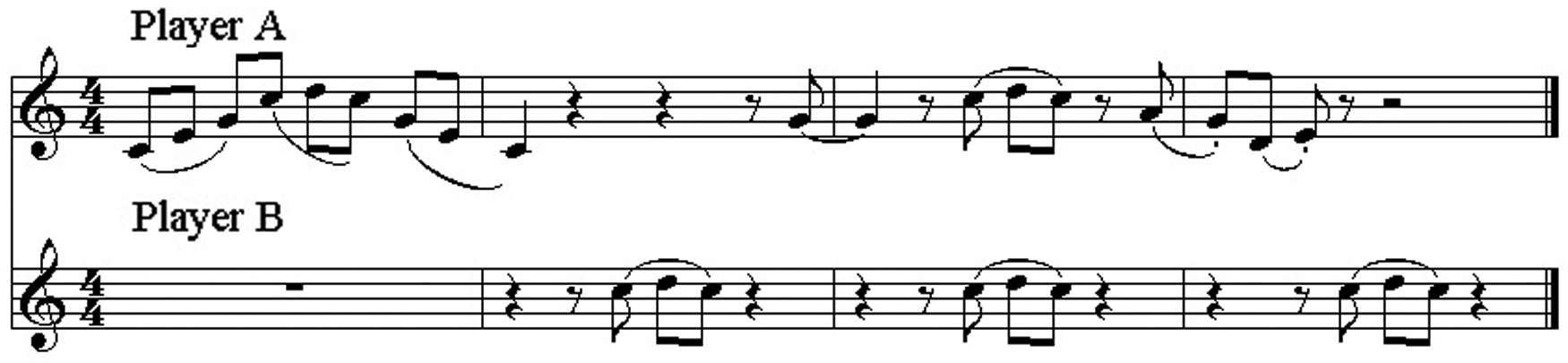
Referring to this example, the teacher can ask player B what elements make up this opening motif. Answer: the first three notes that outline the ascending triad; the second three notes, which portray the highest peak; and the last three notes that outline the descending triad. From this breakdown, the teacher can further prompt the student to extract the essential notes of each motif. For example,
Example 4

This type of analysis can make players aware of the difference between what is salient in a passage that makes it suitable for highlighting and what is essential from the structural point of view. Using the essential pitches can provide another choice of material to produce an alternative version of highlighting, but perhaps more effectively, they can also be used for supporting. From these alternatives, improvisers develop a sense of how their individual choices can contribute, modify, or affect the collective meaning of the music. Thus, students are guided in developing their own understanding of interaction through improvisation by considering divergent routes to construct their musical discourse.
If the players understand each other, as shown by their ability to identify the strategies that their partners use, and if they find themselves presenting material that offers the partner opportunities to engage, then the interaction is successful. On the other hand, if both players play material that in isolation might be correct but does not allow for interaction from the other player, the mechanics of interaction would be considered faulty.
This latter self-centered approach to improvisation often happens when players focus on playing within a style, often presenting new material in every single phrase. Although each phrase may sound stylistic, and even could make a good individual solo, it is very difficult for a partner to interact with a discourse that changes the topic in every new statement. Here, the role of the teacher is to stress the necessity to incorporate the partner by using simpler ideas and sticking to them for longer stretches of time, at least until the partner grasps “what the conversation is about.”
From my own experience with high school and undergraduate students, I’ve discovered that it is effective to apply the strategies through very simple, almost obvious exercises. To practice copying, for example, we organize the class into pairs that take turns participating in a “dialogue” over a four-bar sequence. On bar 1, player A creates a simple motif using notes from a chosen scale; the challenge for player A is that the motif must present some salient feature to be copied by player B. This salient feature could be an angular melodic contour, a syncopated rhythm, a crescendo dynamic, and so on. After the initial motif is presented in bar 1, bar 2 is a silent bar that allows player B to choose one feature to copy. Then, on bar 3, player B plays the motif that copies the feature. After this, bar 4 is another silent bar that allows player A to plan a new motif with distinctive features to be played in bar 1 of the next four-bar sequence. The roles of initiator and follower can change after a few tries without even stopping the exercise. Here’s an example:
Example 5
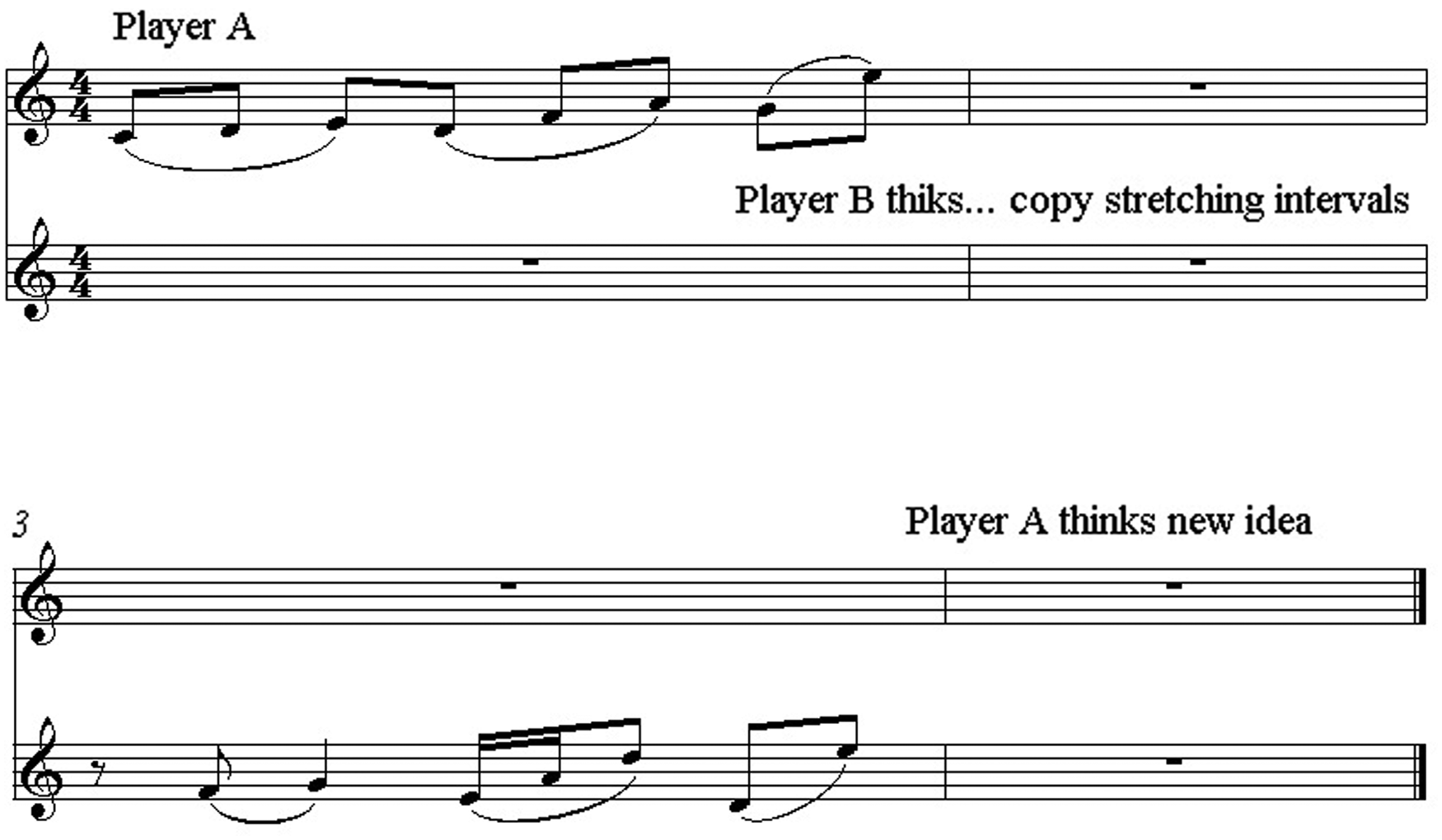
Taking this exercise to a higher level, the silent bars can be eliminated, thus increasing the speed for processing the information as well as delivering a more natural musical conversation. Taken to an even higher level, the exchange of original and copied ideas can take place over an un-predetermined number of bars or beats. In this case, the improvisers will overlap at points and will rest together at some other points. This confluence of silence or sound from both players is a valuable aspect of improvisation.
Once the strategies have been practiced individually (and the teacher can praise the improvisers and ask them what they’ve just done at this point), learners can combine them in a freer context. The combinations can be agreed on beforehand or left open for spontaneous choice. Example 6 combines supporting, copying/adapting, and highlighting. Player A improvises a line over a supporting background from player B. Player B’s background consists of a very simple yet rhythmic vamp. After a few phrases, player A reaches a climax and uses the rhythm of player B’s vamp, thus copying one of its features. Then, already familiar with the vamp’s rhythm, player B highlights some notes of this rhythm and harmonizes it, thus adapting player A’s climax. This combination of several strategies over an improvisation closely resembles verbal exchange in a conversation, which is the ultimate goal of these strategies. However, when combined, the strategies should be applied consciously, out of choice, and purposefully. Also, it is important to practice the strategies in isolation and in combination within one same session; in other words, avoid practicing mechanically for weeks before applying the strategies within a more real-life situation. Example 6 shows strategies combined.
Example 6
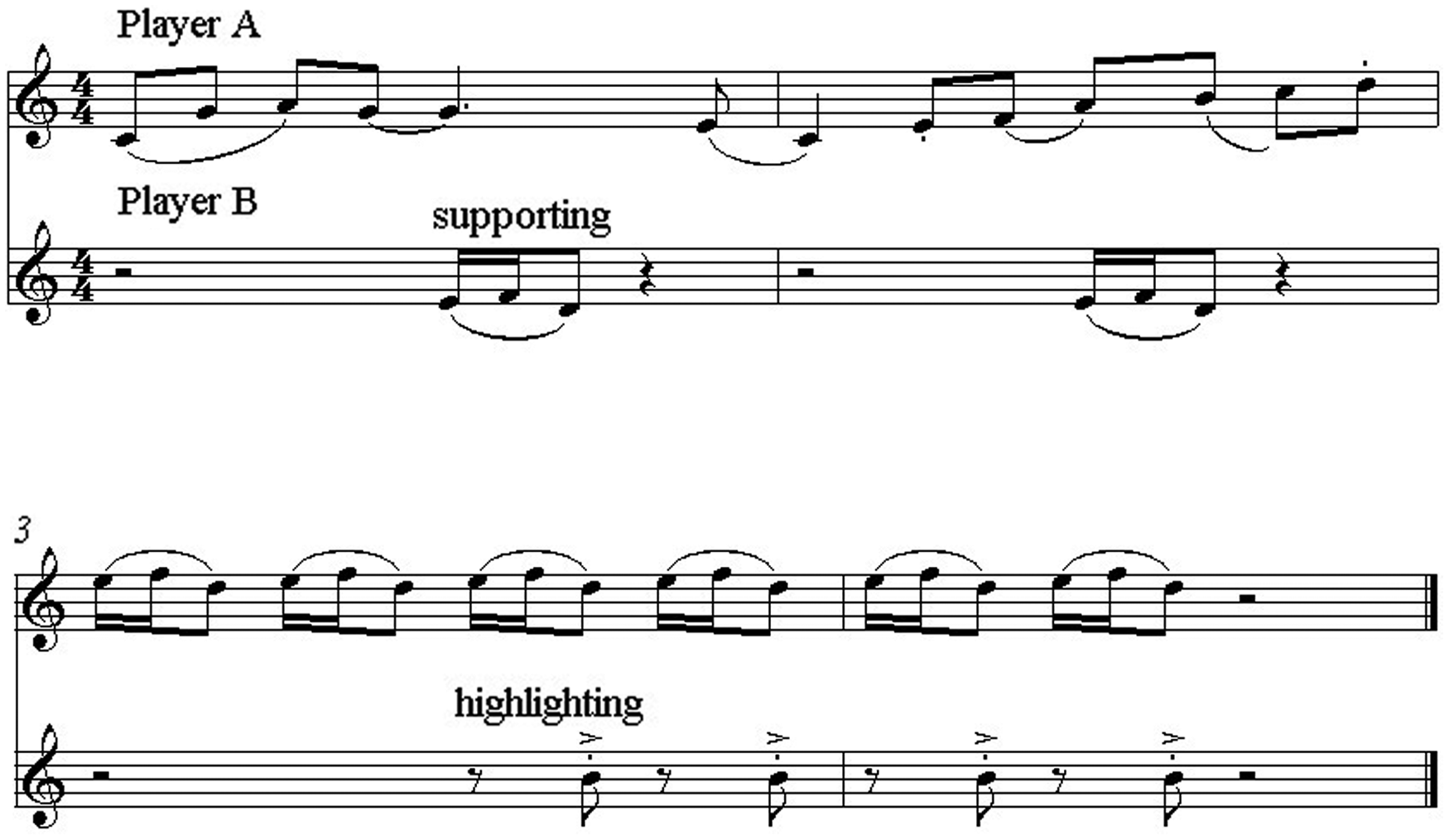
Last but not least, the best way to assess the progress on these strategies is by recording or videotaping the exercises, especially when applied in combination and in an open format (i.e., over un-predetermined number of bars). When reviewing the recordings, learners should identify points in which applying the strategies could have contributed to a more accomplished interaction. Rather than focusing on what went wrong, reviewing must focus on what could have been better.
A Skill for Our Time
Improvisation is becoming an essential skill not only for jazz musicians but for all types of players. Applying the eight strategies for collaborative improvisation described in this article can address areas of interaction often neglected by the more established methods of teaching improvisation. Approaching improvisation as a dialogical skill can contribute to music education in two ways:
This type of musical dialogue can provide access to improvisation to a wider range of players, such as the classically trained musician who might be willing to make music spontaneously but may not necessarily be drawn to jazz or popular music. Given that improvisation as a form of interaction relies on musical vocabulary already assimilated, musicians new to this practice do not need to expand on their musical vocabulary.
Improvisation as a form of interaction is a highly relevant strategy in the multicultural school setting. I argue that currently, in music education, communicating through interaction is more important than is mastering the features of a style or preserving its conventions and traditions.
To advance music-making as a multicultural manifestation, improvisation needs to open doors to a wide range of musical languages, influences, and settings. Therefore, improvisation as a form of interaction may lead to innovative ways of making, thinking about, and enjoying music.