



Abstract
Composition pedagogy is explored from the perspective of a composer and a music teacher educator in this article. The primary goal is to help practicing music teachers develop strategies that will encourage students to create original music. The authors provide reflection about the process of helping students compose on the basis of personal experience composing and teaching young composers, via the work of leading scholars in music education and by using narrative excerpts and musical examples. Key strategies are identified that contribute to the successful teaching of composition, particularly at the beginning, middle, and the end of musical compositions. Contributing most notably to this discussion is the use of terminology in teacher feedback.
What strategies are most likely to help young people compose music? Here are some ideas.
Over the last fifteen years, an emphasis has been placed on teaching composition through the National Standards for Music Education developed in 1994 by MENC, now the National Association for Music Education. 1 Many music educators may avoid teaching in this area since they themselves have not formally studied composition. A good place to learn how to teach composition is from composers themselves. Has music education as a field sought the expertise of composers when considering the teaching of music composition? What do composers have to say about teaching composition? It also seems logical that the composition community could learn a good deal about how to teach students to compose from music educators, who focus their efforts on the teaching and learning of music. The potential for sharing knowledge exists for both music education and composition.
The purpose of this of article is to give practicing K–12 music teachers some resources, written by practicing composers and teachers of composition, on how to go about teaching students to compose. This is not meant to be a follow-the-recipe, paint-by-number approach. It is meant, however, to reflect ways that composers have helped people compose music more successfully. Our ideas here are intended to complement the existing music education literature on this topic by dealing with a number of important questions often omitted in other sources—questions central to all the techniques and ideas presented hereafter.
This article builds on approaches developed by leading music education researchers and practitioners, as well as by a number of practicing composers and composition pedagogues. Teacher-educator Maud Hickey’s 2003 book Why and How to Teach Music Composition: A New Horizon for Music Education was consulted foremost, particularly chapters by Betty Anne Younker and Sam Reese. 2 Additional works by Hickey and Peter Webster, Jackie Wiggins, Rena Upitis, and John Kratus were also consulted. 3 One source by Alan Belkin, a composer and faculty member at the University of Montreal, Canada, has been especially helpful. 4 Even though his work was meant for much more mature composers, when viewed in elementary terms, Belkin’s ideas also serve to enlighten teachers who work with K–12 students. Furthermore, two practical guides to teaching composition in K–12 settings have been written recently: Maud Hickey’s Music Outside the Lines: Ideas for Composing in K–12 Classrooms and Musicianship: Composing in Band and Orchestra, which the first author coedited with David Stringham. (See the “Suggested Resources for Teaching Composition” sidebar for these and other reference works.)
In addition to recent work in composition pedagogy and the sociology of creativity, 5 we have drawn upon personal experience—helping students (K–12) turn musical ideas into created musical works—to inform this article. Kratus suggests that teachers interested in incorporating creative activity into the music curriculum “(1) analyze the component parts of the complex behavior, (2) focus the students’ development on the components, and (3) enable the student to work toward mastery of the components within the context of the whole.” 6 Following the advice of Kratus, to make this information more accessible to the practicing teacher, we have organized the information presented here according to helping students (1) begin, (2) continue, and (3) end a piece of music.
Suggested Resources for Teaching Composition
Belkin, Alan. A Practical Guide to Musical Composition, 2008. http://www.musique.umontreal.ca/personnel/belkin/bk/F-1.html. Accessed December 4, 2009.
Burnard, Pamela. “The Individual and Social Worlds of Children’s Musical Creativity.” In The Child as Musician: A Handbook of Musical Development, edited by Gary McPherson, 353–74. New York: Oxford University Press, 2006.
Hickey, Maud. Music Outside the Lines: Ideas for Composing in K–12 Classrooms. New York: Oxford University Press, 2012.
Hickey, Maud, ed. Why and How to Teach Music Composition: A New Horizon for Music Education. Reston, VA: MENC, 2003.
Hickey, Maud, and Peter R. Webster. “Creative Thinking in Music.” Music Educators Journal 88, no. 1 (2001): 19–21.
Kratus, John. “Music Education at the Tipping Point.” Music Educators Journal 94, no. 2 (2007): 42–48.
Kratus, John. “Structuring the Music Curriculum for Creative Learning.” Music Educators Journal 76, no. 9 (2009): 33–37.
Randles, Clint, and David Stringham, eds. Musicianship: Composing in Band and Orchestra. Chicago: GIA, 2013.
Reese, Sam. “Responding to Student Compositions.” In Why and How to Teach Music Composition: A New Horizon for Music Education, edited by Maud Hickey, 211–32. Reston, VA: MENC, 2003.
Reese, Sam. “Tools for Thinking in Sound.” Music Educators Journal 88, no. 1 (2001): 42–53.
Upitis, Rena. Can I Play You My Song? The Compositions and Invented Notations of Children. Portsmouth, NH: Heinemann Press, 1992.
Wiggins, Jackie. Composition in the Classroom: A Tool for Teaching. Reston, VA: MENC, 1990.
Wiggins, Jackie, and Peter Webster. “Fostering Revision and Extension in Student Composing.” Music Educators Journal 9, no. 3 (2005): 35–42.
Younker, Betty Anne. “The Nature of Feedback in a Community of Composing.” In Why and How to Teach Music Composition: A New Horizon for Music Education, edited by Maud Hickey, 233–42. Reston VA: MENC, 2003.
How to Begin
Beginning a composition is sometimes the most daunting act. This reality is the same for students as it is for established composers. Many students, though, do not have a substantial collection of successful experience under their belt to balance out the anxiety of coming up with original ideas. They sometimes require assistance, but it is a tricky process for both teacher and student. If the act of decision making is preempted by the suggestions, one of the most crucial aspects of composing is eliminated—namely, choosing how and with what the work will begin. Therefore, helping students generate ideas that will propel their work forward is the primary goal as students begin a piece of music. The teacher might offer several high-quality solutions to the problem of how to start. Sometimes giving many possible initial ideas helps more than any other technique, as students can then, by engaging their imagination, add to, subtract from, and work to transform those ideas. Of course, there are always gifted students in every class who can generate original starting material without any help from the teacher.
Several individuals skilled in composition pedagogy have sought to give teachers ideas about how to help students begin their work. Wiggins suggests that with younger students, the teacher improvise various accompaniment patterns, styles, and melodies and ask students for their opinions about which example best fits his or her idea about how the piece should go. 7 When this approach is used, students generally respond to one idea more favorably than to others, thus propelling the work forward.
Belkin suggests that another way of thinking about how to begin a piece of music is to consider that the work should “ask a question” metaphorically, so that the listener wants to hear more—the “answer.” 8 This technique lends itself well to considering each composition as a sort of soundtrack to a movie. If something scary happens in a movie, the viewers might need a resolution. Or, if nothing is happening in a movie, the viewer may become bored and desire to see—and hear—something exciting. For more information on how narrative metaphors can provide the impetus for starting a composition, see Sandra Stauffer’s chapters on narrative thinking and creative thinking in the book Musicianship: Composing in Band and Orchestra. 9 Certain aspects of the music play a more important role than others in how the musical “question” and its “answer” evolve, guiding the development of the composition. Some of the aspects Belkin comments on include crescendi and/or significant expansion of register within the first phrase, rising lines, unresolved harmony, rhythmic variety, and orchestral and registral discontinuities. 10 (See Table 1 for musical rationales and further explanations of these processes.)
Musical Elements Typically Associated with Beginning a Piece of Music

Figure 1 shows a student melodic idea, as well as several teacher suggestions for how a student might improve the melodic line. To better understand the nature of teacher feedback in this case, consider the following narrative:
Here’s my melody, teacher. What do you think? (Student shows teacher her notated melody.)
I see how your ideas have progressed since the last work that you showed me. (Slight pause.) I see that your melody rises and falls within this same note set. (Points to page.) Have you thought of maybe extending the range beyond the note range that you used at the beginning of the line?
(Student looks at the work; she displays a thoughtful countenance.)
Oh, do you mean making the melody extend an octave higher? (Slight pause.) And maybe adding a crescendo?
Yeah. (Slight pause.) What do you think?
I like it, but it’s not exactly what I had in mind.
Oh . . . well, have you thought of maybe creating unresolved harmony at the end of the musical line?
(Teacher notates an alternative ending with the harmony ending on a dominant chord.)
Hmmm . . . that’s interesting, but it not exactly what I was thinking of. (Slight pause.)
(Teacher gives a reassuring glance. She starts to speak, but then stops herself when she hears student begin to speak.)
I was kind of thinking that I’d like it to be more rhythmic—like this track. (Student pulls out her MP3 player, plugs it into the class sound system, and plays a chart by Count Basie.)
I see. How about using this rhythmic figure then? (Teacher notates a syncopated sixteenth-note figure.)
(Excited) Oh, how about this? (Student quickly rewrites the melody and then glances at teacher as if desiring affirmation.)
Wow! Now, look at how much your melody has changed. It certainly looks more intense. I think that that was what you were after, wasn’t it?
(Student smiles in agreement.)

Musical Elements Associated with Beginning a Piece of Music
Not all compositional problems are solved with this much positive resolution, but this narrative example should give the reader an idea of how teacher feedback can direct students to solving their musical problems. As Reese explains in his chapter of Why and How to Teach Music Composition: A New Horizon for Music Education, responding to student compositions can be a difficult task, but if teachers focus their efforts on giving what he calls “perceptive, imaginative assistance,” then the process of giving teacher feedback can be fruitful for students. 11
A productive pedagogical approach must also come to grips with the often baffling language related to this stage of composition, working out meaningful distinctions, and often working with makeshift language and terms. Terms like idea, starting idea, and musical proposition require some elucidation to become part of a creative imaginative process, but can be valuable in some cases. Much of the traditional vocabulary, like exposition, theme, and melody, as well as more abstract concepts, like musical suspense, drama, musical logic, or musical process, can serve as valuable teaching tools during the initial stages of producing an original musical work. Musical idea is a term with several definitions. Working out what terms mean will help educators choose and use the terminology that will be most helpful for students.
Successful Continuation
Younker suggests that effective feedback—where the power of the teacher’s role in teaching composition resides—focuses on “what has been done, what needs to be done, and what can be done.” 12 Therefore, a fair amount of reflection must take place when considering how to best help students maintain and improve their musical products. The next section addresses how to create continuity in musical compositions.
Belkin addresses five areas when teaching the concept of successful continuation: satisfactory flow, renewal of interest through contrast, suspense, points of reference, and climax. 13 (See Table 2 for musical rationales and further explanations of the five areas.) The student composer would need assistance in learning how to maintain a narrative progression over the course of a composition, or how to establish and maintain the coherence of one or more musical processes. Since music happens over time, similar to the flow of a story conveyed in the pages of a book, narrative metaphors are helpful to young composers. Stories and good compositions need satisfactory flow, contrast, and suspense. By understanding this, teachers can develop comments that are helpful to students as they work through the creative process.
Suggestions for Successful Continuation

Teacher suggestion taking into account the strategies
Sample Student Ending Idea
It is essential to work out the meanings of language of teacher feedback. Traditional terms, like development and variation, come into play, along with terms like imitation, counterpoint, and canonic procedures. Metaphorical notions, like evolution, cataclysm, and climax, as well as concepts like musical character and gesture can be informative. Consider the following narrative:
I really like what I did at the beginning of the piece. But, I can’t think of how this next part should go.
(Teacher looks on thoughtfully, showing that she understands where the student is coming from.)
Hmmm . . . I see. Well, I see that you’ve done some pretty exciting things with the rhythm in the low voices and percussion at the beginning.
(Slight pause.) I was thinking that the low voices were like the rumblings of an approaching army . . . and the percussive hits work like the pounding of their drums.
(Smiling) You mean like in Braveheart or Lord of the Rings or something?
Yeah . . . like the buildup to the battle . . . but not quite the battle yet.
Oh, so you’d like things to heat up in this piece soon, but not yet?
(Student smiles as if agreeing.)
Well, a fanfare type of riff might be nice, used artfully as you approach where you see the climax happening. You might introduce it in a low, more sublime timbre . . . and then, at your point of impact, pull out the stops and bring in the brass with the same riff.
Oh, cool . . . so I could like foreshadow the impact point with another voice?
Again, most compositional situations do not end as neatly as this narrative suggests. However, the process can be—as was illustrated—enlightened by using ideas borrowed from the world of narrative. Borrowed terminology, like dramaturgy and transformation, can be useful terms to have in the teacher’s tool belt. Procedural concepts, like fugal technique—and more abstract notions, such as analogy, translation, and extension—can be helpful to students who have ideas but are not clear on how to articulate those ideas. Hosts of other terms borrowed from dance or cinema, such as sense of movement or flashback, can sometimes illuminate the ongoing creative process.
How to End
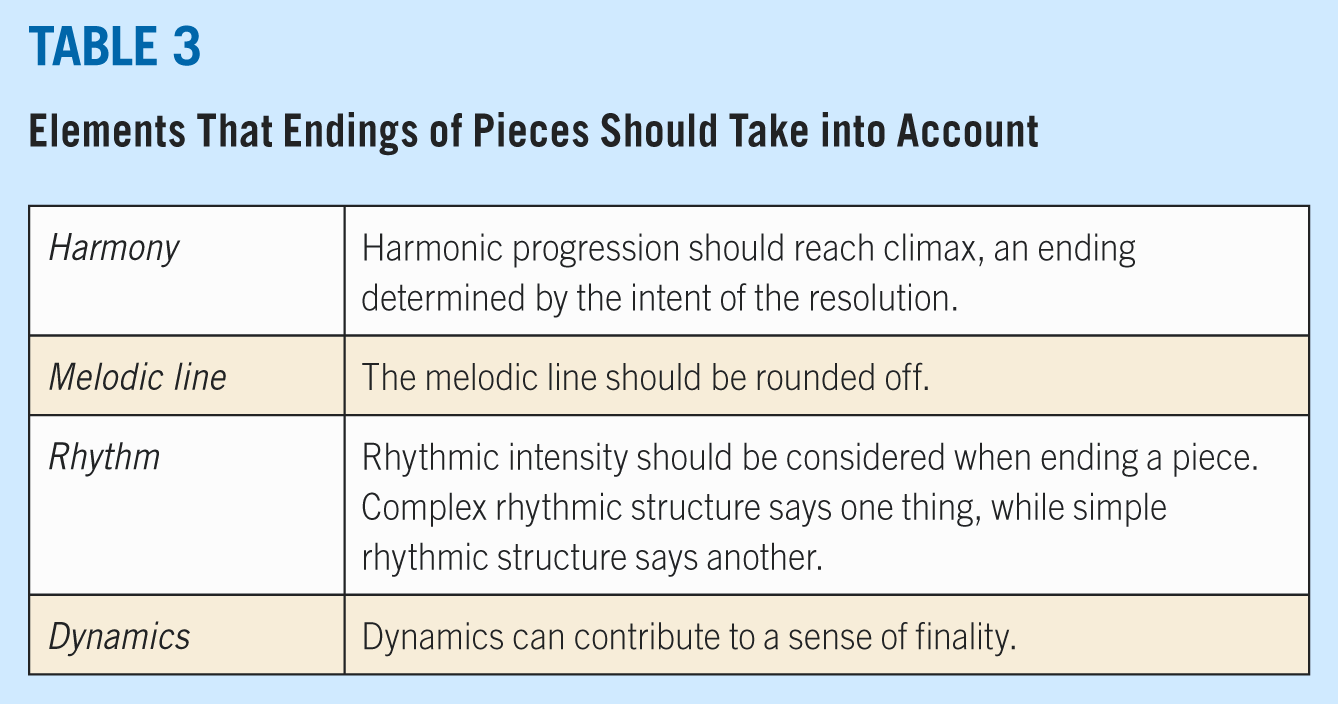
The conclusion is the last thing that the listener hears. The ending imparts significance to everything that has happened previously in a piece. It is also a process, not reducible to “the ending.” It should be a priority of the composer and the composition teacher from the beginning of the process. The ending must be the ultimate resolution of the ideas of the piece. It must take into account the concept of resolution, specifically, the areas of harmony, melodic line, rhythm, and dynamics. In all works, the ending establishes the desired degree of closure and coherence, and creates the last reflections on processes of variety and change, as well as identity. See Table 3 for a summary of these specific ending musical gestures. Figure 2 shows an example of a student conclusion, with possible teacher suggestions based on Table 3.
Elements That Endings of Pieces Should Take into Account

Musical Elements Associated with Ending a Piece of Music
Hickey and Webster suggest that all musical activities advanced by the music teacher, whether they be listening, performing, improvising, or composing, should engage students’ ability to “think in sound.” 14 Following this train of thought, the following narrative demonstrates how a teacher’s feedback could function in helping the students conclude a piece of music:
Here’s my ending. What do you think?
(Teacher looks at the work. Student tries to read the expressions of the teacher to figure out how well the ending statement is being received.)
Well, you have some nice ideas here. I like the movement in the flute melody line. (Slight pause.) What do you think the purpose of the clarinet and alto saxophone part is?
The purpose—what do you mean?
The flute line is the melody—it has a place as the conveyor of the primary musical thought. But, what are you trying to do with the clarinet and alto saxophone parts? Are they working together?
Yeah . . . I think that they should work together somehow. (Thinking.) They really aren’t doing much here . . . are they?
(Teacher gives a supportive glance.)
Maybe they should drive the ending a bit more. Instead of being like still background pictures, like in the old cartoons, maybe they could be like moving action pictures . . . a little more Avatar-like?
That sounds promising. I think you might be on to something.
This narrative portrays the teacher’s desire to let the student lead the flow of ideas by giving feedback and prompts that lead to the student’s personal interpretation of how the piece should sound at the end. The student demonstrates what it means to “think in sound.” Thinking in sound can be an empowering experience for students, indeed, the ultimate goal for all teachers who inspire to give their students opportunities to flex their creative muscles.
If the composer waits to compose the conclusion at the end of the process, there is a danger that the work will be wrapped up in haste or in an inappropriate or ineffective stock—or generic—ending. Aside from the opening material, the choice of how to structure the ending might be the most important musical decision the composer makes. Therefore, careful consideration must be given to resolving every aspect of the process. Once again, distinctions in language expressed to students would need to be scrutinized and clarified by the teacher. It is important that the music teacher present meaningful compositional suggestions based on the language and focus that has been established throughout the process. Closure, climax, surprise, response—the whole world of ending—is full of language that would need to be worked through to make it useful to the composer; doing so will likely result in quality assistance on the part of the teacher as he or she guides students to a conclusion of their creative compositional efforts.
Coda
As stated earlier, this article is not meant to be the definitive statement on teaching composition; rather, we hope that the ideas presented here will offer the K–12 music teacher a number of practical ways to address the challenges of teaching composition in the school music setting in accordance to previous work in composition pedagogy. 15 When considered in light of the numerous ways that music is made in the school setting, composition is an area that could allow students to express themselves in personally meaningful ways not often explored within the traditionally conceived model of music education. The National Standards have mandated the inclusion of creative music-making opportunities for students of music; at the same time, high-stakes standardized testing is forcing educational policymakers to question the role of the arts in the education of students. Those of us music educators who have worked toward giving music students opportunities to compose music in the school music setting realize that it is precisely these types of creative music-making activities that are essential to the education of all children, if they, the citizens of tomorrow, are going to compete in an increasingly competitive global economy. Einstein once said, “Logic will get you from A to B, but imagination will take you everywhere.” Teaching students to compose within the school music program is essentially tapping into the second way of thinking that Einstein advocates.
While not addressed specifically in this article, the role of technology in “thinking in sound” should be explored in music teaching and learning as an exciting way of managing the task of organizing and manipulating student created musical work. Leaders in the field, such as Reese and Kratus, present the possibility that music education might be best served by embracing all areas that computers can augment 16 —what Hickey and Webster call the four Ps of creative musical activity: the person, process, product, and place. 17 Computers are not the only solution to the problem of why and how to teach music composition, but they likely will serve a significant role in making creativity more accessible to students of music education in the future. Teachers leaving collegiate music education programs will need to embrace these types of tools for K–12 students to benefit from them.
One of the main reasons that university students in music education cite for wanting to study composition is that they desire to create musically meaningful literature for the ensembles they will direct. This desire is based on utility—that students recognize, sometimes early on in their studies, that it would be beneficial for a teacher to be able to compose original music and arrangements of music for student performance. The composition field admires this unique arrangement, in that music teachers often have more outlets for their created work—whole communities that come to see their students perform regularly. Oftentimes, composers lack regular venues for their created works to be performed.
Composers might learn from the music education community, as music educators focus their work on understanding the complex world of pedagogy, theory, and practice. One must first do before one can teach. It is therefore the belief of the authors that educators who are serious about teaching composition first learn to compose themselves. While engaging in the process of composition, the reflective teacher will likely develop strategies for teaching composition that will enlighten their teaching practice. Perhaps then they can share their strategies with both communities—composition and music education.
Request for Submissions: Articles from PreK–12 Music Teachers for Music Educators Journal
MEJ Academic Editor Patrick K. Freer is seeking submissions of articles that deal with
If you’re interested in
Authors should follow the “Manuscript Submission” guidelines found at www.mej.sagepub.com. All submitted manuscripts will be reviewed by members of the Editorial and Advisory Committees. Some of these may also appear on the National Association for Music Education (NAfME) website, www.nafme.org.
Ideal length should be no more than 12 double-spaced typed pages plus references.
Instructions for submitting manuscripts are found at www.mej.sagepub.com.