



Abstract
Creativity can be experienced in many roles of musicianship: performing, improvising, and composing. Yet, activities that encourage creative thought in our music classrooms can be a challenge to implement. A strong music education curriculum for middle school general music is important; as this may be the last time we reach students who do not participate in band, orchestra, or choir. This article provides information on the development of a middle school general music curriculum model where creative thinking in music through music composition activities is the focus of instruction. Students with limited experience in music were given opportunities to explore and express musical ideas in their compositions. Music fundamentals were introduced following the composition experience. The composition experiences provided fertile ground for creative thinking in music, and students in the program were highly engaged in the music-learning process. The Webster Model of Creative Thinking in Music is examined to discover the keys to success in this model.
Composing offers students in pre-ensemble classes the chance to think creatively and be successful with music regardless of past experiences.
Some believe that music programs in our schools are naturally creative classes. If students are participating in a music program, they must be creative. However, music activities in many classrooms focus primarily on the development of ensemble and individual performance or acquisition of facts—not always creative endeavors! Creativity can be experienced in many roles of musicianship: performing, improvising, and certainly, composing. Yet, activities that encourage creative thought in our music classrooms can be a challenge to implement in the curriculum. Problem solving, experiential learning, and creativity development are key concepts in many education circles today. How do we make sure that these dimensions of learning are truly a meaningful part of the music education curricula in our classrooms?
Peter Webster, a scholar known for his work in creativity and music education, believes that creative thinking in music is actually problem solving with musical sound and that creative thinking in music should be an integral component of a child’s music education. 1 Webster uses the term creative thinking in music to emphasize this important role in teaching and learning about music. He defines creative thinking as a “dynamic mental process that alternates between divergent (imaginative) and convergent (factual) thinking, moving in stages over time. It is enabled by internal musical skills and outside conditions and results in a final musical product which is new for the creator.” 2 Webster explains that music learning from creative thinking occurs when children are given a chance to explore musical ideas and apply them in problem-solving tasks. Their musical imagination is involved. Students become more engaged with this type of musical experience—and more excited about musical learning.
While creative thinking can occur in many aspects of music learning, the focus of this article is to examine how the process of music composition encourages creative thinking in our classrooms. How do we find time to include meaningful creative composition activities in the music education curriculum? At what age should we focus on these ideas? The middle school general music curriculum is one area where composition and creative thinking can have a very successful relationship with student learning in music.
Creative Musical Thinking
At Roberts Middle School in Cuyahoga Falls, Ohio, sixth-grade general music had been dropped from the curriculum. The district decided to bring the class back to the middle school for the 2011–2012 school year. It became the goal of the principal and the music teachers involved to rework the curriculum in order to create a more successful model for the program than had been previously used. The first order of business was to change the name from General Music to Music Creations class. This was going to be a class that was quite different from a traditional general music class. A National Board Certified Teacher, music educator Pamela Rezach, took the lead on investigating the possibilities. Rezach was inspired by the Credit Suisse Very Young Composers (VYC) project developed by New York Philharmonic bassist and composer Jon Deak. The VYC provides opportunity for elementary children with limited or no musical experience to explore and create musical ideas, have these ideas notated by “scribes,” and then have their compositions performed by members of the philharmonic. 3 Students are introduced to instruments of the orchestra and learn to create musical ideas that the instruments might play. Though she could not adapt the exact VYC model in her classroom, Rezach’s goal was to produce a curriculum for middle school general music that worked harmoniously with these ideals in a public school setting.
The first sixth-grade Music Creations class was one semester long and had eighteen students registered. Rezach, who served as both band director and general music teacher at the school, faced the same challenges many music educators face in trying to implement composition activities in the classroom. She did have a few students with previous experience in elementary band, but most students had little prior musical experience. The only available classroom was the middle school band room. She had limited instruments available and no student computers to use for composition activities. She did have five-gallon “bucket drums” and a set of drumsticks for each student in the class, an acoustic piano, a couple of electronic keyboards, and a number of mallet percussion instruments in the band room—a place to begin!
Music Creations Class
The semester began with musical exploration of rhythmic patterns on bucket drums to create a comfortable atmosphere and stimulate the creative musical thinking and exploration that would continue throughout the Music Creations class. Initial problem-solving activities for the students included echoing patterns played by the teacher, improvising their own patterns, and then leading the drumming sessions. Throughout the semester, Music Creations class began with a “breaking-the-ice” group activity that reinforced concepts such as finding steady beat and rhythmic subdivisions of beat by playing bucket drums, bouncing balls, or batting balloons to a partner on subdivisions of the beat, all while listening to music recordings.
Composition activities with pitch began with careful instruction on how to use the instruments in the classroom appropriately, an explanation of the different sounds the instruments were capable of, and a discussion of how notes can move (up, down, repeat, stepwise, and by leaps). The students were allowed time for musical exploration on melodic percussion instruments and were encouraged to create short melodies. This was problem solving with musical sound in action! Working in small groups (two to three students), they took turns exploring different instruments and made decisions on how to best arrange the notes to express their ideas. They seemed to enjoy listening to each other’s pieces. Students were encouraged to use graphic notation symbols—called “composition maps”—to help them remember their ideas. Composition maps consisted of drawings with swirls, steps, circles, and other notations to represent the music they composed. Students with music experience were encouraged to use traditional music notation in their maps. This was an excellent method of allowing differentiated instruction to accommodate differing levels of musical experience. These young composers were encouraged to use the rule “play it three times in a row.” A creation was considered “composed” when a student could repeat the same musical idea three times in a row. The students worked hard on their projects and prepared to share their simple melodic compositions with the class. They were required to play their musical ideas and present their composition map with a verbal description of the melodic patterns they used.
The next step was to go back to work and extend the compositions. The students worked to develop more complex compositions by expanding and adding to their original compositional ideas. After new musical ideas were added, students worked together in small groups to create accompaniments for each composition using additional nonpitched percussion instruments, such as maracas, triangles, and small drums. Collaboration was an important part of this process. Students were also required to teach their melodies to another member of their group. This “student teaching” component surprised Rezach with its effectiveness. It was very important to the “student teachers” that the student receiving the instruction play the new composition correctly. They were very creative in their methods of getting their instruction just right. In the final component of this part of the class, each composer performed his or her work for the class in its extended form with the group accompaniments. This required musical collaboration between students in preparation for the performance. Student composers experienced a strong sense of pride and accomplishment as they shared their musical compositions with their classmates. Rezach remarked that every time she asked for volunteers to perform pieces for the class, or for visiting guests, every hand was eagerly raised. This was a warm and receptive audience that had experience composing. They were supportive of their classmates and of the new musical ideas that they shared.
No musical terms other than those defining how notes move (steps, skips, repeats, up, and down) were used to begin this process. Music learning was occurring through exploration and student creativity. After completion of the initial compositions, Rezach introduced fundamental musical concepts, such as form and dynamics, using the student compositions as models. For example, students learned to identify form in their own works and the works of their classmates. They also explored how the compositions might be made more interesting by adding dynamic contrasts, accents, and other musical elements. After the introduction of each element, students were given time to modify their compositions using the new concept that had been introduced.
In some general music classes, students may resent having to read and write about composers from the past. Here, students completed research projects on important composers in history using the school computer lab and library. They seemed to share connections with the composers they wrote about in class. One student shared that his composer, Duke Ellington, “was inspired as a teenager and even started his own jazz band!” This writing activity (often an important component of Common Core initiatives) may have had a greater impact because the students first had the experience of composition.
Student compositions provided context in which to apply the fundamental music concepts they were learning about and may have encouraged a greater understanding of why it was important to learn about these concepts. Creative thinking in music, encouraged through these composition activities, provided a spirit of teacher–student collaboration, with students taking an active part in creating the learning environment.
Why Middle School General Music?
If we consider creative thinking an important part of the music education process, what better place to implement creative activities than a middle school general music setting? Often middle school general music classes do not have a clearly identified purpose. Should the class be required for all students? Does it become a music appreciation class that emphasizes fact-based learning? Is there a performance component? With students having a wide range of music experiences, it is often difficult to plan effective musical performances. Without an active focus on performance and musical context, the middle school general music class can become drudgery for both student and teacher, instead of a place for enthusiastic music learning.
This lack of agreement on the curricular goals for the middle school general music class often causes it to be shuffled to a position of lower priority in the minds of teachers and administrators. In her book Middle School General Music: The Best Part of Your Day, Elizabeth McAnally reminds us that the middle school years are an important time for students to develop musical preference and identity. This is a critical time to involve middle school students in an effective music education program. McAnally shares that “middle school general music represents our last, best hope for convincing adolescents that they can be musical.” 4 In many school systems, a middle school general music class may be the final opportunity we have to provide music education for students who do not participate in band, orchestra, or choir programs.
Active participation may be the most important component of a middle school general music program. In his text Teaching General Music in Grades 4–8: A Musicianship Approach, Thomas Regelski states that without active music-making, students tend to remain passive consumers of music. Students should be involved in active learning activities and experience the real-life roles of musicians. 5 In the middle school general music class, where students of differing levels of musical experience limit opportunities for performance, composition can become the means for engagement. In the Music Creations class, the role of composer provided the opportunity for active learning—an integral part of the creative-thinking process—and allowed an in-depth understanding of music that might not be achieved in a traditional music appreciation format.
When considering composition activities for the classroom, music educators may be concerned that they lack proper training to teach composition effectively or that the creation of musical ideas is too difficult for students who do not come from a music performance background. Composition activities can provide an excellent context for learning about concepts such as dynamics, form, texture, and notation. 6 Middle school students enjoy the process of creating their own musical ideas and may be the perfect age for musical development of this type. Their preferences are being developed, and they have enough informal musical experience to recognize a variety of musical forms and changes. Music education researcher Lucy Green investigates how informal, popular music learning strategies can promote effective learning in the classroom. She identifies five principles that support this concept: (1) Informal learning begins with music that students choose for themselves; (2) the main method of music learning occurs through aural experiences rather than notation; (3) informal learning happens not only individually—but also with peers, where there is an exchange of knowledge; (4) knowledge and skills tend to be learned in random, nonsequenced steps; and (5) informal approaches usually involve integration of listening, performing, improvising, and composing with an emphasis on personal creativity. 7 The Music Creations class allowed these middle school students to bring musical ideas from personal areas of experience. They worked individually and in collaboration with peers, exploring their musical ideas and creating their own compositions, which provided a path to music learning.
Creative Thinking at Work
Webster also encourages music educators to “design environments that help learners to construct their personal understanding of music . . . to develop a sense of musical independence.” 8 The center portion of Webster’s model (see Figure 1) identified as the “thinking process” provides a view of how creative thinking in music occurs across time, and may help to provide an understanding of why the Music Creations class worked so effectively (see Figure 2).
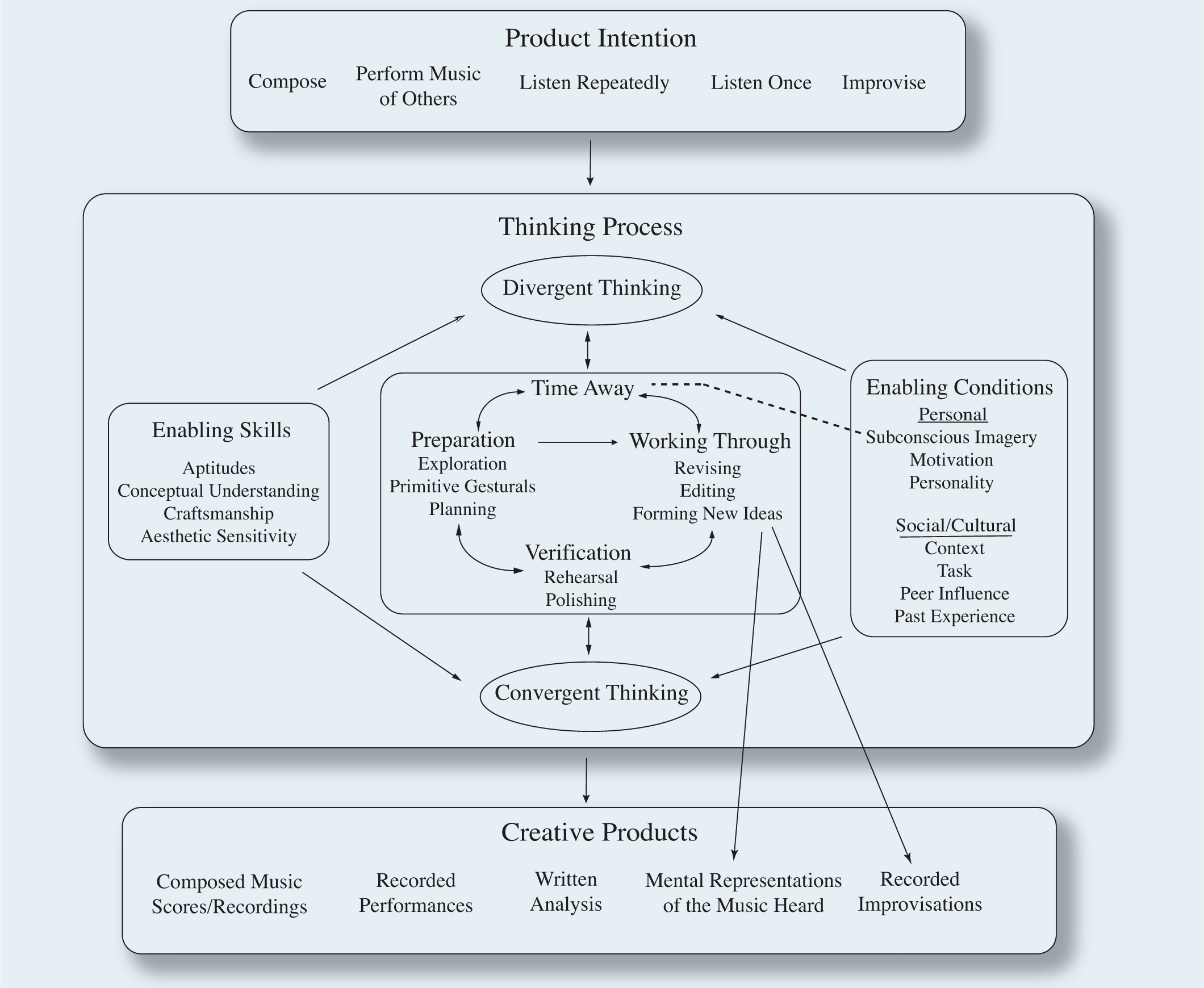
Webster Model for Creative Thinking in Music
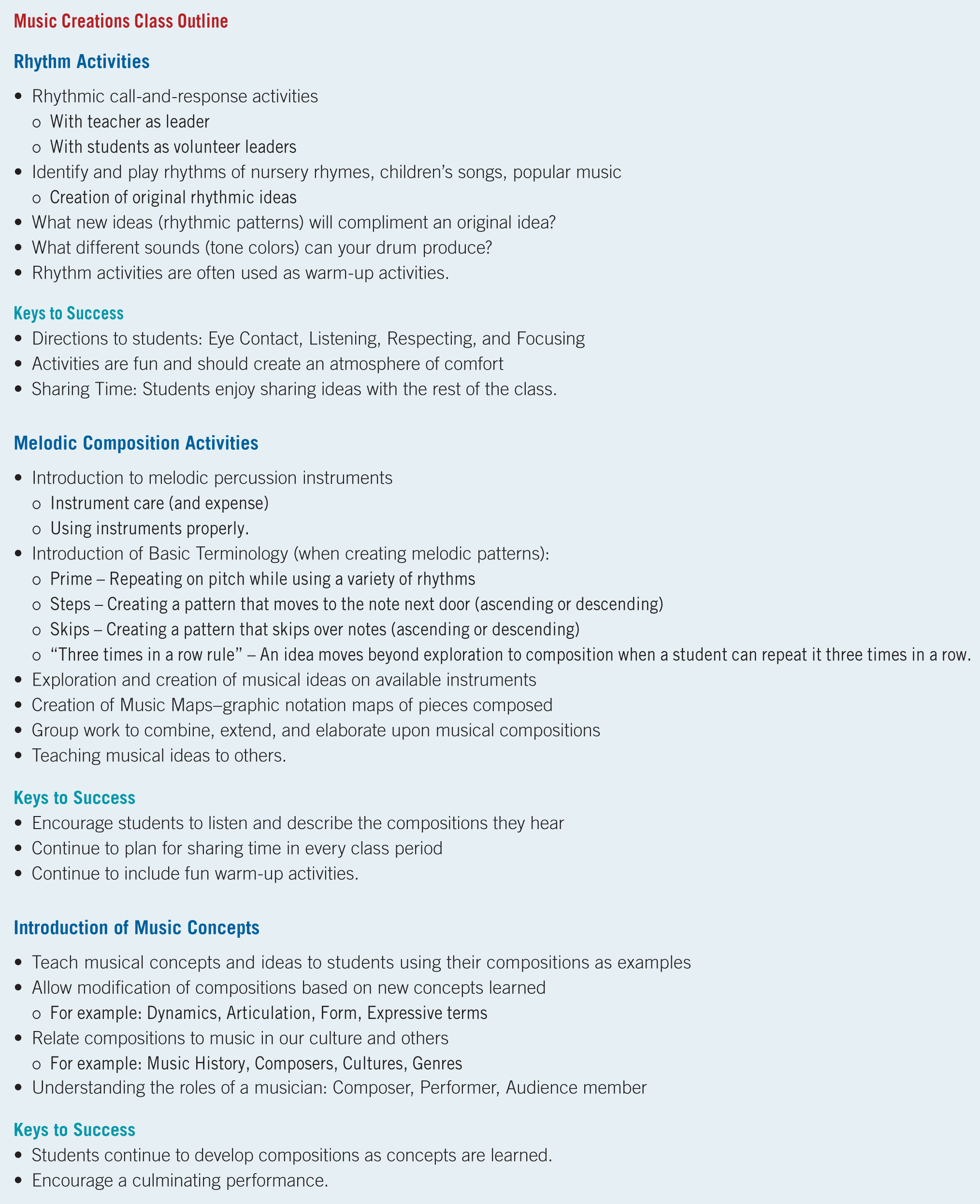
Music Creations Class Outline at a Glance
Enabling Skills
Webster acknowledges that each student must have certain aptitudes and conceptual understanding of music to compose successfully. A sense of aesthetic sensitivity is important as well. While many of these students had only a music listening background, they were still musically curious and enjoyed the process of exploration to find ways of expressing themselves musically. They started with the simplest level of conceptual understanding: music moves up, moves down, repeats, moves stepwise, and moves by leaps. This was enough information to begin the process. The students who were members of the school’s band program brought higher levels of musical experience to the process. They were intrigued by the structure of the class and blended with the inexperienced members of the class beautifully. By the end of the semester, there was a much greater level of conceptual understanding for all students. Rezach explained to the students that since they were all composers of new musical ideas, they must also respect the ideas of their fellow students. All students were careful and appreciative listeners to the compositions of their peers. This was a wonderful method of developing aesthetic sensitivity and acceptance of new musical ideas!
Enabling Conditions
Webster divides this part of the creative-thinking process into two main areas: personal (the characteristics each student brings to the classroom) and social/cultural. The Music Creations class “context” provided a safe space in which creativity and musical exploration were encouraged. The class also challenged each student with musical tasks or problems to solve—starting with small ideas—and then encouraged development of these ideas. This process gave students an opportunity to bring their musical identity and preferences to the task, work from different levels of musical accomplishment, and collaborate with their peers in the process. Providing enabling conditions for these students to problem solve in a musical context may be the most important step in assuring that creative thought can be developed in our students.
Divergent Thinking Process
According to Webster, the thinking process should involve four important steps. Preparation, time for students to explore musical ideas and think about where these ideas might lead, was clearly an important component of the Music Creations class. Students began with the most primitive of musical gestures—and of musical understanding—and began the process of creative thinking. Students were given time to work through their ideas by revising and creating new ideas by extending the compositions and adding accompaniment figures through the use of handheld percussion instruments. Through sharing times and performances, each student was provided the opportunity to verify the composition. Rezach felt strongly that time away from composing was important as well. After a few days of activities that did not involve composition, the students returned to the composition process and seemed to approach their compositions with renewed enthusiasm and energy.
Convergent Thinking Process
The students’ musical explorations and creative-thinking processes came together in a completed composition product, which was videotaped for posterity. Each student could proudly identify his or her own composition as a creative achievement.
Student Discoveries
After its initial semester, the Musical Creations class was declared a roaring success and continues as the middle school general music offering at the school. A financial grant from the Parent-Teacher Association enabled Rezach to purchase keyboards to facilitate musical exploration and learning in future classes. At the end of the first semester, the students were asked to write about what they learned in the class. Student comments indicate the positive effects the class had on their music learning: 9
“At first Mrs. Rezach didn’t teach us a lot because she wanted us to learn for ourselves. I learned about how the xylophone works and I wrote my own musical piece. We learned how to read music—like reading the notes like D-sharp and E-flat. We learned how to make music. We looked for things like making the A section, B section, and the coda. I learned about how to perform. I have to speak loud enough so everyone can hear me, I have to stand up straight so I am facing the audience—and I have.”
“I learned that mixing melodies and certain instruments sounds beautiful.”
“I’ve learned that anybody can compose music. I’ve also learned how to play music on a xylophone. I have learned about different composers. I learned how to put background with music as well. It has been really fun.”
“I learned how to create music. First you figure out what you want to play. After that, you play it and see if you like it or not. Then you write pictures to match the music to help you remember. Finally, you just practice.”
“I really liked Music Creations class because it was more like a class where we didn’t really need to know a lot about music to create music.”
This model offers an opportunity for students to actually experience creative thinking through composition, allowing them to think musically in a way that is quite different from performing or listening. Students often feel differently about music they perform after the experience of composition and often demonstrate increased musical understanding through this creative thinking process. 10 In her book Teaching for Musical Understanding, Jackie Wiggins states, “Musical thought is more than thinking about music; it is thinking in music. Opportunities for thinking in music are essential to the music education process.” 11 As we work to make music education a more meaningful part of the general education process, perhaps the process of creative thinking in music through music composition should be a more important focus for learning. Many of the techniques demonstrated in this model could also be used in elementary general music classes and with musically inexperienced students in high school settings. This middle school general music classroom was definitely a place where creative thinking in music enhanced the curriculum and provided opportunity for in-depth learning as the students stepped into the real-life roles of composers.