



Abstract
This article provides guidance for music teachers who want to introduce Korean folk music to their students. It introduces Arirang—both a specific folk song and a category—and describes three different versions: the “Miryang Arirang,” the “Jindo Arirang,” and the “Gyeonggi Arirang.” The “Arirang” tune appears in many social contexts that can be shared with students; these examples show how well known the form has become worldwide. In addition, Arirang songs have rhythms and lyrics that lend themselves to being taught through a rich variety of listening and performing activities; they can also provide opportunities for student composition and improvisation. The article includes suggestions for presenting “Arirang” in the music classroom.
Korean folk music can offer a window into the culture and can become the basis for considerable cross-cultural learning in your music program. As I am on hall duty at work, I hear sixth graders who are at recess. Some of them have chosen to go outside; others are in the auditorium. A group of students begins singing the popular Korean folk song “Arirang.” As I get up to see who is singing, I notice that it is a few of my band students. Last year, the band performed Variations on a Korean Folk Song Rhapsody, based on the folk song. Before the performance, some of the students and I sang “Arirang” together for the audience. It is these students who are singing now, although I have not heard them sing the piece since last year’s concert. As I walk over, I ask if I can join them, and we sing it a few times together before I have to resume work.
Michael Wall is a doctoral student who wrote about this experience as part of an assignment involving observation of children’s spontaneous musical behaviors. He reflected on his encounter:
The band students clearly enjoyed the folk song, especially when they learned the translated lyrics. The town of Paramus [New Jersey] has a large Korean population, so some of the students coached us on pronunciation and the translation. The lyrics roughly translate to “Cross over the Arirang Pass; if you leave me, after not even four kilometers, your feet will hurt.” At the concert, we had a mix of Korean, Japanese, and Caucasian students singing the folk song together. The song allowed some of the Korean-speaking students to assume leadership roles in class and gave the English-speaking students a chance to learn a song in a new language. I was surprised to hear the students singing it now, almost a year after our concert. Obviously they enjoy the song. In addition, the song may have had an effect on the group’s communal musicking identity. Not only did the language provide a new way in for students, but also the idea of singing in a band concert may have opened up new doors for students as well.
1
From Wall’s description, we can appreciate the benefits of introducing this non-Western piece, which produced such positive experiences for multiple ethnic groups in his class. However, despite their belief that world music is important for children to experience, many music educators in today’s classrooms still hesitate to include world music in their curricula. 2 Roy M. Legette found two main reasons for this: First, teachers lack readily available resources, and second, they lack the expertise needed to adequately prepare and present the materials. 3 To assist with this situation, many practical suggestions have been made for how to teach world music, such as Global Voices in Song, a CD-ROM series for multicultural music classrooms, 4 and O-Generator, a two-DVD set with an interactive music tutorial based on African and South American beats. 5 However, there is still a need for materials that music educators can access to teach Korean music in particular, 6 which will be especially appropriate as increasing numbers of Koreans become part of the population in North American schools.
When music educators share the multicultural nature of the United States in the music classroom through diverse repertoire choices, the student experience is enriched with lyrics in different languages, leadership opportunities for minority students, and a broadened musical palette. As a model for introducing music from another culture, three local versions of the Korean folk song “Arirang” are presented for introducing students to Korean music and culture, with strategies for incorporating them into today’s classroom.
Some Arirang Background
There is no scholarly consensus about the meaning or etymology of the Korean word Arirang. Some twenty different possible origins exist. 7 For example, it is perhaps derived from the word A-i-nong, which means “I want to become deaf.” This is a historical reference to people’s desire to escape harassment by the bureaucratically self-righteous Chosôn Dynasty (1392–1910), which was presumably achieved through the act of not listening—“passive resistance” in modern terminology. It might also come from the words A-ri-da seo-ri-da, meaning “suppressed spirit.” Or perhaps the word simply imitates the sound of the music itself.
The name “Arirang” simply refers to a group of Korean folk songs that has been orally passed down for generations. There are many different versions of “Arirang,” and each is identified by a two-word title. The first word in each song title indicates the name of the city or district of origin, so people immediately recognize the location of origin from the title. There are more than sixty different cities associated with versions of “Arirang” still in existence today. 8 The three versions of “Arirang” used here come from the cities of Miryang, Jindo, and Gyeonggi. These three local versions are representative of the many different versions that exist in South Korea and provide a rich teaching resource for the music educator. Moreover, becoming familiar with various versions of “Arirang” would expose students to the broader cultural heritage of South Korea.
In all its versions, the Arirang songs have a simple melody, a range that is vocally accessible, and repeated rhythmic patterns and lyrics that make it fun for students to both sing and play. I have chosen the “Miryang Arirang” and “Jindo Arirang” versions because they are both lyrical and relatively easy to learn and the “Gyeonggi Arirang” because it is the most widely recognized outside Korea.
All three of the selected local versions of “Arirang” use the same rhythmic pattern, the Semachi Jangdan. Jangdan, meaning rhythm, is the rhythmic pattern that is repeated in Korean traditional music. It is played with a Korean traditional percussion instrument, janggu, which is an hourglass-shaped drum (sometimes spelled janggo, changgu, or changgo or called seyogo [slim-waist drum], the janggu is widely used in the traditional music of Korea). Even though there are various Jangdan, depending on the specific rhythmic pattern, the “Miryang Arirang,” “Jindo Arirang,” and “Gyeonggi Arirang” all use the Semachi Jangdan, consisting of three beats per measure using a 9/8 time signature and a moderately fast tempo—between 72 and 108 beats per minute. 9 The pattern of Semachi Jangdan is seen in Figure 1.

Semachi Jangdon (a Korean traditional rhythm)
“Miryang Arirang”
This is a representative song from the province of Gyeongsang-do in the southeastern part of South Korea. According to ancient tradition, townspeople in the Miryang district began to sing a song about Arang, the beautiful daughter of a magistrate, who refused a man she did not love. Her wrongful death by a corrupt servant is finally avenged when the evil servant is brought to justice. The song is sung to comfort her victimized soul, 10 which wanders as a spirit until the wrong is righted. In contrast to the legend, the song “Miryang Arirang” is dignified and reflects the bright and simple character of the townspeople, with a tone of resilience. In addition, “Miryang Arirang” is particularly meaningful to Koreans. When they lost their independence to Japan during the Japanese Colonial period (1910–45), it was this melody that was used for the independence movement song, although with different lyrics, associated as it was with hope and the will to be independent (see Figure 2). 11

“Miryang Arirang”
“Jindo Arirang”
In contrast to the “Miryang Arirang,” the “Jindo Arirang” comes from the southern part of South Korea, called Jeollanam-do. Due to the location of Jindo, residents there live with rough waves and high winds, so the melody is correspondingly fast and powerful. The lyrics are mournful, conjuring up family members going off to sea. However, the Jindo people are determined to remain upbeat. Hence, this version has layers of both sadness and humor. 12 The song is sung by women while working together in the fields, 13 and it has 700 verses. 14 Also, publishers have arranged the verses in different ways, 15 a function of the variability of orally transmitted folk music. A popular arrangement of the “Jindo Arirang” is presented in Figure 3. 16
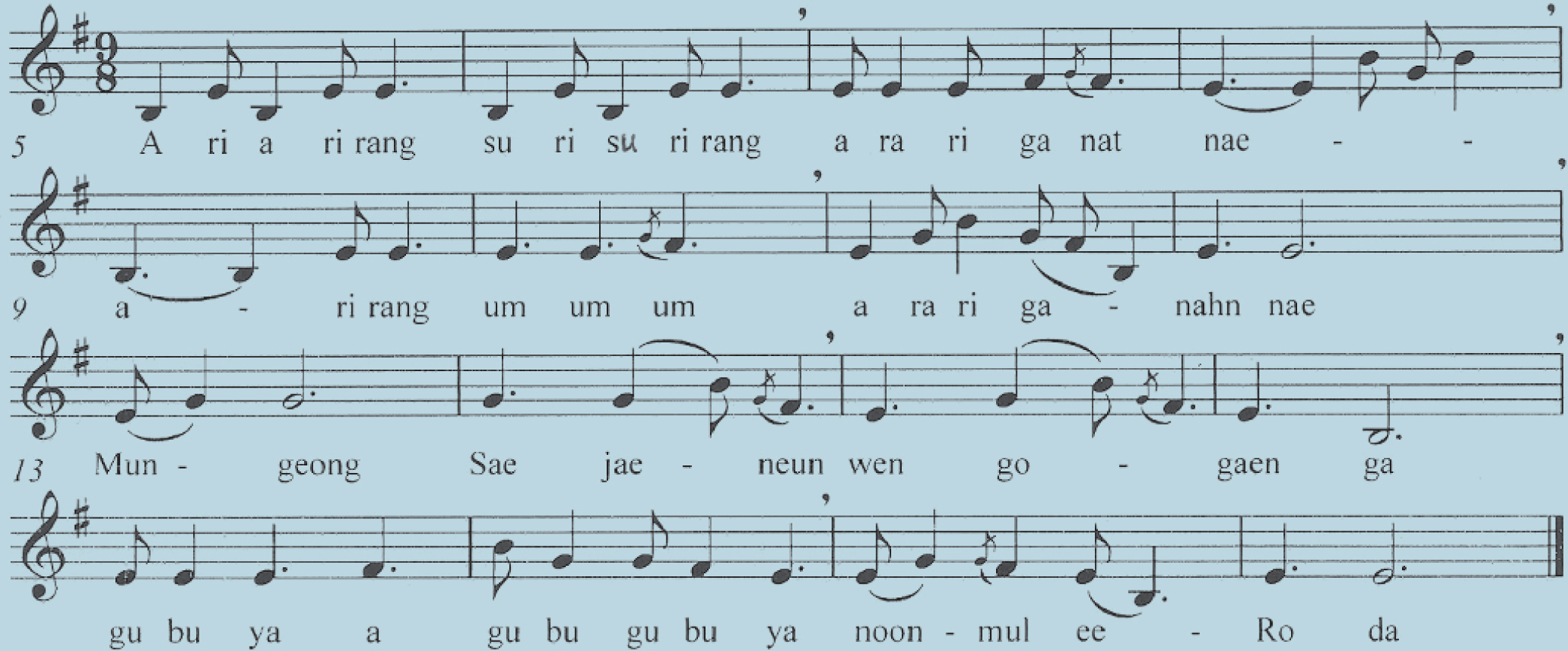
“Jindo Arirang”
“Gyeonggi Arirang”
The most famous melody of this famous Korean folk song is called “Gyeonggi Arirang” or simply “Arirang.” 17 This “Gyeonggi Arirang” is assumed to have been composed in either Seoul, South Korea’s capital city, or in the Gyeonggi area outside of Seoul during the end of the Chosôn Dynasty (1392–1910) or the Japanese Colonial period (1910–45). Because it was composed so late, it seems to incorporate the attributes of the other two representative local Arirang songs. It became famous after being used as the theme of the film Arirang by director Yunku Na in 1926. After that, the song appeared in Korean literature and in popular and traditional music. The unique and distinctive pentatonic melody of “Gyeonggi Arirang” can easily change moods depending on the key in which it is played, the instruments, the accompaniment, the rhythm, or the tempo. It can evoke a nostalgic or sentimental mood, can just as easily express regret or longing, or can be bright and cheerful. The “Gyeonggi Arirang” in Figure 4 is the “Arirang” best known to Koreans as well as internationally. 18

“Gyeonggi Arirang”
Social Contexts and Activities
There are two main advantages to using “Arirang” in music class. First, “Arirang” has been used in a wide array of social contexts, making for a diverse collection of educational resource materials. It has been arranged and produced in a wide range of musical genres, including gospel, classical, band, popular, jazz, and New Age music. For example, in gospel music, Bert Polman, on the faculty of Calvin College in Michigan, wrote the hymn “Christ, You Are the Fullness” to the music of the “Gyeonggi Arirang” because of its appealing melody. 19 In classical performance, the New York Philharmonic, under the baton of Lorin Maazel, performed the “Gyeonggi Arirang” for an encore on a recent tour to North Korea and South Korea. 20 Shuichi Ihida, music teacher of the Kashiwa Municipal High School Marching Band, one of the most famous high school bands in Japan, won first prize playing “Arirang” in the World Association of Marching Show Bands (WAMSB) World Championship. 21 In the United States, John Barnes Chance and James Curnow each published the concert band piece “Variations on a Korean Folk Song” 22 and “Korean Folk Rhapsody,” 23 respectively, to the melody of the “Gyeonggi Arirang.”
“Arirang” can be heard in even more diverse musical genres. The Korean pop group SG Wannabe used the melody of “Gyeonggi Arirang” in the prelude to a song, lending a modern interpretation to the lyrics; Dohyun Yun adapted the “Gyeonggi Arirang” to a rock song that was used to cheer on the Korean football team during the 2002 FIFA world cup. 24 Also, a composer, Jisoo Lee, recorded his song “Arirang Rhapsody” with the Czech Philharmonic Orchestra in Dvorak Hall of the Rudolfinum in the Czech Republic. 25 In 2009, to commemorate the sixtieth anniversary of missionary Homo Herbert’s death (1949), the music CD “Arirang of Rice Song” was released. Herbert was an American missionary in the Colonial Chosôn period and the first person to write “Arirang” in a Western score, publishing it in his “Korean Vocal Music” in 1896. 26 The 2009 release was a reproduction of Herbert’s first “Arirang” score. In addition, the Korean Traditional Performing Arts Foundation released two CDs, Arirang: The Name of Korean I and II, containing various local Arirang songs in different styles, including bossa nova, jazz, classical, and New Age. These CDs have been played by Sergei Trofano (gypsy violinist, Moldova), Inger Marie (jazz vocalist, Norway), Yuichi (New Age pianist, Japan), Ulf Wakenius (jazz guitarist, Sweden), and European Jazz trio (Netherlands), as well as by Yuhki Kuramoto (jazz pianist, Japan), Lee Ritenour (guitarist, USA), and Ithamara Koorax (jazz vocalist, Brazil). 27 Korean director Hyung Rae Shim played a new arrangement of “Arirang” as background music in his movie D-War. 28 Moreover, Yu-na Kim, a winner at the 2010 Figure Skating Winter Olympics, skated to “Arirang” to showcase a beautiful and memorable dance on ice. 29
In addition to the widespread appearance of “Arirang” in musical contexts, the word Arirang itself has been used to name the Arirang Prize presented by the United Nations Educational Scientific and Cultural Organization (UNESCO) for efforts to protect intangible cultural heritage. 30 Moreover, the “Arirang” was listed as one of the Intangible Cultural Heritages of Humanity in 2012. 31 (A diverse collection of video clips also exists that teachers can use as classroom materials—see the “Links to Resources for Teaching ‘Arirang’ Songs” sidebar.)
The second advantage of using “Arirang” is that it presents so much potential for activities with rhythm and lyrics, rich comparative listening opportunities, and performance possibilities that students can enjoy. Simplifying the rhythm of “Arirang” (as I have done in Figure 5) would enable early elementary-age students to explore the rhythm with their own “body instruments”—their voices (singing), hands (clapping), feet (stomping), knees (slapping), fingers (snapping)—or by using non-pitched percussion instruments. In addition, while students are singing the easier arrangement (in 3/4 time signature), they can clap their hands with a 2/4 time signature, experiencing two different meters in one song. The Korean Semachi Jangdan rhythmic pattern (see Figure 1) provides material for accompaniment for the three Arirang songs. If they can be obtained, one could also use an actual Korean instrument, such as the Janggu, or other percussion instruments that are available or made for the purpose. Once students imitate and absorb the rhythm, they can improvise the patterns from simple to complex and can form ensembles to make music with their bodies and/or other instruments.

Excerpt from “Gyeonggi Arirang” converted to 3/4 time signature
Third, most of the “Arirang” versions have repeated measures with the word Arirang. Therefore, if students are struggling with the lyrics, teachers could suggest that they compose new lyrics in English for part of the song. With “Miryang Arirang,” students could learn the refrain in Korean, and they could write their own lyrics in English for measures 1 through 8, which precede the refrain. For “Jindo Arirang,” students might write new lyrics for measures 9 through 16, which follow the refrain. In fact, the Korean lyrics of the “Arirang” refrain are relatively easy to learn, making it an exciting way to learn some phrases in a new language. Korean students could help teach these Korean lyrics to their classmates, as happened in the middle school vignette quoted at the beginning of this article.
Fourth, there are many possibilities for listening activities, helping students to become aware of various instruments, tempos, styles, and musical genres, especially recordings and websites that are readily available. Students can compare versions, write their own versions, or model the idea of varying treatments of a tune found in their own folk-music culture. Movement is also a way of learning music. Younger children can move freely, and older children can by taught specific folk movements. “Gyeonggi Arirang,” in particular, can be introduced with easy movements that simulate the traditional Korean dance: stretching both arms to one side, keeping one arm extended and bending the other elbow back to curve the bent arm in the direction of the extended arm, and then moving both arms to the other side to form the mirror image of the movement, alternating from side to side with each measure.
Links to Resources for Teaching Arirang Songs
“Arirang” Song Performances on the Web
New York Philharmonic: http://www.youtube.com/watch?v=QrEedoLFyfo&feature=related
“Variation on a Korean Folk Song” by John Barnes Chance: http://www.youtube.com/watch?v=cmpLqoFgTzU
“Korean Folk Rhapsody” by James Curnow: http://www.youtube.com/watch?v=ZuOdfAR4w-s
SG Wannabe: http://www.youtube.com/watch?v=1btvt2X10A4
Dohyun Yun: http://www.youtube.com/watch?v=ItYpy3VWVas
Yu-na’s Kim’s Homage to Korea: http://www.youtube.com/watch?v=kSTOfN67rcQ
Yu-na Kim’s Arirang [Montage]: http://www.youtube.com/watch?v=IveuG4Z72-c
Yu-na Kim’s Arirang Rhapsody: http://www.youtube.com/watch?v=BmxU9S89z0c&feature=related
Arirang Performance with Korean Traditional Instruments: http://www.youtube.com/watch?v=bKQNubisYJk
Korean Traditional Costumes and Movements (at 5:15): http://www.youtube.com/watch?v=hQTcH1t74QA
“Arirang Rhapsody” by Jisoo Lee with the Czech Philharmonic Orchestra http://blog.naver.com/shahoku?Redirect=Log&logNo=100118793566
Recordings of Arirang Song Performances
Arirang: The name of Korean, Vol. I: http://www.kyobobook.co.kr/product/detailViewMuc.laf?ejkGb=MUC&mallGb=MUC&barcode=8804775034848&orderClick=LAK
Arirang: The Name of Korean, Vol. II: http://www.kyobobook.co.kr/product/detailViewMuc.laf?ejkGb=MUC&mallGb=MUC&barcode=8804775037580&orderClick=LAK
Arirang of Rice Song: http://www.kyobobook.co.kr/product/detailViewMuc.laf?ejkGb=MUC&mallGb=MUC&barcode=8804524020221&orderClick=LAK
Last, the “Arirang” offers achievable performance opportunities with instruments or voice. On the piano or chromatic barred instrument, the “Gyeonggi Arirang” is especially appropriate for introducing black keys on the keyboard, since the piece can be played on the five black keys in order, starting on C#. For higher-level students, the song is ideal for the recorder. Vocal performance possibilities abound, with anywhere from two to dozens of the possible 700 verses, and eight measures of chorus, in the various versions. Music teachers can ask students to sing together during the chorus and to sing individually for the other measures, using their improvisations of lyrics. In addition, the three “Arirang” versions consist only of the five notes of the pentatonic scale, well suited to sing in a round, so the second voice comes in after the first two measures. Another suggestion is for teachers to prompt one student to play the melody “Arirang” with the xylophone or recorders as an ostinato and the others to play whatever rhythms they want to play or sing. Ultimately, they can improvise and play their instruments and sing together as one big ensemble.
Introducing “Arirang”
Introducing students to the “Arirang” via visual materials is likely to attract more attention than, for example, teaching the history of South Korea. One appropriate visual would be the video of Yu-na Kim’s skating performance with the “Arirang” in the background (see the link listed in note 30 of this article). Teachers can pique student interest with beautiful music in contexts to which students can easily relate and thus draw out any questions about the country and culture. Then, teachers can share information about South Korea, including its location and some elements of its culture, such as a taste of its music, art, and poetry. Music teachers can also introduce Korean dance, showing Korean traditional dance costumes through the computer or photos. These things will help students better understand Korean culture, as will showing video clips with Korean children of the same age performing the “Arirang.”
Teachers should determine whether new arrangements of the “Arirang” are more suitable to their students’ abilities and interests than are traditional performances. If the song seems too long or a little bit difficult for a particular class, it may be better to introduce students to just one part of the “Arirang” song; that way, music teachers can avoid feeling too rushed, and students can have sufficient time to understand the music and context. Once children are comfortable with one part of a song or lesson, they may be motivated to learn the rest of the song on their own, or they may ask the teacher to keep working on the song in class. All these things are designed to create a positive world music class environment. As you can see in Figure 5 earlier, rearranging “Arirang” can facilitate the use of Arirang songs in the classroom.
Conclusion
The three Arirang songs are evocative pieces for connecting students in the music classroom to Korean folk music and culture. By choosing famous pieces such as the “Arirang,” music teachers can provide educational experiences that may be replicated over a lifetime: Since the “Arirang” is found in so many different contexts worldwide, even children who don’t have the opportunity to travel to Korea will likely have occasion to hear it. The three Arirang can serve as a model for other music teaching choices, helping students to appreciate music itself and more easily connect to Korean and other cultures.
“There are no shortcuts. To be successful, “start a little earlier; work a little harder; stay a little later. Put the odds in your favor.”