Abstract

Music Career Advising: A Guide for Students, Parents, and Teachers
by Eric Branscome. Lanham, MD: NAfME/Rowman & Littlefield, 2013; https://rowman.com/Action/SSearch/RLE/NAfME
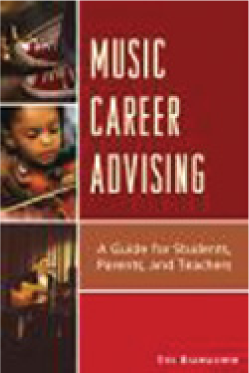
Music Career Advising: A Guide for Students, Parents, and Teachers is a practical, relevant, and easy-to-read 162-page handbook on career suitability in the music profession. An informative resource for high school students considering a career in music, it can also be used by parents who want to educate themselves on the career options available to a student of music.
Written in a very approachable tone, the opening chapters address practical questions, encourage personal reflection, and present realistic personal concerns that serve to guide the candidate interested in an undergraduate degree in music. Each chapter focuses on one of the twelve accredited Bachelor of Music degrees, providing a general overview of each. These include performance, music theory, composition, music history and literature, sacred music, jazz studies, pedagogy, musical theater, music business/industry, electrical engineering/recording technology, music therapy, and music education. Three additional areas of undergraduate music study are also included: librarian, conducting, and instrument repair.
At first glance, the book seems surprisingly subjective in its approach. The author includes the heading “What Does It Take to Be a Good Fit” within each music career chapter. He describes the character traits, personal interests, and work values required of someone in each profession. However, the details included are the results of the author’s own extensive study in the area of career advising, the results of which have been quantified, interpreted, and presented in a very practical and matter-of-fact way in order to guide the reader toward the most suitable career path in music. Each chapter familiarizes the reader with the jargon of each music specialization as well as the most obvious careers for which the degree prepares the student. The author poses a clear and convincing argument on the advantages of pursuing a degree in music and continues to provide supporting material throughout.
Although the book makes brief reference to graduate degrees, its focus is primarily on undergraduate degrees in music and individual career suitability. The book does not discuss summer programs of music study, nor does it include information on academic or entrance requirements for the various degree programs. The author includes a short annotated bibliography of books and websites that serve as a resource for more in-depth inquiry into careers in music.
Assistant professor of music education,
Department of Curriculum and Instruction,
Eastern Kentucky University,
Richmond, Kentucky;
Practice Personalities: What’s Your Type?
by Thornton Cline. Anaheim, CA: Centerstream, 2012; http://www.centerstream-usa.com
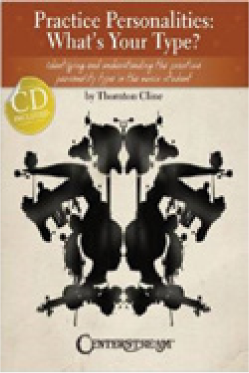
Thornton Cline explores practice personalities and strategies identified over a twenty-five-year career as a violin, piano, and guitar pedagogue in university and private studio settings. Cline states that his own education lacked attention to these considerations. Practice Personalities: What’s Your Type? intends to assist students, parents, and educators in the discovery of practice personalities and application of effective, tailor-made strategies to each.
Cline divides his textbook into twenty-four chapters accompanied by a compact disc with sample piano, violin, and guitar lessons and demonstrations. Chapters recount the challenges and benefits of practicing, the nine practice personalities, and proposed strategies. Short interviews with band, brass, woodwind, and percussion specialists are interspersed. The last ten chapters are, in fact, appendixes with photographs, charts, a biography, reprinted music excerpts, and virtually no prose.
How Do Books Get Reviewed in “For Your Library”?
Do you have a recently published book on music education or music history or a related topic that would be of interest to music teachers? Send a copy for consideration for review to Caroline Arlington, NAfME, 1806 Robert Fulton Drive, Reston, VA 20191. (Review copies must be submitted to NAfME without charge. Copies of books chosen for review are given to reviewers and cannot be returned.) Be sure to include the publisher’s name, city, and state, as well as the web address.
For information on how NAfME members can review books for Music Educators Journal, go to nafme.org. Find the “Book Review Guidelines” under Music Educators Journal.
Cline’s chapters on the challenges of motivating practice and the discussion of the benefits of correct practice may cause educators to nod their head in agreement. He writes in a colloquial tone appropriate for its audience and states well-founded reasons for writing the text. The author identifies eight practice personalities ranging from the “perfectionist” to the “dramatic” and the ninth personality, “build your own,” which combines any of the eight. Studio teachers should find it easy to categorize former and current students accordingly.
The descriptions of each practice personality share observed traits with their associated joys and frustrations. One hopes for detailed advice or amusing anecdotes. However, Chapter 14 briefly provides suggestions of “meaningful rewards” and, contrary to the purpose of the text, one-size-fits-all methodology. In a single page titled “Chapter 16,” a list of meaningful rewards ranges from ice cream to expensive vacations. His methodology refers frequently to a “rule of seven” where “the goal of the student is to play the passage mistake-free for at least seven times in a row consecutively” (p. 52).
The public-domain excerpts and the accompanying disc of audio lessons disappoint, as it is unclear how the excerpts “are useful and can be adapted to the practice personalities identified in this book” (back cover). The proposed strategies prescribe common techniques. For example, the audio lessons on the violin excerpts recommend slow practice with a chromatic tuner for intonation and pitch accuracy. Unfortunately, the recordings fail to demonstrate mastery of fundamental concepts of technique and musicianship. Omitted and misinterpreted ornaments with inaccurate intonation and pitches set a poor example for the aspiring musician and cause one to question the effectiveness of these techniques. Finally, a number of the discussed pedagogical concepts are best seen rather than heard, such as shifts on the violin and correct finger spacing. Perhaps a DVD would better accompany this offering.
While Cline includes some good, general suggestions, this textbook lacks the insightful, creative strategies one expects from reading the back cover, foreword, and first few chapters. Widely read web blogs, such as http://www.bulletproofmusician.com, may provide better insight into practice techniques.
Assistant professor of clarinet,
Department of Music,
University of Delaware,
Newark, Delaware;
New from NAfME . . .
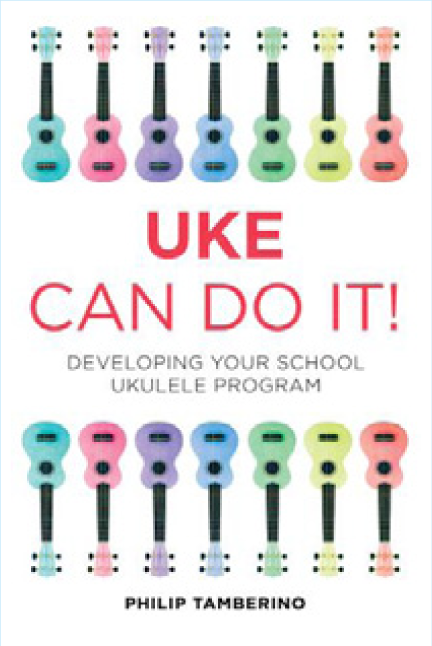
Affordable, versatile, portable, and popular once again, the ukulele is an ideal instrument for lifelong music-making that can also be an engaging component of school music programs. At the elementary or secondary level, students can use the ukulele to explore everything from music theory, improvisation, composition, and ear training to repertoire that includes contemporary popular music. Less expensive than other instruments that can do as much, the ukulele is perfect for breathing fresh air into any music program.
Uke Can Do It! provides everything music educators need to develop a ukulele program in their school, including the following:
A guide for first-time ukulele buyers
Beginner instruction in how to play the ukulele
Playlists of ukulele music by top performers
Strategies for proposing and outfitting a ukulele program
Classroom management tips
Support for use with special learners
Learning sequences in ukulele technique
Ideas for classroom use and performance
Scales and chord charts with fingering.
NAfME members get a 25 percent discount on all books copublished by NAfME and Rowman & Littlefield. Visit them online at https://rowman.com/Action/SSearch/RLE/NAfME, or call Customer Service toll-free at 800-462-6420.