



Abstract
Hundreds of educators contributed to writing and reviewing the new National Core Music Standards over two years of development. Thousands more will find their professional lives shaped by these standards over decades to come. Three individuals involved in standards development explain.
Keywords
The 2014 Standards for Music Education are the product of a team effort, but the real adventure lies in their implementation in music classrooms.
The large group of expert educators who contributed to writing our new national music standards was charged with authentically reflecting the discipline of music, while providing a learning framework designed to help music educators thrive in today’s educational environment. The current environment differs from 1994 in a number of respects, ranging from the greater availability of technology to increased emphasis on assessment and college and career readiness. The National Core Music Standards were consciously crafted to reflect such contemporary trends.
The key focus for the National Coalition for Core Arts Standards (NCCAS) and for our team of music writers has been to provide standards and supplemental materials that will be of maximum help to arts/music educators, both in shaping their instructional programs and in advocating for those programs. Music educators who have aligned their curricula and instruction with the 1994 standards and empowered their students to function with some degree of musical independence should find it relatively easy to adjust to the new standards. On the other hand, music teachers who have focused more narrowly on technical skills and notation will find encouragement in the new standards to include more creative work and to engage their students in higher-level thinking leading to authentic musical decisions. The differences and similarities between the 1994 and 2014 standards are summarized in Figure 1.
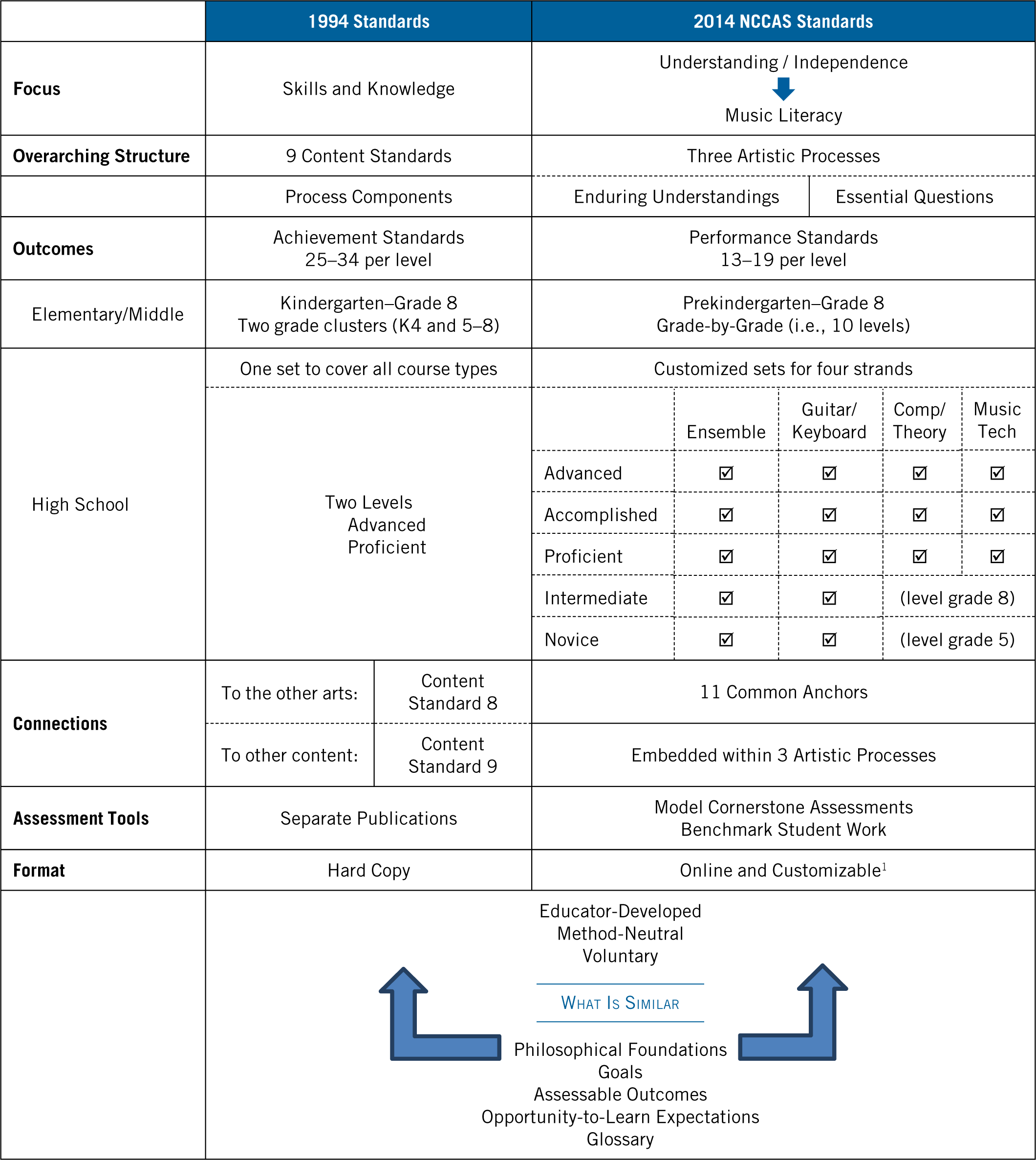
Music National Standards Comparison: 1994 versus 2014
Regardless, the new format should make it easier to develop instruction, because the structure provides an authentic sequence for outcomes—such as singing and playing, analyzing and evaluating—that were emphasized in the 1994 standards. By embracing and applying the new standards, music teachers will also cultivate the cross-cutting college- and career-ready and 21st-century skills that are increasingly expected of students in all subject areas.
The View from the Ground Floor
The new Core Music Standards highlight the process instead of the final product. The following example illustrates why a focus on the process may facilitate accurate evaluation.
Two eighth-grade orchestras (or bands or choruses) are performing at a festival. Both groups A and B get superior ratings for the performance portion, playing (or singing) with good tone and near-perfect intonation and blend while following the conductor. An administrator attending the festival might conclude that the students in each group received a similar education in music. However, that administrator might be unaware that group A also excelled in sight-reading, while group B opted out. Also, the administrator may not know that nearly all the students in group A plan to continue studying music in high school, while most of the students in group B do not. The reason for these differences is the process by which the two groups’ performances came to be. Group B has been working on festival music since the beginning of the school year. The students were not involved in the selection of the music, cannot rehearse independently, and are missing reading fundamentals. Group A, however, played completely different music in the fall and only recently began preparing the festival music. The students were consulted about the repertoire and were actively engaged in troubleshooting during rehearsal. This is possible because their note-reading ability is strong and because they have learned to follow expressive cues from the conductor.
Is Music Creative?
Most music educators would consider music classes inherently creative. Yet, using a standard measure of creativity, group B falls short. In her book Creativity in Context (Westview Press, 1996), Teresa M. Amabile states that a product is creative if it is novel and appropriate and the path to creation is heuristic. In other words, the path to creation is not linear and involves lots of twists and turns, as opposed to following predetermined sequential steps. Group B falls short because the instruction was entirely teacher centered, following predetermined steps in which students slowly learned the music to the point where it was nearly memorized. Because the students never made any choices about repertoire, expressive elements, troubleshooting, or rehearsal schedule, it is hard to argue that those students were engaged in a creative endeavor.
The instruction in group A was entirely different. It was often student-centered and challenging. The students were involved in selecting appropriate repertoire for festival through discussions about programming and selection criteria. During rehearsal, the teacher often engaged students by asking questions, such as “Why did I stop?” or “What can we do to fix this passage?” Students were involved in decisions about expressive elements; at times, students were divided into sectionals that were student led. Having to troubleshoot and make decisions throughout the process engaged higher-order thinking. The students in group A were involved in creative music-making even if no composition or improvisation was involved. They were creative within the constraints of the task, preparing repertoire for a traditional festival performance.
Adapting Amabile’s definition, group A’s performance was novel because it included some unusual expressive choices based on students’ suggestions. It was appropriate because it worked in a festival setting and resulted in a superior rating. Finally, the path to creation of the performance was heuristic because it included lots of student input, causing the teacher to constantly change direction during rehearsals.
The new Core Music Standards further challenge students and teachers to engage in the creation of new musical products through improvisation and composition. For example, programming a piece for festival that allows for improvised solos in performance would engage students in true creation. By emphasizing creating, performing, and responding, the new Core Arts Standards focus on the processes engaged in during daily classroom activities. This will encourage teachers and administrators to evaluate the process, not just the final performance.
The Process of Creation
The standards were developed through a collaborative process that, quite appropriately, resembled in some ways the process used to prepare group A’s festival performance. Just like the students in group A, my subcommittee was given a set framework in which to develop the standards. The path to creation took many twists and turns. Our main job was to formulate descriptions for three (later five) different levels that were true to this framework: proficient, accomplished, and advanced.
The two ensemble committees focused on the traditional band, orchestra, chorus, and jazz ensembles (Traditional Ensembles) and, with Emerging Ensembles, reflected the continuous creativity that occurs in the field itself. During the first meeting, we spent two hours discussing what constitutes an emerging ensemble (iPad bands, mariachi, bluegrass, rock, classical chamber groups, jazz combos, etc.). We agreed that an emerging ensemble was student led and could include instruments on which some students might be beginners. In subsequent meetings, we realized that we could not divide the level descriptions according to technical criteria, because an advanced musician may be learning a new instrument in an emerging ensemble. Consider, for example, a student who has played trombone since sixth grade but decides that marching band in sophomore year requires too much time and therefore elects to learn guitar in a beginning rock band. Though this student is a beginner on guitar, he or she may know how to select repertoire that fits a rock band. In other words, the student is a beginner on guitar, yet advanced when it comes to selecting repertoire. The Core Music Standards allow teachers to differentiate these abilities.
Another central issue that was discussed often in our meetings was the appropriate degree of prescription. On one hand, it was argued the standards should be open-ended, leaving interpretation and the creation of related tasks up to the teacher. On the other hand, nebulous standards may simply create confusion. Indeed, many reviewers commented that the initial draft of the standards was too open-ended.
I was particularly interested in the Creating process, which relates to my research on improvisation. Artist-level improvisers tend to plan ahead by shaping the output according to large musical structures. 1 For example, while playing one chorus, one of my participants described planning to play more notes to increase intensity in the following chorus. Thus, I was thrilled to see that planning was a process component of Creating in our given framework. Initially, I wrote for the planning component of Creating at the intermediate level: “Use selected musical ideas to support overall design.” The final more specific standard has two parts and reads as follows:
Select and develop draft melodies and rhythmic passages that demonstrate understanding of characteristic(s) of music or text(s) studied in rehearsal.
Preserve draft compositions and improvisations through standard notation and audio recording.
Notice how the final standard gives the teacher a specific task (to preserve the draft in notation or on a recording) and relates the task to music studied in rehearsal—and applies to both composition and improvisation. Therefore, the language of the final standard can be used to create specific assessments.
It Takes a Village
The preceding example illustrates another important point. No one person wrote the standards. My contribution was thrown out, reused, revised, and filtered, and that is how it should be. In addition, my initial draft came out of many previous drafts and related discussions and was shaped to fit the given framework. The final version is informed by research and grounded in the needs of the classroom. In addition to the issue of specificity, other issues discussed included which elements should change across the levels from novice through advanced, the type of language used in the Standards, the number of words describing each level, and the number of parts included in each level. In later meetings, the Emerging Ensemble committee joined with the Traditional Ensemble committee to discuss whether different standards should be published for each type of ensemble. In the end, only one set of high school ensemble standards was published, which may fuel some controversy down the road.
In many ways, my role in this process was similar to that of students in group A in the initial example. The task and the parameters were set, and I was guided every step of the way, yet my input was taken into consideration. I hope that the new Core Music Standards will foster an appreciation among teachers and administrators for classrooms in which students are constantly engaged in creative processes. This should be true even if that setting sometimes looks “messier” than a teacher-centered environment. The Core Arts Standards build on the 1994 standards, are based on a solid theoretical framework, and were created along a path of continuing discovery. The process of creation was at times confusing, exhilarating, frustrating, and enlightening. Since the Core Arts Standards are novel and appropriate, and their path of creation was heuristic, I hope history will ultimately judge them as highly creative.
Martin Norgaard is one of seven members of the Emerging Ensembles subcommittee, one of the subcommittees that wrote the new standards. (Other subcommittees were Traditional Ensembles, Theory/Composition, Harmonizing Instruments, Technology, PreK–2 General Music, 3–5 General Music, and 6–8 General Music). Meeting online over more than a year, the subcommittees drew on the expertise of various research advisers to connect research with classroom best practice.
Martin Norgaard, “Descriptions of Improvisational Thinking by Artist-Level Jazz Musicians,” Journal of Research in Music Education 59, no. 2 (June 2011): 109–27; and Martin Norgaard, “How Jazz Musicians Improvise: The Central Role of Auditory and Motor Patterns,” Music Perception 31, no. 3 (February 2014): 271–87.
Navigating the New Music Standards
As outlined in the “Philosophical Foundations and Lifelong Goals” presented in the National Core Arts Standards: A Conceptual Framework for Arts Learning (http://nccas.wikispaces.com/Conceptual+Framework), the new NCCAS arts standards are designed to help students develop artistic literacy in the broad sense. In music, this translates as music literacy. Such literacy includes but extends beyond the ability to read and write notation.
In today’s multimedia society, text is any medium used to convey meaning, and literacy is two-way competence in a medium—that is, the ability both to convey one’s own ideas and to understand others’ ideas when conveyed through that medium. Music literacy is, therefore, the ability to convey one’s own musical ideas and understand how others convey their ideas through music.
Functionally, another way to describe music literacy is the ability to independently carry out the artistic processes of creating new music, performing existing music with understanding and expression, and responding to others’ music with understanding. 1 (As described further later, the music standards also address connecting to and through music.) Consistent with best practices identified in state and international arts frameworks by the College Board, 2 which has partnered with NCCAS throughout the standards development process, the new music performance standards are organized by the steps or process components of these three processes (see Figure 2).
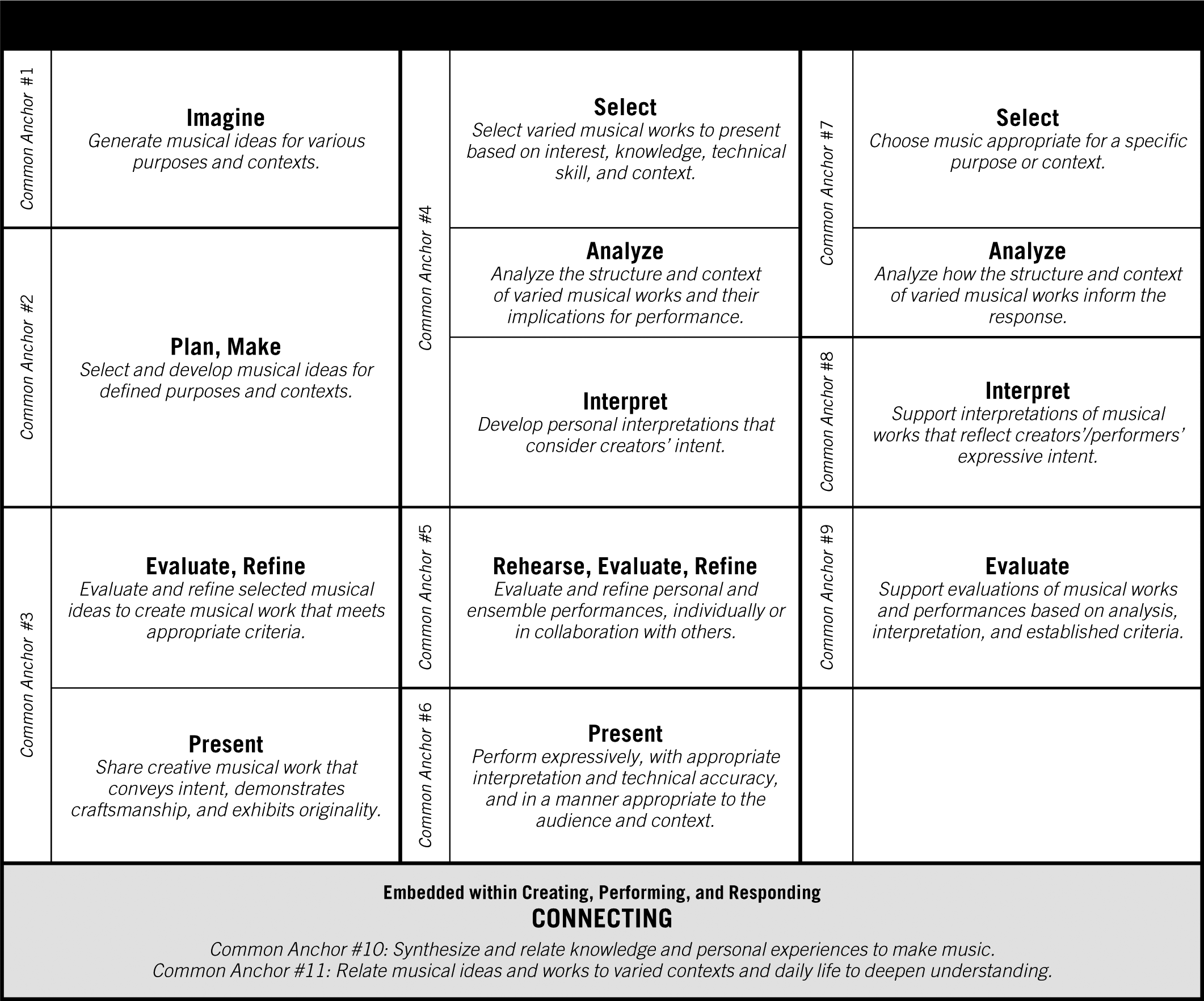
Music Standards Structure: Three Artistic Processes with Thirteen Process Components and Connecting
Why the New Standards Are Integral to Music Learning
Music educators have always developed and applied standards. They apply standards to themselves as musicians and as teachers and convey standards to their students as learners. The context for the Core Arts Standards, however, provides important background for understanding and supporting this step forward for our field.
The Goals 2000: Educate America Act called for the codification of standards for education. The resulting music standards, published in 1994, provided our profession for the first time with a consensus description of what students should “know and be able to do” as a result of their music studies in school.
As is true with the new standards, the standards accepted by then secretary of education Richard Riley in 1994 were explicitly voluntary. In this case, voluntary meant that the standards had no federal mandate behind them. A state or local school district that did not formally adopt the standards or did not bring students to the levels of attainment spelled out in the standards faced no sanctions. On the other hand, when a state adopted the standards, they became policy, and teachers in that state were encouraged to teach in ways that would enable their students to reach the standards.
In most cases, no one inspected the extent to which teachers complied with the standards in their classrooms, nor were there any standardized tests to determine whether students were achieving the level of knowledge and skills called for in the standards. Nevertheless, the 1994 standards gradually effected nationwide change in an educational system involving some 140,000 music educators serving more than 50 million students. Indeed, by 2007, a survey conducted for the National Association for Music Education (NAfME) [then known as Music Educators National Conference (MENC)] found that “a vast majority of teachers report being at least generally familiar with the national standards”; that “state, district and school administrators’ standards for music education reflect the national standards for music education”; and that “despite the many potential obstacles to incorporating the national standards for music education, on average, teacher felt that doing so is quite important.” 1
The Present
The new standards build on the incremental yet widespread success of using voluntary standards to improve instruction. But they do so in an educational climate that, once again, has changed.
One major change is the extent to which national standards are perceived as voluntary. The No Child Left Behind Act of 2001 and a variety of administration initiatives since that time have promoted common curricula across states in English/language arts and math. Using legislative and administrative tools, policymakers have spent the past decade building a foundation of Common Core State Standards (CCSS) topped by layers of new student assessments (PARCC and Smarter Balanced) and new systems for evaluating teachers and schools.
The media have reported increasing reservations about these new systems based on the CCSS. Reflecting the rough-and-tumble of American politics, these concerns sometimes reflect real issues and are sometimes intended merely to damage a given person, political party, or approach.
Fortunately, the coalition overseeing our new Core Arts Standards was able to identify and avoid many pitfalls of the CCSS standards. Examples include the following:
Arts standards were developed through a transparent process that engaged practicing teachers and researchers at every level and in every subspecialty of the field. The educators on NAfME’s music standards writing team and subcommittees possessed more than 1,800 years of experience teaching preK–12 music: 540 years in general music, 1,000 years in ensembles, 130 years in teaching with and through technology, and 200 years of teaching theory/composition. In addition, the standards writing teams reached out to and involved a group of expert research advisers for input based on current research. Multiple rounds of review over a two-year period led to more than 48,000 downloads of standards drafts, which yielded more than 1 million data points and comments that were pondered as the standards were refined. Finally, for the music standards, NAfME facilitated five online focus groups whose feedback was combined with recommendations from several state-level focus groups. Remarkably, this was all accomplished with no funding from the federal government aside from a small grant from the National Endowment for the Arts to solicit input and advice from professional artists.
The arts standards are assessable but not weighed down with elaborate systems of high-stakes, standardized assessment and evaluation. Instead, they provide a draft set of “model cornerstone assessments” to guide teachers as they create classroom assessment.
The new standards are designed to help arts educators navigate emerging systems of assessment and evaluation, which can pressure teachers and schools in ways contrary to students’ best interests. Toward this end, NAfME is building the Model Cornerstone Assessments into the association’s suggested processes for teacher evaluation.
Moving to Adoption and Implementation
As with the 1994 standards, adoption of the new Core Music Standards is voluntary. Individual teachers who see their value will incorporate them into curriculum and instruction, and over time, they will be adopted or adapted by states and local school districts. The National Coalition for Core Arts Standards (NCCAS), which oversaw the writing the new standards, designed them to encourage such adoption.
The NCCAS coalition includes professional associations representing each of the art forms for which standards are being written as well as other important contributors. The College Board contributed a national perspective and important baseline research to the effort, including documents illustrating how the Core Arts Standards align with key aspects of the CCSS. The John F. Kennedy Center for the Performing Arts has helped make certain that the standards addressed the needs of students with disabilities. Americans for the Arts is contributing support for strategic outreach. And one of the coalition’s key founding organizations, the State Education Agency Directors of Arts Education (SEADAE), has ensured that the structure and the content of the standards will facilitate adoption at the state level—a process that has already begun.
Formal adoption by a state is just the first step in a gradual process of implementation. School systems will have to figure out how to balance resources. NAfME is launching a new “Solutions Music Group” to provide help in this area. (Information will be available on the NAfME website and shared with school systems.) Teachers will have to figure out how to refine their teaching. (NAfME will soon invite all members to help identify skills and knowledge essential to support the instructional sequence presented in the standards.) NAfME and other advocates will have to get involved in making certain that updated Opportunity to Learn Standards are met, giving teachers and students the resources they need to bring the standards to life. Each of these tasks will take time.
Teachers ultimately hold the keys to implementation. As they study and implement the standards, music educators will develop strategies to ensure that every student is empowered to engage in Creating, Performing, and Responding to music (as well as in the embedded area of Connecting) and that every course in school fosters at least some learning in each of these processes.
“National Standards in the American Music Classroom” (report to MENC: The National Association for Music Education by Eureka Facts, LLC, June 2007).
The new standards encourage music educators to design music curriculum, instruction, and assessment that help students think like musicians, in much the same way that contemporary science educators engage students in the scientific process used by professionals in the field. Indeed, newly released standards in all subject areas—including Next Generation Science Standards—all emphasize empowering students to carry out independent processes authentic to the discipline. The goal of focusing on such processes is not necessarily to develop future professionals in a field but, rather, to provide authentic pathways to understanding that field.
To achieve independence, contemporary approaches to curriculum development share an emphasis on developing understanding. Developing such a curriculum requires writers to articulate a finite set of understandings that are central to each field, which are commonly referred to as Enduring Understandings or Big Ideas. Identifying Enduring Understandings at the district or school level is a challenging process that can consume a large quantity of precious curriculum-writing time.
To facilitate curriculum development, each process component in the new standards is paired with at least one Enduring Understanding and a corresponding Essential Question. Essential Questions (sometimes referred to as Focus Questions) are provided for teachers to use as they encourage their students to uncover these Understandings. The Essential Questions in music are intentionally worded for use with high school students— i.e., representing the culminating level—so teachers of younger students will need to develop wording appropriate for their particular population.
Outcomes
Both the 1994 and new sets of standards provide assessable outcomes, written with the implied stem “Students will . . .” In 1994, such outcomes were labeled “achievement standards” and spanned kindergarten through grade 12. The standards were presented in four grade-level clusters—K–4, 5–8, high school proficient, and high school advanced—each of which included between twenty-five and thirty-four achievement standards.
Consistent with emerging standards in other subject areas, outcomes in the new NCCAS arts standards are labeled Performance Standards. Responding to requests from state education agencies, and again consistent with emerging sets of standards in other subject areas, Performance Standards are provided for more grades and levels than in 1994, thereby leaving fewer gaps to fill when writing local curriculum. However, to make life easier for busy teachers, the new standards specify fewer outcomes per grade or level—in music, between thirteen and nineteen performance standards.
Prekindergarten to Grade 8
Standards are provided for each grade.
NAfME Standards Writing Team
The writers, subcommittee members, and research advisers invested thousands of hours to develop and refine hundreds of draft documents. Members of the main standards task force were the following:
High School
To support the increasing number of music teachers who are reaching out to students by offering a more diverse array of courses, the new music standards articulate a distinct set of performance standards for each of the four most common contemporary music elective strands: ensemble, harmonizing instruments (guitar, keyboard, etc.), composition/theory, and music technology.
NCCAS high school standards for all art forms are presented in at least three levels:
Because many students become involved in ensemble and harmonizing-instrument classes before they enter high school, performance standards in these strands also provide two preparatory levels:
Connections
Well-written music standards that urge students toward understanding automatically address key outcomes, such as college and career readiness and 21st-century skills. Similarly, competently carrying out the processes of creating, performing, and responding requires students to make connections with culture and context. Because connections are an essential part of each artistic process, connecting outcomes in music cross-reference users to Creating, Performing, and Responding performance standards. Keeping track of standards in only three processes simplifies curriculum writing and minimizes the burden on music teachers.
Parallels among the arts disciplines are highlighted in the eleven Common Anchors that are shared by all five sets of discipline-specific standards. As illustrated in Table 2, each anchor spans one or more process components. Music educators who are interested in delving more deeply into how the new standards in music relate to standards in the other four arts disciplines are also encouraged to download and read the “Conceptual Framework for Arts Learning” referenced earlier.
Model Cornerstone Assessments
Arts educators, like their colleagues in other subject areas, are under significant pressure to measure and assess their students’ achievement. 3 To assist teachers in meeting these growing expectations, NCCAS undertook the development of a set of assessment tools labeled Model Cornerstone Assessments (MCAs). Music researchers collaborated with writing committees to develop the MCA drafts released with the new music standards.
These early MCAs are truly works in progress, intended to provide protocols to help music educators develop measures of student achievement in the performing process. They represent a synthesis of best practices, based on months of reviewing examples from across the United States and internationally. However, the MCAs released in June 2014 should be considered drafts until they are tested by music teachers in classrooms over the next two years of pilot-testing and refinement.
Even when they are in final form, MCAs will not be presented as the way to assess learning, but rather as high-quality examples that music teachers can choose to adopt, adapt, or reject entirely, as they deem appropriate for their particular situations.
The MCA piloting process offers an ideal opportunity for interested teachers to join the hundreds of other music educators who have already contributed to standards development through writing and reviews. We encourage you to contribute to completing this endeavor by signing up at www.nafme.org/standards to pilot-test the MCAs.
Music teachers are so accustomed to investing hours beyond the call of duty in their students and programs that they will fully appreciate the dedication and passion that inspired writers to invest many thousands of hours in developing the five sets of music standards, an expanded glossary, draft assessments, and other documents generated by this epic endeavor. The work continues and will require the efforts of everyone in the profession to pilot-test the assessments, advocate for resources, and—most of all—to contribute creative strategies that empower students in the classroom and rehearsal room. Together, we can use the new standards to orchestrate success for all our students.
Footnotes
Notes
Supplementary Material
Please find the following supplemental material available below.
For Open Access articles published under a Creative Commons License, all supplemental material carries the same license as the article it is associated with.
For non-Open Access articles published, all supplemental material carries a non-exclusive license, and permission requests for re-use of supplemental material or any part of supplemental material shall be sent directly to the copyright owner as specified in the copyright notice associated with the article.
