



Abstract
Assessing student performance is a central challenge for music educators. In alignment with previous research, this article asserts that rubrics provide a viable and useful structure for assessing music performance. To expand the potential of rubrics in music education, challenges to effective rubric construction are identified and addressed through the construction of three different types of performance rubrics: (1) a discrete-component rubric, (2) an integrated-component rubric, and (3) a self-reflection rubric. Through analysis of these rubrics, we identify ways to construct assessment criteria that are sufficiently descriptive to accurately measure achievement and provide helpful feedback to learners. We demonstrate how criteria can be constructed that both encourage achievement of curriculum expectations and technical proficiency and leave room for students’ expressive intentions. We offer ideas for integrating these rubrics into the music classroom.
Effectively constructed rubrics can enhance the learning experience in the music classroom while helping educators and students know where they stand.
A central challenge for music educators is the assessment of student performance. 1 Several articles in the March 2012 Music Educators Journal focused on rubrics as a powerful and useful approach to address this challenge. 2 Rubrics are valuable for this purpose because they have the capacity to address the complexities of music performance assessment, for example, the challenge to assess both technical performance aspects (i.e., skills, technique, and proficiency) and expressive (i.e., aesthetic, creative, and artistic) performance qualities, which are more subjective.
The pursuit and the study of music are full of opposing binaries or dilemmas that teachers must negotiate and reconcile as they facilitate music learning. 3 One of the most pervasive and evident examples is the binary of musical expressivity versus technical proficiency. The struggle to simultaneously respect and reconcile these two contrasting yet equally essential aspects of musical performance poses an inherent challenge for music educators in designing performance assessment. 4 Sometimes these aspects are considered separately, sometimes they are conflated, and sometimes one aspect is prioritized over another. Often, it is the expressive aspects of performance that receive short shrift because they are subjective and harder to measure. Yet, as renowned music education philosopher Charles Leonhard maintained, “without its expressive function and aesthetic quality music has nothing unique to offer to the education of children and young people.” If technical aspects become the sole focus of music education, then “music loses its heart.” 5
Several benefits of rubrics have been identified in the literature. Research has emphasized their value in increasing score reliability by providing consistent grading criteria that are standards based. 6 This consistency also enhances the validity of evaluative judgments made from assessments by teachers, students, and parents. 7 As researchers Robin Tierney and Marielle Simon found, rubrics are also a particularly effective assessment structure for grading student performance across a variety of performance components and in relation to multiple quality indicators. 8 Rubrics are assessment structures that allow for the qualitative measurement of multiple performance components simultaneously. Moreover, when used at the onset and throughout learning periods, rubrics can serve a formative function. 9 In this way, rubrics delineate achievement criteria for students and provide a structure for self-, peer-, and instructor-based feedback (i.e., assessment for learning).
For rubrics to fully achieve their benefits in the context of performance assessment, careful consideration must be given to rubric design, and specifically, the quality and focus of rubric criteria. However, within the literature on rubrics in music education, little attention has been given to diverse approaches to constructing rubrics. Based on rubric examples from previous publications, four challenges to rubric construction have been observed. These challenges limit the ability of rubrics to accurately measure student performance, increase score reliability, and enhance utility for teaching and learning.
Challenges
First, it is difficult to articulate criteria that accurately describe the nuances of student performance. Often, rubrics use language that is too subjective and ambiguous to enable students and teachers to consistently identify significant features of performance at various levels. Typically, rubrics demark performance levels by using subjective adjectives to describe performance elements. 10 For example, in describing a student’s breath support, rubric criteria may be articulated as follows: level 1, minimal breath support; level 2, some breath support; level 3, adequate breath support; and level 4, full breath support. Students and teachers are likely to interpret these adjectives differently. As a result, students and teachers will inconsistently assess performance, which limits the value of rubrics to support shared understanding of expectations, performance standards, and learning goals. In addition, these criteria provide students with little guidance on how to improve their performance through formative assessment. 11
Second, most rubrics measure the quality of discrete components of performance but do not consider the integration of various musical components and the relationship among them. 12 For example, typical performance rubrics have separate criteria for tone, breath, and dynamics, each as a separate component. Few rubrics integrate these components to consider how tone, breath, and dynamics interact within the student’s performance. To better understand complex phenomena, such as music performance, it is helpful to isolate constituent elements. However, it is critical to avoid the pitfall of reductionism that leads toward conclusions based on the examination of discrete variables artificially cut out from their web of interrelationships 13 —music is far greater than the sum of its parts. While there is significant value in measuring discrete musical elements, there is also value in expanding assessment approaches so that they capture the complexity of performance as a whole.
Third, rubric criteria often focus solely on technical skills because these are more easily observed and measured, and because these skills are emphasized in standards-based curricula. 14 While it is important and useful to measure technical expectations, music educators must beware of blinkered vision that limits their ability to recognize and assess the expressive qualities that are enabled when technical skills are in place. 15 Rubrics focused solely on technical expectations do not fully encourage student musicianship and engagement in expressive aspects of performance. Accordingly, in exploring approaches for rubric construction, our intention is to identify possibilities for criteria that move beyond a finite list of technical expectations and that provoke expressive performance elements.
Last, while formative uses of rubrics support students’ capacity for self-assessment and reflection, few rubrics actually incorporate these skills into rubric criteria. It is crucial that students develop skills of self-regulation—that they learn how to become independent learners. Throughout the learning process, teachers should support students in understanding how that process works. For example, teachers can model and encourage reflection on the strategies that lead to learning achievement. 16 Rubrics play a valuable role in explicitly addressing and supporting students’ management of their own learning. As self-assessment and reflection are two core competencies for musicians that are enhanced through assessment for and as learning strategies, 17 expanding rubrics to serve as tools that promote students’ self-assessment and reflection capabilities is beneficial.
Challenges for Rubric Construction
Subjective and ambiguous criteria
Limited assessment of integrated performance tasks
Focus mainly on technical skills and less on expressive aspects
Limited focus on self-reflection skills
Addressing Challenges
In this article, approaches to rubric construction are explored to help music educators address the identified challenges of using rubrics in performance assessment. The focus is on developing high-quality assessment criteria, as it is the quality of criteria that determines the effectiveness of the rubric for assessing and promoting student learning. 18 High-quality criteria specifically describe performance qualities in language that is useful to students and teachers. To be effective, descriptive criteria clearly articulate distinguishable levels of performance by accurately and fully identifying what is going on. In designing descriptive rubric criteria, the concept of enabling constraints is useful in addressing and encouraging both technical and expressive performance qualities. Criteria that use the concept of enabling constraints strike a balance between describing performance choices (i.e., possibilities) and describing performance products (i.e., prescription). Criteria with too much choice may be overwhelming for students, not providing sufficient structure to help shape their learning. On the other hand, criteria that are too prescriptive limit creative possibilities and restrict artistic learning. By designing rubric criteria that allow sufficient choice within a deliberate and focused structure, learning is encouraged through enabling constraints.
While the concept of enabling constraints may seem counterintuitive at first, it supports learning that is “simultaneously rule-bound (constraining) and capable of flexible, unanticipated possibilities (enabling).” 19 Criteria that are enabling to expressive qualities, for instance, do not preestablish processes or products of learning but, rather, support the construction of novel ways of connecting and extending technical concepts. Moreover, there is recognition that to enable students to think and perform differently, they must work with and within constraints. As Stravinsky famously claimed, “the more constraints one imposes, the more one frees one’s self of the chains that shackle the spirit.” 20 Reframing rubric criteria as enabling constraints begins to address some of the concerns raised above regarding the subjectivity and ambiguity of typical rubric criteria. It also shifts the emphasis of criteria toward a more balanced, integrated approach between technical and expressive performance elements.
Performance Rubrics
This section offers a description of three different music performance rubrics: (1) a discrete-component rubric, (2) an integrated-component rubric, and (3) a self-reflection rubric. Through analysis of these various rubrics, we identify ways to construct criteria that not only encourage achievement of curriculum expectations and technical proficiency but also leave room for students’ expressive intentions. Examples throughout the article are purposefully located on performance tasks as performing is one of the most widely occurring activities in music classrooms and can serve as a generative basis for constructing rubrics for other music-learning tasks, such as listening and responding, analyzing, and composing. These rubrics can be used to support the assessment and learning of individual or group performances during either rehearsal periods or final performance contexts. In addition, through teacher adaptations, these rubrics can be used at various educational levels from elementary to tertiary.
Three Types of Performance Rubrics
Discrete-component rubric
Integrated-component rubric
Self-reflection rubric
Discrete-Component Rubric
A discrete-component rubric measures one individual component of music performance at a time using descriptive criteria and accurately distinguishing performance at various levels. More accurate descriptions promote more consistent judgments on student performance. 21 To construct descriptive rubric criteria, teachers must move away from subjective adjectives of performance elements and toward a descriptive articulation of what performances sound like at various levels. A useful question to ask yourself when developing descriptive criteria is, What sounds different about student performance at each level? Table 1 provides an example of descriptive and less-descriptive criteria related to the performance component of dynamics across three levels.
Example of a Discrete-Component Rubric
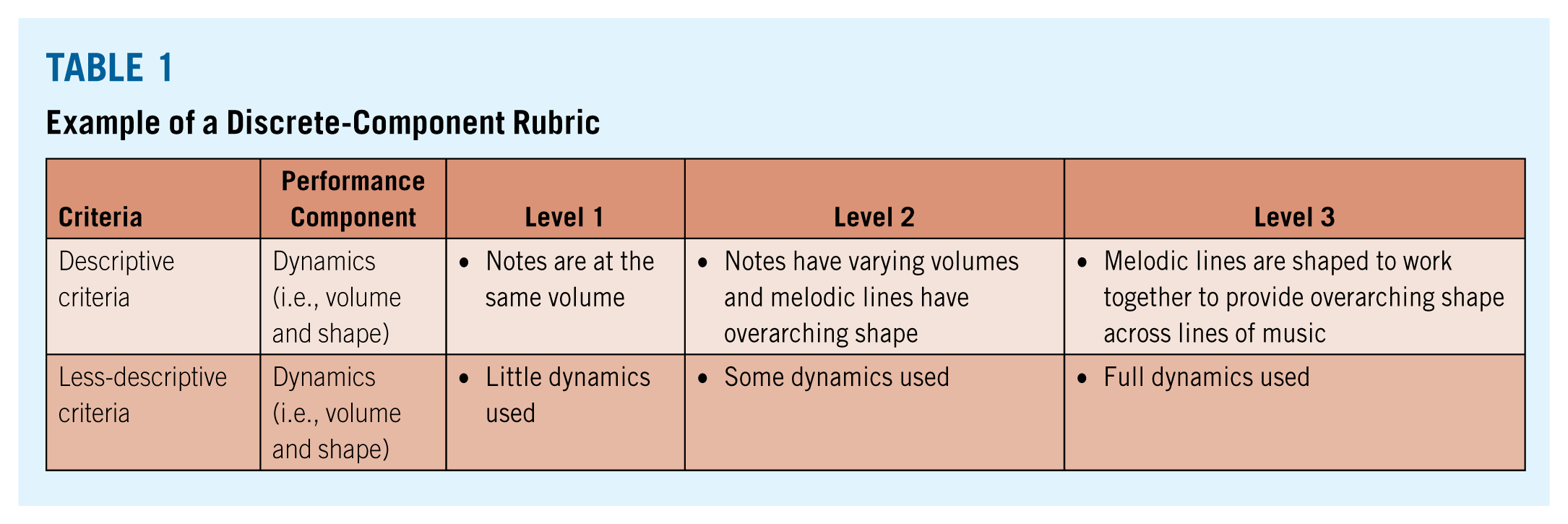
The example in Table 1 distinguishes the difference between descriptive and less-descriptive criteria. The descriptive criteria enhance the demarcation of performance across three levels, which would enhance the reliability of scoring and the utility of these criteria to support student learning. In contrast, the less-descriptive criteria are subjective and ambiguous, leading to decreased utility and reliability (i.e., What is the objective difference between little and some dynamics? Would students be able to use these criteria to effectively distinguish their use of dynamics and support their learning?).
The descriptive criteria provide specific constraints for students to work with and within—the notions of volume and shape in relation to melodic lines—while enabling opportunities for students to make the artistic choices concerning when and how to use volume and shape to create a dynamic performance. In this way, these criteria are predicated on the notion of enabling constraints. At each level, the use of dynamics becomes more sophisticated (i.e., from no dynamic shaping to dynamic shaping within a melodic line to dynamic shaping within and across melodic lines). Accordingly, students and teachers can use these criteria to support learning toward a higher level of performance. However, while this rubric does move toward greater descriptiveness, and therefore clarity in distinguishing performance at various levels, it is still problematic in that it measures a particular performance component as though it were distinct and unconnected to any other. The following rubric aims to integrate music components within performance assessment.
Integrated-Component Rubric
An integrated-component rubric aims to address the common challenge of how to assess a holistic performance in which components combine and support one another, rather than separately assessing discrete performance components. This kind of rubric emphasizes the relationship between performance components; the ultimate purpose is to help learners understand how components work together in an effective performance. Table 2 presents an example of integrated criteria. In this example, learning about the relationship between breath, dynamics, and tone quality in vocal performance has been targeted. The criteria in this rubric identify how the technical component of breath works to enable the expressive components of dynamics and tone quality. Descriptive criteria are used as a basis to distinguish the use of these elements across three levels of performance. As with the discrete-component rubric, these criteria are structured using the concept of enabling constraints. The criteria provide constraint by isolating assessment on three musical components while enabling students to individually negotiate the relationship between these components to communicate their musical intentions.
Example of an Integrated-Component Rubric
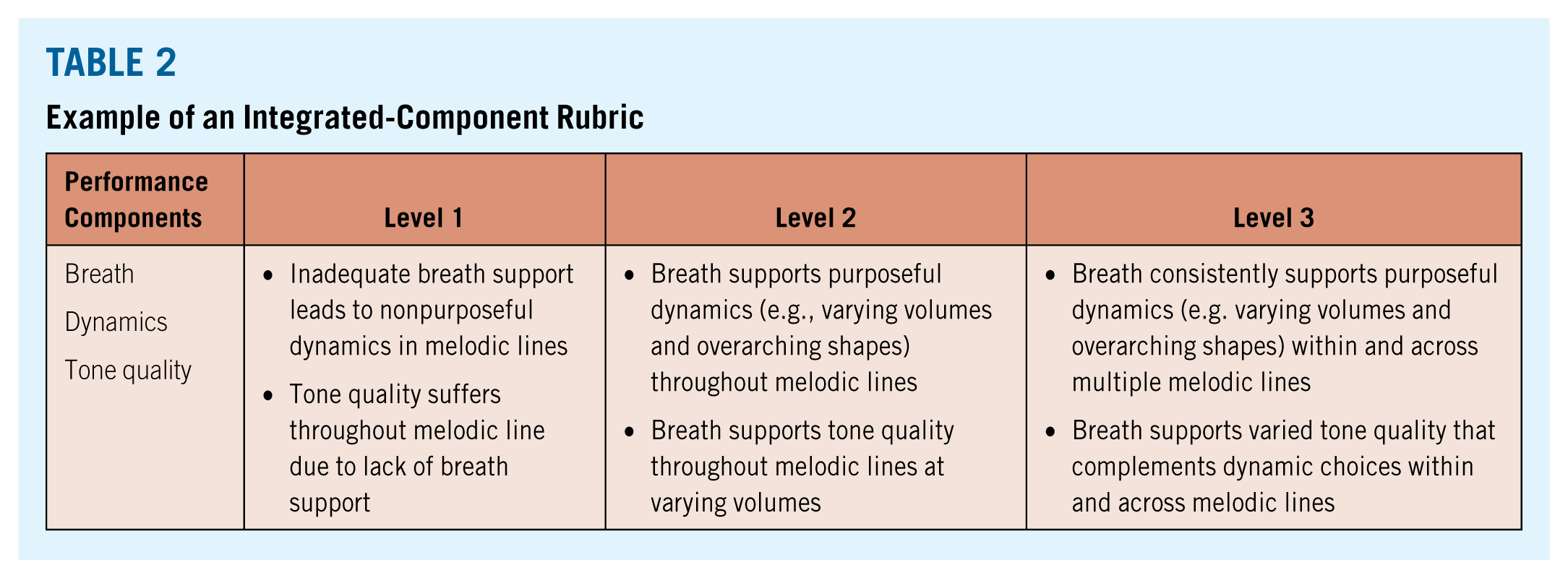
Integrating criteria across musical components enables a more holistic assessment of performance while distinguishing overarching levels of achievement. We see value in this form of criteria because musical components are always interconnected in performance and, more important, because performance components are largely mutually dependent. For example, in a vocal performance, the effective integration of dynamics cannot be achieved without adequate breath support. Accordingly, integrated criteria detailing the relationship between constituent components more authentically and accurately describe musical performance. By incorporating such descriptive criteria, an integrated performance rubric can facilitate more reliable assessments of student performance across various levels, while simultaneously providing feedback that clearly and meaningfully indicates how musicians can improve their performance.
Challenges also exist in the design and use of integrated-component rubrics. With any rubric, challenges arise when criteria do not meaningfully capture what is going on in the performance. One inherent shortcoming of the integrated rubric is that it cannot capture all the permutations of the relationships between components that might be present in a musical performance. In our rubric focusing on the relationship between breath, dynamics, and tone quality, for example, there is nowhere within the rubric to represent a performance in which breath fully supports the voice but dynamics are nonpurposeful, random, or vague. Another shortcoming of the integrated rubric is that it may not have been designed to consider significant components that influence the targeted area of performance. For example, in our rubric, there is no option for describing a performance in which tone quality is uniformly disastrous through no fault of the breath but, rather, due to inappropriate positioning of the larynx.
To move beyond these challenges, two suggestions are offered: First, recognizing that the value of integrated-component rubrics lies in focusing on particular relationships between musical components in detail, teachers and learners are encouraged to design and use integrated rubrics judiciously, targeting specific relationships between performance components that are relevant to learners’ needs (i.e., that enable learners to grapple with common performance problems). Second, by accepting that rubrics can never fully capture the complexity of musical performance, it is suggested that teachers not only use rubric criteria as starting points but also provide additional comments that expand or clarify the rubric criteria to accurately describe and assess the performance in a way that is meaningful and helpful to the learner. Teachers will also need to decide how to assign grades using rubric levels and relate rubric criteria to local grading systems in a way that aligns assessment feedback with students’ grades and with state/provincial educational standards.
In constructing integrated, descriptive performance criteria, it is useful to ask the following two questions: (1) What sounds different about student performance at each level? and (2) How are musical components working together to achieve that sound at various levels of performance? We strongly encourage teachers to involve learners in answering these questions and in identifying, negotiating, and constructing meaningful rubric criteria. With any assessment structure, it is crucial that students have a solid understanding of the language and the concepts represented. Involving learners in rubric design can help them gain this understanding. As another means of enabling students to meaningfully engage with the assessment tool, it is useful to integrate the criteria into listening and performance appreciation tasks so that students can begin to recognize the interconnected nature of the relevant components within performance. In addition, the use of integrated rubrics may be scaffolded through specific lessons and discrete component rubrics that address musical components separately.
Self-Reflection Rubric
At the core of all good performance is the ability of the performer to self-reflect in-performance and in-practice. 22 However, few rubrics acknowledge self-reflection as a core performance skill. Our understanding of self-reflection is predicated on Zimmerman’s notion of self-regulation, which “refers to self-generated thoughts, feelings, and actions that are planned and cyclically adapted to the attainment of personal goals.” 23 Specifically, Zimmerman described a three-phase cycle that enables student self-reflection. 24 First, students engage in observing and emulating proficient self-regulators. Second, students apply criteria to self-assess their own performance through scaffolded activities that enhance practice and performance through targeted learning. Last, students engage in autonomous self-assessment that leads to self-regulation and progressive practice and performance. In this way, the self-reflection process has a direct and significant influence on student practice behavior by using self-assessment (against rubric criteria) to plan for individual learning. This framework of self-reflection is used in Table 3 to construct descriptive criteria that can be integrated into performance rubrics to support students’ abilities to self-reflect. The self-reflection rubric shown builds on principles of rubric design represented in the previous two approaches. The difference in this rubric is its content and focus on self-reflection. Hence, while the other two rubric approaches present different methods for generating criteria, this rubric provides a different content focus for performance rubrics.
Example of a Self-Reflection Rubric

The continuum of criteria in Table 3 suggests the use of self-reflection from an external activity in which students apply criteria to others’ performance to a self-directed assessment activity that enhances personal performance. The continuum moves students toward greater autonomy for their learning and encourages the development of self-assessment and self-regulation abilities to facilitate progressive practice and performance. Self-reflection criteria are expressed as enabling constraints that provide some guidance on the structures that support self-reflection (i.e., teacher directed to student directed) but that do not stipulate the focus or emphasis of self-reflection. In this way, the criteria are adaptable to individual students’ learning needs (informed by reference to discrete or integrated rubric criteria) and enable student autonomy in learning.
We recognize that the self-reflection criteria presented in Table 3 are general and could be supported with specific self-reflection examples through teacher instruction. The following suggestions are offered for using the self-reflection criteria: To meet the level 1 criterion, students might assess a professional musician’s performance or assess a peer’s performance using discrete or integrated component rubrics. For achievement of level 2, teachers could ask students to record their individual performances then formatively self-assess using a performance rubric. In this way, teachers are still provoking students’ self-reflection. Students would then use that assessment to identify key aspects of their performance to focus on during subsequent practice sessions. Students might achieve level 3 by describing their self-assessment and self-regulation approach and by demonstrating, through performance or other means, evidence of their individual growth and learning.
Teachers are encouraged to use the criteria as a basis for constructing learning tasks that explicitly promote students’ self-reflection capabilities and develop a habit of self-reflection in students. Additional learning tasks anchored to self-reflection criteria may include the creation of practice logs, blogs, or podcasts that incorporate written and/or spoken word commentary, along with audio or video documentation to capture learning moments and strategies; video or audio recording of performance trials and subsequent analyses; and the development of student learning plans based on self- and instructor-diagnostic assessments. Given that self-reflection is a difficult behavior to observe, it would be most helpful for teachers to describe to students the use and impact of self-reflection within their own practicing and performing. 25 In assessing their self-reflection abilities, at first students may be inaccurate in their self-assessment. Engaging students in conversations about their self-assessment, self-regulation, and planning for learning will further facilitate self-reflection as a core performance skill and develop greater accuracy in their assessment of self-reflection. Using self-reflection rubrics across a music program explicitly promotes assessment as learning and encourages students to develop a habit of focused, progressive practice through self-assessment and self-regulation. 26
Rubrics in Music Education
The three rubric approaches presented in this paper can be used individually or collectively within music programs. Sequencing the use of discrete- and integrated-component rubrics may be valuable to students as they learn about different musical components and then later about the integration and influence of musical components within performance. In addition, using these rubrics in music appreciation tasks, throughout student practice sessions for self-reflection, and in final student performances will enable students to better understand performance criteria, leading to more accurate and helpful feedback on student learning. Furthermore, structuring tasks that encourage students to self-reflect on their performance—self-assess, self-regulate, and plan for their learning—in relation to discrete or integrated rubric criteria will accelerate learning by teaching students how to identify and achieve performance goals.
Underpinning all three rubric approaches is the construction of high-quality criteria that both enable performance possibilities and that provide sufficient structure to guide student learning. Specifically, across the approaches, the concept of enabling constraints was used to develop descriptive criteria related to either discrete musical components, integrated musical components, or self-reflection skills. Regardless of the approach, criteria that provide qualitative descriptions that authentically and accurately distinguish performance levels are valuable. These criteria enable feedback that will support learning and improve performance. While constructing these criteria is not easy, moving toward more descriptive criteria will provoke learners and teachers to necessarily identify, grapple with, and articulate concepts at the very heart of music learning. Teachers and students can work together through music appreciation tasks to develop meaningful criteria. In this way, the generation of performance rubrics becomes a valuable learning activity in its own right, whereby students not only learn to recognize and appreciate the subtleties and nuances of music performance but also become familiar with performance assessment and the criteria that will be used by teachers, peers, and themselves to assess and enable the development of their own musicianship.
No matter how carefully rubrics are crafted and how high the quality of their assessment criteria, rubrics can never capture the full complexity of music performance. Rubrics have the potential to both constrain and enable effective assessment. As teachers and students use rubrics as assessment tools, they must be prepared to move beyond the confines of the predetermined criteria—they must be ready to think outside the boxes. We recommend that assessors add comments to clarify and expand rubric criteria so that the performance is accurately and richly described and assessed in a way that is meaningful and helpful to the learner. By thinking of the rubric as a starting point in learning, it serves to enable rather than constrain the act of assessment.
In presenting our three approaches to rubric construction, we aim to provide educators with theoretically informed, tangible strategies to generate rubrics for their specific performance contexts—rubrics that effectively serve both to measure student achievement and, most important, to support and enhance student learning. We assert that while these approaches are theoretically informed, they still require empirical support. Providing this support represents an area for future research. Ultimately, we see value in investigating and supporting classroom assessment programs predicated on high-quality criteria and performance rubrics that engage students in assessment for, of, and as learning activities. Integrating criterion-based performance assessment throughout music instruction can significantly support music learning and honor both expressive and technical aspects of performance. However, this can be accomplished only when criteria are structured as enabling constraints that are descriptive, formative to student development, and reflective of the complexities of music performance.