




Abstract

If you regularly read Music Educators Journal, you may already be familiar with the name Karel Husa or have listened to the work Music for Prague 1968. Husa is a Czech-born composer and conductor, winner of the 1969 Pulitzer Prize and 1993 University of Louisville Grawemeyer Award for Music Composition. He became an American citizen in 1959. Husa created a demanding work for solo clarinet for the Prague Spring Festival of 2007. It’s titled Three Studies for Solo Clarinet and was published in 2007 by the Czech company Editio Baerenreiter Praha (PA.H7992).
If you’d like to read what a reviewer has to say, check out Fred Jacobowitz’s opinion in “Karel Husa’s 3 Studies for Solo Clarinet” in the March 2011 issue (volume 38, number 2) of The Clarinet (http://www.clarinet.org). That article focused on a description of the music with an outstanding comparison to Igor Stravinsky’s (1919) Three Pieces for Clarinet. This article suggests fingerings and embouchure techniques that will help the student clarinetist.
At a recent performance of Karel Husa’s Three Studies for Solo Clarinet, I asked the audience of more than fifty people, “How many of you have ever heard of Karel Husa?”
Fewer than five hands were raised.
“How about Igor Stravinsky?”
At least three-fourths of the audience raised an arm.
“How many of you have ever heard of Georg Philip Telemann?”
Maybe ten people responded in the affirmative.
“How about Johann Sebastian Bach, composer of The Well-Tempered Clavier and the Saint Matthew Passion?”
All of them knew Bach.
“How many of you ever heard of Frank McCourt, author of Angela’s Ashes?”
Almost all hands shot up.
Had I had asked the last question twenty-five years ago in the late 1980s, no one in an audience at Old Westbury Gardens Summer Concert Series on Long Island, New York, would have raised his or her hand. Why? Frank McCourt was a servant of the New York City Public Schools at that time. It wasn’t until he retired that he really began writing, and in a very short time, he became a New York Times best seller, a Pulitzer Prize winner, and a famous personality when his book Angela’s Ashes was made into a movie.
Why am I talking about movies when this article is about how the student clarinetist should prepare to study Karel Husa’s Three Studies for Solo Clarinet? Let me go back to the 1700s. If a musician had asked the audience who had heard of Telemann, everyone would raise his or her hand. Very few audience members would have heard of Bach in the 1700s. It wasn’t until Mendelssohn discovered much of Bach’s music and performed it more than a hundred years after Bach’s death. Bach was too busy in his day to promote his music. He was a servant of his church—more like a minister of music than a composer. The great music he composed was usually heard in a church during the services. That was his job, and it was enough for him. He enjoyed making a decent living composing music that would be heard. Even if the technologies had existed at the time, Bach wouldn’t have needed to have his works playing on YouTube or as background to television shows or movies, although he might have found these platforms intriguing!
Joseph Rutkowski
Photo by Tiffany Thomas
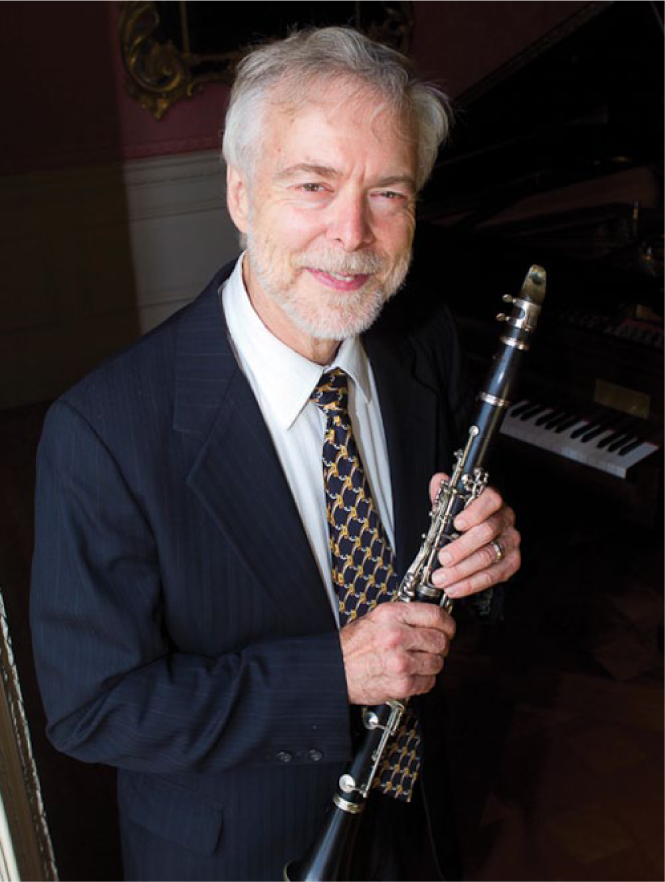
Throughout most of Karel Husa’s life, he was composing, but he was also a professor of music in at Ithaca College and Cornell University in the state of New York. Being a teacher requires serving the students and the school. I believe that in time, maybe not in my lifetime or yours, Karel Husa will be almost as well known as Igor Stravinsky.
Karel Husa just turned ninety-three years old and is living in North Carolina, still composing. He was born in Prague, Czechoslovakia, studied music there and then in Paris with Nadia Boulanger. While Husa was in Paris in the 1950s, Czechoslovakia became a Communist state. Husa decided that he could never return to his homeland. He moved to America and found a home in Ithaca, New York, after being invited to become professor of music composition at Cornell University and Ithaca College. He was so shaken by the 1968 Soviet invasion of Czechoslovakia that he composed one of his most famous works, Music for Prague. The Czech government then banned his music. No one in the country was permitted to perform or listen to the music of Karel Husa. Saddened but not discouraged, he continued to compose works on commission from the New York Philharmonic, Chicago Symphony, and many other great symphony orchestras, as well as renowned chamber ensembles. During the late 1980s, when many of the Eastern Europe nations were becoming democracies, the Czech Republic, being one of them, actually invited Karel Husa to conduct the Prague Symphony Orchestra in the Czech premiere of his Music for Prague. This was a dream come true for Karel Husa. Since that concert, Husa has been proclaimed a heroic figure by the Czech government and people.
Without question, this work by Husa should be included in the clarinetist’s solo repertoire. Note that the piece is unaccompanied, meaning that there are no actual harmonies that will be heard. There are, however, special effects that require the clarinetist to accomplish. The range of dynamics is quite large: from a sound that is almost inaudible to a quadruple forte. There are trills that go from one pitch to the same pitch, but with different timbres (by using different fingerings on the instrument). There are quarter-tones (e.g., the note between F and F-sharp). There are glissandi or “smears.” And there is a section at the end of the piece that requires the clarinetist to go back and forth between a normal tone and a “reedy” tone.
I have the good fortune of having known Karel Husa since my student days in the mid- 1970s. I was able to have conversations with him and send e-mails of MP3s of my practice sessions. His e-mailed replies helped me as much as if we were in the same room. Indeed, Karel Husa at age 93 is a modern man in 2014.
Husa sent me an e-mail just before I performed the New York premiere of his Three Studies in 2010. It read, in part: When I was asked to compose a work for solo clarinet for the competition at the Prague Spring Festival 2007, I was told that the best young clarinetists from all over the world will compete, therefore I should not worry about difficulties and explore many possibilities of the instrument. Such a statement pleased me, as much of my music—I am told—is difficult, and I find writing easy music more difficult (!). So, without worrying, I tried some new paths and techniques, hoping they will be possible. And the performers proved it. In any case, we composers have to try exploring.
When one first looks at the score for Three Studies, it may seem quite daunting. However, these three pieces are not beyond the capability of the serious high school student. In my opinion, this work would most probably be classified as level 6, the highest level that is assigned.
1. “Mountain Bird”
In this work, the metronome marking of quarter note = 72 should be kept in mind. I suggest starting with the metronome set at eighth note = 72 (twice as slow) and then building up the speed until the eighth note = 144. Husa suggests using a small accent and tenuto on the first of all the thirty-second–note passages in this movement (see Figure 1).

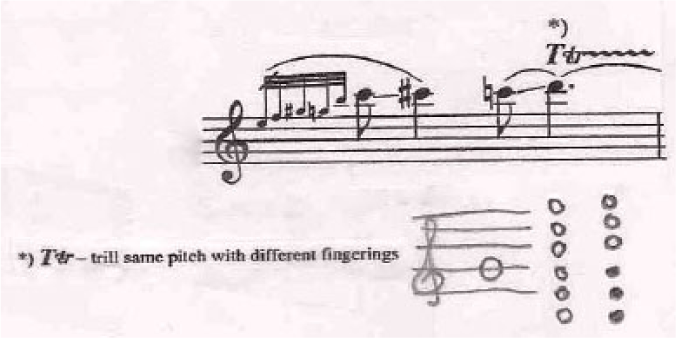
At the beginning of the third staff, the slide from the high C up to C-sharp can be accomplished by a loosening of the embouchure/opening of the throat and oral cavity while depressing the two right-hand keys to reach the C-sharp (see Figure 2).

In the fourth staff, the slide from the high C to D can be accomplished by the same embouchure/throat technique and opening up the left thumb hole to produce the high D as an overblown open G. The trill on the high D is indicated in the score as “trill same pitch with different fingering.” While sustaining the overblown open G, create a trill with a different-sounding high D by covering the right-hand tone holes with all the fingers that usually cover them (see Figure 3).
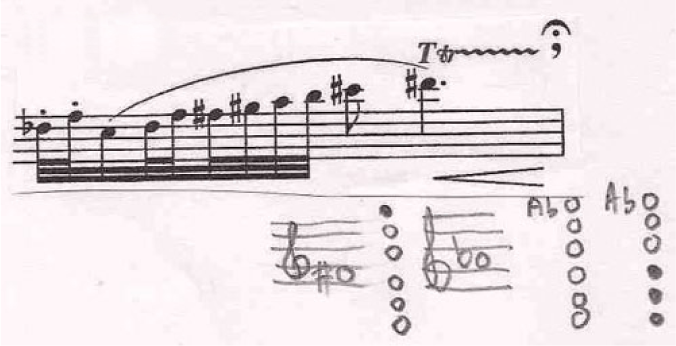
At the end of the fourth staff, the thirty-second–note run up to the C-sharp may use the overblown first-space F-sharp so that the high D-sharp may be played as an overblown second-space A-flat and using the same right-hand tone-hole trill (see Figure 4).
Karel Husa (L) and a younger Joseph Rutkowski (R) in 1988.
Photo by Pamela Sklar

At the end of the fifth staff, the slide from C to E-flat may use the same fingering and right-hand trill (see Figure 5).
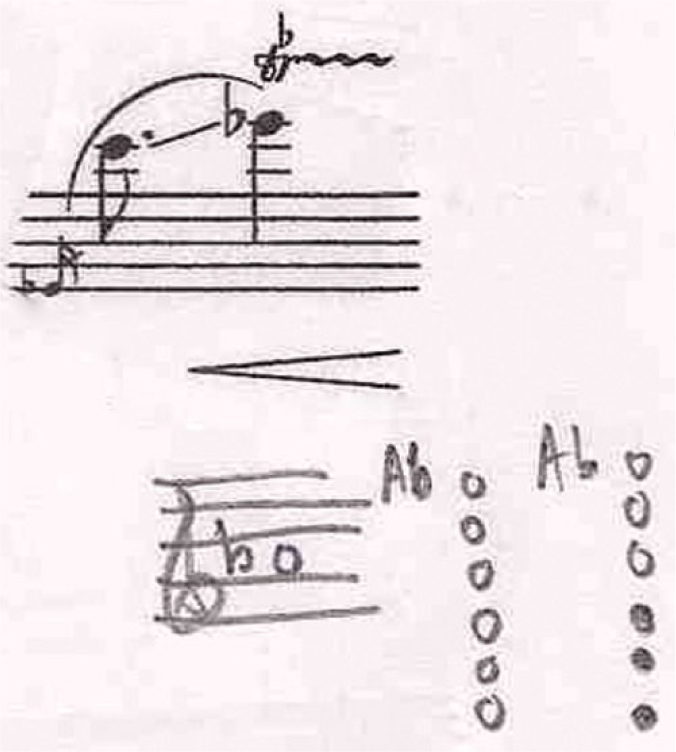
In the beginning of the sixth staff, the slide from the C to E-natural may use an overblown third-line B-flat with the right-hand trill (see Figure 6).
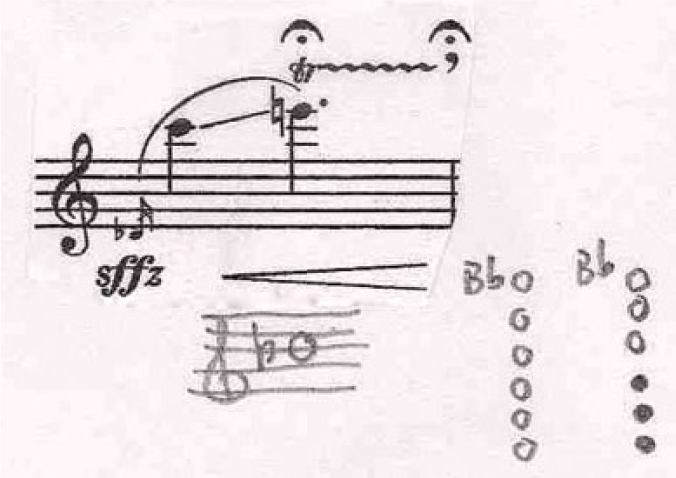
The next note, F-sharp, can be played as an overblown B-flat (above the staff) and then using the embouchure/throat technique to lip down to the B-flat. The G-sharp may be played as an A above the staff with the right-hand first finger (fifth-line F) trilling with the chromatic F-sharp key to produce the same pitch effect. The trill may be lipped up to the C-sharp using the overblown first-space F-sharp (see Figure 7).
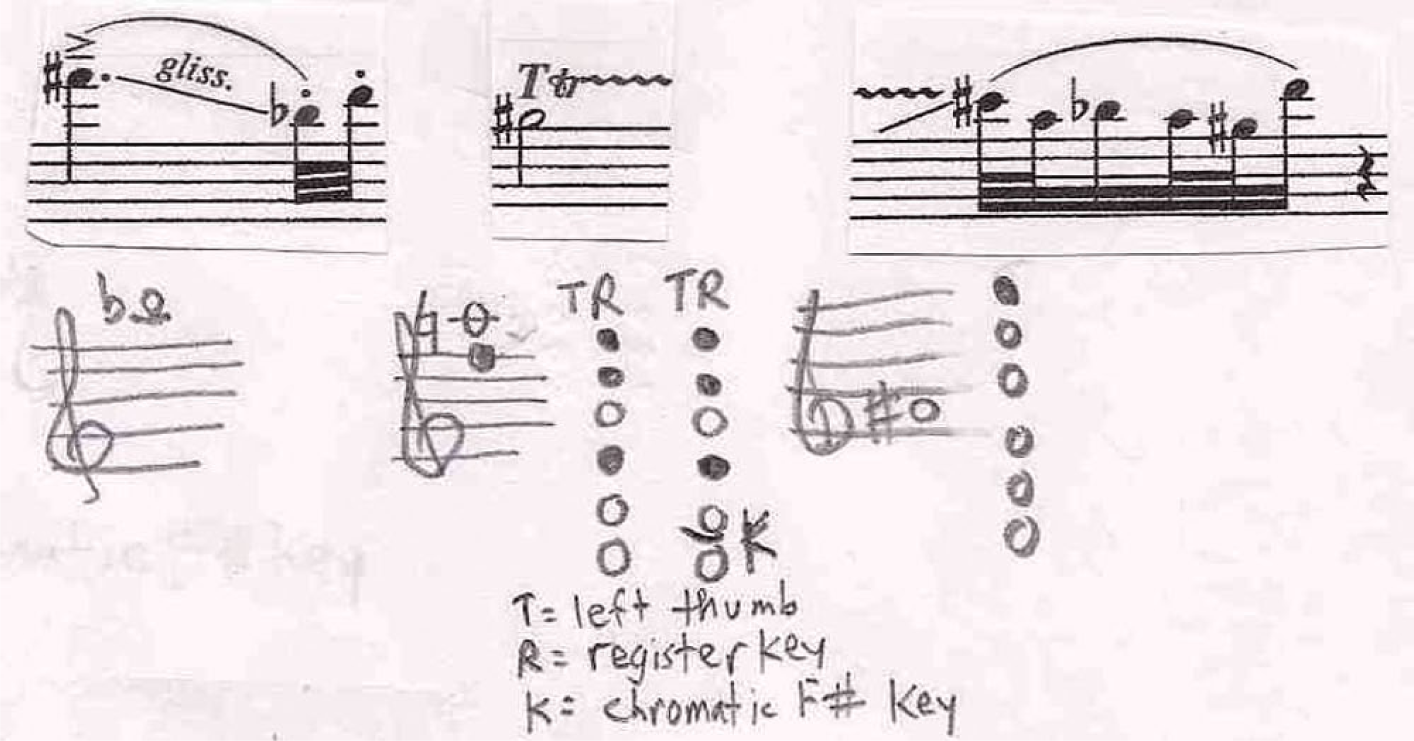
Page 2 of “Mountain Song” requires no unusual fingerings until the second-to-last staff. The high E-natural may use the overblown third-line B-flat with the right-hand trill that was previously described. The trill on the F-sharp can be achieved by keeping the right-hand second finger down while trilling the G-sharp with the left-hand pinky key. Obviously, strict adherence to dynamics is essential (see Figure 8).

2. “Poignant Song”
For this piece, the metronome marking may be set at eighth note = 112 to help with subdividing the quarter note. Husa cautions that the glissandi lines between notes are not as important as the melody. In this movement, they should be interpreted as smooth slurring, as opposed to jazzy glissandi.
In the first staff, the B-flat can be lipped down without changing the fingering to the written A and then lipped up to a B-natural by slowly depressing the right-side B-flat trill key (see Figure 9).
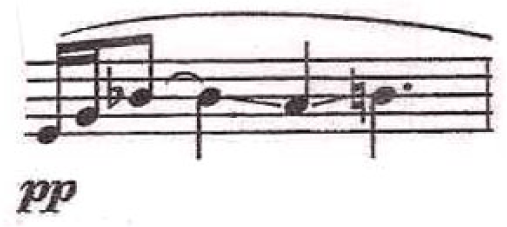
Husa suggests that a very gradual crescendo should be accomplished from the pp on the beginning of the third staff all the way to the fff on the fourth staff of the second page.
The first staff on the second page presents a difficult same-pitch trill. The opening D same-pitch trill may be approached as in the first movement (overblown open G with right-hand tone-hole trill). The trill on the low E is simply to F-natural. The trill on the D-sharp is down to the quarter tone between D-sharp and D-natural. This can be accomplished by fingering a D-sharp and trilling the left-hand third-finger tone-hole and C-sharp key. The fourth line D same-pitch trill may be played by using the normal fingering and trilling the second space A-flat key while keeping all the fingers covering the tone holes (see Figure 10).

In the second staff, the “slow vibrato” on the B-natural may be a slow and wide lip vibrato, in Husa’s words, “lamenting, like crying” (see Figure 11).
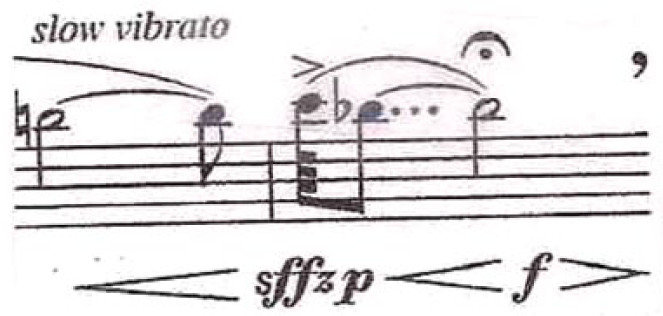
In the fourth staff, the high G crescendo starts on fff and should be “a powerful cry with drama” advancing to as many fs as possible. The fermata above the breath mark indicates “a long wait” (see Figure 12).

In the final staff, the glissando from E to E-flat may be accomplished by lipping down the pitch while closing the right-hand ring keys without covering any tone holes. Adherence to the final two tones without vibrato while using what the composer calls a “hollow sound” is essential (see Figure 13).

3. “Relentless Machine”
The metronome marking of dotted quarter note = ca. 116–120 is a supreme challenge. Start the metronome at eighth note = 100 and build up the tempo at your own pace toward the indicated marking.
The first same-pitch trill on the low A may be accomplished by trilling the low pinky E key. The various quarter-tones that appear as eighth notes may use conventional fingerings that one can find online (e.g., The Clarinet of the Twenty-First Century by E. Michael Richards, http://userpages.umbc.edu/~emrich/chapter2-6.html). See Figure 14.
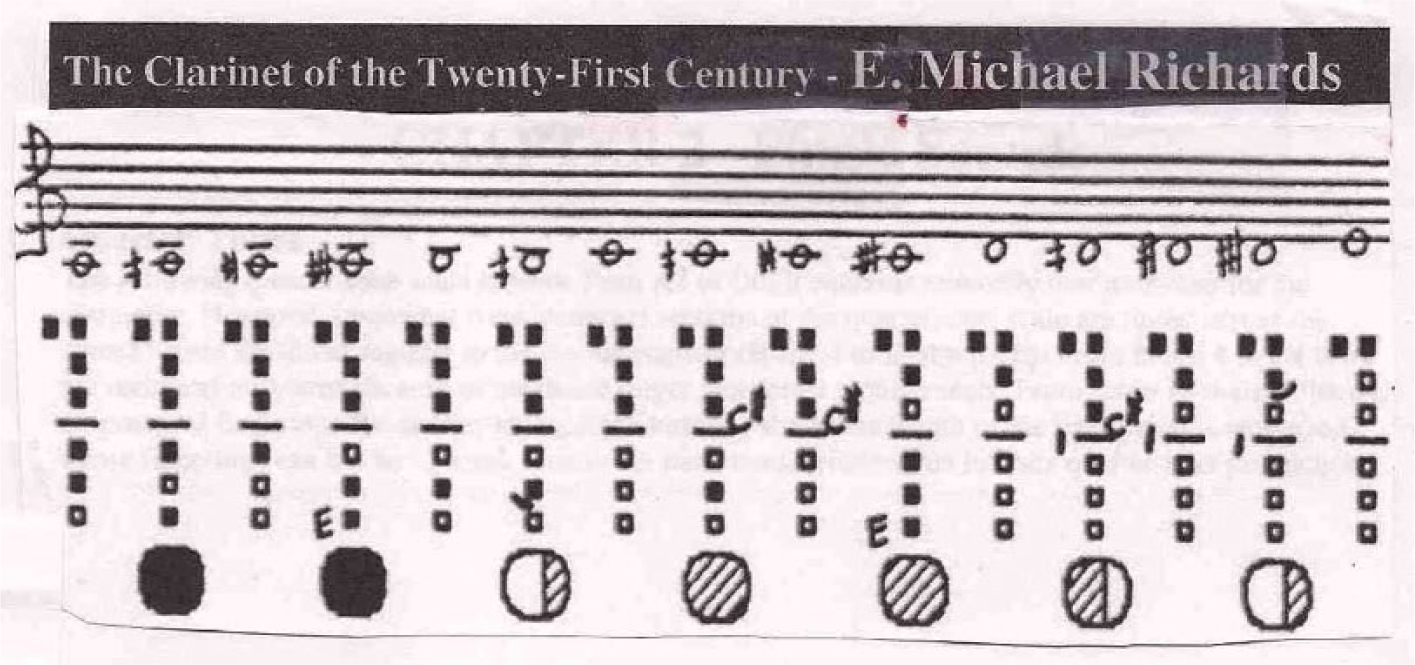
However, Husa suggests that the unraveling of the chromatic scale from the low-A trill should sound “mysterious” and “scary” like a “gentle wind” coming out of this almost inaudible sound of a trill. What happens at the end of the first staff is most important. The five-eighth–note pattern on A is the returning motif of most of this movement. It should sound like the soft patter on a snare drum that keeps interrupting the 6/8 dance of the “relentless machine.” Husa emphasizes that there should be no accent on the first and fourth eighth notes of the 6/8 meter section. In Husa’s own words (from a recent telephone conversation I had with him), “There are three colors or characters of this movement: the breath/wind; the five-note motif; and the 6/8 dance being danced by a clumsy or grotesque child. The trills on the second page should reminisce the trills from Richard Strauss’s Till Eulenspiegel’s Merry Pranks so that they sound like ‘jokes.’”
On the second page, the third-staff B “same-pitch” trill may be accomplished by lifting the left-hand forefinger (see Figure 15).

In the sixth staff, the term reedy suggests that the player use a loose embouchure, much like a young player who has not mastered the correct manner to produce a good tone. The constant transfer between reedy and nat. (natural) styles is a challenge that can be mastered with practice.
On the third and final page, overblown notes will help with the production of these higher tones at the rapid tempo (using first-space F-sharp for the high C-sharp and open G for the high D). See Figure 16.
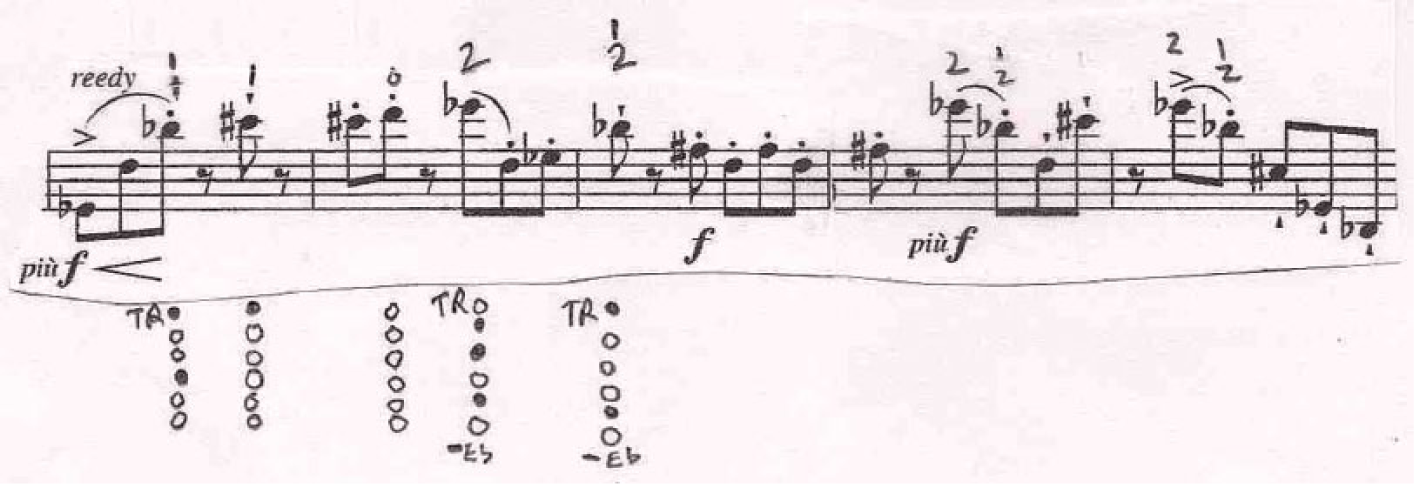
The final five staves present the ultimate challenge. The dotted quarter note now becomes a quarter note. (It is indicated that the sixteenth note remains the same, but the sixteenth notes that precede this section are quadruplet sixteenths; each group of four sixteenth notes = c. 116–120; see Figure 17). I have not discovered any alternate fingerings that will help with the execution of this exciting finale. I suggest putting the metronome on eighth note = 60, using conventional fingerings, and gradually speeding up the tempo to eighth note = 208 and eventually the quarter note = c. 116–120, convincing the student and listener what a cathartic experience this marvelous work represents.

Karel Husa has led a life of great productivity and generosity toward his students and his audiences. I encourage you to listen to some of his major works and to offer your most skilled young clarinet players the opportunity to be challenged and to enjoy one of the most interesting woodwind pieces of our time.