



Abstract
This narrative describes two United States Air Force bandswomen whose combined careers span the past sixty years. Cornetist Martha (Martye) Jean Awkerman joined the U.S. Women in the Air Force (WAF) Band in 1955. She served the WAF band as cornet soloist and principal trumpet until the band was disbanded in 1961. In 1983, tubist Jan Duga joined the U.S. Air Force Band, Washington, D.C., and served until her retirement in 2013. During the decades between their terms of service, shifting societal structures, a rapidly expanding economy, and civil rights activism challenged traditional barriers to education and employment for women. In particular, the passage of Title IX and the fight for an Equal Rights Amendment engendered progress for women throughout the military.
They met in Missouri at the first International Women’s Brass Conference in 1993. USAF Chief Master Sergeant Jan Duga had finished lunch and was leaving the Washington University campus cafeteria when former USAF Master Sergeant Martha Awkerman marched up and asked, “You ever heard of the Women’s Air Force Band?” Duga, a tubist with the United States Air Force Band, had never heard of an all-women Air Force band. “No,” she answered, “I don’t think there was one—all I know is what I am in.” 1
The lives of two military musicians offer a look at how performance career opportunities have expanded for women over the past six decades.
It was a moment appropriate to that first gathering of professional women brass players. The organizers had stated in the purpose for the conference that “women have been largely ignored in the documentation of performers, composers, and educators, and as a result, women performers today are often unaware of their ongoing contributions to music history.” 2 And as this conversation between Jan Duga and Martye Awkerman demonstrated, not only are women performers often unaware of their own contributions, they are also unaware of the achievements of the women who came before them. “She set me straight,” laughed Duga. Over the next few years they became friends as Awkerman set about acquainting Duga with the United States Air Force “Women in the Air Force” (WAF) Band, the Air Force’s only all-women military band.
A Will and a Way
Martha Jean Awkerman, known as Martye, served as principal trumpet and cornet soloist in the WAF Band from 1955 to 1961. She joked that her path to becoming a professional musician began when a minister gave her a Boy Scout bugle to play with while the church orchestra practiced in her living room. 3 When she grew older, Awkerman insisted on playing the trumpet, and after making her try the flute, her band director relented. She took private lessons, played in the school band, and earned a top position in the Pennsylvania All-State Band. In the fall of 1946, Awkerman was awarded a scholarship to attend the Cincinnati Conservatory of Music to study cornet with Frank Simon.
SSgt Martha Awkerman, official Air Force publicity photograph, ca. 1956
Photo by the USAF Public Affairs Agency

Simon encouraged her to build her performance résumé, so she toured the United States with several brass ensembles while earning her undergraduate degree in music. “You were lucky if you got somebody who knew you or believed in you,” Awkerman explained, “they helped you.” She was aware that her performing options were limited—symphony orchestras were only just beginning to welcome women as harpists, but not brass players, and jobs were just as hard to come by in jazz bands and other entertainment. “You couldn’t get in college marching bands, couldn’t get in orchestras, couldn’t get in much at all,” said Awkerman. Nonetheless, she was determined to have a career in music performance.
In 1948, the George A. Hormel meat packing company supported the popular radio show Music with the Hormel Girls in which musical numbers were performed by members of a rather unique sales force. The stage band consisted of women musicians who would visit American cities to perform for local audiences as well as make a live radio broadcast, but during the day they would sell Hormel products door-to-door or make appearances at local groceries.
4
The radio show and the possibility for a professional position caught the attention of the young cornetist in Cincinnati: I heard [them] on the radio, and it sparked my interest . . . we practiced in our dorms—we had pianos in our rooms and everything—and at a certain time on Saturday afternoon I made [everybody on our floor] quit practicing. We would take our radios and tune them in to the same thing, and all sit out in the hall [and listen] to the Hormel Girls radio broadcast. And the more I listened to this, the more I liked it. So I went down, got a can of chili, and got the address for the Hormel Meat Packing Company off of it, and I wrote them a letter. I told them I was graduating and everything—you know, where there’s a will, there’s a way.
The Hormel Company responded to her letter with an invitation to audition for the band. The director liked what he heard, and she was invited to join the show. In 1951, the Hormel Girls were a phenomenon in American consumer culture. Band members were given white cars with the Hormel logo on the side, and every week they would travel to a new town to perform and sell Hormel products. 5 Awkerman confessed that selling meat was at the bottom of her list: “All I wanted to do was play!”
She performed with the Hormel Girls until it ended in 1953, but she was not discouraged. “I just kept jumping,” Awkerman explained, “I was always looking for the next thing I could get into.” A friend from the Hormel Girls had played in an Army WAC Band during World War II. She introduced Awkerman to her former conductor, Marybelle Nissly, now the commander and conductor of the United States Air Force Women in the Air Force (WAF) Band. When Awkerman returned home to Mount Union, Pennsylvania, she contacted Captain Nissly to see if there was an opening for a cornet player. As Awkerman recalled: [The Captain] said, “Well I’m coming home on leave and my home is in Lancaster, Pennsylvania” and my home was close to Chambersburg which wasn’t too far. So she said, “I’ll meet you at the Chambersburg train station at 8:00 Sunday night, and I’ll audition you.” Well, she didn’t get there until after midnight. Everything was closed up, but there was a big office building there. You know Captain Nissly—happy-go-lucky and where there’s a will there’s a way—she said, “Let’s see if this office building is open.” The fire escape doors were open, and I knew enough about the service to know that you had to be polite to this captain. So anyhow we went into this office building, pitch dark except for the exit light. She sat down on the steps of the exit and . . . I played her a solo, and I was in the WAF Band!
6
SSgt Martha Awkerman, cornet soloist, performs with the U.S. WAF Band on tour ca. 1959
Photo by the USAF Public Affairs Agency

The WAF Band was a successor to the all-women military bands of World War II that played for ceremonies, troop entertainment, and war bond drives. 7 At the end of World War II, the Army Air Corps was reorganized into the United States Air Force. At that point a women’s auxiliary, the Women in the Air Force (WAF) was also established. In 1949, Colonel George Howard, Air Force Chief of Music and Commander of Bands, reorganized the field bands in the wake of the postwar drawdown and decided to create a band to support the daily routines of the new WAF trainees. 8 In January 1951, the band of eighteen members was officially activated as the 543rd Air Force Band (WAF). 9
Marybelle Nissly, who went back to teaching after the war, was offered a direct commission to Captain if she would return to service to command the WAF Band. She accepted and poured herself into developing and promoting the band. 10 In addition to regular concerts at Lackland Air Force Base, she expanded the band’s touring schedule, adding additional public concerts, parades, and other events across the country.
Awkerman’s national reputation and professional touring experience as a cornet soloist made her a perfect addition to the WAF Band when she joined in 1955. “Captain Nissly and I met right at the right time,” she reflected, “she needed somebody, and I needed somebody; she needed the trumpet player and I needed the band. I learned one by one to love everything about the WAF Band—marching, shining shoes, pressing uniforms, GI night, retreat and, most of all, concert band rehearsals and playing concerts.” 11
Awkerman was a hit with the audiences. She regularly performed as a soloist with the band on popular standards such as “La Virgin de Macarena,” “The Carnival of Venice, and “Hejre Kati.” One reviewer gushed: Probably the applause reached its greatest crescendo for the young cornetist, Airmen Martha Awkerman of Mount Union, Pennsylvania, who did a magnificent job on an intricate and difficult arrangement of the old folk tune “Funiculi, Finicula.” Her spirited rendition of the number caused thunderous applause, from the young people particularly, and she was called back for an encore.
12
Awkerman also performed on the coach horn, a long valveless bugle used in the nineteenth century to signal delivery of the mail by stagecoach. Despite its limitation in range and a piercing timbre, a repertoire of tunes and calls have been composed for the instrument. One newspaper reporter, less enthusiastically, wrote that after hearing Awkerman “blast through” “The Chase,” he was glad “she finally caught whatever it was she was chasing.” 13
From 1955 through 1959, the band made visits to far-flung military bases in Alaska and Puerto Rico. They marched in parades for countless civic festivals, such as Tampa’s Gasparilla Days and the Seattle Seafair, and gave concerts in some of America’s most famous venues—Rockefeller Center, Boston’s Symphony Hall, and the Hollywood Bowl. But by the end of the decade, the Air Force’s zeal for enlisting women ebbed. Faced with budget and personnel cuts, many in command felt that eliminating the WAF altogether should be the solution. 14
The year 1961 began rather auspiciously as the band marched down Constitution Avenue to honor the inauguration of President John F. Kennedy and then performed at the annual meeting of the American Bandmasters Association three months later. But these were the last blue skies the band would see. In late spring the band was informed they would be deactivated in August. Soon after the Office of Special Investigations (OSI) launched an all-out investigation into allegations of homosexuality among the band members. During this era, it was not unusual for the women’s ranks to be purged of those deemed “unfit for service,” but band members described this particular witch hunt as vicious. 15 Any woman merely suspected of being a lesbian or “associating with known lesbians,” which is not a hard case to make in a traveling military band, was told she had two options: accept a general discharge or contest the allegation and be dishonorably discharged. All through the summer airmen would go to morning rehearsal to find band members had literally disappeared in the night with no goodbye. The results of the OSI investigation were devastating—of fifty members, only sixteen were left to play the band’s final concert.
Awkerman survived the purge and refused to leave the band until the very end. In the last few days, as the instruments and music were being packed up to be sent to storage, the remaining bandswomen were asked to fill out an out-processing list that asked for their name, date of service, if they desired discharge, and what job they would like to pursue. Awkerman was the last to give her information. Defiantly, she wrote in large letters that the next job she wanted was to “play in the USAF Band, Washington D.C.”
That was not going to happen. The Air Force Band was not open to women. Awkerman and her bandmates returned to civilian life and found few options to continue their professional musical careers. Many of the bandswomen used their GI Bill to attend college. Several attempted to join their university bands only to find that women were not allowed. When asked for an explanation, one university director justified the policy by stating, “Women can’t march and play an instrument at the same time.” 16
Awkerman auditioned for the Long Beach Municipal Band in Long Beach, California, one of a few bands in the nation supported by city government. 17 She became the band’s first female member but struggled for acceptance. The Musicians Union contested her appointment, and individual members of the band subjected her to continual harassment, character assassination, and threatening late-night phone calls. 18 But just like the WAF Band, she refused to leave. “There was no way I was going to allow them to push me out of this band,” Awkerman declared. 19 She stayed and played with the Long Beach Municipal Band for seventeen years until it lost the support of the city and disbanded.
Eventually, Awkerman retired from full-time performing and teaching but was determined to support women musicians at every opportunity. She thought it important for young women brass players to know “what we older players have been through.” In January 2005, she met with Danelle Larson (formerly Keck) to record an interview about her time with the Hormel Girls. Toward the end of the conversation, Awkerman reflected on the progress that women had made in music: There’s a girl in a picture over there. We are thirty years apart in age and in career. We opened the door for these kids, all we women that stuck with it, because it was really bad. It’s been a long hard trip.
The “girl in the picture over there” was Chief Master Sergeant Jan Duga, who opened a few doors for women in music herself.
“Breaking a Lot of Tradition”
Fourth-grader Jan Duga went to her first day of band class with an E-flat tuba mouthpiece in her pocket. The music teacher handed her a flute, a clarinet, even a violin, but Jan was set on playing the largest wind instrument. “Are you sure want to play the tuba?” the teacher asked. “Yes,” she answered, “I want to be unique.” And she was: I would have to cart that tuba in one of those upright shopping carts three blocks from where I lived from school—up and down the curbs, down the steps to the basement where they had the music room. I got called “Granny,” you know, because I’m pushing around this shopping cart, but it was a great place to throw your umbrella down the bell and put your lunch and your books in the bottom. There’s my tuba with the bell up, you know, going along in the cart with a pad underneath it!
Duga’s father made a living as a physicist but was also an accomplished tubist. Jules Duga played with the Columbus Symphony Orchestra and was a charter member of the Brass Band of Columbus. An alumnus of The Ohio State University, Jules Duga had marched sousaphone with the university band and “dotted the i” in the famous Script Ohio formation five times in 1952, his fourth year. He took a strong interest in Jan’s music education and served as her private lesson teacher until she went to college. “My dad would [say] ‘master the page,’” his daughter said, “not just be able to get through it, but be able to play it perfectly. When I would master a page he would give me a dime and mark a little ‘pd’ on the corner.”
CMSgt Jan Duga in rehearsal with the U.S. Air Force Band in 2012
Photo by SMSgt Phil Krzywicki

In addition to playing in her high school band, Jan played in the Columbus Symphony–sponsored youth orchestra program, starting in sixth grade with the Cadet Orchestra and advancing to play with the wind symphony and the youth orchestra. Jan described her experience sitting in the back row of mostly male trumpet and trombone players. “I would get funny looks,” she remembered, “but I just sat down and started playing. What are they going to say? Not that I am tooting my horn, but I would always be prepared and I would play, and they would respect that.” But not everyone adjusted easily to a woman in the tuba section: My dad has a great story. He was an adjunct [tuba] teacher at Capital University . . . and he told a story of this one student of his, [and it] must have been one of the first meetings they had together. This kid starts talking about going up through high school. “There was this one girl that kept beating us all out, and she’s like sitting first chair,” and he was just babbling on. My dad of course let him continue to talk and slander the whole way, and he finally let the kid know, “Well, that’s my daughter.”
While Duga was in high school, some significant legislative battles were being waged that would affect her opportunities for college and her future career. In 1971, the Supreme Court struck down sex-based military job classifications, ruling that occupation restrictions “must be reasonable, not arbitrary, and must rest upon some ground of difference.” At the same time, the Equal Rights Amendment was being debated in Congress. Major General Jeanne Holm, author of Women in the Military: An Unfinished Revolution, asserts that these legal and political developments galvanized the services to review their gender-based policies “because they feared defending them in courts already showing marked inclinations in the direction of civil rights.” 20 The Air Force, choosing a proactive course, opened as many career fields as possible to women, one of which was musician. 21 In 1973, clarinetist Karen Riale joined the Air Force Band, becoming the first woman to play with any of the premier D.C.-based service bands. 22
Title IX became law in June 1972. Popularly known as the law that mandated equal sports opportunities for girls, Title IX actually addressed a wide range of issues in education, including admission to college programs, access to course offerings, and equitable distribution of resources irrespective of gender. 23 In music education, the law challenged the informal, and occasionally the formal, practice of directing women away from instrumental music education. It also ended male-only marching bands, a persistent practice in several large universities, including The Ohio State University. 24 In the same year that the Air Force Band welcomed the first woman to its organization, The Ohio State Marching Band added five women to its ranks. 25
Three years later, Duga followed her father’s footsteps to Ohio State. She chose to major in instrumental music education and tried out for The Ohio State Marching Band, earning her the distinction of becoming the first woman in the sousaphone section: The day they announced the members, which is like three or four days into the tryout week, one of the gentlemen shaking my hand said, “You’re breaking a lot of tradition.” I don’t even remember “Congratulations” coming out of his mouth. He’s just shaking my hand and saying, “You’re breaking a lot of tradition.”
Undeterred, she continued as she had in high school—coming prepared to every rehearsal and earning the respect of her section by playing well. It worked. In 1979, Duga became the first woman to “dot the i” in the Script Ohio formation exactly twenty-seven years after her father had done so.
Duga studied tuba with Robert (Bob) LeBlanc at Ohio State. “He was very supportive,” she remembered. “I don’t think I ever heard the words, ‘You’ll never get a job, or they’ll never hire you, or you can only teach in junior high;’ I never heard anything negative.” She completed her music education degree and was certified to teach but at the urging of LeBlanc decided to pursue a master’s degree in solo performance at Arizona State University.
CMSgt Jan Duga, tubist with the U.S. Air Force Band, prepares for a concert at the U.S. Capitol Building, Washington, D.C.
Photo by TSgt Adam Green
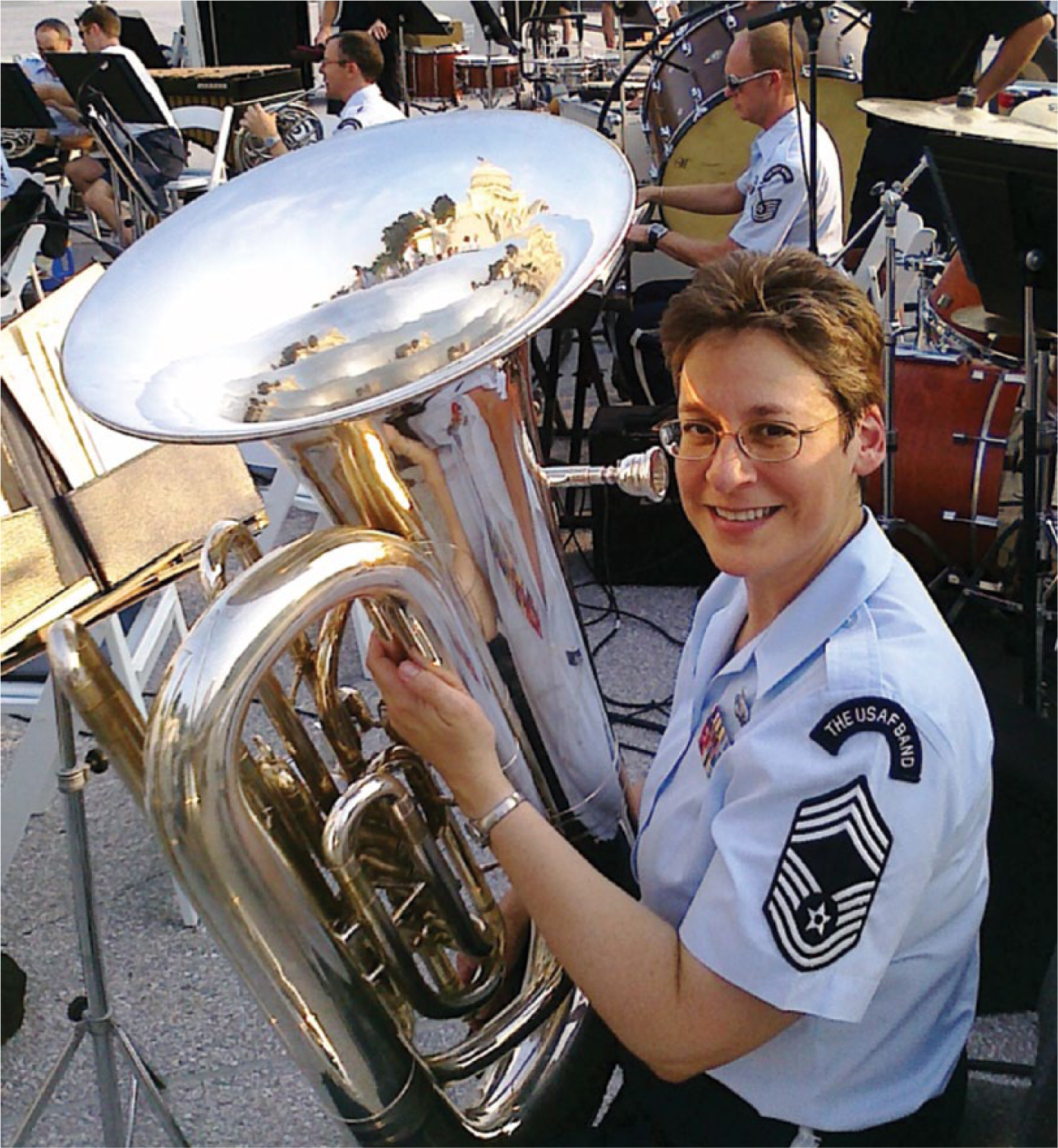
At the conclusion of her studies, she accepted a job teaching middle school band and fifth-grade instrumental and general music, and she also assisted with the high school band for the Chillicothe City School District in Ohio. She only taught for a few months. The Air Force Band held auditions for a tubist in November of 1982. Thirty-seven players, including Duga, auditioned for the spot. When the auditioners realized a woman was among the semifinalists, they put up a screen so they could not tell who was playing. A week later, the call came. She was offered a position with the D.C.-based Air Force Band, and she accepted.
Duga described basic training at Lackland Air Force Base as tough, a “total mind game,” but also noted that tryout weeks for The Ohio State Marching Band had been harder in some ways. For six weeks, she learned military protocol, Air Force history, teamwork, and military marching.
I remember one time in the drills we had to do left turns and right turns and to the rear, about turns, about-face and all this. They would teach it to us, and then they would pair you up with the girl next to you. You had to teach it to them and they teach it to you. We’d be practicing this, and this girl says, “Wow—you do that pretty well,” and I’m thinking, “Yeah, I’ve had four years in high school, four years in the best university marching band in the world, and I can do this.”
She completed basic training and departed for Washington, D.C., as an Airmen First Class (E3) but was immediately promoted to Technical Sergeant (E6) when she signed in at Bolling Air Force Base. “The D.C. premier bands are all based on a special promotion system,” she explained. “Players in the USAF Band must be enlisted, and they are all highly skilled professionals, so the Air Force compensates them with a higher rank to attract world-class talent and make it possible to live and work in the nation’s capital.”
A month later, Duga was off on her first national tour down the West Coast from Washington through California with the United States Air Force Band under the direction of Colonel Arnald D. Gabriel. It was just the first of many travels through the United States as well as international performances in several European destinations. One such trip was to Russia to play in Moscow in 1995 commemorating the fiftieth anniversary of V-E day: [The USAF Band] was the band representing the United States, and we played alongside the Russian Red Army Band. That was cool. We brought some extra uniform pieces and equipment to swap or to give because they have a hard time getting some of that equipment. I brought some old mouthpieces and valve oil and one of the tuba players was so happy. But he didn’t have anything to give me, so he took a patch and ripped it right off his uniform and gave it to me. That patch is in my shadowbox along with all my Air Force patches. That was one of the coolest memories of being there.
When the band was not traveling, its members had a full schedule of concerts and official events in the nation’s capital. One of Duga’s earliest parades was the procession that preceded the internment of the Vietnam War Unknown Soldier at Arlington National Cemetery. The rehearsal day was hot and the route was long, beginning at the Capitol and proceeding past the Lincoln Memorial, onto the Memorial Bridge, then into Arlington. The band’s trainer kept an eye on the new, female tubist. “Early on, I think I did pleasantly surprise people with what I was doing, because they didn’t expect me to be able to complete the parade route,” Duga commented.
Duga marched in inaugural parades for presidents Ronald Reagan, George H. W. Bush, William Jefferson Clinton, and George W. Bush. For President Clinton’s 1993 inauguration, she was assigned to play ceremonial music at one of the many balls that evening. Duga and the band waited over seven hours to play “Hail to the Chief” for the president’s arrival. She says the wait was worth the moment: I was so excited, you know—my heart is jumping out of my throat; I was almost hyperventilating! I’m like, “This is what you see in the movies; this is what you hear on TV and stuff and I’m doing it! We are actually doing it!”
Other performances were marked by sadness and remembrance. Duga described a concert in Portland, Maine, during the Persian Gulf War. The vocalist started to sing “America the Beautiful,” and the entire audience stood up. “It was such a showing of patriotism and solidarity; we were all in tears,” she shared. Three weeks after the attacks of September 11, 2001, the Air Force Band kept its commitment to tour and set out to play a series of community relations concerts. “We had packed audiences,” Duga recalled. “It really made a difference; it was a healing process for everyone so soon after 9/11. To see that, even to have some of the band members experience, for the first time, that the job that they were doing really affected people and meant something was an eye-opener.”
As the years progressed, Duga advanced in rank and took on greater responsibilities within the Air Force Band organization. She served as the tour manager for seven years and was the superintendent of the band, the second highest enlisted leadership position in the organization. She was promoted multiple times, achieving the highest enlisted rank of Chief Master Sergeant in 2004. She hopes that the women who see the stripes on her sleeves see them as evidence that women “can do this. You just never know what is going to inspire somebody.”
“Living Martye’s Dream”
Following their meeting at the 1993 International Women’s Brass Conference, Duga and Awkerman kept in touch. Awkerman sent newspaper clippings and other information about the WAF Band to Duga, and Duga would call Awkerman and share stories of her work and travels with the Air Force Band. A few years later, Dixie Johnson, a WAF Band member from 1952–55, started an effort to preserve the WAF Band’s history. She reached out to Chief Master Sergeant Joe Tersero (now retired), the Air Force Band’s Chief Librarian and unofficial historian. Together they rescued mold- and water-damaged documents from Captain Nissly’s basement and carefully set about restoring them.
At the same time, WAF Band members began holding annual reunions. One of their first projects was to gather together artifacts of their service—photographs, orders, uniforms, programs, newspaper clippings—and donate the collection to the Schlessinger Library at Harvard University. In 2001, the WAF Band celebrated its fiftieth anniversary in Washington, D.C., and played for the dedication of the Women in Military Service for America (WIMSA) Memorial at Arlington Cemetery. Colonel Lowell Graham, Commander of the Air Force Band at the time, invited the WAF Band members to the band hangar at Bolling Air Force Base. After touring the facilities, the colonel invited the WAF Band to sit in with the Air Force Band, and together they played “The Stars and Stripes Forever.”
Chief Master Sergeant Tersero organized an effort to commemorate the history of Air Force bands by creating display cases filled with historical artifacts and documents. One case was dedicated to the WAF Band. As she was working on the project, Duga ran across the outprocessing document listing what the last few WAF Band members planned to do when the band disbanded: A lot of them wanted to be flight hostesses. Some wanted to get out, get married and have kids. Some were disgruntled with having been disbanded; they were just upset—you get that from the tenor of what they wrote. Martye’s was the last name—you know it’s funny, hers is the last name and it starts with an A—hers read something like, “To play in the U.S. Air Force Band in Washington, D.C.” That was her wish to do after she got out of the WAF Band. I saw that and I got a lump in my throat.
Duga later wrote that seeing Awkerman’s entry “hit me like a ton of bricks. Here I was, and with all the other women who’ve served as members of the D.C. band since 1973, living Martye’s dream.” 26
In 2007, Awkerman, now in failing health, moved back closer to family in Carlisle, Pennsylvania. Duga visited a couple of times. “We would just talk. She was just so enamored of my career and was just so supportive,” she shared. A short year later, Awkerman passed away. Duga, Joe Tersero, and a few WAF Band members attended the funeral. Duga asked the American Legion honor guard if she could pass off the flag to the next of kin. The request was granted. “It was a sad day,” she remembered. “Passing off the flag is not an easy thing to do, but it’s such an honor. It was just very special to be able to do that for Martye.” She later wrote in tribute: Martye left an indelible mark as a pioneer for women brass players and as a legendary musical icon. Her stellar musical and leadership contributions began paving the way 30 years before I joined The USAF Band. I honor her legacy as one of many who have realized Martye’s dream and continue to carry on the tradition of excellence that was her forte. In the Air Force, we call it “Being faithful to a proud heritage.” I think her life speaks volumes for all women brass players who set their sights high and persevere in attaining their goals.
26
After thirty years of military service, Chief Master Sergeant Jan Duga retired in 2013. “I got paid to play my horn and serve my country; it was just a fabulous career,” she declared. As of this writing, she remains the only woman tubist to have served with any of the premier service bands in Washington, D.C. “I didn’t choose to be first,” she explained, “I just happened to be first.” Like Awkerman, Duga recognizes that these firsts are important for all American bandswomen. “We are all pioneers. Not that it will be easier for women to get in; it’s just that it’s been done. We blazed that trail.”