Abstract
Early in my teaching career, my goals were to teach students to play their instruments beautifully and to help them correctly and independently interpret music notation. However, many of my students were missing the internal musicianship skills that enable high-level music-making. As we teach instrument technique and notation, we sometimes overlook the important skill of audiation. When our students perform, we want them to do so not only because they have visually interpreted their written notation, but because they have aurally internalized what makes musical sense. This article offers activities for developing beginning instrumental students’ abilities in three areas of musicianship: rhythmic ability, tonal ability, and creativity.
As a beginning middle school band director, I conceived of my role as basically twofold: to teach students to play their instruments beautifully and to teach them to correctly and independently interpret music notation. Soon, it became apparent that many of my students were missing something perhaps more important—the internal musicianship skills that enable high-level music-making. I remember wondering why students could not keep steady time or hear missed accidentals, getting looks of terror when asking students to improvise, and questioning why students understood the “rhythm tree” but still could not accurately perform simple notated rhythms. My students could read notation and manipulate their instruments but had difficulty discriminating pitch, keeping time, and playing creatively. I had developed their (external) mechanical skills but ignored their (internal) musicianship skills.
How can music teachers best help their students internalize the music they study? Here are some suggestions.
Edwin Gordon makes a distinction between executive skills and audiation skills. 1 Executive skills are the skills involved in physically manipulating the instrument (posture, hand position, range, facility, breath support, embouchure, tone production, etc.), often referred to as “technique.” As music teachers, we generally do a good job developing these skills in our students, probably because much of the time in our college methods courses was devoted to learning how to play and teach secondary instruments. But sometimes, in an attempt to equip students with the myriad executive skills they need to successfully manipulate their instruments, audiation skills (the ability to hear and comprehend in one’s mind sounds that are not physically present) can be overlooked.
Incorporating audiation skills development into what was previously a twofold understanding of my responsibility as a band director (technique and notation), I now conceptualize music teaching in terms of developing five distinct areas of musicianship. These areas, which I call “The Big 5,” consist of rhythmic ability, tonal ability, executive skills, notation-reading ability, and creativity (see Figure 1). Often what seems to be an inability in one area may really be a symptom of an entirely different problem. For example, a student consistently plays a B-flat when a B-natural is clearly indicated. To address this, the teacher directs the student’s attention to the key signature and reminds the individual of the fingering for B-natural. The student nods, and the teacher proceeds thinking that the student’s misunderstanding was corrected; after all, the student is now playing the correct pitches. The student may be well aware of how to read notation and know the fingering for the correct note; the problem may be that the student was aurally unaware that the note was incorrect in the first place. If this were the case, the teacher’s time would have been better spent on developing the student’s tonal ability.

Teaching the “Big 5”
Another example where a problem in one area of the Big 5 might masquerade as a problem in a completely different area is when a student plays an incorrect rhythm. The teacher might presume that the incorrect rhythm is a result of a poor understanding of notation. Or, the student might cognitively understand the rhythm but because of poor technique be unable to accurately execute the rhythm. But perhaps the problem stems neither from poor notation-reading ability nor from poor technique but from an underdeveloped internal sense of steady time that prevents him or her from maintaining the beat. In such a case, the teacher should spend time developing the student’s rhythmic ability. When considering that many challenges that students encounter could realistically stem from any area of the Big 5, it is often difficult to determine the source of the problem. Furthermore, as experienced musicians, we draw from all of these areas simultaneously when performing, thus it is easy to forget that they are distinct areas that must be developed independently in beginners. 2
Students need to understand notation and properly manipulate their instruments, but it is important that these skills stem from audiation. 3 When technique and notation are realized through an aural sensitivity to sound, performance is transformed from an act of mechanics to an expression of musicianship. Since band directors generally do a great job teaching executive skills and notation, this article focuses on activities for developing beginning instrumental students’ abilities in three commonly underdeveloped areas of the Big 5—rhythmic ability, tonal ability, and creativity. Many of the activities presented in this article are associated with or drawn from Music Learning Theory; however, this article is neither sufficient as, nor intended to be, an instructional guide for implementing Music Learning Theory. For instruction in Music Learning Theory, readers are strongly encouraged to consult the writings of the original authors and attend certification workshops through the Gordon Institute of Music Learning. 4
Developing Rhythmic Ability
I conceive of rhythmic ability as one’s skill at performing rhythms in the context of steady time. One’s rhythmic ability is independent of one’s notation ability. A student may have a well-developed internal sense of rhythm without the ability to read rhythmic notation, and vice versa. Just think of all of the complex rhythm patterns in world drumming traditions that are performed without written notation; these performers have highly developed rhythmic abilities.
The use of movement is essential to the development of rhythmic ability. 5 Many ensemble directors teach their students to tap their toes to the beat; however, starting with toe tapping may be challenging for students who are unable to keep a steady beat with their bodies. In these instances, music teachers can draw from Laban-based movements to help students develop a kinesthetic response to music. 6 For example, moving the body in a continuous, fluid manner, or flow, helps students to experience the space between beats. By varying heavy and light body movements, students experience meter and accents. By moving their bodies using both sudden and sustained movements, students can experience time. Instrumental ensemble directors should also draw heavily from the myriad movement activities used in instruction based on Dalcroze, Orff, Kodály, and Music Learning Theory to continue the rhythmic development that was begun in elementary general music classes. 7
Beginning band students want to learn tunes immediately, and teachers can incorporate rhythmic development activities when teaching students to play rote tunes. 8 Using simple three-note melodies such as “Hot Cross Buns” and “Mary Had a Little Lamb,” the teacher could model the tune while students keep the macrobeat (pulse) in their heels and the microbeat (division of the pulse) in their fingertips, allowing students to experience the tune in the context of steady time. 9 The teacher could then chant the rhythmic patterns of the melody and have students echo while maintaining the macrobeats and microbeats. To make sure that students are keeping time independently and not simply chanting a fraction of a second behind the students around them, provide students with a metronome beat, and then turn off the metronome and have students silently audiate the rhythm of the tune inside their heads and raise their hands when they get to the final note of the piece. Teachers might begin by having students audiate only the first few beats and increase the duration as students progress. Once the teacher has taught students the fingerings/slide positions/sticking patterns by rote, students can chant the rhythm patterns while executing the corresponding fingerings/slide positions/sticking patterns in time with a recorded tune, GarageBand loop, or metronome click. By limiting the executive skills demands, teachers can focus on developing students’ rhythmic abilities.
After students learn a simple three-note tune such as “Hot Cross Buns,” the next step might be to teach the same tune in triple meter where students keep the macrobeats in their heels and a triple division of the beat in their fingertips (for an example of how a duple tune might be converted to triple, see Figure 2). Kodály and other approaches, including many of those for band, often use one set of tunes to teach duple meter and a different set of tunes to teach triple meter. While this approach has merit, I also find value in applying both types of beat division to the same tune so that students’ attention is directed toward only one variable—in this case, meter. This also helps students feel the kinesthetic difference between duple and triple beat division before they are asked to understand the notational difference.

“Hot Cross Buns” (Minor/Triple)
Developing Tonal Ability
Think of tonal ability as the ability to differentiate pitch in the context of a tonality. As with rhythmic ability, a student’s tonal ability is independent of the cognitive function of understanding notation. A student may have a well-developed sense of pitch without any cognitive ability to read tonal notation, and vice versa. Many pop and folk artists sing and play beautifully without using (or even knowing how to read) notation.
When a student has a well-developed tonal ability, correct notes become the fruit of audiation rather than the fluke of technique. We want our students to play the correct pitches because they hear that they are correct, not simply because they know the corresponding fingering for each notated symbol. Essential to the development of tonal ability is the ability to match pitch by manipulating the voice. 10 The teacher could ask students to manipulate their voices high and low like a siren until they arrive on a given pitch. Another activity that can help students begin to differentiate pitch is to play three notes that move diatonically such as concert B-flat, C, and D and teach students to associate the pitches with low, middle, and high, respectively. The teacher could then play these pitches in different sequences and ask students to label them as low, middle, or high corresponding to the order in which they were given.
As with rhythmic development, teachers could also use tonal development activities when teaching students to play rote tunes. Teaching simple three-note melodies such as “Hot Cross Buns” and “Mary Had a Little Lamb” by rote, the teacher could first establish tonality and then vocally model the tune for students and ask them to sing it back. Sometimes students are hesitant to sing but will readily play on kazoo what you ask them to echo, which accomplishes the same thing (tonal development) in a way that students sometimes perceive to be less threatening. To help ensure that students are audiating the tune, the teacher could give the starting pitch and ask students to silently sing the tune inside their heads and then sing the last note aloud on the correct pitch. This activity could even be valuable for middle school and high school students who struggle to retain the correct pitches of a phrase from start to finish without the aid of their instruments and/or without the aid of hearing those around them.

Another helpful activity is to sing the tune for students, stop at various places in the tune, and ask them to sing the resting tone (tonic pitch). This activity is aimed at helping students audiate the tonality and key in relation to the melody, leading to improved intonation when performing. This ability will also pay dividends in the future when students are more aurally aware of how their parts function within the ensemble, leading to better balance and blend. When students are singing and audiating the correct pitches of the tune, it is a good time to transfer this understanding to the instrument. After teaching the fingerings by rote, the teacher could then have students sing the tune while pressing the corresponding fingerings. Of course, the end goal is that students play the tune on their instruments, but devoting a little time to preparatory exercises such as these will help ensure that their playing is guided by audiation.
When students can accurately perform a simple three-note tune such as “Hot Cross Buns,” the teacher could then have students learn the same tune by rote in the parallel minor mode. This will help them hear the difference between major and minor in the context of the same tune and in the context of sound rather than sight. As students become comfortable playing three-note tunes, the teacher could pick a new tune that is aurally familiar to them, give them the starting pitch, and ask them to figure out the pitches on their instruments by ear, further solidifying the ear-to-hand connection. This activity could also be used when teaching middle school and high school ensembles by selecting more complex melodies and having students learn them in different keys and modes. Advanced ensembles might still have to start by using only a few notes if this approach is new but will likely advance much faster than beginners will.
Developing Creativity
There are many writings on and definitions of creativity in music, 11 but I find it helpful to think of musical creativity simply as the student’s ability to generate musical ideas apart from that which is externally dictated. Even when our students are proficient at reading notation, manipulating their instruments, differentiating pitch across a range of tonalities, and internalizing complex rhythms in the context of steady time, they are missing a crucial component of musicianship if they have not developed some sense of independent musical thought. Think of all of the garage band members, living room guitar players, and self-taught pianists who create their own music; regardless of their ability to read or write notation, they are functioning as creative musicians.
As music teachers concerned with the ever-looming performance, we often find it easy to spend time teaching notation skills and executive skills at the exclusion of developing students’ musical creativity. However, music educator and improvisation specialist Chris Azzara found that students who receive music instruction that includes opportunities for improvisation performed notated music more accurately than did students whose musical instruction did not include improvisation opportunities. 12 Often, as students gain proficiency reading notation and manipulating their instruments, they become less willing to improvise; therefore, it is usually best to get students improvising as early as possible. Incorporating improvisation exercises into early instruction also signals to students that musical creativity is a tenet of basic musicianship rather than an advanced skill to be developed later.
Music Learning Theory makes a distinction between discrimination learning where students are taught by rote and inference learning where students are asked to make decisions by drawing from information previously learned by rote. Rote learning, or echoing, provides students with the necessary vocabulary to begin making their own musical decisions. Once students have echoed tonal and rhythmic patterns, a sequential next step might be to then have them creatively apply those patterns in ways that make musical sense. Sometimes referred to as “call-and-response,” this can be as simple as the teacher playing the notes B-flat, C, and D using a combination of quarter notes and eighth notes and students providing musical responses using the same parameters. To help ensure that students are making deliberate sounds and not just picking random pitches, the teacher might ask the students to sing their responses before playing them. To help students design their responses in ways that make musical sense according to Western European syntax, the teacher could imply a quasi–half-cadence by ending the first half of a phrase on a dominant pitch (such as C in this instance), with the students’ task being to then complete the phrase and end on the tonic pitch (B-flat in this instance). Creative development can be easier for students when they are given parameters. Students can sometimes be intimidated with improvisation because there are too many choices. When we limit the possibilities, students are often much more comfortable with and successful in making creative music decisions.
Another activity to help students develop creativity is to use previously learned tunes as platforms for improvisation. This could be as simple as playing the first half of “Hot Cross Buns” and having students create the second half by improvising a musically appropriate ending. When students are comfortable creating alternate endings to familiar three-note tunes, the teacher could have students create countermelodies to the same tunes. It is usually best to first model this for students by having them play the familiar melody while the teacher creates the countermelody. This does not need to be, nor should it be, complex; by simply choosing one or two notes and aligning them harmonically, students are making deliberate creative decisions. 13 Finally, the teacher could have students create their own tunes by rearranging the notes and rhythms to familiar melodies. All of these activities could also be used in middle school and high school band settings with the use of more complex literature and a more sophisticated treatment of harmony.
Putting It All Together
Devote time in each class, if even in the warm-up, to developing each area of the Big 5 (see Figure 3 for sample activities that can be used to help students develop in each area). Certainly, the bulk of class time should usually be devoted to rehearsing the ensemble (sound, balance, blend, intonation, etc.), but by beginning every rehearsal with 5 to 7 minutes of audiation-building activities, we help students develop elements of musicianship that can lead to more sensitive and autonomous ensemble playing. I want my students to push the correct buttons at the right time and to do so with a characteristic sound and have found that the quickest and most musically authentic way of accomplishing this is to develop their tonal, rhythmic, and creative abilities. 14 When my students perform from notation, I want them to do so not simply because they have visually interpreted their written instructions but because they have aurally internalized that which makes musical sense. When students aurally recognize that they have missed a note, we no longer have to remind them of their fingerings and key signatures. When students feel the pulse and its division, the cognitive task of recognizing notation becomes that much easier. When students create melodies in their heads and realize them on their instruments, they become independently functioning artists. As students develop their abilities in each area of the Big 5, they get that much closer to becoming comprehensive musicians.
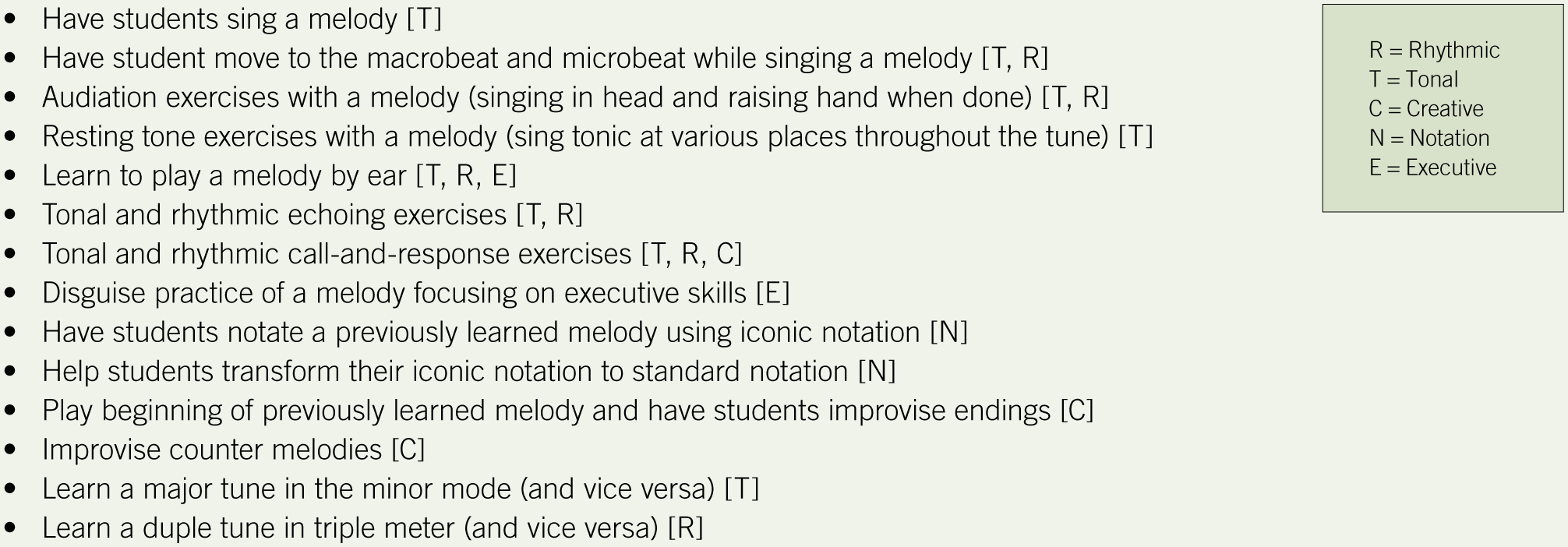
Sample Activities for Developing the “Big 5”