Abstract

Women Drummers: A History from Rock and Jazz to Blues and Country
by Angela Smith. Lanham, MD: Rowman & Littlefield, 2014; https://rowman.com.

Off the top of your head—no web surfing allowed—how many female drum-set players can you name? When is the last time you noticed a female percussionist behind a drum kit? Although women have participated in music-making for thousands of years, they have frequently been underrepresented, marginalized, discriminated against, or left out of written histories. In Women Drummers, Angela Smith celebrates the contributions of an often-forgotten population of female drum-set players who deserve to be recognized for their contributions to modern music.
By providing a comprehensive overview of heroines such as Viola Smith and Sheila E., their stories, their inspiration, and their struggles in the realm of an ever-evolving music industry, Smith helps to fill the gap in musical literature that has previously presented drum-set playing as male-dominated and/or masculine by writing a book on exceptional women drummers in the genres of rock, pop, country, blues, and jazz. In doing so, Smith brings to the forefront of the reader’s consciousness the stories of women pioneers who succeeded despite gender bias and societal attitudes toward females, female musicians, and female drum-set players.
How Do Books Get Reviewed in “For Your Library”?
Do you have a recently published book on music education or music history or a related topic that would be of interest to music teachers? Send a copy for consideration for review to Caroline Arlington, NAfME, 1806 Robert Fulton Drive, Reston, VA 20191. (Review copies must be submitted to NAfME without charge. Copies of books chosen for review are given to reviewers and cannot be returned.) Be sure to include the book’s publication date and the publisher’s name, city, and state, as well as the web address.
For information on how NAfME members can review books for Music Educators Journal, go to nafme.org, choose “MY CLASSROOM,” then “Journals/Magazines.” Under Music Educators Journal, click on Book Review Guidelines.
The format and structure of this book provide a sequential framework in which Smith chronologically unfurls the biographical information, stories, and anecdotes of drummers from the 1920s to the present. It is broken into chapters with creative titles, such as “Hep Girls: The ’40s” and “Jazz Chicks with Chops.” Smith manages to include a plethora of information while maintaining a flow and personal voice throughout the drummers’ narratives. Black-and-white images of the drummers, some in action, provide context and personalize the stories of the women included in the book. Smith’s appendix is noteworthy for the breadth of resources included: a discography, video links, and online resources.
One of the main reasons I applaud Smith and this book so openly is that this book is a symbol of hope for the future. If the women highlighted in this book can persevere through the obstacles, discrimination, and stereotypes they experienced—to make music in the ways they wanted—then a future society that includes less discrimination against female musicians, and more unabashed music-making regardless of gender, seems closer to reality.
Angela Smith, both a music journalist and a musician, clearly did a vast amount of research through methods including but not limited to interviews, e-mail correspondence, and searching to compile the biographies and information included in this book. Women Drummers would be a welcome addition to any music aficionado’s bookshelf, especially for one interested in promoting a more gender-balanced society. Educators and musicians interested in expanding their knowledge of female drummers and where their stories fit into modern music history will find that Women Drummers offers both a wealth of information and a compelling read. Overall, Angela Smith has written an effective resource in Women Drummers—one that informs and inspires.
Lower School music educator,
The Tatnall School,
Wilmington, Delaware;
Patrick Conway and His Famous Band
by Mark Fonder. Delray Beach, FL: Meredith Music Publications: 2012; http://www.meredithmusic.com/.

In the intellectual diet of the instrumental music educator, works such as Edward Lisk’s Creative Director series, Frank Battisti’s On Becoming a Conductor, and James Jordan’s trilogy on the spiritual and philosophical aspects of conducting all play a vital role. We owe an enormous debt of gratitude to these teachers for showing us “how it should be done.” Just as essential, however, and often neglected, are works such as Brian Norcross’s One Band That Took a Chance and Richard Hansen’s The American Wind Band: A Cultural History, for these are the books that show us “how it has been done.” These are not works that discuss abstract scenarios for perfect (and nonexistent) worlds. These are works that tell real stories of real people in real situations, solving real problems. A worthy and timely new addition to that group is Mark Fonder’s Patrick Conway and His Famous Band.
The most salient moral of this particular tale is that the problems that we face as band directors in the 21st century (lack of funding, lack of recognition and appreciation, etc.) are not new and are not insurmountable. It is easy for us in the early stages of our careers to fantasize about the “golden age of the concert band” when every band concert was attended by hordes of people absolutely desperate to hear the latest march—a time when every band director was a world-renowned celebrity with trunks of cash and a mansion in every city. Mark Fonder makes it clear that such an era never existed. Even at the height of his career, Patrick Conway did not own his own home. Virtually every fall, announcements in local newspapers would announce that the famed Patrick Conway Band would surely disband if emergency funding were not secured to finance the next season. The entire story is one of living paycheck to paycheck.
The smaller stories within the larger narrative are all about Conway’s solutions to these challenges, virtually all of which are still applicable in the 21st century. These solutions include creative programming that caters to an ever-changing audience, leading-edge fund-raising tactics, and a rehearsal and management style that cultivated decades-long allegiance from his musicians.
One story that stands out in particular is the backing of the earliest municipal band in Ithaca, New York, by wealthy local businessman Ebenezer Treman. From the very beginning, Treman knew that musical organizations would never be profitable for a city in the traditional sense: they would always cost more money than they made in ticket sales. However, Treman subsidized the band heavily for many years because he comprehended something in 1895 that most businesspeople in the 21st century cannot seem to get their heads around: arts organizations raise the status of a city in a way that is not concretely measurable. When people know that a city has a thriving orchestra, municipal band, art museum, dance company, theatre, or the like, they know in some sort of subconscious way that this would be a good city to settle in. Then they do so, and they bring their minds, their hearts, their souls, and their checkbooks. They buy real estate, eat in the restaurants, support places of worship, and share their ideas and innovations in local industry and government. This is how cities grow and flourish. Every time a city decides to remove its support for an arts organization, it is choking off one of its own roots.
Fonder’s book includes these stories in addition to comprehensive discussions of Conway’s programming and rehearsal style, with copious photographs and concert programs to enlighten the narrative. It will be a valued addition to the library of any wind conductor or band enthusiast.
Doctoral wind conducting associate,
Rutgers University,
New Brunswick,
New Jersey;
Star-Spangled Banner: The Unlikely Story of America’s National Anthem
by Marc Ferris. Baltimore: Johns Hopkins University Press, 2014; www.press.jhu.edu.

With the 200th anniversary of the War of 1812 recently recognized, many teachers in the United States have reviewed both the war and our national anthem that resulted from it. In the summer of 2014, I participated in lesson-plan writing workshops for the Baltimore Symphony Orchestra as it prepared its midweek education concert series. “The Star-Spangled Banner” was the theme of one of its concerts. Having just done my own research and writing on the history of the “The Star-Spangled Banner,” I was eager to read Star-Spangled Banner by Marc Ferris.
This is an American history book, not a music history book. The author is not a musician: he refers to a musical portion of the Catholic mass as the “communion-wafer ceremony.” He gives a truncated and somewhat misleading explanation of the rise of municipal and military bands in the United States, and he poorly words a sentence about the original key of “The Star-Spangled Banner.” I understand his point: the song is difficult to sing in the key of C major because of the high range of the second strain. (I start my own choirs a third lower, in A major.) However, his wording could make a reader think the key of C is the most difficult key in the world. He also drops tantalizing hints, such as mentioning that Francis Scott Key penned lyrics to hymns in the Episcopal Hymnal, but then never elaborates further. Nit-picking, I know, but noticeable to trained musicians.
Reading the book as American history proved enjoyable. The book is divided into chapters by periods, with each chapter discussing the state of the union and its relationship to our national anthem. I wish the author would have spent more time on the actual events surrounding the writing of “The Star-Spangled Banner.” Ferris hits all the major historical points, but he left me wanting more detail. Apparently only YouTube today matches the nineteenth century in musical parody, and Ferris gives many amusing examples of different uses for the tune of “The Anacreontic Song,” also known by its first line, “To Anacreon in Heaven.” (This English drinking song provided the tune to which Francis Scott Key wrote the poem “Defence of Fort McHenry,” the lyrics for America’s current national anthem.) Even more amusing is the final chapter, where Ferris recounts the wide variations in performance of the anthem, ranging from the intentional to the accidental. While reading the Civil War section (“American Discord”), I was amazed to learn that the piece survived that conflict mostly unscathed. Also amazing is the long battle to officially name “The Star-Spangled Banner” as the national anthem of the United States. It became the official national anthem only in 1931. For many years, “The Star-Spangled Banner” was grouped with any number of other songs we would refer to as “patriotic.” In fact, foreign diplomats often had to ask the United States what song should be played at formal functions. For music teachers with an ax to grind about performances of our national anthem, I smiled when reading that in 1899, a reporter complained that many Americans showed no respect whatsoever for their national symbols. Some things never change.
General music and chorus teacher,
Harford County Public Schools,
Bel Air, Maryland;
Engaging Musical Practices: A Sourcebook for Middle School General Music
edited by Suzanne L. Burton. Lanham, MD: Rowman & Littlefield Education in partnership with National Association for Music Education, 2012; https://rowman.com.

In our current middle school general music landscape, a great variety of curriculum types and course foci exists. A majority of these are acknowledged in Engaging Musical Practices: A Sourcebook for Middle School General Music. Containing twelve diverse chapters, this book is a combination of both research-based and classroom-practical information and therefore can find use in the collections of a variety of readers.
Chapters are contributed by teachers and higher education faculty primarily from the Northeast section of the United States. The book is as described—a sourcebook, not to be confused for either a comprehensive review of any one subject or a collection of lessons. Each chapter has its own format, which means there are a variety of approaches taken by the authors to describe their topics. These chapters are filled with either textual information, like those on special needs and adolescent development, or more practical information for teachers getting started in the area of middle school general music. Perhaps the most immediately informative for those looking for new ideas for the middle school general music class are the chapters on steel drum, drumming and percussion, keyboard, and guitar. As many teachers have not received comprehensive training in these areas, these chapters provide graphs and pictures for understanding instrument basics, beginning lesson ideas, and lists of further resources. Those who are not looking to introduce new instruments to their curricula may find inspiration in other chapters, which provide ideas for songwriting, film scoring, center-based classroom activities, and using technology for interactive music-making.
A thorough understanding and acknowledgment of middle schoolers’ needs to be active, personally engaged, and social learners is present throughout this compilation. As such, the book presents middle school general music not as music education’s ugly stepchild, or as an advanced elementary general music class, or as a passive music history or music appreciation experience, as has sometimes been the case for this adolescent alternative to ensemble classes. Instead, it presents subject matter that can help teachers organize a developmentally appropriate and engaging general music experience uniquely for middle schoolers.
I would recommend this book to new middle school teachers who are not sure where to begin with their curriculum planning, experienced middle school teachers who may want to introduce a new component to their curricula, or those looking for a potential textbook for a middle school general music methods course.
Graduate student,
Developmental psychology,
Arts and Mind Lab,
Boston College,
Boston, Massachusetts;
The Complete Idiot’s Guide Music Dictionary
by Stanford Felix. New York: Penguin Group, 2010; http://www.amazon.com/Complete-Idiots-Guide-Music-Dictionary/dp/1592579973
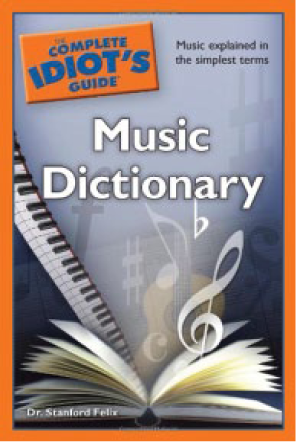
In his book The Complete Idiot’s Guide Music Dictionary, author Stanford Felix makes the claim that the work offers “music explained in the simplest terms.” Indeed, Felix has done just this. He uses what he calls “layman’s terms” to clearly define topics that in other resources might be understood only by a doctoral music student.
The dictionary aims to give short and easy-to-understand definitions to many music terms and concepts. It covers musical notation, music theory terms, introductions to major works, musical instruments, music technology, and biographies of composers from many genres. Generally, the book is very helpful, but I noted one confusing example on page 71 in the definition for double sharp. Felix writes, “It’s indicated by two sharp signs side by side in front of a note. . . .” While this may be so, it is not typical and does not match the accompanying graphic below the definition. However, as a whole, this dictionary is useful for anyone needing the basics of music or a brush-up for a music history course. Most of the instruments and musical notations included in the dictionary have an accompanying graphic to provide clarity to the reader. The biographies include brief personal information, major contributions to the field of music, and many well-known works, all of which make the dictionary a good springboard to further learning.
Felix has also included a wide-ranging list of other books and online resources covering the various topics discussed in the dictionary, including other music dictionaries. There is also a visual index that displays the musical symbols and notations, and where to find their definition in the dictionary. For a beginning-to-intermediate understanding of only the “most interesting and necessary music terms” (p. ix), this is the dictionary to choose.
Elementary music teacher,
Warsaw Community Schools,
Warsaw, Indiana;