Abstract
Four components of the Kodály concept are delineated here: philosophy, objectives, essential tools, and lesson planning process. After outlining the tenets of the Kodály philosophy and objectives, the article presents the Kodály concept’s essential tools, including singing, movable do solfège, rhythm syllables, hand signs, singing on letter names, and movement. The article concludes by summarizing the traditional Prepare-Present-Practice-Assess lesson planning process.
Your students can benefit from what you learn from Zoltán Kodály.
Familiar to many, the Orff, Kodály, and Dalcroze approaches offer different concepts 1 for teaching fundamental musicianship skills to children. In an attempt to distinguish these concepts, stereotypes often emerge: the use of barred and unpitched percussion instruments often signifies Orff, solfège and hand signs indicate Kodály, and movement is a sign of Dalcroze. It is not uncommon for most or all of these types of activities to be incorporated into general music classroom lessons. These activities in and of themselves, however, do not reveal the philosophy, objectives, tools, and suggested instructional sequences unique to each concept.
I used to believe that I was “doing” all of these concepts in my general music classroom because I had incorporated different types of Orff, Kodály, and Dalcroze activities into my lessons. But my application of each concept was more cursory than comprehensive. My endeavors were noble: I wanted a balanced and inclusive classroom. However, I came to realize that I was teaching with a mere drop from each bucket. With subsequent and ongoing research on Orff, Kodály, and Dalcroze, I found that though I could appreciate each concept, I needed to delve more deeply into the philosophy, objectives, tools, and suggested instructional sequences of each before I could say that I was authentically “doing” them.
As a singer, choral conductor, and teacher in K–12 and collegiate settings, I gravitated toward the Kodály concept, and I feel quite at home there. My Kodály training has made me a far better musician and teacher, and I present an overview of this concept here. My hope is that those who read this article will also be inspired to learn more about the concept and perhaps attend the Kodály workshops, conventions, and summer training sessions. This could then move teachers past solfège and hand signs toward a deeper understanding of the Kodály concept.
The Kodály Concept
Although Zoltán Kodály’s vision and philosophy guided and inspired it, the concept was developed by his colleagues in Hungarian schools in the 1940s and 1950s. 2 In 1950, the first “singing primary school” was established in Kodály’s birthplace, Kecskemét, Hungary. Music was a core subject at the school, and students were given musical instruction each school day. Under the direction of Kodály’s longtime friend Marta Nemesszeghy (the primary school’s principal), the faculty refined and developed the concept and used tools in their instruction such as movable do solfège, rhythm syllables, and hand signs that had been borrowed from other countries. In the years that followed, the concept spread to other parts of Hungary, and more than 240 singing primary schools were established. 3
In addition to the singing primary schools, the Kodály concept influenced a national music curriculum in public schools. Now music education is compulsory in grades 1 to 10, and the national curriculum is standardized across Hungary. As with the original singing primary schools, modern music instruction in the early grades emphasizes Hungarian folksongs, and international folksongs and art music are added with greater frequency as the children get older. 4
The Kodály Philosophy
Zoltán Kodály believed that “it is the right of every citizen to be taught the basic elements of music.” 5 To ensure universal access, teacher and administrator Lois Choksy articulates that music instruction should begin with the very young and be part of every school’s core curriculum “alongside math and language.” This “complete education,” according to Choksy, would guarantee that students develop musical literacy that is as commonplace as linguistic literacy. 6 Musical literacy in this case is defined as the ability to read and write notation and create music.
Instruction itself should follow a “child-developmental approach,” that is, one that is “highly structured and sequenced, with well-defined skill and concept hierarchies in every element of music.” 7 Presented material should match the child’s capabilities at any given point in his or her development. Furthermore, material should be taught primarily through singing unaccompanied folksongs of the child’s own linguistic heritage, which constitute a “musical mother tongue.” 8 And because music students learn to value what they are taught, only music of the “highest artistic value, both folk and composed, should be used in teaching.” 9 Finally, central to the Kodály philosophy is that music is to be taught—even to the youngest children—only by those teachers who are themselves excellent musicians. 10
Objectives of the Kodály Concept
Choksy presents four objectives of the Kodály concept, 11 the first of which is that the innate musicality in all children must be developed to the fullest extent possible. Second, students should become musically literate, that is, be able to read, write, and create music using the elements of music (e.g., melody, rhythm, form, dynamics). Third, the students’ musical heritage (folksongs, stories, and rhymes) must be integrated into the music curriculum in a way that honors their culture. Finally, musical masterworks must be analyzed, performed, and listened to so that students will come to a “love and appreciation of music based on knowledge about music.”
I will add one additional objective that most Kodály teachers prioritize but that Choksy does not delineate specifically: to develop in every child the skill of audiation or “inner hearing.” Researcher and teacher Edwin E. Gordon observes that audiation “takes place when we assimilate or comprehend in our minds music that we have just heard performed or have heard performed sometime in the past.” Audiation also takes place when we “hear in our minds music that we may or may not have heard but are reading in notation or are composing or improvising.” 12 When speaking of the importance of audiation, Kodály teachers often quote Kodály himself: “There is no good musician who does not hear what he sees, and does not see what he hears.” 13
Tools of the Kodály Concept
To teach musical elements, teachers need a number of instructional tools that are a means (and not an end themselves) for teaching fundamental musicianship skills. Essential tools of the Kodály concept include singing, movable do solfège, rhythm syllables, hand signs, singing on letter names, and movement. These tools are discussed in the following.
Singing
The central tool of instruction is unaccompanied singing, according to Zemke, 14 because the voice is the “most natural instrument” and is innate to all. 15 Choksy notes that singing is the best foundation for developing musicianship skills because “musical knowledge acquired through singing is internalized in a way that musical knowledge acquired through an instrument—an external appendage—can never be.” 16 Singing is part of virtually every kind of activity in the Kodály classroom; students sing while playing games, dancing, moving, sight-reading, and improvising. For instance, students might, within a single lesson, sing in all of these situations: a finger-play, a folk dance, a songtale, decoding a new melody, adding a melodic ostinato to a known folksong, and improvising with puppets.
Movable Do Solfège
Gordon asserts that the use of movable do solfège with la-based minor offers the most efficacious tonal system. 17 Gordon outlines these advantages: First, do is always the tonic center in a major key, re in Dorian, and so on. (In fixed do, for instance, this is not the case.) Second, chromatic tones are accounted for—each with a different name (do, di, re, ri, etc.). Third, modulations are easy to navigate. Fourth, there are no consonants at the ends of solfège syllables (e.g., as opposed to a number system). Fifth, each interval is replicated regardless of key (do to so is always a perfect fifth, etc.), which allows for memorization of intervals. And sixth, the importance of each scale degree within any diatonic scale is not the same; that is, the tonic functions and “feels” different than the dominant, subdominant, mediant, and so on. That each note in a scale functions differently is memorized and replicated at any tonal center.

Common Rhythmic Solmization Systems
Solfège is used daily in the classroom. Students become so fluent in solfège that they begin to “think” in solfège. This allows them to learn new songs quickly, decode previously unknown melodies, listen analytically, memorize, add countermelodies, read new songs, improvise, and compose.
Rhythm Syllables
Hungarian music teachers adapted rhythm syllables from the work of nineteenth-century French theorist Emile-Joseph Chevé. 18 Rhythm syllables assist students in attaching a short syllabic sound to a specific length duration. There are many rhythmic solmization systems, and four are delineated here. The system traditionally used in North American Kodály programs gives a unique syllable or mnemonic—such as ta for the quarter note and ti–ti for paired eighth notes, and so on—to each of the most common rudimentary rhythms but does not consider a sound’s location within the beat.
Three other rhythm syllable systems (each developed separately) focus on a tone’s location within the beat. First is the “ta/ta-ti” system developed by the Children’s Chorus of Maryland. Second is Takadimi, as developed by educators Richard Hoffman, William Pelto, and John W. White. 19 And third is Gordon’s “du–ta–de–ta” rhythm system. 20
There are, of course, many other rhythm systems, and Kodály practitioners may select rhythm syllables that will work best in their classrooms. However, I advocate the use of rhythm syllable systems based on beat function. Gordon offers specific advantages to such syllable systems. 21 First, syllables for macrobeat and microbeat are different. Second, syllable names for all macrobeats are the same regardless of position in the measure. Third, the name for the beat—ta—stays consistent across meters, that is, the quarter note is ta in 2/4 and 4/4, the half note is ta in 2/2, and the eighth note is ta in 2/8. In the traditional Kodály rhythm syllable system, the beat would be called ta in 2/4 and 4/4, ta-a (or too) in 2/2, and ti in 2/8. This makes composing, decoding, and dictation very confusing in meters other than 2/4 and 4/4!
Rhythm syllables are used in the classroom when sight-reading previously known patterns. As children learn new, more complex patterns, additional syllables are added. Students will learn songs with words, solfège, hand signs, letter names, and rhythm syllables and will be able to move easily from one modality to another.
Hand Signs
John Spencer Curwen (1816–1880) popularized the tonic solfège system and hand signs that had been created by Sarah Glover (1785–1867). His modifications of Glover’s work were then borrowed by Hungarian music teachers who adapted and incorporated hand signs into the Kodály concept (Figure 2).
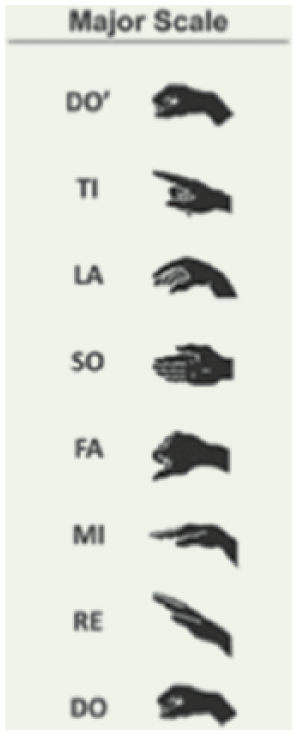
Hand Signs as Adapted by Hungarian Music Teachers

Singing on Absolute Letter Names
Students create hand signs in front of the body with the dominant hand (although some teachers require the use of both hands). Do is placed at or near the navel, and high-do (do’) is placed at either eye or forehead level. Each solfège syllable of the scale is then vertically positioned proportionally between do and high-do (do’).
The efficacy of hand signs has been disputed, 22 but there are widely supported reasons for their use. 23 First, because hand signs are created spatially, they differentiate pitches based on their location in the scale: The relative intervallic distances are mirrored with the use of hand signs. Second, hand signs allow for an additional learning modality. Third, hand signs help students hear, see, and “touch” the pitches on a “tone ladder” in a kinesthetic manner. Fourth, hand signs can improve the accuracy of typically problematic intervals. 24
In the classroom, hand signs are tied to solfège. Sometimes hand signs will accompany solfège singing and other times will substitute for solfège. Students will demonstrate that they can “sing” the tone in their heads while only showing the hand sign. The ultimate goal is for students to be able to audiate when showing the hand signs.
Singing on Letter Names
Letter names, also referred to as “absolute pitch names” or “absolute letter names,” are introduced after solfège is fluent. The use of letter names ensures that students are able to locate pitches quickly on the staff and sing them with confidence. Over time, students learn to sing the letter names interchangeably with solfège. When pieces are sight-read using solfège, the tonic pitch may be moved up or down to accommodate a more comfortable tessitura. When singing on letter names, however, absolute pitches must be used, thereby aiding students’ sense of pitch memory (audiating a C or an A without a reference pitch, for instance). This important skill aids in improvisation, decoding, and dictation.
The German system of letter names (without accidentals) is performed by singing A–B–C–D–E–F–G. When a note is sharped, the “—is” sound (as in geese) is added to the letter; when a note is flatted, the “—es” (as in guess) is added. Exceptions in pronunciation include the following: “Ais” may be pronounced like ace, and Aes may be pronounced like ice.
According to Mícheál Houlahan and Philip Tacka, singing on letter names becomes especially useful when learning an instrument such as the recorder. 25 “Letter names become significant to students,” according to the authors, “when they are applied to an instrument because a letter name has both an absolute position on the staff and an absolute fingering on the instrument.” 26 In the classroom, letter names may be added in about third grade when students have become comfortable with the five-line staff and when the recorder is introduced to the curriculum. With appropriate scaffolding, students will then be able to transpose these songs into multiple keys: The solfège remains the same, and the letter names change with each new key signature.
Movement
Lásló Vikár, an ethnomusicologist and a colleague of Kodály, once said of movement: “Instinctive music is always accompanied by movement.” 27 This is particularly true of Kodály practitioners’ use of movement in the classroom: Students are rarely sitting still. One traditional use of movement in the Kodály classroom is conducting. When conducting, children secure a sense of pulse and gain an awareness of beat hierarchy. 28 Beat hierarchy is the pattern of strong important beats and weak beats that are grouped together. Students internalize these beat groupings to discern a piece’s meter. Conducting also ensures that students execute note lengths to their full value and maintain the musical line’s forward motion. Finally, conducting adds a kinesthetic modality to the musical process.
Second, Kodály teachers infuse movement into lessons through games, dances, and play parties. 29 Beginning with the very young, teachers carefully sequence movement activities to meet the musical and social-emotional needs of children. For instance, in early grades, circle dances and play parties predominate. These dances require play acting (“Ring around the Rosie”), choosing partners (“Bow Wow Wow”), chasing (“The Mill Wheel”), arch forming (“Here Comes a Bluebird”), and winding (“Wind the Bobbin”). As children mature, they are ready for double circles (“John Kanaka”), two lines facing each other (“Lemonade”), and contra dances (“Alabama Gal”). Other movement activities for all ages include passing games (“Button You Must Wander”) and clapping games (“A Sailor Went to Sea-Sea-Sea”).
Third, movement in the Kodály classroom includes structured improvisation. Through the aforementioned games, dances, and play parties, children develop what Choksy calls a “movement vocabulary.” 30 They will then call on this vocabulary to create their own movements to new musical material.
Finally, movement is added to lesson activities to reinforce concepts and skills. Some examples are tracing the contour of a musical line, body percussion (stamping, patting, clapping, snapping), finger-plays, patting the beat, tapping the rhythm, and noting the highest and lowest pitch.
Sequencing for Learning
The Kodály concept embraces the notion that sound precedes symbol, meaning that instructors teach musical skills, concepts, and terminology aurally first. Folksongs and art music are mindfully selected, edited, and ordered with progressive complexity so that skills, concepts, and terminology may be easily extracted and named. Such a repository of literature offers a surfeit of musical fundamentals: scales, keys, rhythms, clefs, musical symbols, form, tempo, dynamics, and more—the elements of music. Solfège, rhythm syllables, hand signs, singing on letter names, and movement serve as basic teaching tools and are integrated into lessons.
Moving always from what is known to what is unknown, Kodály lessons review and reinforce previously learned material before introducing new, increasingly complex musical concepts. Students engage with a carefully scaffolded teaching plan. Over time, students develop a foundation of musicianship that promotes in-tune singing, musicality, inner hearing, and strong music literacy. Kodály spoke of presenting material in this highly sequential and musically intuitive manner: “Music must not be approached from its intellectual, rational side,” he said, “nor should it be conveyed to the child as a system of algebraic symbols, or as a secret writing of a language with which he [or she] has no connection. The way should be paved for direct intuition.” 31
Choksy calls this method of instruction the “child-developmental approach” 32 because instructors continually assess and reassess a child’s capabilities based on age and prior knowledge. To teach rhythm to a first-grade classroom from a purely logical, cognitive standpoint, a teacher might begin by introducing a whole note and then breaking it up into two half notes, four quarter notes, and so on. Logical and feasible, such a lesson plan nonetheless fails to connect with children’s music-making experiences. Because whole notes are uncommon to children’s song literature (consider singing games, improvised songs, play parties, and finger-plays), instruction with these note lengths can be alienating and confusing. Patterns of “long” notes and two “short” notes, on the other hand, appear ubiquitously in children’s song literature, so songs with these rhythmic patterns should be taught first. In a first-grade Kodály classroom, for example, students learn the song “Rain, Rain, Go Away,” which allows them to identify the first line’s rhythm as “long, long, short-short, long.” Soon the students are in the position to attach rhythm syllables to an already familiar song.
The Kodály concept sequences melodic learning in a similar fashion. Kodály practitioners carefully choose songs that evidence appropriate tessitura, melodic range, and that which is most musically intuitive to a child. Choksy asserts that descending tones are easier than ascending tones to match and reproduce. She adds that small skips are easier than narrow steps (e.g., half steps) and that wide leaps are very challenging. 33 Choksy advocates introducing melodic concepts to small children first with so–mi–la songs. Early childhood educator John Feierabend is a proponent of beginning instruction do–re–mi. The classroom teacher will decide on a path that works best for him or her based on the students he or she teaches.
A Kodály sequence would begin with familiar songs, such as “Tick, Tock, Tick-a-Tock,” affording children a tone set with which they can use solfège and hand signs. But teachers offer such songs only if the songs themselves are already familiar, developmentally appropriate songs.
Rhythmic and melodic learning moves along in this way, drawing always from the known to the unknown—sound before symbol. The teaching process might be described as “whole-part-whole” because classes are acquainted first with developmentally appropriate song literature (often by rote) from which musical symbols and terminology are later “named.” Then instructors move on to new, comparable songs using parallel musical material (e.g., similar solfège syllables and rhythmic figures). Students are now prepared to “read” these new songs without rote instruction. As students mature musically, the level of complexity increases.
Common Teaching Sequences
According to the Kodály concept, the teacher sequences melodic and rhythmic elements based on his or her teaching context, considering regional and cultural heritage for inspiration. While there is no one-size-fits-all “method,” many authors, including Choksy, 34 Houlahan and Tacka, 35 Klinger, 36 and Eisen and Robertson, 37 have suggested melodic and rhythmic sequences that general music teachers might use in their teaching. Curriculum creators Michon Rozmajzl and Rosalie Castleberry’s 38 general outline for rhythmic and melodic learning vary only slightly from other printed curricular materials in North America and are viable options for Kodály instruction across many contexts (see Figures 4 and 5).
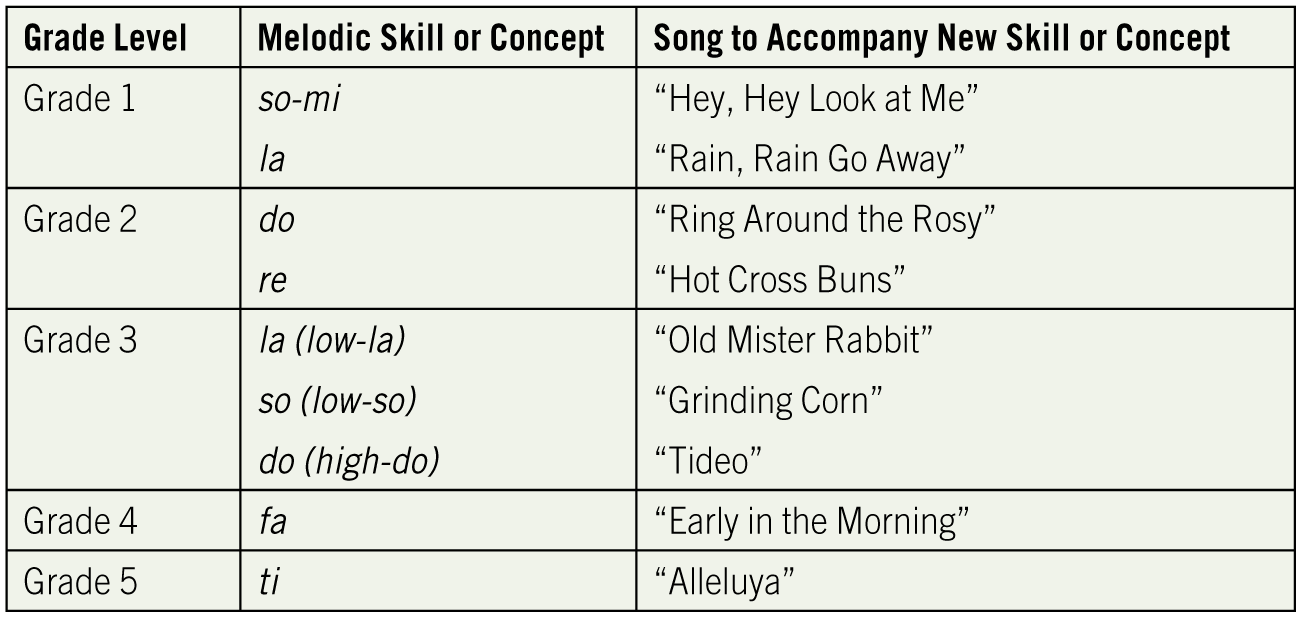
Possible Sequence for Melodic Learning
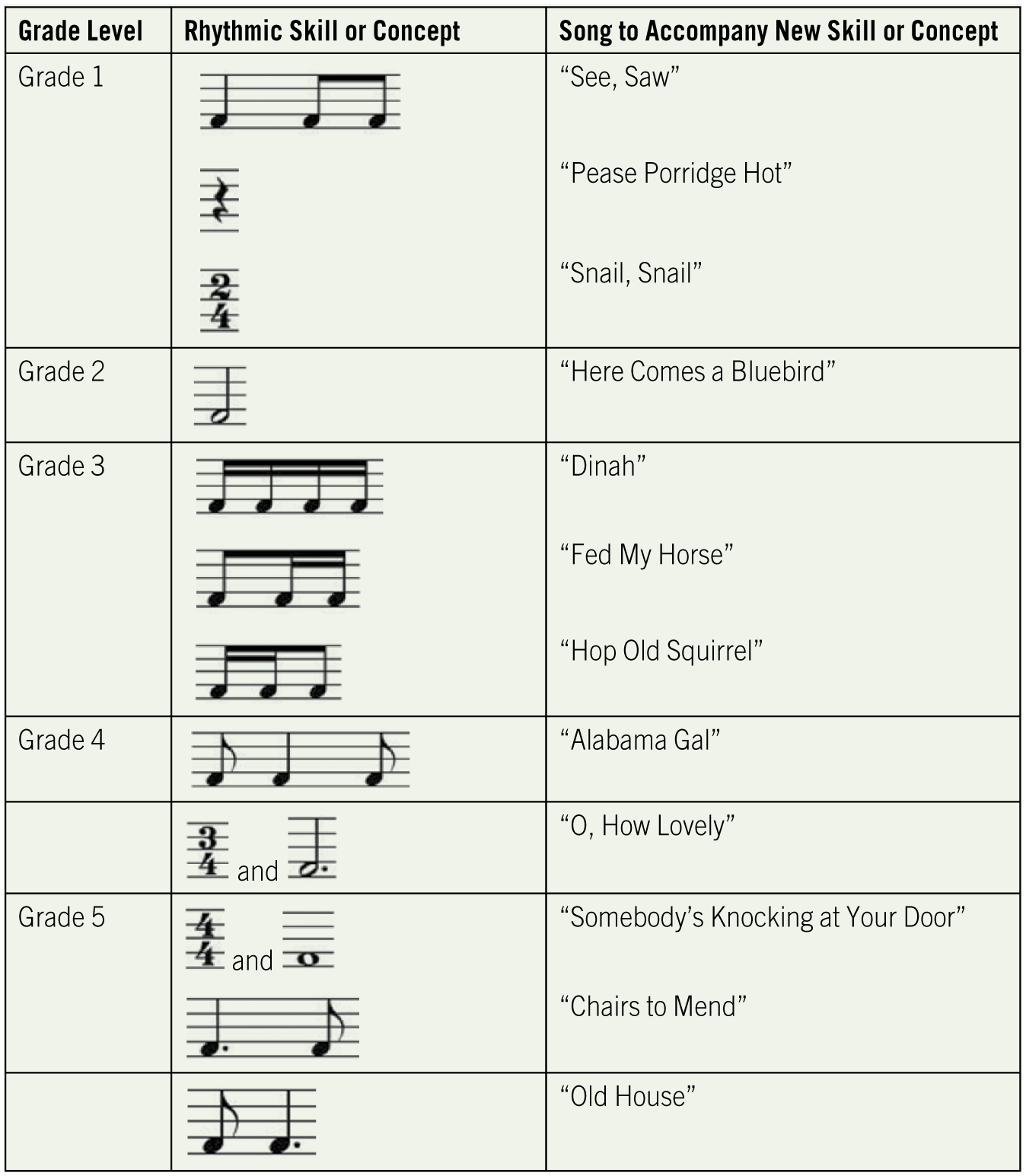
Possible Sequence for Rhythmic Learning
Lesson Planning: Prepare-Present-Practice-Assess
When teachers plan individual lessons and craft a curriculum over the long term, Klinger suggests they continually ask the following questions: What musical skills do the students already possess? What do the students already know, and what can they already do? Then the teacher asks two further questions: What should be taught, and how should it be taught?
39
Teachers structure lessons based on these answers. Klinger recommends a four-tiered planning approach: a prepare-present-practice-assess model used internationally by proponents of the Kodály concept:
List of Kodály Method Books
Choksy, Lois. The Kodály Method I: Comprehensive Music Education. 3rd ed. Upper Saddle River, NJ: Prentice Hall, 1999.
Choksy, Lois. The Kodály Method II: Folksong to Masterwork. Upper Saddle River, NJ: Prentice Hall, 1999.
Eisen, Ann, and Lamar Robertson. An American Methodology: An Inclusive Approach to Musical Literacy. 2nd ed. Lake Charles, LA: Sneaky Snake Publications, 2010.
Houlahan, Mícheál, and Philip Tacka. Kodály Today: A Cognitive Approach to Elementary Music Education. Oxford: Oxford University Press, 2008.
Klinger, Rita. A Guide to Lesson Planning in a Kodály Setting. Rev. ed. Cleveland, OH: Cleveland State University, 2001.
Rozmajzl, Michon, and Rosalie Castleberry. Rhythm and Melody Concepts: A Sequential Approach for Children. Fairfield, NJ: Pencil Point Press, 1995.
The Big Picture
The Kodály concept is more than hand signs and solfège, and I hope that music educators are inspired to bring the concept to their classrooms in a comprehensive way. By comprehensive, I mean that teachers should seek out workshops, conferences, conventions, summer training sessions, and books to fully engage with the Kodály philosophy, objectives, tools, and suggested teaching sequences. Many North American authors, including Choksy, Houlahan and Tacka, Eisen and Robertson, Rozmajzl and Castleberry, and Klinger have already adapted the Kodály concept and published comprehensive methodologies that are well suited for general music classrooms. Their materials explain how to structure and deliver the concepts of a Kodály curriculum using authentic folksongs and composed music as core teaching material and demonstrate how to plan for instruction over the course of a day, a month, and a year using the prepare-present-practice-assess teaching process.
This article offers the big picture and may be considered a beginning step down the road to universal musical literacy for our students. Seek out these other learning opportunities and put the objectives, tools, and suggested learning sequences into action. You may then be confident that you are “doing” Kodály.