




Abstract

The Owner’s Manual to the Voice: A Guide for Singers and Other Professional Voice Users
by Rachael Gates, L. Arick Forrest, and Kerrie Obert. New York: Oxford University Press, 2013; oup.com

It’s true: All the things that we know about the singing voice that we couldn’t explain are now described and confirmed in this informative book! You shouldn’t drink dairy products with fat before you sing because the digestive tract secretes a thick mucus to help digest the fat, and thick mucus on the vocal folds makes singing difficult. You always should drink plenty of water, and not just during a performance, because the body uses water to create the thin film that lubricates the vocal folds.
The Owner’s Manual for the Voice is full of interesting facts that make you stop reading to tell someone near you, “Hey! Did you know that your trachea is about the diameter of your index finger?” Or this one: The vocal folds do not take up the entire “neck” area but instead cover an area shaped like a “V” and about the size of a quarter for a bass, a nickel for the average adult male, and a dime for a female adult soprano. Or this very important one: When looking for an ear, nose, and throat specialist, the best doctor for a singer is the laryngologist.
How Do Books Get Reviewed in “For Your Library”?
Do you have a recently published book on music education or music history or a related topic that would be of interest to music teachers? Send a copy for consideration for review to Caroline Arlington, NAfME, 1806 Robert Fulton Drive, Reston, VA 20191. (Review copies must be submitted to NAfME without charge. Copies of books chosen for review are given to reviewers and cannot be returned.) Be sure to include the book’s publication date and the publisher’s name, city, and state, as well as the URL.
For information on how NAfME members can review books for Music Educators Journal, go to nafme.org. Find the “Book Review Guidelines” under Music Educators Journal.
The book covers everything about the voice. It includes information on the physical structure of the voice, how it relates to other parts of the anatomy, and how it works. It includes information about caring for the whole singer: body and voice. It covers all sorts of vocal disorders. It discusses various medications and their side effects for singers and offers suggestions for alternative medications. There is a chapter titled “troubleshooting” intended to guide you to the appropriate chapter based on your symptoms (voice tires as the day progresses, you wake up coughing, it hurts to swallow). There is a chapter titled “Indirect Culprits” that discusses how other factors such as pregnancy, sleep apnea, or allergies can affect your voice. The second half of the book deals with finding the right ear, throat, and nose specialist; what will happen in a visit; various methods used to diagnose vocal problems; and what will happen in a vocal surgery.
The authors include a professional singer with a doctorate in music, a medical doctor, and a clinical voice pathologist. They write in an authoritative voice that is still conversational. With articles in professional journals using the passive voice or phrases such as “it may be . . . ” or “singers may want to . . . ”—almost as if the author can’t possibly commit to a thought or suggestion—I appreciated the authors’ firm and confident tone. They don’t shy away from medical terminology but explain it and even include a guide for using the right term when talking to your doctor. Say “laryngeal prominence” instead of “Adam’s apple” and “larynx” instead of “voice box.” (There’s no “box!”) Warning to the medically squeamish: Black and white photos abound in the book, and there is also a website with color images and videos that correspond with the text.
I could wish for nothing more in this book except an edition for grades 6–12 so that I could make it required reading for my students.
Vocal music teacher,
Southampton Middle School,
Bel Air, Maryland;
On Becoming a Conductor: Lessons and Meditations on the Art of Conducting
by Frank L. Battisti. Galesville, MD: Meredith Music Publications, 2007; meredithmusic.com
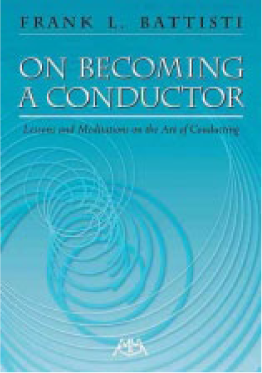
Frank L. Battisti’s legacy and contributions to the wind band world should not be new knowledge to any conductor-teacher. Along with being a renowned conductor, educator, and music advocate, he is considered one of the world’s foremost authorities on wind literature. After much anticipation from friends and colleagues, he finally puts his thoughts and ideas on conducting and teaching into a practical handbook for educators on any level. On Becoming a Conductor: Lessons and Meditations on the Art of Conducting is an in-depth, fully comprehensive guide to all aspects of developing and functioning as a conductor-educator. What makes this textbook terrific is that along with his own experiences and ideas, Battisti fills his pages with quotes from famous conductors, educators, and musicians.
The book is organized into eight parts, beginning with an introduction that offers observations on the role and responsibilities of the conductor by composers, conductors, and writers. Those quoted include Felix Mendelssohn, Leonard Bernstein, and Helen Epstein of The New York Times. Each chapter provides multiple viewpoints as Battisti compiles lists, tables, and quotes from a variety of sources. The author is also eager to provide his own reflections and comments for each topic.
Part I offers recommendations for the personal characteristics, knowledge, skills, and experiences that are essential to conductors. The topic of dedication is also discussed. In Part II, Battisti provides a guide for selecting literature and score study and fills the pages with practical examples and exercises. Young directors will be eager to get their hands on the table of clefs and instrument transposition charts found in this section.
In Parts III and IV, Battisti takes a look at the role of the conductor as a creative interpreter, using what Gunther Schuller calls “the realization of music” as a guide. The section on conducting technique ends with comments from maestros such as William Steinberg and Seiji Ozawa.
Topics dealing with rehearsals, such as planning, considerations, and seating arrangements, are covered in Part V. Battisti has compiled an intriguing table of seating arrangements of great wind conductors dating back to the 1950s. The reader will be fascinated and inspired when comparing the seating arrangements of some of the greats, including Fennell, Revelli, Junkin, and Timothy Foley of the United States Marine Band.
Young conductors will find Parts VI and VII extremely informative and will benefit from Battisti’s expertise in guiding a conductor’s musical development. These sections overflow with advice and guides for self-evaluation and reflection as well as for student assessment in a conducting setting. The book concludes with a list of conductor “Dos and Don’ts,” followed by a touching poem by Warren Benson.
Anyone interested in discovering inspiring, fresh perspectives on conducting will not want to miss this book. On Becoming a Conductor is a compilation of more than fifty years of knowledge from the experiences of one of the most important minds in music. The thoughts, ideas, practical examples, and exercises found in this work make it an invaluable resource for conductor-educators of any background and experience level. This book is highly recommended to all.
Graduate teaching assistant,
Auburn University,
Auburn, Alabama;
Including Everyone: Creating Music Classrooms Where All Children Learn
by Judith Jellison. New York: Oxford University Press, 2015; http://global.oup.com/

For music teachers who have experienced the challenge of finding effective ways to teach students with disabilities and those who are struggling academically and socially in school, Judith Jellison’s new book Including Everyone: Creating Music Classrooms Where All Children Learn provides welcome relief and practical answers. The author begins by setting the tone for the book, shifting readers’ attention from labels and symptoms to a view that encompasses a universal approach to instruction, one that “moves away from the view of students in separate groups and toward a view of students on a continuum of all learners” (p. 96). She offers ideas for instruction that will allow all children, including those who are typically developing, to be more successful and happy in music classrooms and rehearsal.
After establishing the idea that children of all ages and abilities can develop musically, Chapter 2 asks music teachers to consider the overall goals of music teaching. What do we want all students to do with music after they leave the classroom? In what ways are we structuring our curriculum to prepare students for a musical life beyond the confines of the classroom? Teachers can provide opportunities for students to explore their fullest potential and incorporate music into their adult lives. Jellison offers specific ways to design a music program based on a principle of transition—a program that will prepare students for a musical life not only in school but also in adult life.
Children have diverse capabilities, interests, and levels of motivation, and teachers must make decisions that are not only about music goals. Children’s success in school can be dependent on many factors. Chapter 3 presents research and strategies focusing on four principles that serve to guide all decisions regarding children’s music experiences and that will also foster a culture of inclusion (culturally normative music experiences, peer interactions, self-determination, and collaboration). Chapter 4 focuses directly on music learning goals and provides practical applications of principles within a universal approach for instruction. Numerous examples show how universal strategies can be applied in all types of music classrooms (elementary, band, choir, orchestra, nontraditional ensembles). Text boxes provide useful checklists and outlines to assist teachers as they develop strategies for their own students and classrooms. Interesting essays on history and the law appear in appendices, and a section offers activities for readers to “learn more.” To complement the book, Jellison provides a companion website with materials that are coordinated with chapter information. Among these are profiles of students in a range of classrooms settings and lesson plans showing how universal strategies and other principles are used to include these students in classroom and rehearsal experiences. Other information focuses on types of disabilities and current laws.
Jellison expertly provides both a wide lens to address the deepest issues relevant to inclusion as well as a focused lens to address effective implementation. The practical guides based on underlying principles of meaningful instruction make this one of the most valuable books on the subject to date.
Associate professor of music education,
University of North Texas,
Denton, Texas;
Teaching Music through Performance in Middle School Band
compiled and edited by Richard Miles. Chicago, IL: GIA Publications, 2015; http://www.teachingmusic.org

Richard Miles has compiled and edited another essential resource for band directors in the Teaching Music through Performance series. Several accomplished band instructors have provided comprehensive knowledge that continues to bridge the gap between the beginner and the advanced band series. However, this book can stand on its own as an essential resource for the middle school band director.
This work should be a required textbook for any student seeking to become a band director. Chapters 1 through 6 contain vital information covering organization and administration, developing proper instrumentation, recruitment and retention, mastering fundamentals, literature selection, and teaching and rehearsing the middle school band. Several illustrations are presented throughout these first six chapters providing successful models for recruitment letters, rehearsal planning, tone and technical exercises, literature review sheets, and program templates. These illustrations provide band directors with opportunities to adjust the proposed formats and content to fit individual program needs. Though musical advocacy is not a focus of any single chapter, all the authors describe advocacy in various lights throughout their chapters. While each band program differs in a variety of managerial procedures, the fundamental element of musicality is clear in each chapter on music instruction and is affirmed wonderfully by Charles R. Jackson: “Students do not need to perform ‘advanced’ literature to apply ‘advanced’ musicality” (p. 87).
Chapter 7 provides a concise annotated bibliography that can offer wind and percussion instructors more opportunities to continue learning new teaching skills or introducing new concepts to their students. Since many of the topics discussed are foundational to long-term growth and success in band, directors at any teaching level can benefit from reading Chapters 1 through 7.
As with the other books in this series, a resource guide is provided for a wide variety of grade 1–3.5 band music. New to this series is a separate section for marches with selected works distinguished from grades 1–3. This additional resource on marches may offer middle school directors better instructional correlation with the directors who may be using the Teaching Music through Performing Marches book as an educational tool at the high school level.
Contributors to the literature resource guide continue to provide accurate information and instructional opportunities about each work regarding the composer, composition, historical perspectives, technical considerations, stylistic considerations, musical elements, form and structure of the work, suggested listening, and references with additional resources. As with the other Teaching Music through Performance books for wind band, recordings are available for all works with excellent audio examples.
Teaching Music through Performance in Middle School Band continues to provide excellent motivational chapters complete with detailed literature information. This book presents more application procedures for working in the middle school band program and is a fundamental resource for band teaching. It is useful to directors in any level of band instruction.
Director of bands and music education programs,
Birmingham-Southern College,
Birmingham, Alabama;