



Abstract
The integration of music and science is embodied in the music of the spheres, the ancient concept that the universe is ordered in a manner consistent with principles of musical harmony. This idea boasts a long history, from the teachings of Pythagoras (ca. 600 BC) through Isaac Newton in the eighteenth century, and makes a fascinating interdisciplinary topic accessible to middle and high school students. Several music-science correlations are explored, including the mathematical commonalities between musical intervals and planetary orbits. The article includes teaching suggestions and student activities.
Keywords
An idea from antiquity offers young thinkers the chance to understand relationships among science, math and music, and between past and present.
The music of the spheres is the ancient concept that the universe is arranged in a logical and orderly manner, consistent with principles of musical harmony. Most philosophers of the past saw music and science as profoundly linked and inseparable and viewed the world with a sense of unity that has been lost in our age of specialization. While we now label such thinking interdisciplinary or cross-curricular, it was the dominant and accepted mode of thought for most of recorded history among both Western and non-Western thinkers. These figures include names familiar to many secondary students: Pythagoras, Galileo, and Newton, all of whom sought connections among music, mathematics, and astronomy. As late as the seventeenth century, astronomers stated that the music of the spheres provided a divine model for earthly music. The most salient point is that so many great minds took such pains to include music in their worldview and indeed saw music as the organizing principle of the universe.
NAfME is glad to offer recognition of professional development activity to you for reading this article. Please follow the link below and complete a short quiz to receive your certificate of completion.
This integration of music and science makes a fascinating interdisciplinary study accessible to middle and high school students. Secondary students typically have had an introduction to the planets and solar system in the elementary grades. Middle and high school students will also have more than adequate math skills to follow the simple proportions discussed here (e.g., 3 is to 2 as 600 is to 400). This discussion is thus aimed at secondary students who are equipped to handle the mathematical and scientific content and who should appreciate the historical and cultural context of the theories presented. The article offers an introduction to the music of the spheres and is a general guide to a unit at the secondary level. 1
This topic could be handled by the music teacher alone but might best be team-taught with members of the science and/or math faculty. Teachers in each discipline would naturally follow their strengths and teach largely in their own areas: Science teachers would be best qualified to cover the astronomical concepts, for example. The topic could be planned as a unit in a science or a math course or taught in general music, music theory, or related arts courses. Science and math teachers might appreciate the chance to integrate their subjects with each other and with music. Math teachers are frequently looking to interest students with applications of mathematics beyond the theoretical. They should welcome the frequency (pitch) computations outlined in the following as good evidence of mathematics pervading other subjects. Some teachers in other subjects will already have the basic music-reading skills required to negotiate this topic. If not, they could be instructed how to figure out simple musical intervals. Finally, all teachers involved should broaden their knowledge and enjoy the camaraderie of team-teaching.
School administrators may be very impressed to see music, math, and science teachers collaborating. They might even be persuaded that music, math, and science share common ground and can be mutually supportive subjects, subjects in which academic “cross-pollination” reinforces concepts for students across the curriculum. Such integration is a worthy goal for administrators and teachers alike and provides a solid rationale for weaving this novel topic into the curriculum. In addition to the teaching strategies interspersed in the following, suggested resources for planning interdisciplinary lessons are listed in the sidebars. Table 1 provides a suggested unit sequence.
Suggested Unit Sequence
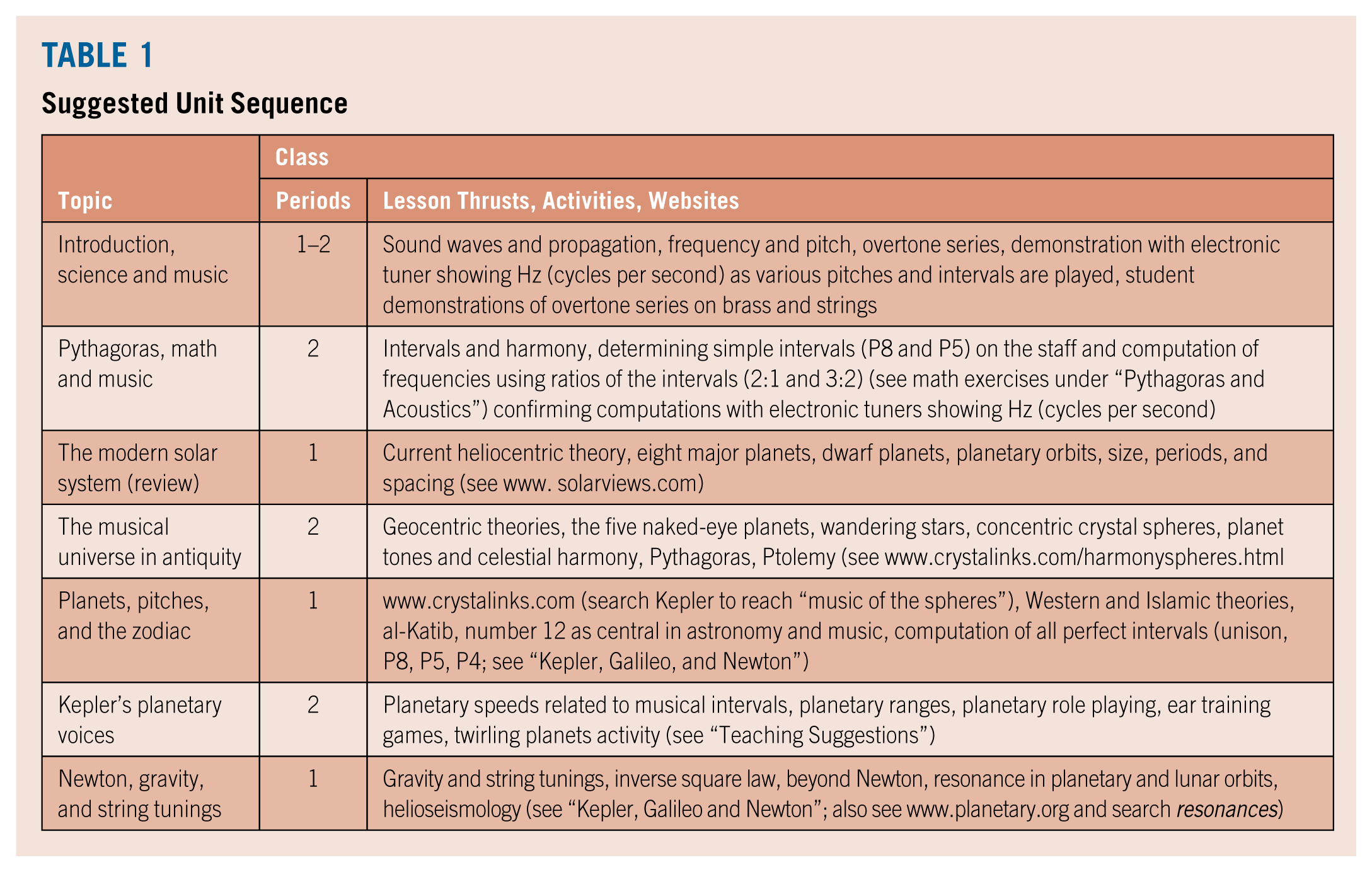
While dozens of sources on the music of the spheres can be cited, we focus on just a few authorities. These include the aforementioned Pythagoras, Galileo, and Newton as well as the less well-known figures of Ptolemy, Copernicus, and Kepler.
Pythagoras and Acoustics
The Ionian Greek thinker Pythagoras (ca. 600 BC) influenced numerous philosophers and scientists for centuries, from Plato and Aristotle through Newton. His teachings ranged from ethics and religion to music and astronomy, always with an underpinning of mathematics. Claimed by Western civilization and the Greek tradition, his philosophy in fact draws from both Eastern and Western sources, including teachings from Egypt and Persia, where he traveled as a young man. 2 He is credited with originating the concept of the music of the spheres.
Although many musicians are familiar with the principles of musical acoustics discovered by Pythagoras, an abbreviated review should be helpful in understanding the science and music connections discussed later. Pythagoras discovered that musical intervals, and hence all harmony, are based on mathematical ratios, ratios that also, amazingly, appear in astronomy.
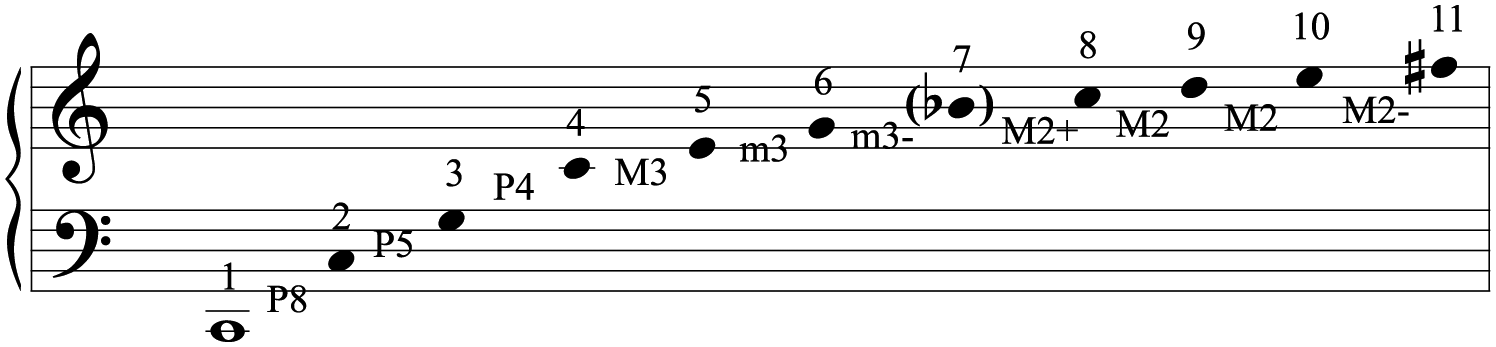
Although musicians often think of an interval as a singular entity with a characteristic sound (a perfect fifth, for example), any melodic or harmonic interval involves two pitches. Each pitch has a specific vibrating frequency, such as the familiar A440. And two pitches with two frequencies can be thought of as a ratio, as shown in the following. The ratios for the intervals in the Pythagorean tuning system 3 can be derived by examining the overtone or partial series. The overtone series is already familiar to many band and orchestra students, especially brass players, who adjust their embouchures to produce the correct pitches on the series, and advanced string players, who use harmonics in the upper registers of their instruments. Instrumental students could illustrate the overtone series in a class demonstration and make the theoretical concepts very real for the other students. (Lower brass instruments work particularly well for this because the fundamental or “pedal tone” is playable.) Figure 1 illustrates the fundamental and partials for the low C on cello, also a very useful instrument for demonstrating the overtone series. 4
Overtone or Partial Series
Referring to Figure 1, the ratios for common intervals can be derived by numbering the fundamental (low C) as 1, the octave as 2, the twelfth as 3, and so forth. The ratios representing the intervals are simply the attached numbers over one another. The first and second partials (C to c) differ by one octave and are represented by the 2:1 ratio:
2nd to 1st partial, 2:1 ratio = P8 3rd to 2nd partial, 3:2 ratio = P5 4th to 3rd partial, 4:3 ratio = P4 5th to 4th partial, 5:4 ratio = M3 (and so forth as shown in Figure 1).
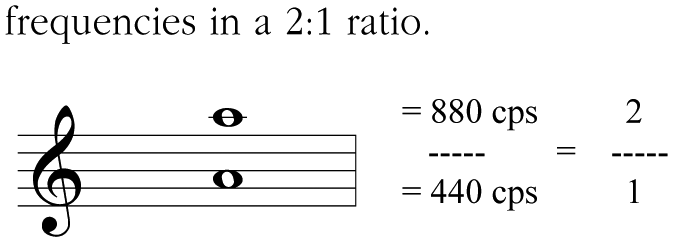
Beginning with the standard A440, an octave higher would be vibrating at 880 cycles per second (cps), with the frequencies in a 2:1 ratio.
Computing the frequency for a perfect fifth (3:2 ratio) is nearly as easy as the octave (2:1 ratio). A P5 above the A440 is fourth-space E. A simple equation then can be set up to find the vibrating frequency of the E.
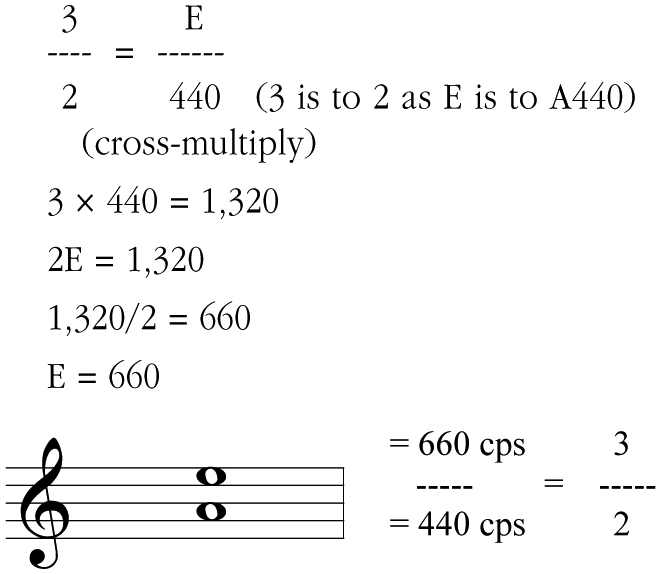
Therefore, the E above A440 is vibrating at 660 cycles per second. Of course, 660:440 is the same as 3:2, the mathematical ratio that defines a perfect fifth in the Pythagorean system.
These limited examples should suffice to illustrate the importance of ratios in musical harmony, ratios that, as mentioned, also appear in astronomy. Working through these examples should also help students begin to appreciate the mathematical foundations underlying music as well as the kinship among music, math, and science.
Planets, Pitches, and the Zodiac
The music and astronomy correlations described by ancient writers were embedded in the scientific knowledge of their time, and not all withstand the scrutiny of twenty-first-century science. One clear example is that early philosophers were connecting music with the five naked-eye planets known in antiquity. Many authorities also held a worldview that was geocentric, where the sun and planets were thought to revolve around a stationary Earth. Nevertheless, these writers found some remarkable parallels between music and the universe as they perceived it.
The music of the spheres, besides implying a general harmony and order in the universe, was originally meant in a more literal way. For Pythagoras and his followers, the “spheres” referred to transparent, concentric crystal spheres that were thought to carry the sun, moon, planets, and stars around the Earth in the geocentric (Earth-centered) system. (Think of nested Russian dolls but spherical and transparent.) Figure 2 is a two-dimensional depiction of the spheres. 5 These nested spheres were thought to be very far away and yet appeared to complete their daily courses around the Earth in twenty-four hours. Such rapid motion was believed to produce sound, as is commonly experienced when large objects move quickly. Each of the spheres produced a single tone and together created a celestial harmony. Later interpretations of the music of the spheres sometimes referred to the actual physical spheres that are the planets and other celestial bodies.
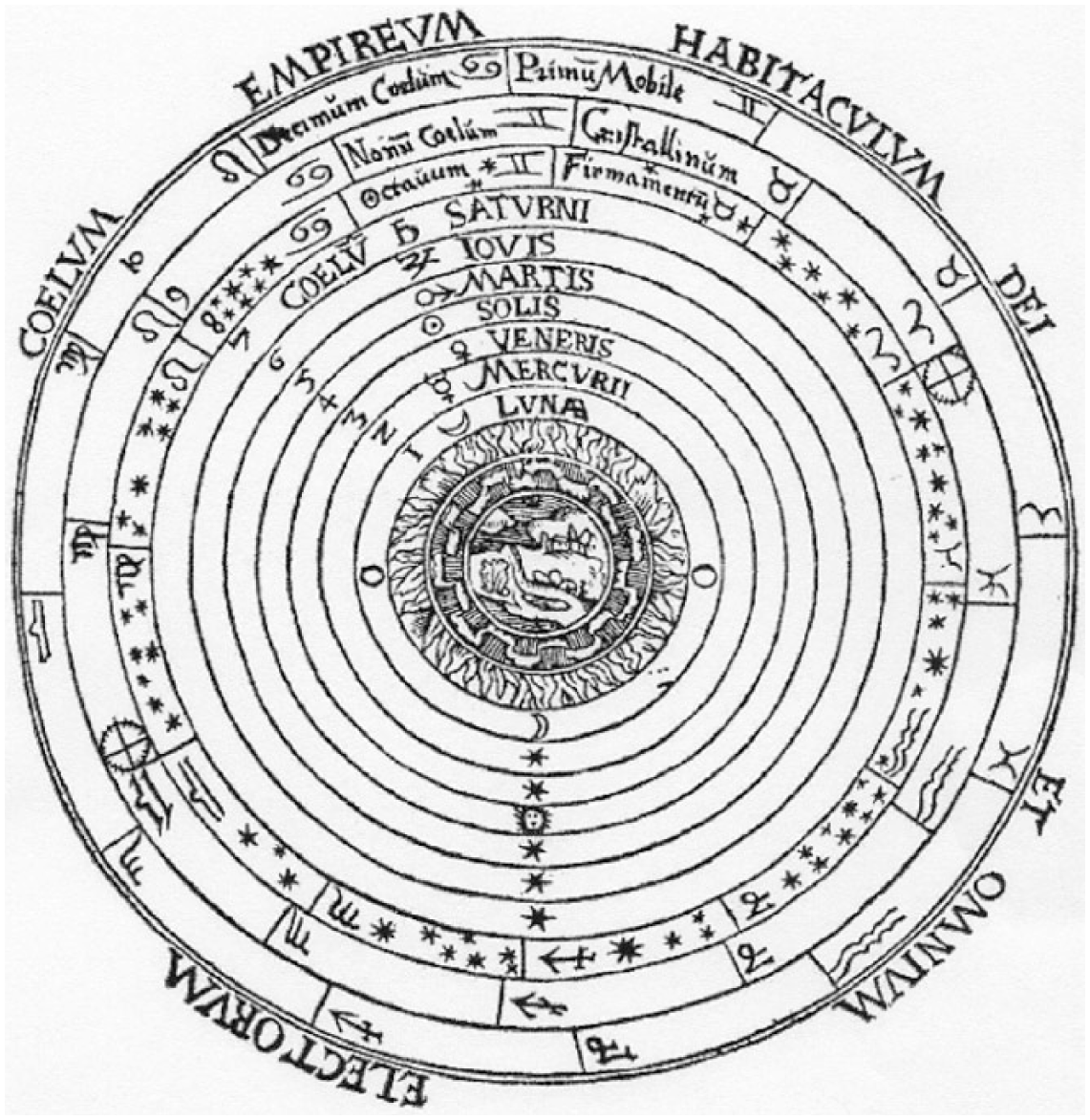
Concentric Crystal Spheres
There were five naked-eye planets known to the ancient world (Mercury, Venus, Mars, Jupiter, and Saturn) plus the sun and the moon. These seven bodies were thought to be carried around the stationary Earth on the seven concentric spheres and were sometimes matched with the seven tones in a musical scale or mode. The eighth sphere was the “fixed stars” (which did not move in relation to each other as the planets did). The stars thus completed the octave in the planet-scale.
Generally, the farthest sphere was logically thought to move the fastest and thus produce the highest pitch. The Roman philosopher and statesman Cicero (106–43 BC) gave a typical description, which echoed earlier Greek views of an Earth-centered cosmology:
The outermost sphere, the star-bearer, with its swifter motion gives forth a higher-pitched tone, whereas the lunar sphere, the lowest, has the deepest tone. Of course the earth, the ninth and stationary sphere, always clings to the same position in the middle of the universe.
6
Although some writers in antiquity seemed to treat the celestial music as actual sounds, most took “harmony” to refer to a logical congruence of elements in the heavens. Centuries after the classical age, Kepler himself described the harmony as being “in thought, not in sound.” 7 This inclusive use of the term harmony is familiar to many students, who are often encouraged to embrace diversity, tolerance, and social harmony.
Some ancient authorities sought different parallels between earthly and cosmic music, notably Ptolemy (AD 127–148), the great Alexandrian astronomer. In his famous treatise Harmonics, Ptolemy matched pitches not with planets but with the twelve constellations of the Western zodiac, familiar to us today as the astrological signs: Aries, Taurus, Gemini, Cancer, Leo, Virgo, Libra, Scorpio, Sagittarius, Capricorn, Aquarius, and Pisces. He was so zealous about the integration of music and the heavens that fully half of Book 3 of his Harmonics is a discourse on parallels between musical harmony and celestial motions. 8
A later Islamic scholar, Al-Hasan al-Katib (ca. AD 1000), also linked music with the zodiac, noting that the number 12 is special because it is evenly divisible into halves, thirds, and quarters. He also anticipated the work of Kepler by deducing the significance of 12 in forming the perfect intervals in music. 9 Students should know that while Europe was in the Dark Ages, the Arab world was flourishing in terms of music, art, literature, and science. Evidence of this Islamic golden age is found in the night sky, where many bright stars retain their Arabic names: Alcor, Aldebaran, Mizar, and Albireo, for example. Also of Arabic origin is the branch of mathematics known as algebra, from al-jabr, “the reunion of broken parts.”
Kepler, Galileo, and Newton
The first empirical scientists also shared an ardent belief in the harmonious nature of the universe. Johannes Kepler (1561–1630), a German astronomer and mathematician, echoed Ptolemy’s and al-Katib’s association of music with the constellations of the zodiac. Kepler reasoned that the division of the night sky into twelve parts was related to the ratios of the perfect musical intervals: Twelve is the smallest number that yields the ratios for each perfect interval in the Pythagorean tuning system. 10
12:12 = 1:1 = Unison 12:9 = 4:3 = Perfect fourth 12:8 = 3:2 = Perfect fifth 12:6 = 2:1 = Perfect octave.
Kepler is best known today for his three laws of planetary motion. These precise mathematical descriptions of the orbits of the planets are among his permanent achievements. The first use of the scientific method is often attributed to Kepler’s contemporary, Galileo Galilei (1564–1642). Both Kepler and Galileo adopted the new heliocentric worldview espoused by Polish cleric and mathematician Nicholas Copernicus (1473–1543). This system, in which all planets revolved around the sun, was quite controversial at the time because it removed the Earth from its place at the center of the universe.
Galileo’s pioneering use of the scientific method is a favorite topic of science teachers and may already be familiar to many students. Some science teachers might also know that Galileo was an accomplished lutenist and wrote extensively on music 11 and that his father, Vincenzo Galilei, was a leader in the Florentine Camerata, a group of poets and musicians credited with the development of opera.
Although Kepler was among the first modern scientists, he was more fervent than anyone in championing the concept of cosmic harmony. “I feel carried away and possessed by an unutterable rapture over the divine spectacle of the heavenly harmony.” 12 He shared with many other great scientific minds the belief that the laws that govern the universe must be elegant and aesthetically satisfying, much like good music.
Kepler’s vision of cosmic harmony matched the real motions of the planets, the motions that he had defined. For a quick science review, it should be mentioned that planets nearest the sun move fastest in their orbits. Mercury and Venus, being nearer the sun than the Earth, complete their orbits in less than a year. (This differs from the earlier geocentric theories that assumed that all the heavens revolved around the Earth in twenty-four hours, meaning that the furthest objects must necessarily move the fastest.) Because the planets move in elliptical paths, it also means that the speed of each planet varies slightly according to its precise distance from the sun, traveling faster when nearest the sun and slowing as it recedes.
For this reason, Kepler suggested that each planet “sings” not a single tone but a range of notes depending on its speed at a particular point in its orbit. He described these planet-intervals in his Harmonice Mundi (Harmony of the World) of 1619. 13 As seen in Figure 3, most of the intervals subsumed by Kepler’s planetary ranges match the ratios associated with common musical intervals. Saturn, farthest from the sun and slowest among the then-known planets, was thought to produce the lowest pitches and varies in a 5:4 ratio, a major third. Jupiter’s velocities match a minor third, a 6:5 ratio. Mars, with a more elliptical path, varies more in its orbital speed and thus has a wider range of a perfect fifth, a 3:2 ratio, at a correspondingly higher pitch as befits its faster orbit. Kepler described the Earth as varying less in its speed and approximating a half step, a 15:16 ratio. Venus, having the most nearly circular orbit, remains almost on unison (1:1). Mercury, closest to the sun and with the most eccentric (least circular) orbit, has the widest range (a ratio of 12:5) and the highest “voice.” 14 Students should note that Kepler, unlike ancient philosophers, has included the Earth among the planets according to the sun-centered theory of Copernicus.

Kepler’s Planetary Ranges
These pairings of planets and intervals, although approximate, are nevertheless remarkable, “far exceeding random expectation.” 15 One historical anecdote that may help us appreciate Kepler’s work is that two years before the publication of his Harmonice Mundi, he had to interrupt his studies to help defend his mother, who was on trial for witchcraft. (His brilliant and logical mind also proved effective in the legal arena: His mother was released from prison but died a few months later.)
Following Kepler, the music of the spheres was acknowledged by Isaac Newton (1642–1727), who despite his revolutionary insights into science and mathematics identified himself as a Pythagorean and sought a connection with the wisdom of the ancients. Newton, of course, discovered that gravity operates not only on Earth but is universal in that it also governs the movements of the moon, planets, and stars. In one quotation, he describes the similarity of the gravitational force to the effect of tension on the strings of a musical instrument:
The Sun by his own force acts upon the planets in that harmonic ratio of distances by which the force of tension acts upon strings of different lengths, that is reciprocally in the duplicate ratio of the distances.
16
In other words, objects twice as far apart experience only one-fourth the gravitational attraction, and doubling the frequency of a pitch requires four times the tension on a string (22 = 4). This “inverse square law” therefore applies to both planets and pitches. Whatever our understanding of Newtonian physics, his writings show the ancient idea of cosmic harmony extending into the 1700s. Newton, one of the most brilliant minds of any age, found these parallels between science and music somehow irresistible and compelling.
Today we know that some musical elements in our solar system actually extend well beyond what Kepler and Newton found. Neptune and Pluto—bodies unknown in their day—orbit in a 3:2 resonance. (Neptune completes exactly three orbits for every two orbits of Pluto.) Similar resonances are found among the moons of Jupiter and the rings of Saturn. The new science of helioseismology reveals that the sun itself vibrates with acoustic pressure waves. 17 Although twenty-first-century astronomers no longer pursue the ancient theories of Pythagoras or Kepler as viable hypotheses, composers of the twentieth and twenty-first centuries continue to be inspired by astronomical themes. Most notable among several major works is the orchestral suite The Planets by Gustav Holst. 18
Teaching Suggestions
Table 1 offers a unit outline of about ten classes, assuming fifty-minute class periods. The structure and length of a unit will depend on school schedules, the interests of the teachers, and the ages and backgrounds of the students. Table 1 generally follows the chronology, scope, and organization of the article and reflects a thorough secondary school treatment of the subject. Shorter interdisciplinary topics can be chosen from within the unit, for example, “science and music,” “math and music,” or “the musical universe.”
Collaboration between science and music teachers can help in refining the following lessons. Sources listed in the sidebar and in Table 1 should also help teachers flesh out these lesson activities.
Kepler’s Solar System
Many abstract astronomical and musical concepts discussed previously lend themselves to concrete activities by students, beginning with “planetary role-playing.” Seven students will suffice to show the solar system as known by Kepler: One student represents the sun, stationary in the middle of a large room, while six others arrange themselves in the proper order. Mercury orbits closest to the sun, followed by Venus, Earth, Mars, Jupiter, and Saturn. The outer planets orbit much slower and take longer to complete their trip around the sun, thus those students would walk and circle the sun very slowly, while the inner planets would circle quickly. If space permits, Jupiter and Saturn should follow much larger orbits, with those students spacing themselves much further from the sun, than Mercury, Venus, Earth, and Mars. (See www.solarviews.com for quick information on orbital periods and distances of the planets.) The students should circle the sun counterclockwise, as the planets do when viewed from above (north of) the plane of the solar system. A planet also spins on its axis in addition to its orbital motion around the sun, and students could be challenged to add this counterclockwise spinning motion to their orbiting of the sun. Nametags and/or pictures of each planet should help to illustrate this not-to-scale human solar system.
The intervals shown in Figure 3 should then be incorporated into the activity, with the teacher playing the pitch and range of each planet as the students take turns orbiting. For more musically advanced classes, the teacher could create an ear-training game in which the range and the pitch are played on piano while students identify the corresponding interval and planet.
While illustrating science concepts, this activity also allows students to physically experience slow movement associated with low pitches and faster movements associated with higher pitches, as occurs with the vibrations produced by instruments and voices. In this sense, the activity is akin to some Orff activities reinforcing pitch and rhythm concepts via movement. The ear-training component could be basic, as in discriminating between the high voice and wide range of Mercury and the low bass and limited range of Saturn. Alternately, students could be challenged to hear the difference between the minor third in Saturn’s voice and the major third of Jupiter, a more sophisticated task.
Electronic tuners (including applications available for smart phones) can be incorporated into this and other activities involving pitch and intervals. Pitches detected by tuners are often displayed as “Hz” (Hertz, or cycles per second), thus highlighting the scientific side of pitch (frequency) in a visible and quantitative way. 19
Planets on a String
A second activity to show the correlation between planetary distances from the sun and the planets’ orbital speed is to have a student twirl a small rubber ball on a string to represent a planet orbiting the sun. The string should be held above the head, with the student twirling the ball around, counterclockwise. With a foot or two of string, the ball will naturally circle quite fast, several times per second. Releasing more string will cause the ball to “orbit” at an inherently slower speed. A ten- to twelve-foot radius takes about three seconds to complete a circuit, dramatically slower. A stopwatch (or metronome) can be used to time and compare the relative circuits of the ball at different distances. This activity is best conducted in a large open room, a gymnasium, or outdoors. For safety, the student “sun” should wear gloves, and the students observing should be kept well away from the orbiting ball. A three-inch soft rubber ball works well. Again, this activity should be accompanied by appropriate pitches (Figure 3), very low for Saturn and Jupiter with long, slow orbits and progressively higher tones as the ball circles gradually faster for Mars, Earth, Venus, and Mercury. Timing and recording the circuits can help to keep the students focused on the serious side of a fun activity. Traditional worksheets or other summaries of the activity can likewise reinforce the concepts demonstrated. For example, a written summary might ask students to match each planet with Kepler’s corresponding pitches, reviewing the immediate lesson as well as reinforcing basic elements of pitch and music reading in bass and treble clefs.
A Broader Perspective
While most music educators have been taught to think of music as a specialized and separate discipline, adolescent students may actually be quite amenable to the interdisciplinary thinking discussed here. In any case, students and teachers alike should be duly impressed with the intellectual breadth and weight accorded to music over the centuries. They might also agree on the mysterious emotional power of great music. Historical sources suggest that this power comes from imitating a cosmic model. Even today, we might allow that in the broadest sense music is heavenly: It draws us up to a higher plane, elevating and enriching our lives.
Resources for Planning: Music of the Spheres
Print Sources:
Frederickson, Karen. “Through the Back Door: Exploring the Science of Sound.” General Music Today 12, no. 3 (1999): 10–16.
Gingerich, Owen. The Eye of Heaven: Ptolemy, Copernicus, Kepler. New York: American Institute of Physics, 1993.
Godwin, Joscelyn. The Harmony of the Spheres: A Sourcebook of the Pythagorean Tradition in Music. Rochester, VT: Inner Traditions International, 1993.
James, Jamie. The Music of the Spheres: Music, Science and the Natural Order of the Universe. New York: Springer-Verlag, 1993.
Kepler, Johannes. Harmonice Mundi (The Harmony of the World). Translated by E. J. Aiton, A. M. Duncan, and J. V. Field. Philadelphia: American Philosophical Society, 1997.
Rogers, George L. “Interdisciplinary Lessons in Musical Acoustics: The Science-Math-Music Connection.” Music Educators Journal 91, no. 1 (2004): 25–30.
Rossing, Thomas D., F. Richard Moore, and Paul A. Wheeler. The Science of Sound. Reading, MA: Addison Wesley, 2001.
Wagner, Michael J. Introductory Musical Acoustics. Raleigh, NC: Contemporary Publishing, 1994.
Warm, Hartmut, Signatures of the Celestial Spheres: Discovering Order in the Solar System. London: Rudolf Steiner Press, 2010.
Electronic Resources
Acoustical Society of America, www.acoustics.org
“Dance of the Planets,” www.astronomy.ohio-state.edu/~pogge/Ast161/Unit4/dance
Crystalinks, www.crytalinks.com (search Kepler to reach “music of the spheres”)
Kepler’s Discovery, www.keplersdiscovery.com (select place in the universe and then cosmos as a whole to reach “harmony of the world”)
Keplerstern Verlag, www.keplerstern.com
Discovery Education, www.discoveryeducation.com
NASA Wavelength, www.nasawavelength.org
The Planetary Society, www.planetary.org/multimedia/space-images
Frank Potter’s Science Gems: Physical Science I, www.sciencegems.com/physical.html
Smithsonian Education, www.smithsonianeducation.org
Views of the Solar System, www.planetary.org (search resonances)
Sounding the Sun: Helioseismology, www.stat.berkeley.edu/~stark/Seminars/Aaas/helio.htm