




Abstract
Music teacher evaluations traditionally examine how teachers develop student music-learning objectives, assess cognitive and performance skills, and direct classroom learning experiences and behavior. A convergence of past and current educational ideas and directives is changing how teachers are evaluated on their use of student-centered instructional approaches in the music classroom. These are classrooms facilitated rather than directed by the teacher in which students regularly communicate, collaborate, self-reflect, problem solve, and peer-evaluate about their learning. The authors trace the influence of three important initiatives that, among others, contributed to the implementation of student-centered learning in music classrooms: Arts PROPEL, Comprehensive Musicianship, and 21st Century Skills. The article also explores relationships between these entities, the National Music Standards, and teacher evaluation and provides an innovative model of teacher evaluation.
Keywords
Best practices now encourage music teachers to create student-centered classrooms.
Evaluation of music teachers traditionally involves an examination of the teacher’s ability to develop student music-learning outcomes, assess cognitive and performance skills, and effectively direct the learning experiences and behavior in their classrooms. As well, the successful ensemble directors are judged by the quality of their students’ performances and executive skills. Technically, those expectations have not changed, but a convergence of past and current educational ideas and directives is altering how teachers are evaluated on their use of instructional approaches in the music classroom. With the teacher as facilitator, young musicians are encouraged to self-reflect, peer-evaluate, and problem solve about music-making and creating. This is often referred to as student-centered or learner-centered teaching practice. Figure 1 outlines the student-centered learning influences and outcomes we examine here.
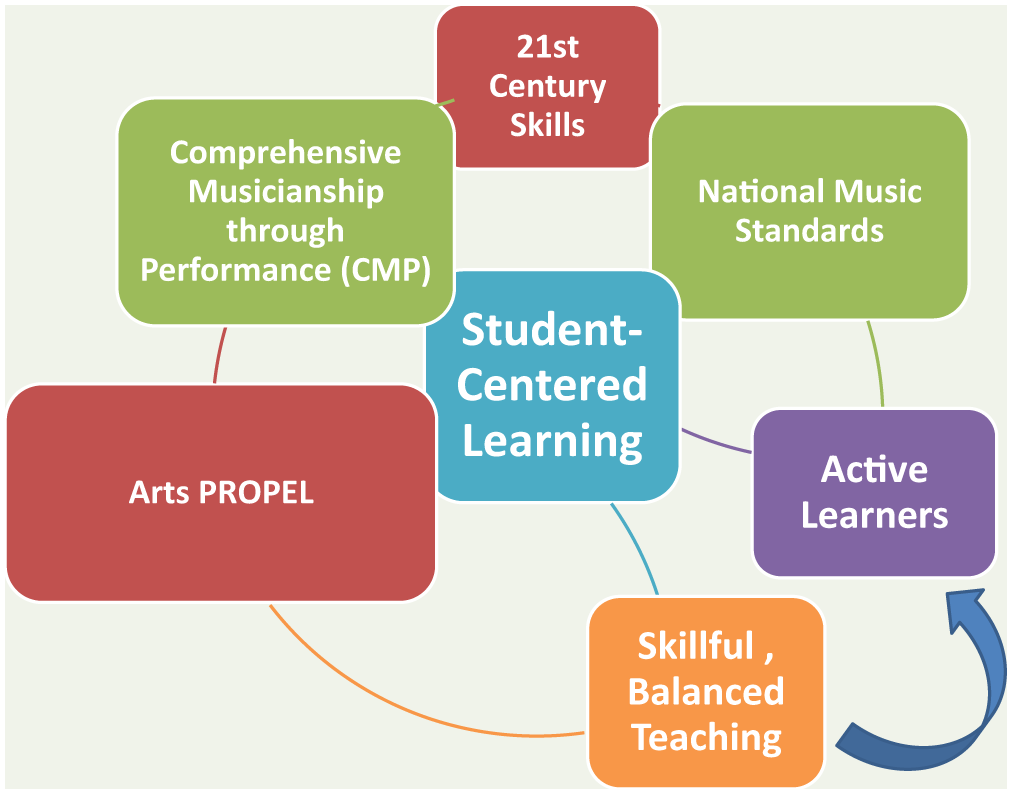
Student-Centered Learning Influences and Outcomes
NAfME is glad to offer one hour of professional development credit to you for reading this article. Please follow the link below and complete a short quiz to receive your certificate of completion.
Early Innovations Student-Centered Teaching
Comprehensive Musicianship through Performance
In 1977, the Wisconsin Music Educators Association, the Wisconsin School Music Association, and the Wisconsin Department of Public Instruction collaborated to develop Comprehensive Musicianship through Performance (CMP). 1 CMP is a program of instruction that encourages students to engage in composing, improvising, transcribing, arranging, conducting, rehearsing, and performing. CMP fosters student-centered approaches to ensemble instruction in which students are involved in authentic musical experiences, including selecting, analyzing, and assessing their and their peers’ music and musical performance. One of the primary goals of CMP is for students to become independent, self-regulated musicians. Developing a comprehensive musicianship approach to teaching requires adequate planning and rehearsal time, training and professional development, and a willingness to forego a “top-down” instructional approach. As we will see, the forthcoming changes in teacher evaluation may open the doors for this to happen.
Arts PROPEL
Arts PROPEL, an initiative led by Howard Gardner and Dennis Palmer Wolf (Harvard University) and Drew Gitomer (Educational Testing Service), was a five-year collaborative project in the late 1980s and early 1990s with Project Zero, the Educational Testing Service, and the Pittsburgh (Pennsylvania) Public Schools. The acronym PROPEL stands for the integrated artistic processes of Production (making and learning basic skills and principles), Perception (studying artistic choices and connections), and Reflection (assessing one’s own work). The program was notable for its design of a student-centered framework for instruction and assessment in music and the visual arts. Students were encouraged to authentically participate in music performance through interactive communication and collaboration as well as self- and peer assessment and reflection. Students also produced portfolios or process folios called Domain Projects to track personal growth. The handbooks that were created for each arts area included comprehensive evaluation forms. 2 These visual organizers made self- and peer assessment accessible in a music classroom. Figure 2 is an example of an ensemble performance assessment modeled after an Arts PROPEL assessment tool.
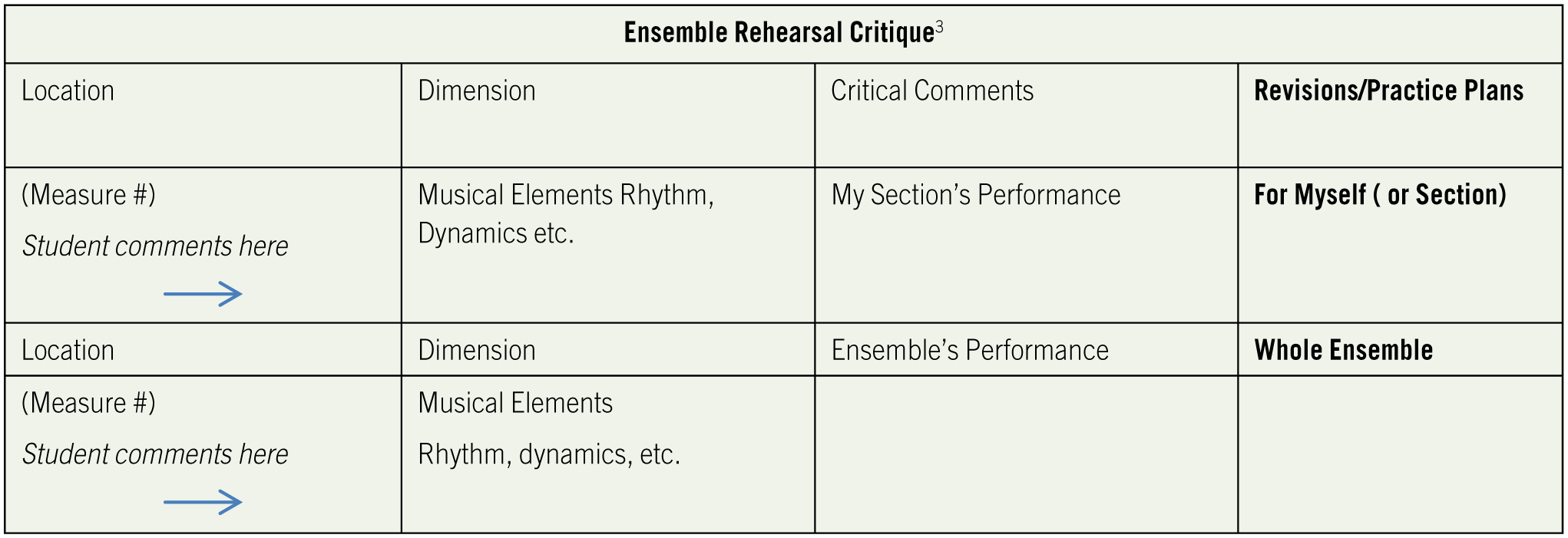
Arts PROPEL: Ensemble Performance Assessment
Arts PROPEL projects promoted active student involvement in music-making. This was at a time when general music teachers traditionally directed all classroom activities and few interactions occurred between students. In performance ensembles, teachers traditionally led the rehearsals, offering direct assessments of students’ execution of the music without student reflection or reflective interactions between parts. The authors of the Arts PROPEL documents planted the philosophical seeds for the student-centered approaches to music and art instruction that are now an integral part of the Music Standards.
Partnership for 21st Century Learning
In 2002, a notable group of educational organizations, businesses, and education leaders founded the Partnership for 21st Century Learning (P21) in order to convey the responsibilities of educational institutions in meeting the needs of the 21st-century workplace. 3 Technological advances in the 1990s were (and still are) moving at an alarming pace and were changing nearly every aspect of human communication, learning, and lifestyles. The P21 leaders concluded that individuals could no longer work or learn in isolation from one another, that top-down and autocratic leadership in the workplace or in schools would not be effective or successful. P21 leaders also included the arts and music as a fundamental subject essential for student success in the work and life of the new century. The learning and innovation skills that were implemented in earlier initiatives and promoted by P21 include, among others, Creativity and Innovation, Critical Thinking and Problem Solving, and Communication and Collaboration. 4 P21 promotes a balanced, interactive, and relevant approach to teaching that blends teacher expertise with active student engagement. The efforts of this group set the stage for the development of new national standards in all curriculum areas, including the arts and music, a decade later.
Together, and with other initiatives of the times, Comprehensive Musicianship through Performance, Arts PROPEL, and the P21 skills afforded a solid foundation for implementing student-centered music classes and ensembles. Student engagement in learning is now becoming valued and actively promoted in current professional development and teacher evaluation systems. For music educators, this approach is clearly articulated in the 2014 Music Standards. With knowledge and conceptual and procedural skills (or executive techniques) as a foundation, many teachers are beginning to be evaluated on their ability to set up student-centered classrooms and ensembles—a major pedagogical shift that is coming to fruition after decades of development.
The 1994 Music Standards
Published by the National Association for Music Education, the 1994 Standards for Music were the result of years of symposiums, philosophical discourse, and documents. Though some argue that these Standards were never adequately implemented, they did serve an important purpose and function. The 1994 Standards were the result of consensus by music educators nationwide for a breadth of approaches to teaching music that promoted creativity, analysis, listening, and cross-curricular connections in addition to performance. The standards also spurred the development of assessments, including rubrics that became a widespread assessment tool in education in the 1990s. With them, teachers began to formally evaluate the discrete skills and knowledge that students should know and be able to do to perform musically. Over the past 20 years, this language transformed state, district, and local curriculum development; scope and sequences; learning goals and objectives; and teacher evaluation.
We believe that the 1994 Arts Standards were a necessary step in the evolution of music education. As a profession, standards were needed in order to develop continuity for what music teachers teach. However, ensemble and classroom instruction were largely contingent on teacher direction; student-centered learning was not a primary goal of these standards. Teacher evaluation was either completely lacking or based on a supervisor’s observations of children’s behavior or solely based on performance quality.
2014 Music Standards
The 2014 Music Standards, as well as all other current national curriculum standards, have embedded 21st Century Skills within their performance standards statement. The paradigm shift in the music standards resulted from the goal artistic literacy through authentic participation. 5 To authentically participate in music, students must actively pay attention to and think about their music-making through self-assessment and self-regulation. The Artistic Processes of Creating, Performing, Responding, and Connecting are further refined through Process Components, including imagining, evaluating, planning and making, presenting, selecting, analyzing, interpreting, rehearsing, refining, and reflecting. These processes describe students’ work in music learning, not necessarily the teacher’s work in teaching. As a result, the teacher or ensemble director needs to consider three levels of preparation in lesson planning and assessment: what students know, what students can do, and what students think about their music-making.
These three levels reflect the Four Dimensions of Knowledge: Conceptual, Procedural, Metacognitive, and Factual—found in distinguished educators Lorin W. Anderson and David R. Krathwohl’s revision of Bloom’s Taxonomy 6 :
What Students Know: Facts and Concepts (music vocabulary and concepts);
What Students Can Do: Procedural Skills (Executive skills and performance practices); and
What Students Think about Their Learning: Metacognition (Students becoming independent learners).
Each of these knowledge dimensions could be taught and assessed at any of the six levels of the Revised Taxonomy: Remember, Understand, Apply, Analyze, Evaluate, or Create. These dimensions and levels of knowing correspond readily with Artistic Processes and 21st Century Skills. Figure 3 illustrates the relationships among the Artistic Processes and Components, 21st Century Skills, instruction-assessment levels, and teacher evaluation.
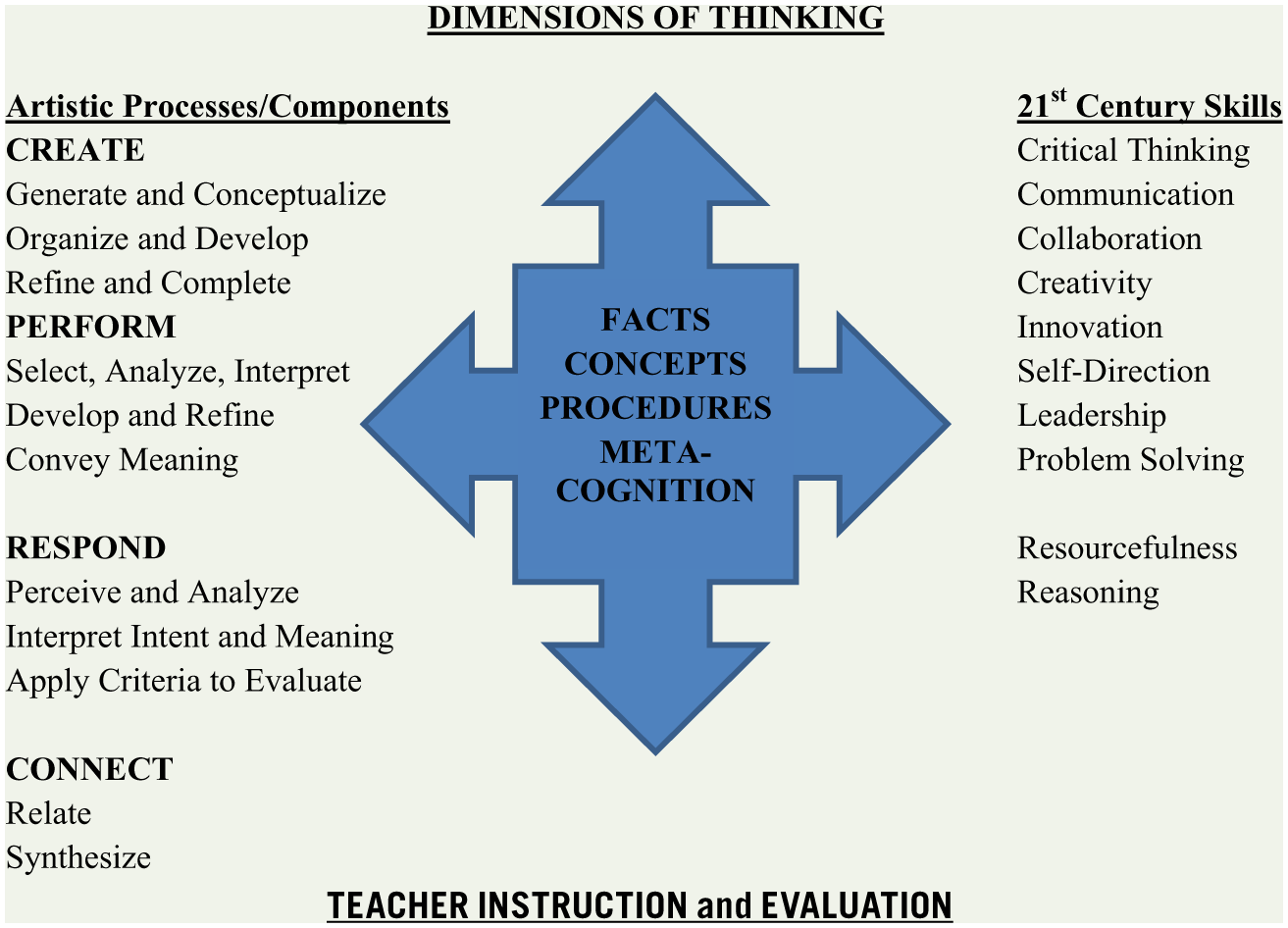
Relationships between Artistic Processes and Components, 21st Century Skills, Revised Bloom’s Dimensions of Thinking, and Teacher Evaluation
By actively generating their own learning, students must be able to perform musical tasks as well as demonstrate their conceptual understanding of the music and self-awareness of performance quality. This process necessarily requires the 21st Century Skills: collaboration, communication, creativity, and critical thinking—the visionary life skills envisioned in previous decades. With the passage of national core standards in all curricular areas and the 2015 revision of the Elementary and Secondary Education Act, the Education for Student Success Act, the doors are now open for teacher evaluation to include life skill development rather than solely academic and test score data. Indeed, the NAfME Ensemble Teacher Evaluation Worksheet 2b: Establishing a Culture for Learning, 3b: Using Questioning and Discussion Techniques, and 3c: Engaging Students in Learning include rubrics for evaluating such skills in general music classrooms and ensembles. 7
A Visionary Model
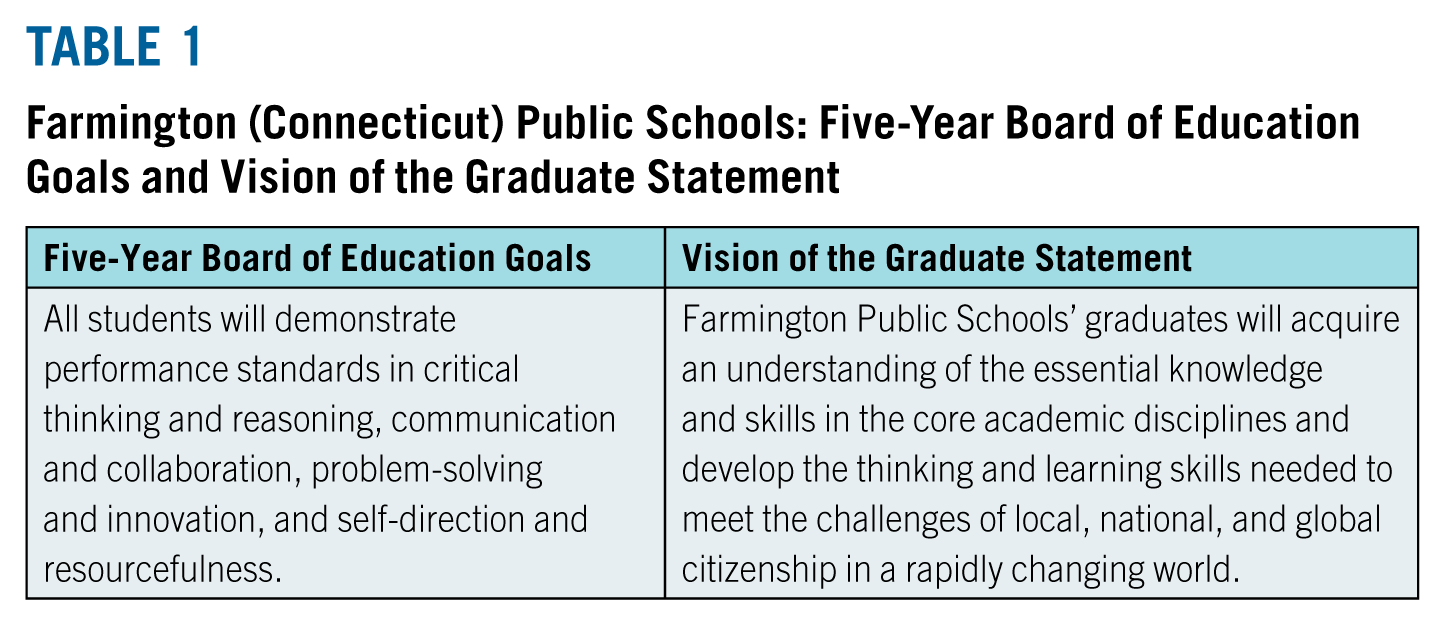
Most school systems in the United States use teacher evaluation systems based on the Danielson,8 Marzano-Toth, 9 or self-created frameworks built on these models. The Farmington School District in Farmington, Connecticut, is implementing both teacher and student school goals that reflect the concepts in these frameworks. The district was selected as a National P21 Exemplar School District in 2013 for developing a new teacher evaluation program with the 21st Century Skills at the core. A portion of their teacher evaluation springs from goals with 21st Century Skills at their core. Table 1 shows the Five-Year Board of Education Goals and the Vision Statement for Graduate Statement. 10
Farmington (Connecticut) Public Schools: Five-Year Board of Education Goals and Vision of the Graduate Statement
Teaching and learning in every classroom reflects research-based principles of the Farmington Public Schools Educator Evaluation and Professional Development Plan. 11 In the plan, students are at the center of the learning experience. Philosophically, the district believes that effective teachers provide environments that stimulate students to be “leaders of their own learning.” 12 In these student-centered classrooms, instruction ensures that every student has the ability to reason and think critically, communicate clearly, and collaborate with others to solve complex problems and generate innovative solutions and ideas. These instructional practices transform the role of the student in the learning process.
Farmington teachers regularly receive professional development training that promotes their skills in reaching these instructional goals. Two specific resources are particularly relevant and are easily transferable to music education. Educators Douglas Fisher and Nancy Frey 13 described a model for the gradual release of responsibility: focused instruction, guided instruction, collaborative learning, and independent learning. This model detailed a sequence of instruction beginning with teacher modeling, moving to guided practice, and ending with individual performance of a skill. A more constructivist model of student-centered instruction might involve encouraging students to first experiment individually or collaboratively with music learning, perhaps through technology, to engage in discovery of learning goals.
In Leaders of Their Own Learning, educators Ron Berger, Leah Rugen, and Libby Woodfin described extensive examples of student-engaged assessment. They defined the qualities of the engaged learner as one who demonstrates mastery of content and skill-based standards, who explores pathways of learning based on interest and individual choice, and who is supported through challenging tasks and innovative instruction. 14 The aim is to develop students’ ownership of their learning so that it is valued and internalized for a lifetime.
Active Learners in the Music Classroom
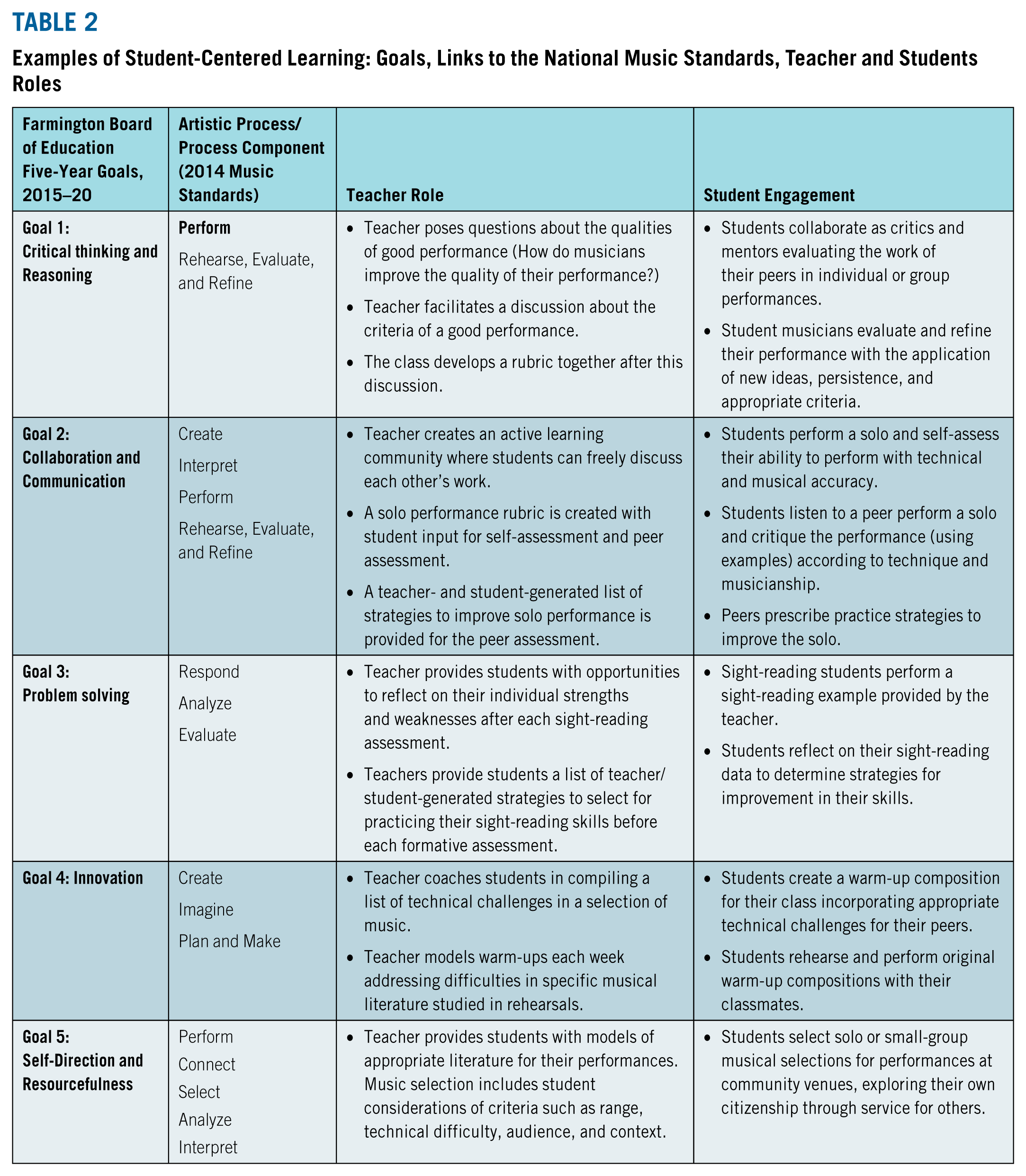
Table 2 shows ways in which student-centered teaching approaches can unfold in a music classroom. The teachers’ roles and the students’ activities are linked to the Artistic Processes of the National Core Music Standards and the Farmington five-year goals (P21 skills).
Examples of Student-Centered Learning: Goals, Links to the National Music Standards, Teacher and Students Roles
Teacher Evaluation in Student-Centered Classrooms
Teacher evaluation in the Farmington School District encourages individual teachers to determine their own goals based on their students’ needs. Farmington developed rubrics for Domains of Teacher Practice to use when evaluating the five domains: (1) Planning, (2) Teaching and Learning, (3) Assessment, (4) Collaboration, and (5) Professionalism. Teacher effectiveness is also rated on the student growth/progress from Student Learning Outcomes (SLOs) measured by assessment data from cornerstone assessments. 15
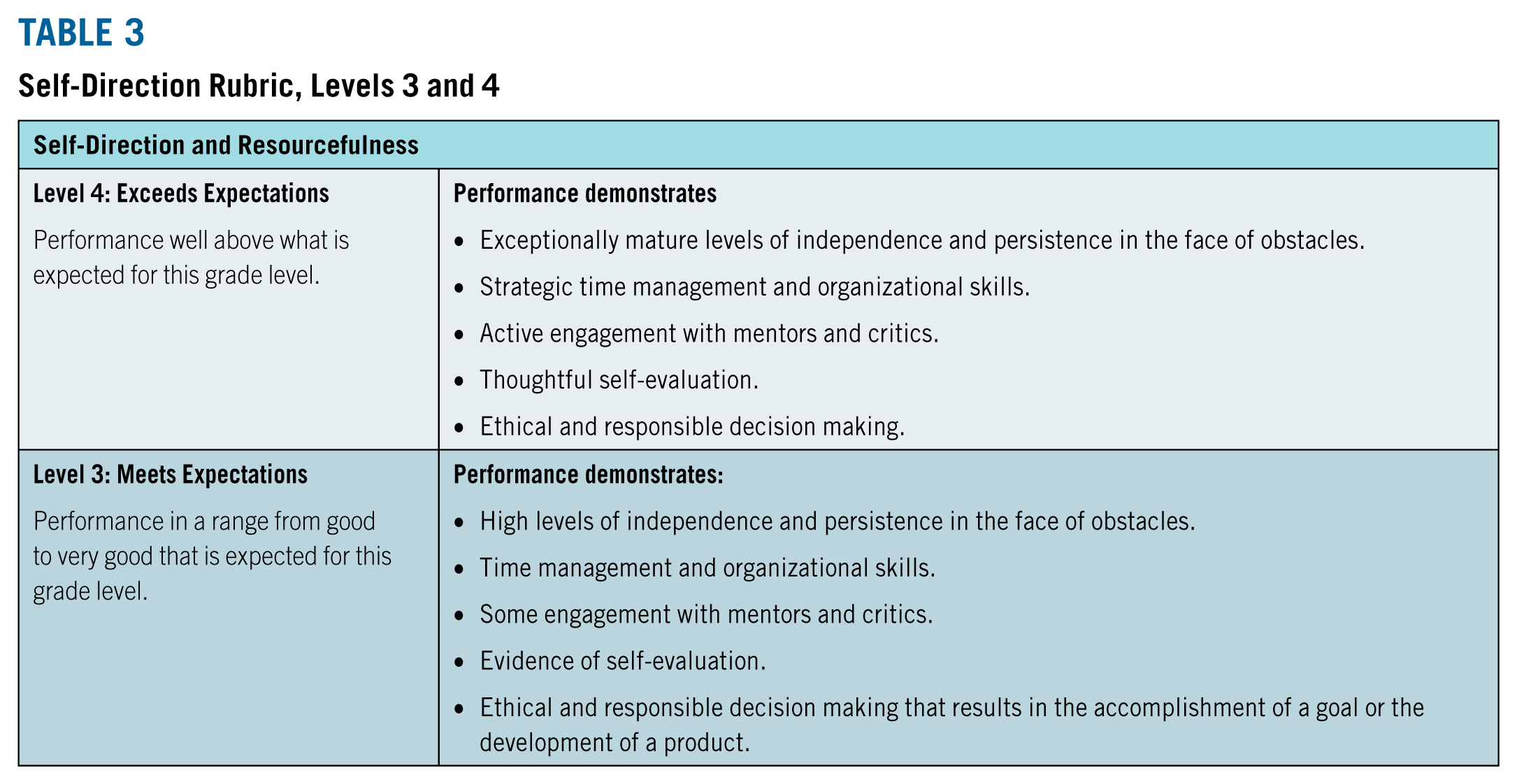
Along with these measures, teachers must tie Vision of the Graduate Skills (see Table 1), based on the Five-Year Board of Education Goals, to their SLOs. For example, the district common sight-reading task and assessment is tied to Problem Solving and Self-Direction and Resourcefulness. Levels 3 and 4 of the Self-Direction and Resourcefulness rubric are found in Table 3. Throughout the year, teachers assess the growth of students’ self-direction and resourcefulness. That data become a component in the teacher’s own evaluation. District teachers and administrators also developed rubrics for Critical Thinking and Reasoning, Problem Solving, Innovation, Communication, Collaboration, and Self-Direction and Resourcefulness (refer to the Farmington website to explore the rubrics).
Self-Direction Rubric, Levels 3 and 4
While the Farmington District teacher evaluation may not be a model that serves all schools, their efforts to recognize the significance of student-centered classrooms as an important factor in district goals and teacher evaluation is worth consideration. The district evaluation plan and a complete set of rubrics can be found at http://www.sde.ct.gov/sde/lib/sde/pdf/talent_office/plans_2015_2016/farmington_evaluation_plan.pdf.
Achieving a Balance
Starting in the 20th century, educators and far-sighted organizations planted the seeds for schools that value active student-centered learning. The results of their work have given rise to new national legislation, national standards, and resulting changes in teacher evaluation. In an age of increasing technological advances, there is a need to balance teacher-driven instruction and collaborative student-centered activities. To teach and assess students for all three levels of knowledge—facts/concepts, skills, and metacognition—highly effective music educators need to move seamlessly between focused instruction, guided instruction, collaborative learning, and independent learning if developing artistic literacy is the goal. Through this process, however, obtaining critical musical skills and musical content must not be lost in a quest to simply change instructional paradigms. Teacher evaluation must also provide a fair and honest assessment of this balance. Educational practices are forever dynamic and changing. Perhaps the way in which we meet the current challenges will provide a foundation for future generations of music educators that will ultimately benefit their students.
“To teach and assess students for all three levels of knowledge—facts/concepts, skills, and metacognition—highly effective music educators need to move seamlessly between focused instruction, guided instruction, and independent learning if developing artistic literacy is the goal.”