



Abstract
Arts integration has been a mixed blessing, with both the potential for developing deeper understandings amid concerns that it diminishes the integrity and authenticity of learning in the arts. This article describes concept-based arts integration as a model of arts integration where curriculum is designed around shared concepts that connect across the arts and other academic subjects. The benefits of using concept-based arts integration curriculum are explored within the scope of an educational outreach program led by a professional symphony orchestra that partnered in a multiphase arts integrated program with forty surrounding elementary schools. Several strategies and criteria are included to help music educators identify shared concepts and design concept-based arts integrated projects in their schools.
The New Bedford Symphony Orchestra in Massachusetts partners with local schools to share the true interdisciplinary learning.
Arts integration has an extensive history offering examples of efficacy and inspiration as well as cautionary tales. Supporters have articulated benefits that include improved academic achievement, creative thinking, and student engagement. 1 Others have described the potential for arts integration to promote deeper understanding and increase retention and application of knowledge to future contexts. 2 While these examples are far from exhaustive, they offer supportive testimony to the learning and achievement outcomes that have stemmed from arts integration.
NAfME is glad to offer one hour of professional development recognition to you for reading this article. Please follow the link below and complete a short quiz to receive your certificate of completion.
The Kennedy Center’s Changing Education through the Arts defines arts integration as “an approach to teaching in which students construct and demonstrate understanding through an art form. Students engage in a creative process which connects an art form and another subject area and meets evolving objectives in both.”
3
Researcher and author Gail Burnaford defines arts integration as “a powerful vehicle to cross the boundaries of core subjects and arts concepts, affective and cognitive modes of expression, form and content, processes and products, the self and the world.”
4
Furthermore, she sees arts integration as a way to look beneath the surface and expand the ways in which children come to learn and experience new ideas: The arts seem to deepen instruction authentically because they invite intellectual depth. . . . Arts integration is concerned with intellectual work and with inquiry as ways to learn and grow. Students engaged in an art activity are expanding the repertoire of tools at their disposal to construct meaning.
5
For Burnaford, children benefit from arts integrated learning that is thoroughly and thoughtfully connected to learning in other subject areas. She believes in encouraging children to think and make connections that foster capacities that replicate how people think and work in the real world.
Some observers have cited additional benefits of arts integration in supporting transfer of knowledge to new and novel contexts. 6 David Perkins, a professor of education at Harvard University and a founding member of Project Zero, explains that the transfer of learning does not happen automatically, nor does it, as some educators might hope, simply take care of itself. For children to take something learned in one context and apply it in another, educators need to support transfer by structuring learning opportunities and activities that encourage connection making. 7 Recent research in transfer has found that the way in which children’s mental representations form during initial learning may either promote or limit their ability to transfer knowledge to new and novel contexts. 8 When future contexts share similar surface contextual commonalities, transfer is far more likely to occur. However, when the surface contexts are different, students are far less likely to notice that an underlying concept or structure is the same. For example, Perkins described the case where physics students learned how to calculate the time it would take for a ball to fall from a tower. 9 On a later exam, the same students were asked to calculate the time it would take a ball to fall to the bottom of a well. The students argued that they never covered this in class. The students failed to see the similar underlying structure between the two problems and focused solely on the changing surface contexts from the tower to the well. By experiencing diverse and explicit examples within an arts integrated curriculum, students develop a frame of reference that defines deep underlying structures shared across disciplines. By perceiving these deep structures, students are better able to identify and transfer their knowledge to future contexts, even when surface contextual details are changed. 10
Challenges in Arts Integration
Conversely, concerns about arts integration range from inadequate teacher preparedness and problematic scheduling issues to models of arts integration that lessen the integrity and authenticity of learning and creating in the arts. 11 Researchers in a number of studies have investigated arts integration issues related to the adequacy of preservice training, administrative and classroom teacher support, and preferred models of arts integration. 12 The investigators recommended additional college course work focused on exploring arts integration practices and additional collaboration time given to classroom and arts specialists to plan and implement arts integrated lessons.
A significant concern regards arts integration examples where the arts have lost integrity and priority, taking a back seat to learning in the academics. In a 2013 study of arts integration in a primary school, one classroom teacher described the inclusion of arts in academic lessons as “icing on the cake.” 13 The study’s author, Lisa LaJevic, cited this as a problem for arts integration as the arts were devalued and used simply for decoration. 14 While these issues have been reiterated by many, there has been agreement that this concern may stem from a specific style of arts integration. 15
Noted arts researcher Liora Bresler identifies four styles of arts integration, including the subservient approach, the coequal or cognitive integration style, the affective style, and the social integration style. Each of these approaches to arts integration is unique and illustrates a different perspective about the roles and values of arts within the curriculum.
16
The term subservient is used to describe one form of art integration where the arts are used to add “spice” to the academics.
17
These subservient arts integrated activities are often implemented by classroom teachers with limited experience and training in the arts. Children sing songs or create arts and crafts activities to match themes or topics studied in academic classes. Similarly, Robert Wiggins, a professor of education at Oakland University in Rochester, Michigan, uses the term teaching-tool connections to describe one style of arts integration where the arts have a secondary role to learning in other subject areas.
18
Here, Wiggins offers specific curriculum examples of teaching-tool connections: In this type of integration, one discipline provides a vehicle through which facts or information can more efficiently be learned and remembered. Some examples are singing the alphabet or multiplication facts, drawing or decorating a picture of the numeral 3, or singing a song to memorize the state capitals. This approach has little to do with teaching the concepts of any of the subjects. At best, these activities are useful mnemonic devices and should not be considered integration.
19
While the benefits and learning outcomes of these depthless styles of arts integration are minimal, they are more commonly found in practice due to their ease of implementation and reduced need for expertise in the arts. 20 However, the National Arts Education Association has voiced concerns that this form of integration adds to the diminished priority and fragile status of arts education and may ultimately lead to its complete absorption into the academic subjects. 21
Concept-Based Arts Integration
In contrast to the problematic arts integration style described here, the model of “concept-based” arts integration provides an opportunity for all subject areas, including the arts, to meet on a level playing field with no subject area sacrificing its integrity for the sake of learning in another. Each subject—whether math or science or music—connects to each other by way of a shared concept. This shared concept is consistently presented across each domain and is important to understanding that subject area. In music, the shared concept would be one that music educators find meaningful and essential for their students to learn. Thus, with concept-based arts integration, the idea of interdisciplinary learning forms a two-way street, where the understanding that is gained in one subject area strengthens the understanding in another. 22 Students learn by making connections across domains and are charged to demonstrate their understanding of the concept in diverse ways. While the term concept-based is used here, Liora Bresler’s coequal style of arts integration similarly places the arts as “equal partner, integrating the curriculum with arts-specific contents, skills, expressions, and modes of thinking.” 23
By using shared concepts to connect across disciplines and the arts, students are guided to extend their scope beyond surface, contextual detail to see shared deep structures that transcend domain-specific contexts. In concept-based arts integration, students are guided to explore these shared concepts to form an abstraction. This abstraction results from observing how the domain-specific details interact to represent the concept. By moving beyond domain-specific surface features and forming an abstraction at the conceptual level, students are better equipped to recognize these structures in future examples and successfully transfer their understanding to new contexts. 24
Concept-Based Arts Integration in Practice
For the past several years, the New Bedford Symphony Orchestra (NBSO), a professional orchestra located in New Bedford, Massachusetts, has partnered in a multiphase arts integrated program with predominantly third-grade students from forty surrounding elementary schools. These elementary schools represent a wide range of existing formalized music instruction, ranging from schools with biweekly instrumental lessons and/or general music classes to schools with only thirty minutes of general music every other week. The NBSO program begins each year with the selection of a shared concept. In previous years, shared concepts included form, repetition, variation, and symmetry. In the 2015–16 school year, the NBSO selected adaptation and motion as the shared concepts of study (see a short video about the Learning in Concert program at https://www.youtube.com/watch?v=OzAzKG1sXng&t=11s). In music, these two concepts are vital to understanding how music moves and how a musical idea can evolve and change throughout a piece of music. Adaptations and motion are also concepts that are important to the study of biology. Indeed, most of the participating elementary schools had included the study of animal locomotion in their curriculum while exploring the physical adaptations that allow animals to better survive and move in their environment. From the perspective of both subjects, music and science, these concepts of adaptations and motion were equally relevant and authentic. This is the crucial element separating the unbalanced and subservient arts integration style described previously and the shared concept-based integration described here.
By exploring concepts across subject areas, students are given opportunities to move beyond isolated facts within each subject to develop deeper understandings. 25 Deirdre Russell-Bowie, a professor of primary education at Australia’s Western Sydney University, refers to this type of arts integration as syntegration, where the exploration of concepts across subject areas develops “a higher level of learning and critical thinking.” 26 Syntegration occurs when concepts are explored across disciplines in a meaningful way that promotes analytical thinking. Syntegration can break the boundaries between subject areas and encourage children to think conceptually in broad terms.
With collaboration time at a premium in many schools, teachers may look to explore an arts integrated project with a single grade or a subset of their overall student roster.
When working across subject areas, students are able to communicate and represent their work using varied symbol systems and demonstrate understanding using diverse methods. 27 For example, students can demonstrate understanding in music through a musical performance, music analysis, or music composition. In science, students can demonstrate understanding through the written word, observations, graphs, or experiments. Every time students explore the concept of study using these varied forms of symbol systems or demonstrate their knowledge through a performance or product, they deepen their level of understanding.
Adaptations in Motion: Animal and Musical
In three separate encounters across a single school year, members of the NBSO worked with children from these elementary schools to connect the concepts of adaptation and motion in music to similar ideas from animal biology. It began in the fall with a trio of NBSO musicians and the NBSO education director offering a presentation via in-school assembly programs that explored the concepts of adaptations and motion in classical music, biology, and scientific illustration. Throughout the assembly performance, the performers led the children through the evolution of motion, from ancient fish swimming in water 360 million years ago, to the emergent crawling motion of a prehistoric fish, and finally to common land tetrapod motions such as tree climbing, jumping, running, and flight.
In these performances, students were introduced to the acronym TRAM (tempo, range, and motion) as a cross-curricular tool to guide the children’s analysis of motion in music and motion in animals. The children explored animal and musical motion using varied symbol systems. For example, the performers used a graphing system to illustrate various forms of animal locomotion on a magnetic TRAMboard and then played classical music that moved in the same way as each animal. In his book, Critical Links, Next Steps: An Evolving Conception of Music and Learning in Public School Education, Larry Scripp, a music researcher and professor at Boston’s New England Conservatory of Music, describes how the use of multiple symbol systems combine to improve understanding:
Music, language, and math seemingly all have mutually exclusive symbol systems, yet, if all three are being taught in conjunction with the other, fundamental commonalities—and precise distinctions among the symbols systems—are better understood by all.
28
In research on learning with representations, University of Nottingham (England) professor of learning sciences Shaaron Ainsworth describes how students may use more familiar or accessible representations to support understanding in those that are less familiar. 29 For example, with little to no understanding of musical notation, children can use other forms of representations to help build and support their understanding and facilitate their work. In another context, music or an illustration may help young children represent or work with a scientific concept that is more unfamiliar and abstract. By exploring concepts across disciplines, children may find one or more representation that is more accessible and familiar to lean on and support their growing understandings in those that are more unfamiliar or complex. 30 Ainsworth goes on to say that the use of multiple representations allows students to develop deeper understandings, more so than if only a single form or representation were used. 31
In the assembly, the students watched a video that showed the undulating, back-and-forth motion of a fish swimming and gliding in water. The children were then shown a graph of the melody from the “Flower Duet” from the Leo Delibes opera Lakmé. While listening to the piece, they could hear the melody move in the same back-and-forth motion as the fish. As the performance continued on to different types of tetrapod motion, the children had the opportunity to graph and compose their own locomotion melodies on the TRAMboard (see Figure 1). By controlling the melodic motion, tempo, rhythm, and range, the children’s melodies moved like animals climbing, jumping, running, and flying.
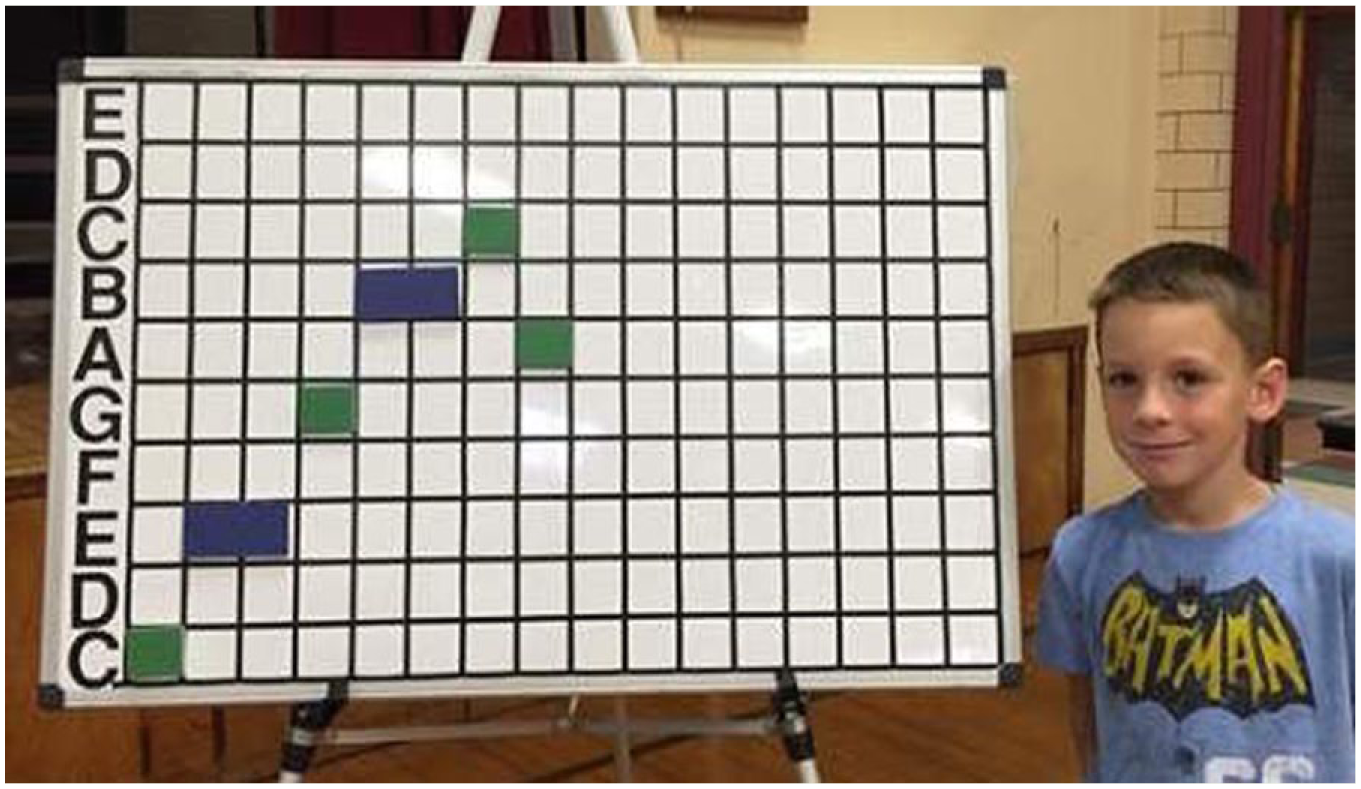
A Student Composes a Tree-Climbing Melody on the TRAMboard
At first glance, some readers might question the musical selections previously described in the in-school assembly performance. Indeed, some might ask if you are going to explore fish swimming in water, then why not perform “Aquarium” from Carnival of the Animals by Camille Saint-Saëns? Or why not perform Schubert’s Trout Quintet? While these pieces match the idea of fish or swimming and water, they do not appropriately demonstrate the undulating swimming and gliding motion of fish. These pieces by Schubert and Saint-Saëns are about water or fish, while the “Flower Duet” demonstrates swimming motion through its melodic and rhythmic motion. For all activities throughout the yearlong exploration, music was selected using the criterion that the motion of the music must match the motion of the specific type of locomotion in question, which caused the musicians themselves to look at some very familiar pieces in a new light.
In the activities described previously, the children explored the concept of motion through visual observation, graphing, listening, verbal descriptions, and composing. Their understanding of motion was represented through both music and animal observations. In music, the children learned to compose and analyze melodic motion in steps, skips and jumps, tempo, rhythmic motion, and melodic range. In science, the children explored the unique aspects of each animal’s physical structure that allowed it to move in a particular way. They also considered how animals’ physical attributes have aided in their ability to escape predators, reach food sources, and survive in their environment. In this example, the children used the subject-specific knowledge within music and biology to create a product that demonstrates the broader, shared concepts of adaptations and motion. Concept-based curriculum author Lynn Erickson uses the term synergy to describe this exchange between students connecting their knowledge within each subject area to thinking and exploring in a broader frame at the conceptual level. 32 The activity of composing animal locomotion melodies encourages synergistic thinking by drawing subject-specific knowledge together into a creative activity that requires higher-order thinking skills.
As the children explore motion and adaptations within the broader conceptual frame, they are asked to attend to the deeper underlying structure within each example. Instead of focusing on the colorful appearance of the animals or the instruments performing in the music, their focus is directed to the similar structures of motion and adaptations in both domains. Later, while analyzing their animal locomotion melodies using TRAM, the children detailed how specific musical elements were manipulated and adapted to mimic the motion of their animal. These surface details of the melody were described in terms of the broader underlying concept of motion and adaptation. The students’ abstraction to the conceptual level showed that they were able to attend to and apply common underlying structural aspects across ever-changing surface contexts, thereby demonstrating a positive indicator for transfer. 33
At the conclusion of the NBSO’s assembly program, the children were presented with free passes to their local zoo. On each pass was a map of the zoo with designated “TRAM stops” located throughout. When the children visited one of these TRAM stops in the zoo, the parents scanned their cell phone to the QR code on the “TRAM stop” sign. This launched a video of the symphony musicians playing classical music that moved just like the animal in that exhibit. So while the children watched birds flying in the exhibit, they listened to an example of classical music that moved like flight. Music was not used as background to add ambiance to the animal exhibits but was represented equally and authentically as each piece demonstrated animal locomotion through its specific tempo, range, and melodic and rhythmic motion.
Over the course of the school year, the NBSO returned to work with these children again, this time through a class lesson in their individual classrooms. In this lesson, the children were presented with three musical motifs that moved in ways that were representative of a swimming and gliding motion (Figures 2 and 3). The children were then directed to select a form of land tetrapod locomotion by drawing slips of paper out of a paper bag that listed either crawling, climbing, jumping, running, or flying. The class then chose their favorite swimming motif from the three that were presented. This swimming motif would serve as their starting point. From there, they were challenged to change, adapt, and expand the swimming motif to create a melody that moved like their newly selected land locomotion. Using the concepts of TRAM (tempo, range, and motion) as a guide, they graphed and composed their animal locomotion melodies on the TRAMboard.
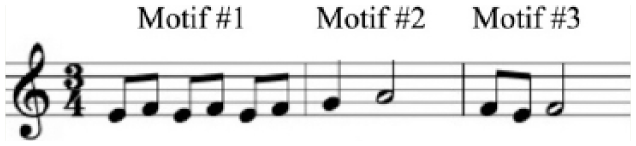
Swimming Motifs 1, 2, and 3
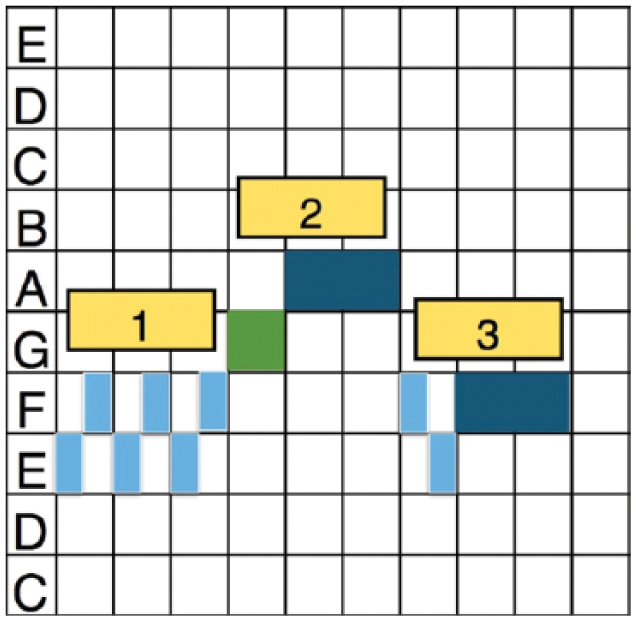
Swimming Motifs 1, 2, and 3 Graphed on the TRAMboard
As an example, at one school the children selected swimming motif number one as their favorite of the three. They then selected jumping as the form of land tetrapod locomotion to evolve their swimming motif to create a melody that jumped like a rabbit. While the original swimming motif number one moved in stepwise motion back and forth between eighth notes on E to F, the children decided that they needed to stretch the distance between those notes to create their rabbit’s jumping motion. Their adapted jumping melody maintained the eighth-note rhythms from the swimming motif to imitate the quick and steady jumping pace of a rabbit escaping a predator, but now their expanded intervals of a third, seventh, sixth, and octave added jumps that sprang up from the ground-level note, C (Figure 4).
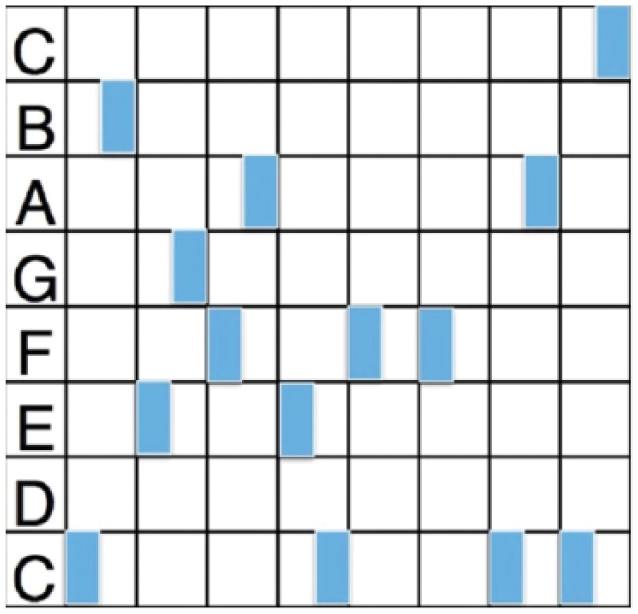
Rabbit-Jumping Melody Composed by a Third-Grade Classroom
Following the NBSO’s classroom visits, many school music educators continued exploring the concepts of motion and adaptations in their own classrooms. For example, one general music teacher was working on a unit on chords and chord progressions. Using a common chord progression, her students composed melodies that moved like various animals. She then combined the students into quartets to hear four individual locomotion melodies performed together. One quartet featured a melodic combination of a swallow, turtle, rabbit, and whale. Other music educators built their own TRAMboards to use as a standing composition tool in their classrooms. They used the graphing board and magnetic shapes to provide their students with an easily accessible tool for composing music.
The NBSO’s program concluded with a concert that featured videos of the children composing at the TRAMboard and analyzing how they manipulated the tempo, range, and melodic and rhythmic motion to evolve the swimming motif to move like another form of locomotion. Prior to their arrival, the orchestra collected the students’ locomotion melodies from all participating 135 classrooms and arranged them into a new piece for orchestra that was premiered for our 3,600 student composers during these concerts. Their piece began with the three swimming motifs, and then the children’s representative locomotion melodies were combined to crawl onto land, climb into trees, jump, and run. The piece ended with the last locomotion to evolve, flight.
Finding the Right Fit
While the example described here included an outside arts organization as the instructors, classroom and music teachers could collaborate to identify shared concepts within their respective curriculum. As long as the selected concept of study is genuine and rich within each connecting field, any combination of teachers could combine to present their own connected curriculum.
With collaboration time at a premium in many schools, teachers may look to explore an arts integrated project with a single grade level or a subset of their overall student roster. The selection of participating grade levels or students may depend on the level of interest coming from classroom teachers and/or the ability to identify potential shared concepts. To begin, teachers within a school could create an online concept community. Once established, classroom and fine arts teachers could identify and post upcoming concepts to be covered in their classes and invite responders from other subject areas to post comments signaling a potential shared concept. Initially, educators may have difficulty backing away from the facts and topics to see a broader concept. For example, a science teacher may notice an upcoming unit centered on predators–prey systems. While the interdependence between predators and prey describes the topic or theme, the concept might be articulated as balance. While the relationships of predators and prey do not evoke immediate connections with the arts, the shared concept of balance does.
Ideally, if team-teaching opportunities are possible, the music, art, and literature teachers could create one unified project where students use prose, music, and imagery to communicate [aspects of a chosen topic].
As teachers begin to collaborate in an arts integrated project, domain-specific vocabulary may be problematic. In preparing the music and biology curriculum, the lack of uniformity in terminology became apparent between the two connecting fields. For example, while the NBSO used the term adaptations for the program, this term was more appropriate to the field of biology. In music, the term thematic transformation would have been more appropriate to describe the ways in which a motif is developed throughout a piece of music. In another scenario, teachers may find different subject areas with the same terminology but find that their meanings are not the same. For example, music and art share the term texture but have different meanings within each. As educators come together to brainstorm shared concepts, allowing each to describe how the concept functions within their domain may help flesh out inconsistencies or discrepancies. This assures all teachers involved that the concept is one that is truly shared among all connecting subject areas.
Once a shared concept is selected, the participating teachers can list ways that the concept will be explored within their own subject area. For example, if the concept of contrast is chosen, teachers could describe how contrast is demonstrated within their own domain. In music, students could compose and perform melodies that demonstrate contrast through range, contour, dynamics, key, tempo, and texture. In art, the concept of contrast could be explored through creating art work that demonstrates value contrast. In literature, children could write original two-voice poems that demonstrate contrasting perspectives. All of these activities could occur within each teacher’s classroom and thereby eliminate the need to change schedules or coteach. Ideally, if team-teaching opportunities are possible, the music, art, and literature teachers could create one unified project where students use prose, music, and imagery to communicate contrast in number or contrast in light and tone.
In the examples from the NBSO’s arts integration program, the use of shared concepts aimed to connect the study of music and biology while preserving the integrity, value, and authenticity in each. While the use of concept-based arts integration addressed this concern over music’s authentic involvement in arts integration, the issues surrounding teacher training were not addressed. Moreover, with schedule and time constraints in existing college course work, the suggestion to simply add arts integration methods, models, and applications may be impractical. However, if a segment of methods course work could be situated in a setting where arts education students and non–arts education students explore and learn side by side, educators might move into the workplace with a clearer vision of the valuable benefits of connected learning experiences and ways to integrate while maintaining the integrity and relevance of the arts and non-arts disciplines. For music educators currently in the field, authentic connections can begin with the elements and structures found within music and then connect to other subject areas that share the same concepts and offer students multiple pathways toward building understanding.