




Abstract
LGBTQ students in many parts of the United States often experience hostility on the part of other students, teachers, and administrators. This article reviews current terminology, examines present-day attitudes and recent literature, and offers suggestions to educators who want to create safe spaces for all students in their classrooms.
To thrive, students need to feel accepted and supported socially. For many minority students, however, finding social acceptance at school may seem an extraordinary challenge. Sexual-minority students in particular—gay, lesbian, bisexual, transgender, other identities, and those questioning their identity—have unique psychosocial, emotional, and academic needs compared to their heterosexual and nontransgender (sometimes called cisgender or simply cis from the Latin “this side of,” analogous with trans, across) peers that schools rarely address directly. These students face prejudicial behavior daily not just from fellow students but from teachers and administrators as well. 1 Indeed, even some music education professionals still express openly hostile attitudes toward sexual-minority people. 2 Music classrooms are uniquely able to provide safe spaces for sexual-minority students if music teachers are willing to make the effort. In addition to the prosocial effects of teamwork and camaraderie, many common music classroom activities may induce neurobiological effects that alleviate anxiety and depression in LGBTQ students and reduce anti-LGBTQ harassment in schools more generally.
What do educators need to know to help their sexual-minority students feel welcome in their classrooms? Here are some ideas. NAfME is glad to offer one hour of professional development recognition to you for reading this article. Please follow the link below and complete a short quiz to receive your certificate of completion. http://bit.ly/SafeSpacesForSexual-Minorities
Sexual-Minority Identities
The first step in properly addressing the needs of LGBTQ students in music classrooms is understanding the myriad terms used about sexual orientation, gender identity, and gender expression. The landscape of sexual-minority identity and rights has changed drastically in recent years, as have the words used to refer to sexual-minority people. LGBTQ, one currently popular acronym for sexual-minority identities, stands for lesbian, gay, bisexual, trans, and queer. The first three categories acknowledge different sexual orientations and are generally well understood in society today. Trans and queer people, on the other hand, have become more visible in public life in recent years. These two words describe not a sexual orientation but gender identity (i.e., the gender with which the person identifies internally) and gender expression (the person’s external appearance of gender traits).
The word trans refers to persons who identify as a different gender from their biological sex. Trans is a preferred replacement for other frequently misunderstood or misused words, such as transgender, transsexual, and transvestite. Trans people may choose gender expression characteristics that affirm their gender identity, as opposed to their biological sex, such as clothing, facial and body hair, vocal characteristics, and hair styles.
The word queer, historically shunned as a derogatory slur, has a complicated history. Recently, it has started being used by some members of the LGBTQ community to refer to (a) individuals who are gender nonbinary and therefore do not express a uniform set of gender traits or (b) individuals who wish to move their own identities beyond simple categories of gender and sexual orientation. People who consider themselves queer or genderqueer are increasingly visible in teen and young adult populations—a time in life when individuals often challenge social norms.
Teachers require the best information to address the needs of students in their classrooms, but literature in music education journals regarding LGBTQ identity continues to be scarce. In his 2013 literature analysis, 3 music education professor Patrick K. Freer found that of the more than 4,000 articles published in eleven different arts education journals since 2000, less than 2 percent included any LGBTQ-related content. Furthermore, across the thirteen-year period analyzed by Freer, he found no notable increase in the frequency of LGBTQ-related articles when surveying eleven different arts education journals. The lack of LGBTQ-related issues in education has been referred to as being among the “missing topics” in education as a whole.
LGBTQ Student Needs in Our Classrooms
Despite increased visibility of LGBTQ people in American culture in recent years, homophobia and transphobia are still widely prevalent in schools in the United States. Furthermore, both covert discrimination and overt harassment toward sexual orientation and gender identity are prominent in classrooms. 4 In fact, several authors have argued that homophobia is “the last socially acceptable prejudice.” 5 Students who experience harassment and teasing because of their perceived sexual orientation suffer from depression and substance abuse at alarmingly high rates. 6 In music classrooms specifically, homophobic attitudes toward students cause inhibition of creativity, interfere with development of close relationships, and limit communication between teachers and students. 7
Music classrooms may be uniquely supportive educational environments for LGBTQ students because by their very nature, group music-making may lead to greater social understanding. LGBTQ students often feel socially isolated from their peers because they cannot talk about personal details regarding feelings and relationships. Group music-making may help alleviate this social isolation through nonverbal emotional communication because students participating in group music-making are subconsciously engaged in emotional interactions. 8 This may in turn help ameliorate some of the anxiety and depression LGBTQ students experience as a result of social isolation. Indeed, when asked directly, LGBTQ students identified music ensembles as places that allow for freer expression when compared to other classes in school. 9
Musical interaction with others through music-making may also influence student empathy toward each other. In fact, interactions through music ensembles create friendly, welcoming environments in which they can develop social and emotional communication, experience other people’s emotions, and learn how to provide supportive emotional responses. 10 Engaging students in empathic understanding is an effective strategy for combatting homophobic attitudes and actions because empathy has direct effects on human behavior by actively preventing bullying, aggression, and violence between students. 11 Because music-making requires cooperation between individuals, it may increase both group trust and the likelihood of future cooperation. 12 Students who make music together form a sense of camaraderie that transfers to other social settings and makes students better citizens. 13
Experiences within the music classroom appear to provide measurable protective effects for LGBTQ students outside the music classroom. In a recent survey of secondary ensemble alumni in college music courses, choral conductors and researchers Paul Caldwell and Joshua Palkki found that students who engaged in choral music activities were 15 percent less likely to experience bullying and harassment than LGBTQ students outside of those activities. 14 If music teachers properly exploit the unique social interactions facilitated within music classrooms to address diversity, our classrooms may positively affect LGBTQ students throughout the school environment.
Unfortunately, despite the measurable protective effects of group music-making on LGBTQ students in the school environment, research suggests that students do not perceive music teachers as supportive of LGBTQ identities. In a recent survey of over a thousand collegiate choral singers, only 19 percent had disclosed their LGBTQ identity to their secondary choral music teachers. Furthermore, only 12 percent of the singers would recommend that other LGBTQ students confide in their choral music teacher.
Music and Movement
Recent neurobiological research on empathy suggests that the protective psychosocial benefits of music ensembles may not come from the emotional content of the music or even the direct social interactions among students. Rather, positive effects from music experiences may evolve from direct impacts of synchronized physical and auditory stimuli on brain systems. No matter the instrument or ensemble, group music-making always involves some level of synchronized movement with others. Recent research suggests that synchronized movements with others possibly directly affects social judgments of other people. 15 By combining mirrored action with emotional contexts, humans not only understand the sensations experienced by others but also predict their intentions. 16 Specific movement techniques may further optimize student responsiveness to the emotions of their peers, enhance student creativity, and create empathy between learners, specifically overcoming the psychosocial deficits that Bergonzi identified in his 2009 article.
Researchers have identified three specific types of movement activities that have measurable effects on human empathy: imitation, synchronicity, and cooperation. 17 Rachyl Smith, a member of the Creative Movement Alliance Board of Directors, noticed improvement of attitudes and relationships among students in classes after engaging in cooperative synchronous movement activities. 18 “Once they have been working in pairs for a minute or so, you can see a ‘switch,’ and they click with their partner. . . . After a day of creative motion, they are more comfortable singing, more comfortable with the instructor, and there’s not as much fear in the classroom.” Smith suggests using props like balloons, dowels, and even the legs of pantyhose with partners in synchronous movement and cooperative movement exercises. With dowels, each partner holds the dowel using only the tip of their index finger. While listening to music or singing a known song, the partners push and pull the dowel back and forth between themselves imitating the phrasing of the music. They can also pass a balloon or push and pull elastic cord to achieve the same effect. These activities are successful with students at all levels in active listening activities or with ensemble members to improve group cohesion during performance.
Tim Waugh, artistic director of the Charlotte Bronze handbell ensemble, also advocates the use of mirroring exercises to improve ensemble cohesion. 19 Waugh’s favorite exercise is called “painter and canvas,” another technique that works well with elementary and secondary students. One partner holds a hand up, palm facing toward their partner. This is the “canvas.” The partner uses two fingers as a “paintbrush” and taps the pulse on the canvas’s palm. The teacher may instruct the students to use any pulse or subdivision (whole, half, quarter, eighth), or the students may choose their own. The canvas partner moves a hand around the space, and the painter must continue to tap the pulse and follow the canvas’s palm at the same time. This can be done while listening to music, while singing a known song, or while the teacher improvises on the piano.
Waugh also uses props such as balloons and tennis balls to establish uniform beat anticipation throughout the group. First, students establish a firm understanding of the pulse using the prop by themselves. Then, they work to establish the pulse by passing the ball or balloon back and forth with a partner. Finally, the whole ensemble can work together to keep a uniform pulse with everyone carefully following the pulse of the group, passing the prop around the circle or passing it across the circle. Teachers can modify these activities successfully for both elementary and secondary music students.
I have used partner-mirroring activities with great success with elementary and middle school students. Two partners stand facing each other. Each member of the pair of partners takes a turn being the “leader” and the “follower.” The leader improvises movement with arms, hands, and body, and the follower must carefully mimic their movements. This exercise is enjoyable just using hands or especially with props like scarves and flags. Furthermore, this technique works equally well listening to music as it does singing a known song. I encourage students to work with unfamiliar peers, or I also purposefully pair students who may benefit socially from such interaction. After these activities, I have observed that students are more responsive to each other’s feelings than before the activity and are less likely to engage in bullying behaviors. In particular, students whom I have perceived as possibly having LGBTQ identities “come out of their shell,” are more relaxed around their peers, and begin to express themselves more freely even outside of music class activities.
Of course, many of our music classrooms are quite small and do not allow much space for students to move. Seated movement activities also may be successful options in the smallest spaces. In choral music ensembles of all ages, seated synchronized physical warm-ups are successful in improving posture as well as creating a sense of group cohesion. 20 Synchronized movement responses to music, such as those outlined by movement experts James Froseth and Phyllis Weikart, 21 may also engage empathetic responses between students and establish welcoming psychosocial environments for minority students. Taking this one step further, teachers may partner students sitting next to one another or mix up the seating arrangement to further enhance group collaboration.
With older students, particularly late high school students, some synchronized movement activities may be perceived as childish. When students of any age are resistant to improvisational movement, teaching conducting gestures is still an effective strategy for implementing group movement. Teaching beat patterns automatically synchronizes the ensemble while simultaneously addressing music curriculum goals. With older students, gestures for dynamics, pitch, and articulation also may be introduced. In time, applying conducting gestures to repertoire becomes its own form of creative movement. The students can be partnered or grouped to collaborate on planning conducting gestures, further developing group cohesion and group problem solving.
Music Teachers as Role Models
Because of the unique neurobiological bond that music teachers develop with students through group music-making, we are especially capable of influencing student perceptions. Music teachers must demonstrate acceptance of LGBTQ students by being excellent role models for their students. In one recently published dissertation, male singers in high school choirs expressed progressive views of masculinity and sexual diversity when the teacher modeled such behavior. 22 By interacting directly with the views of our students, music teachers may contribute to the safety and well-being of LGBTQ students throughout the school. 23
Music teachers must be sensitive when using language about gender and identity. Make no assumptions when dealing with students regarding sexual orientation or family structure and use gender-neutral language like person when referring to a student’s romantic interest. 24 Conductors should refer to voice type or instrument rather than gender. 25 Instead of saying, “Now the girls sing,” say, “Now the treble voices.” Remember that students engaged in music-making together are emotionally vulnerable, so the attitude and language of the teacher may affect LGBTQ students’ perceptions both of their peers and of themselves.
Teachers should use the name and pronouns that a child prefers as long as they do not interfere with the classroom environment. Refusing to use a person’s preferred identifiers erodes a person’s dignity and value, and the student may feel personally rejected. Increasingly, many gender-queer people and LGBTQ identity scholars are using gender-neutral pronouns such as they in the third-person singular. 26 While this use of language may seem awkward or incorrect to some, the American Dialect Society officially recognized its use at their annual conference in 2016. 27
All teachers must be aware of and responsive to uses of inappropriate language regarding LGBTQ people in their classrooms. Unfortunately, music teachers appear to be unprepared to deal with offensive behavior toward sexual-minority and gender-variant students. 28 When an insensitive or offensive word is used, stop and address the behavior immediately. Repeating the word is actually a highly effective method for stopping the behavior, if the teacher is able to do so. Engage students in a conversation about the abusive language and redefine standards for acceptable talk. 29 Group music-makers already are attuned subconsciously to each other’s emotions, and thus discussions of offensive language may be more effectively approached from an “us” perspective rather than as individuals. 30
For both LGBTQ and non-LGBTQ students, dress codes and uniforms may be a substantial barrier to participation in music ensembles. Increasingly, I have had cisgender female students in my ensembles who were truly uncomfortable wearing dresses. Allowing students to choose the appropriate type of uniform for themselves provides a supportive environment for all students. Music teachers are encouraged to permit students to wear clothes that affirm their gender identity regardless of their biological sex. 31 This permission does not mean ensembles cannot have a uniform. Uniforms for performance may be presented as alternate but equal options rather than assigning them as the “boys’” uniform and the “girls’” uniform. However, the most supportive option may be a gender-neutral uniform. In this way, teachers avoid imposing unwanted attention on students based on their uniform choice and prevent “outing” closeted or questioning students.
Finally, topics addressing LGBTQ identities must be included in music class curricula. 32 Unfortunately, little professional literature exists that describes the most appropriate implementation of LGBTQ studies in primary and secondary education. 33 Many teachers do not teach about LGBTQ issues, and some teachers still discuss homosexuality and transgender identities in a negative light. Simply using the acronym LGBTQ around students may raise interest about what each letter means and create intellectual curiosity about issues regarding sexual-minority identity, improving the school climate for LGBTQ students.
It is important here to point out that teaching about LGBTQ people and their history is not equivalent to teaching about sex. 34 Rather, presenting topics that include LGBTQ issues teaches children about diverse relationships, diverse identities, and diverse life experiences. Furthermore, students recognize that gender and sexuality are part of their school experience whether teachers address them or not. 35 Teachers have no hesitation discussing issues of race or heterosexual cisgenders, yet there is a noticeable barrier when teachers consider sexual-minority identity as part of their curriculum.
In particular, teachers in rural and urban schools may feel increased concern about discussing these issues because of perceived hostility toward LGBTQ people in their communities. In particular, “No promo homo” laws exist in eight states that actually forbid teachers from discussing LGBTQ issues in a positive light. 36 However, these statutes typically only pertain to sex education, not other parts of the curriculum like history or social science. None of the existing laws forbid teaching about historical figures or events that address LGBTQ identity. Additionally, legal scholars generally agree that such statutes are unconstitutional because they restrict a teacher’s freedom of speech and specifically stigmatize LGBTQ students in the classroom.
Some teachers may fail to address LGBTQ issues in their classes because they are concerned about parent disapproval or even harassment from students. Contrary to teacher expectations, inclusion of LGBTQ content in curricula actually has been well received by both students and parents. 37 This positive reception suggests that teachers are unnecessarily cautious when judging student maturity and parental viewpoints. Certainly, it would be inappropriate to immerse students of all grade levels in the issues. Teachers must decide for themselves how best to discuss LGBTQ issues in their classroom. Without reservation, teachers need to be sensitive to and reinforce positive images of LGBTQ people just as they would any other minority group of students.
There are many ways music teachers can address LGBTQ identity in their classrooms. Simply acknowledging the existence of LGBTQ people and nonheterosexual relationships helps students increase their understanding of diverse identities. Furthermore, by carefully tailoring the content and tone of the material, teachers can discuss topics that include LGBTQ identity in both elementary and secondary music classrooms.
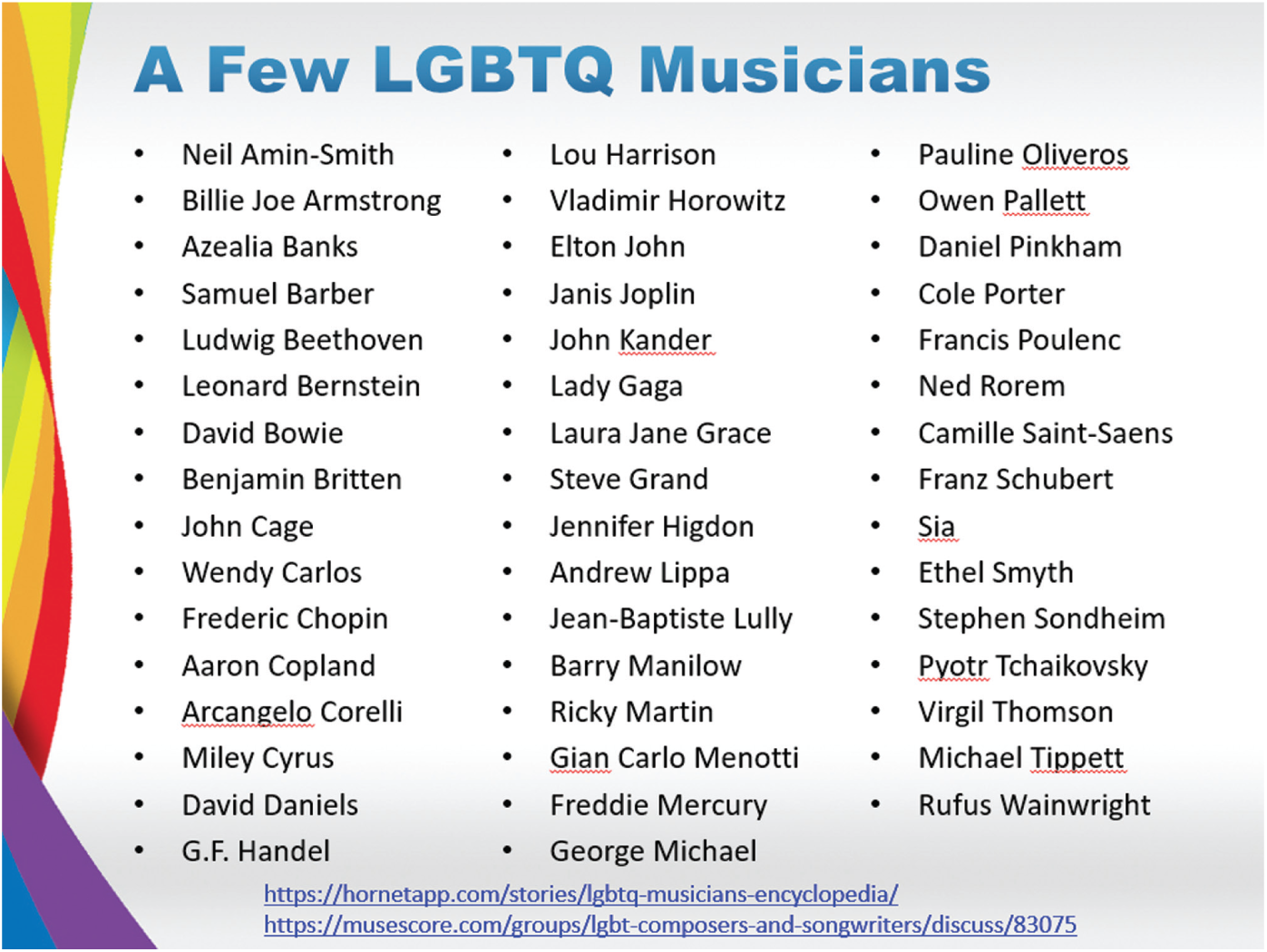
In an effort to think through these issues, teachers need to familiarize themselves with materials and resources that already exist, such as the lesson resources available from organizations like the Gay, Lesbian, and Straight Education Network (GLSEN, www.glsen.org). Music teachers also need to learn about the lives and histories of LGBTQ composers and performers, like Britten, Bernstein, Copland, and Tchaikovsky, to name but a few. They can display information in classrooms about LGBTQ musicians during LGBTQ history month in October or LGBTQ Pride month in June. By engaging our students in discussions about the LGBTQ identities of the musicians’ music to which they listen and perform, music teachers can foster the understanding of students of LGBTQ people in their schools and communities.
Without question, more research must be done into the specific effects of music classrooms on students with LGBTQ identities. Movement activities that are synchronized with sound seem to have specific psychosocial effects on students that may contribute to protective effects for LGBTQ students outside the music classroom. Music teachers can help direct students toward a greater empathetic understanding of LGBTQ people by simply being sensitive to and inclusive of LGBTQ students and of issues surrounding sexual-minority identities. While intolerance may never disappear completely, we can make our music classrooms safe havens for LGBTQ and other minority students that foster understanding far beyond our classroom walls.
Footnotes
William Southerland is a second-year doctoral student in music education at the University of North Carolina at Greensboro. He also directs the Triad Pride Men’s and Women’s Chorus, ensembles for LGBTQ people and their allies in the Greensboro/Winston-Salem area. He can be contacted at