




Abstract
Researchers have published an increasing number of reports about undergraduate music students suffering from depression, anxiety, and stress as well as of in-service teachers’ experiences with burnout. Whether an undergraduate music student, a teacher, or a teacher educator, those in our profession need to increase awareness of the prevalence of stress and mental health concerns in music education. Along with presenting information to increase mental health literacy, this article discusses the use of self-care as a form of stress reduction among current and future music educators.
Keywords
We need to be more transparent about mental health and wellness issues in the music teaching profession.
Photo of Christa Kuebel by Ken Wendt.

NAfME is glad to offer one hour of professional development recognition to you for reading this article. Please follow the link below and complete a short quiz to receive your certificate of completion.
Ask an undergraduate music education student, “How are you?” and you will likely hear responses such as “Busy”; “You know, it’s marching band season”; or “Tired from staying up late to study after rehearsal.” Preservice music educators are typically working through a heavy academic course load accompanied by performance and ensemble expectations as they prepare to move into their career in music education. Inquire with an in-service teacher and the answers will likely be similar: “Well, it’s concert season”; “Well, it’s concert season . . . again”; and comments such as “Finalizing grades for the end of the marking period” and “Preparing for contest.” In-service music teachers are instructing and assessing numerous students while preparing multiple concerts each year along with finding time for fund-raising, advocacy, and professional development.
I have worked in music education in nearly all specializations and with students from infants to adults. I have been a full-time music teacher, as well as a music education undergraduate and graduate student, working side by side with peers and colleagues. At every level and stage of music education, I have observed both the joy and the stress of the music education profession in myself, my students, and my colleagues. It is the level of stress I see that is concerning.
In this article, I address the current literature on stress and burnout among preservice and in-service music educators as well as share information on mental health and resources to increase mental health literacy. I also discuss the concept of self-care, followed by a self-care assessment tool and an outline for developing a self-care plan. I am not a medical or mental health professional, but I have sought appropriate resources and the expertise of mental health professionals in writing this article. The suggestions I provide are not substitutes for appropriate medical attention.
Is It Stress?
Two common terms used in research on the wellness of preservice and in-service music educators are stress and burnout. Stress is “a physical, mental, or emotional factor that causes bodily or mental tension.” 1 Stress induces physical and psychological reactions that may increase in seriousness depending on the level and duration of the situation causing the stress. High levels of stress may lead to physical concerns, such as fatigue, headaches, high blood pressure, or ulcers. These may also lead to psychological issues, such as irritability, detachment, or depression. 2 Burnout has three components: (1) emotional exhaustion, (2) depersonalization, and (3) reduced personal accomplishment. 3 Although stress and burnout can have similar symptoms, it is prolonged and excessive stress that leads to burnout. As discussed in the following sections, stress and burnout can lead to negative consequences for both preservice and in-service music educators.
Preservice Music Educators
Higher levels of stress and symptoms of burnout have been found among music performance and music education undergraduate students when compared to both national averages and undergraduate students in other degree programs. 4 This may be due to several factors. Music students experience the normal stressors of college life, such as academic success and failure, financial pressures, and increased independence along with responsibilities to rehearse, perform, and practice. 5 Due to heavy course loads and additional performance responsibilities, students often minimize time spent eating, sleeping, or socializing in order to accommodate their overloaded schedules. 6 Performance anxiety, perfectionism, and excessive self-criticism in practicing and performing may also negatively affect music students. 7 Self-worth and value become intertwined with how students view themselves as performers.
Along with stress, depression and anxiety have been reported at high rates among music education students. 8 Mental illness is experienced by one in five Americans, and 75 percent of cases begin by the age of 24. 9 This means that traditional college-age music students and early-career educators are at the ages when they may be more likely to experience symptoms. Although mental health concerns are prevalent, researchers have shown that music students may be unlikely to seek professional help, which may lead to more serious implications. 10 The onset of a major life transition, such as starting college, graduation, or the commencement of a new career, is a crucial moment for attention to mental health and wellness.
In-Service Music Teachers
Researchers have shown for several decades that in-service music teachers are also at risk for high levels of stress and burnout. 11 Reported sources of stress for music teachers that potentially lead to burnout include lack of training, administrative support, and appropriate funding. These deficits are further imbalanced by an overwhelming workload, long hours, and challenging classroom situations. 12 Although the literature in music education is limited, researchers in general education have reported that burnout may lead to impacts on the profession, including negative student outcomes and possible teacher attrition. 13 This might also impact music educators even more deeply as they are often faced with additional responsibilities such as those discussed previously. 14
Is It More Than Stress?
Although not the focus of this article, preservice and in-service music educators may benefit from gaining an understanding of signs that stress has become a more serious concern. Stress may not cause mental illness, but it has been shown to impact psychological conditions, such as depression and anxiety. 15 Having an understanding of mental health concerns may help support students or colleagues in need.
Improving mental health literacy may be an important first step in being able to recognize when symptoms are more than “just stress.” Mental health literacy includes having an understanding of mental health signs and symptoms, resources, and coping strategies. If a mental health professional is available in your school or district, he or she could be a first contact for training on signs and symptoms of a mental health concern or crisis. If an outside source is needed, the National Alliance on Mental Illness (https://nami.org) has published easy-to-read reports and infographics with warning signs of mental health concerns that are downloadable on its website.
I also encourage undergraduate music students, teachers, and teacher educators to discover the resources at their school or university, such as a school psychiatrist or counselor, counseling services, or a health center, before a potential crisis emerges. Be aware of emergency procedures both during and after the typical work hours in case you, a student, or a colleague is in need during an afternoon or evening rehearsal or performance. Along with knowing what is available within your school community, national organizations have easily accessible information to support mental health literacy. If faced with an emergency for yourself or someone else, the Crisis Text Line (https://www.crisistextline.org/how-it-works/) allows those in need to text home to 741741 to begin communication with a trained professional immediately.
Self-Care as Prevention
Increasing awareness of the stress of the music profession and improving mental health literacy are steps that can provide more consciousness of the way these things affect music educators. Developing and implementing a self-care plan may also help prevent or reduce the effects of stress and burnout. The following suggestions could help to assess one’s current level of self-care and guide in developing a realistic and effective system of self-care.
What Is Self-Care?
Self-care is deliberate action taken to care for one’s mental, emotional, and/or physical health. 16 It is intended to provide an individual with the tools needed to recharge and reset so he or she may fulfill goals and responsibilities and maintain healthy relationships. One can think of self-care like the safety announcement heard on airplanes reminding passengers that in case of an emergency, they should put on their own oxygen masks before helping others. Music teachers must take care of themselves before they are able to be present for students, administrators, teachers, parents, professional communities, and others in their lives. Self-care is not selfish, a form of procrastination, an overindulgence, or an excuse for unhealthy actions or coping mechanisms. It does not have to be expensive or time-intensive and should not be unrealistic.
The figures provided in the remainder of this article are intended to be interactive. As you continue reading, take time to consider the questions and information presented so that you can begin to develop your own self-care goals and plan. Suggestions for self-care activities are listed are presented in the next sections; however, it is important to first understand your current self-care status.
What Is Your Current Level of Self-Care?
How would you describe your current self-care status? Consider the ways you take care of yourself in six areas (physical, mental, emotional, academic/professional, social, and spiritual) by working through the questionnaire in Figure 1. 17
After completing the assessment in Figure 1, review your ratings. In which areas are you meeting your needs? Which areas need more attention? Keep in mind your responses to the questions above as you think about a self-care plan.

Self-Care Assessment
Developing a Self-Care Plan
Developing and implementing a self-care plan may help to prevent negative experiences during times of high stress that one might experience in music education. I suggest two things to keep in mind when developing your plan: First, your self-care plan is not anyone else’s self-care plan. If going to the gym causes more stress in your life than relaxation because you feel that it is something you “should” be doing, perhaps you can find another way that you enjoy moving your body. Try taking a walk with a friend or joining a community sports team instead.
Second, self-care should be scheduled and honored in the same way that anything else in your life would be. While the concept of self-care may not seem like the most important thing on your to-do list, it is not optional. While you cannot skip class or a meeting to visit a spa, put your self-care activities in your calendar in the same way that you would other scheduled events. If taking time for self-care feels stressful, try starting with five minutes for yourself a few times in the course of the week, and observe the effect it has on your general well-being and other areas of your life.
Ways to Practice Self-Care
As shown through the assessment tool, self-care can be discussed in the following categories: physical, emotional, psychological, academic/professional, social, and spiritual. I highlight a few examples of each area in Figure 2 that might be helpful in developing your self-care plan. 18
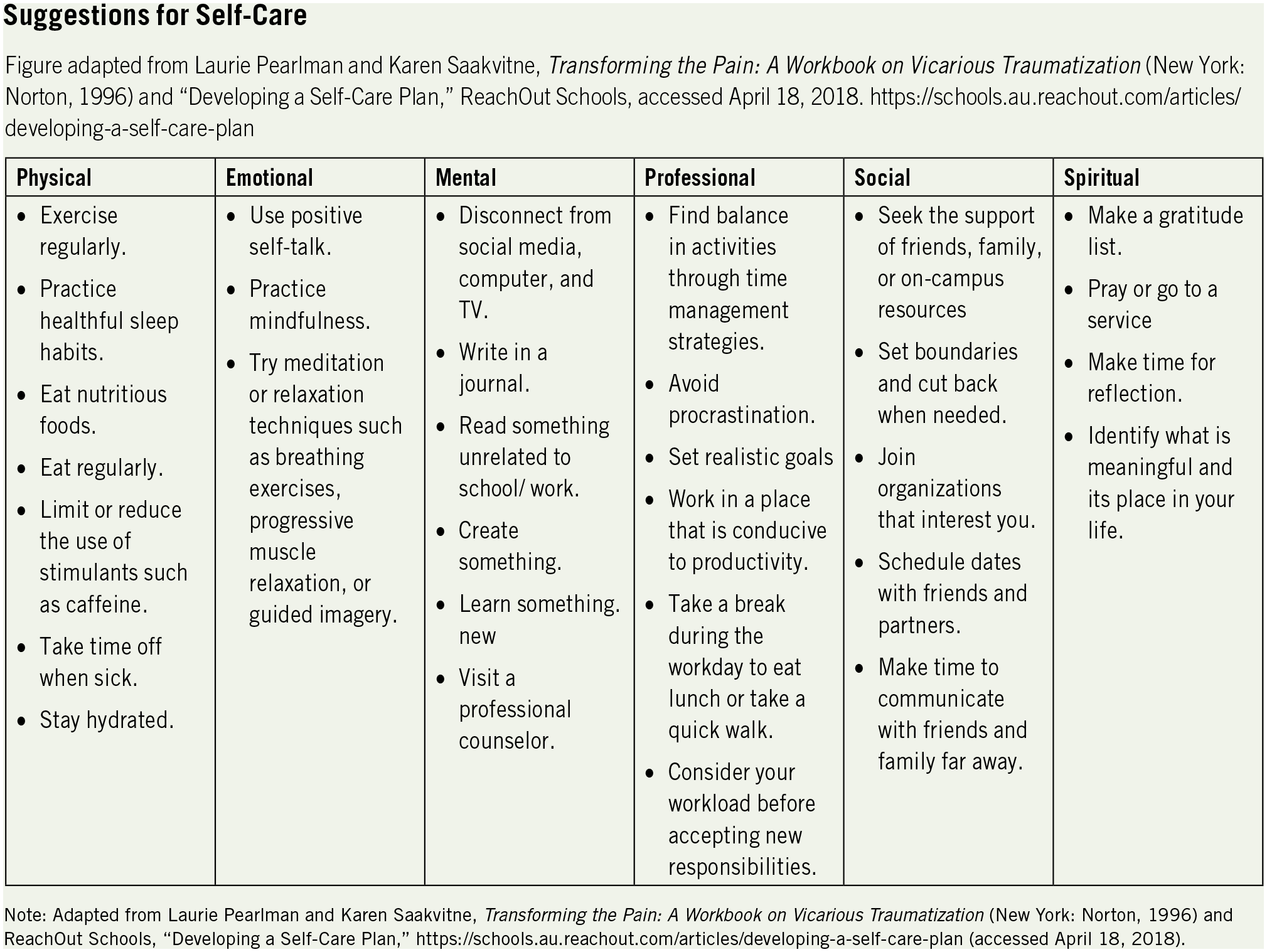
Suggestions for Self-Care
Consider your current level of self-care and ways you can pursue self-care with the following questions from Figure 3: How do you feel about your current level of self-care? What area is in need of the most attention? What obstacles prevent you from practicing self-care? What types of self-care can exist in your life even with these challenges?

Developing a Self-Care Plan
Setting Self-Care Goals
Now it is time to set self-care goals (see Figure 3). Based on the assessment you completed and questions you answered, you may see an area of your life that needs the most focus. Instead of feeling overwhelmed by introducing multiple methods of self-care into periods of time you realistically may not have, start small. What is one self-care strategy you can implement this week? Write it as a “SMART” goal (specific, measurable, achievable, realistic, and time-bound) and then take a moment to schedule it.
Place the goal you have written somewhere that you can see it daily. After a set period of time, such as a week or month, review and assess your goal. Perhaps your goal is not working because it was too ambiguous or not realistic for the amount of time you have or financial restraints. Use that information to revise your plan. If it is working, notice how it is making you feel. Perhaps you can add an additional form of self-care once you feel confident with your original goal.
The Bigger Picture
Although all preservice and in-service music educators may benefit from increased mental health literacy and implementation of a self-care strategy, it may also be time for larger changes to take place in the field of music education. Researchers have provided suggestions as to how administrators and educators may begin to initiate positive changes related to musician wellness. I discuss these here along with some strategies that I have implemented in my own classroom.
An important aspect of supporting music educators is improving mental health literacy regarding the signs and symptoms of burnout and mental health concerns as well as specific knowledge of university or school resources. 19 This information should be disseminated to faculty, staff, and students. This may be particularly important in the university setting, as undergraduate students are likely to turn to friends and applied teachers before they are willing to reach out to campus services. 20
There are several methods through which preservice and in-service music teachers can be instructed on mental health literacy and general wellness. Undergraduate students could be taught through a specific course, a seminar series, or an orientation workshop led by faculty or counseling center staff. 21 Opportunities to discuss campus resources, self-care, and work/life balance might be most crucial early on, or prior to beginning a music major, in order to provide students with valuable resources before they enter the height of their undergraduate demands. Practicing teachers can be reached through staff meetings and training sessions provided by counselors or mental health professionals. Professional development or learning communities could also provide opportunities for teachers to build support among colleagues.
What is taught about wellness is as important as when and how. Topics for in-service teachers could include training in stress management, assisting with the development of strong classroom management skills, and providing administrative support. 22 Undergraduate students could be taught skills to develop intrapersonal skills, such as time management and organization; strategies for studying; and healthy sleep, diet, and exercise habits. They may also be guided to develop interpersonal skills, including learning to effectively relate to peers, family, and figures of authority. 23 The specific topics of mindfulness and meditation have received increasing attention in music education. For example, Frank Diaz teaches the Mindfulness in Music Teaching and Learning clinic at Indiana University along with completing research in these areas. The web page for this course (https://music.indiana.edu/precollege/adult/mindfulness/schedule.shtml) provides suggested readings on this topic. For any of these ideas to be successful, teachers, administrators, arts supervisors, and music teacher educators need to work together to support preservice and in-service music teachers.
Another consideration for music teachers and undergraduate students is an awareness of a reasonable workload. While participants have described their overloaded schedules, limited research exists regarding the number of hours preservice and in-service music teachers spend working in an average week. For undergraduate students, faculty and advisors may be able to help with creating a manageable schedule. Instead of thinking about your schedule only in terms of what classes you will take, keep in mind rehearsals for ensembles, practice time, fieldwork hours, or a part-time job. In-service teachers have less control over their class schedule, and it is easy to say yes to many things due to administrative requests and in order to provide opportunities for students; however, it may be valuable to consider your actual number of work hours before accepting additional school responsibilities or performing gigs. For both preservice and in-service music educators, it is particularly important to consider your existing workload before making new commitments. Remember that it is better to be healthy in the long term than to burn out quickly.
As a music teacher educator, I have found several successful strategies for implementing knowledge on mental health and self-care in my university courses. From the beginning of the semester, I provide students with information on campus resources, such as the counseling center, as well as other services, including the academic support center. Throughout the semester, I work to develop rapport with my students so they may feel more comfortable approaching me with specific concerns. During midterm of each semester, I take time to present information on self-care, have students complete a self-care survey and questionnaire similar to that provided earlier, and discuss strategies for stress reduction and overall healthy lifestyles. While these efforts do take time away from content of each class, providing students with the support, knowledge of resources, and opportunity to decrease the stigma surrounding mental health is a valuable lesson.
For both preservice and in-service music educators, having a self-care plan may provide some relief among an overwhelming schedule; however, there are times when seeking the help of a professional is the best choice. Having a periodic (weekly/monthly/quarterly) visit with a professional counselor may help you to check in with yourself and your well-being. Most schools offer services at no cost, and most insurance policies have mental health coverage built into the plan for no cost or a small copay.
Invest in Yourself
Music education has been shown to be a field in which stress and burnout are common. We must address this difficult realization in order to make changes for the health and success of our current and future teachers. Our concert seasons will continue to come and go, and our responsibilities will not decrease in number, but taking time to consider how to take care of ourselves may allow us to fulfill our responsibilities in safe and effective ways throughout our entire careers.
Footnotes
Notes
Christa Kuebel is an assistant professor of music education at the University of Central Arkansas, Conway. She can be contacted at