




Abstract
Classroom management is commonly understood as the structures and procedures that establish and reinforce a productive learning environment. However, traditional conceptualizations of classroom management are rife with culturally embedded norms, assumptions, power structures, and other roadblocks to a healthy classroom environment for all students. While certain routines can help set the stage for learning, teachers must critically examine such routines and expectations to establish a classroom environment that supports learners’ varying needs and backgrounds. This article unpacks several challenges with classroom management and offers offer a culturally responsive approach that supports community over compliance, moving toward democracy, mutual regard, and safe spaces.
Keywords
NAfME is glad to offer one hour of professional development recognition to you for reading this article. Please follow the link below and complete a short quiz to receive your certificate of completion.
How can music teachers create a classroom that is both safe and conducive to learning for all students?
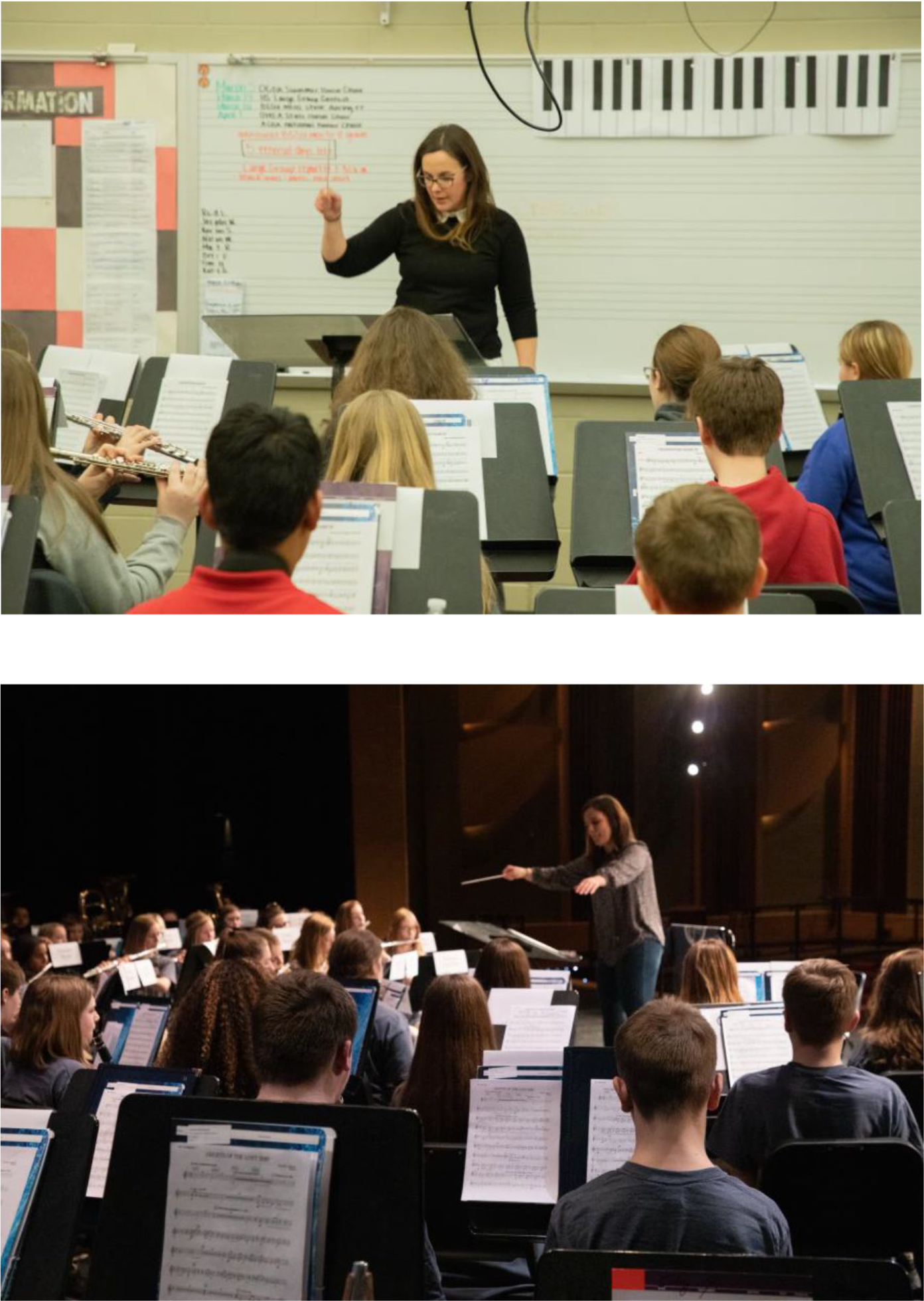
Photos with Lisa Martin conducting was taken at the 2020 Ohio Music Education Association District 3 Junior High Honor Band Festival. Photos courtesy of OMEA.
What behaviors do we expect from our students, and why? In the traditional ensemble ideal, students are attentive, focused, quiet, still, and ready for direction. Those deviating from such norms may be seen as disruptive, disrespectful, or otherwise disengaged—but why do we cast such labels on these students? How might classroom misunderstandings cause harm? In what ways might our behavioral expectations stand at odds with student needs?
In education, classroom management is commonly understood as the structures and procedures that establish and reinforce an emotionally healthy, academically productive learning environment. 1 Classroom management includes both proactive and reactive elements. Proactive procedures center on preemptive actions in the classroom that are designed to shape student attitudes and behavior in a manner that supports attaining various goals. Reactive measures focus on consequences, which occur when established expectations are not met.
Presumably, a successfully managed classroom correlates with student engagement, of which there are three main categories: (1) behavioral engagement, which references overall attention and participation; (2) emotional or affective engagement, which captures motivation, enjoyment, and interpersonal connection with others in the classroom; and (3) cognitive engagement, which refers to students’ concentration, interest, and investment in the content. 2 Oftentimes, when teachers imagine a well-managed classroom, they prioritize behavioral engagement. Though it is convenient to assume a well-behaved student is also a cognitively and affectively engaged student, there is not always a direct relationship. Furthermore, prioritizing behavioral engagement over emotional engagement may send a message to students that it is more important how you are and what you do in the classroom than who you are as an individual. This approach can have an adverse effect on interpersonal relationships in the classroom. Emphasizing behavioral expectations can create problems when norms reflect power structures and reinforce biases that target and devalue individuals.
In this article, I briefly explore common challenges associated with classroom management in traditional, autocratic ensemble classroom models. I then unpack the layered circumstances surrounding classroom cultural norms related to behavioral expectations and disciplinary consequences. Finally, I offer a model of classroom management that supports what behavioral and parenting author Alfie Kohn describes as classroom community over classroom compliance. 3 Through this approach, I encourage teachers to reexamine their attitudes toward shaping classroom environment, moving away from power and biases and toward democracy, mutual regard, and safe spaces in the large ensemble.
“Managing” Classroom Behavior
Researchers have determined that classroom management is a primary area of concern for music teachers. These concerns span various career stages, from preservice to veteran music educators, and classroom-related discipline stressors are a leading reason for teacher burnout and turnover. 4 As such, numerous scholars have developed recommendations for classroom management in the music setting. 5
Classroom management can be especially challenging for ensemble directors for a variety of reasons. For example, ensembles typically boast a higher student-to-teacher ratio, and ensemble physical setup can further limit opportunities for teacher–student interactions. Because ensembles are commonly offered as electives, contact time with students may be less consistent, which can present additional challenges to establishing routines and expectations. Moreover, music educators must demonstrate leadership and interpersonal skills across a range of student developmental stages, all while exhibiting content knowledge from a variety of music disciplines. This charge requires chameleon-like adaptivity within various classroom situations. Finally—particularly in performance-driven, large ensemble settings—music teachers must negotiate an environment where students are uniformly, actively engaged with a single, collaborative task. This circumstance stands at odds with how student learning and engagement typically transpire in other classroom contexts.
To mitigate these challenges, ensemble directors adopt various principles and practices to facilitate some level of order in the classroom. These practices, however, are rarely culturally neutral, and they often illustrate issues of power. While certain routines can help set the stage for learning, teachers must critically examine these routines, their origins, and their related contexts, so as to establish a classroom environment that honors learners’ varying needs and backgrounds. In doing so, teachers must also reflect on their position and influence in the classroom and in society at large. 6
Power, Discipline, and Conflict
There are inherent issues with traditional conceptualizations of classroom management. Kohn suggests many believe the ultimate purpose of classroom management is to ensure student compliance. To achieve that goal, teachers work to “alter those [behaviors] that they, for whatever reason, deem inappropriate.” 7 In other words, traditional models of classroom management are built on principles of control and conformity. Kohn goes on to point out that teachers are privileged: whatever expectations they establish for student behavior are often unquestionably perceived as “for the children’s own good.” 8 The resultant power structure can have unintended consequences for both students and teachers.
Issues between power and behavioral expectations exist in all classroom contexts. However, these challenges are amplified in diverse classrooms. Education scholars Carol Weinstein, Saundra Tomlinson-Clarke, and Mary Curran point out that “definitions and expectations of appropriate behavior are culturally influenced, and conflicts are likely to occur when teachers and students come from different cultural backgrounds” from one another. 9 Most P-12 music teachers are white. 10 Consequentially—and problematically—school music institutional expectations tend to reflect white, middle-class cultural norms. 11 Indeed, the fundamental issue is the ubiquity of these norms. As student populations become increasingly diverse, the effects of institutionalized bias become more apparent. 12 Students exhibiting language patterns, nonverbal communication, and other behaviors that fall (1) outside established institutional norms or (2) outside their teacher’s own embodied cultural conventions can result in a discontinuity that urban education scholar Jacqueline Irvine describes as a “lack of cultural synchronization.” 13 This disparity can beget several consequences, including disconnection between teachers and students, miscommunication, alienation, and poor student performance in the classroom. Challenges with cultural synchronization can also reveal deficit-based attitudes, which further complicate classroom climate. 14
Ultimately, a lack of cultural synchronization sets the stage for a discipline gap, which references the documented, disproportional punitive actions taken against students with diverse backgrounds. The discipline gap includes both selection and sanction: selection refers to who is pinpointed as needing disciplinary action, while sanction refers to what consequence ensues. This disproportionately affects students according to race, ethnicity, gender, sexual orientation, socioeconomic status, and disability, 15 rendering disciplinary inequities inevitable in nearly every classroom context. Males, regardless of race or ethnicity, experience more disciplinary consequences. 16 Discipline also disproportionality particularly affects black students, who experience more office referrals, suspensions, and expulsions than do their white peers, even when controlling for other factors. These penalties negatively affect students’ investment in school, emotional health, and academic success, casting light on the concurrent achievement gap that exists between minorities and their white peers. 17
In the large-ensemble setting, issues of power and disciplinary conflict can be amplified for a number of reasons. First, the very terms conductor and director are defined as “a person who is in charge.” This authority manifests in most aspects of the rehearsal, rendering it an ever-present, seemingly essential aspect of the tradition—the conductor’s power to choose the curriculum, the power to make final musical interpretation decisions, and the power to demand attention while on the podium, to name just a few. In instances of disciplinary conflict, power is magnified. Teacher–student interactions are often showcased on a platform where the rest of the ensemble serves as a captive audience. Imagine a student disengages from rehearsal in a manner that disrupts or distracts others. When the teacher pauses instruction to redirect this student, the interaction is on display for the entire ensemble. This platform can elevate adrenaline in both the teacher and the student, escalating tension. Such conflicts can feel especially tense in instances where there is a cultural mismatch between the backgrounds of the teacher and student. 18
Interpersonal conflicts are often at the heart of most classroom management issues. 19 Typically, these challenges are minor in nature, such as students talking out of turn, raising their voices, socializing, or arguing, 20 but these behaviors represent relational styles that can be mislabeled as infractions, and unjust punishment often follows. 21 Because our backgrounds inform our relational style, pluralistic classrooms may sustain more perceived disciplinary issues than homogeneous classrooms. 22 This reality heightens the need to unpack traditions associated with behavioral expectations in the large ensemble. Ultimately, because “conceptions of what constitutes orderliness vary across situations,” 23 there is no one-size-fits-all approach to classroom management. However, there are steps ensemble directors can take toward acknowledging power and unpacking bias. By questioning routines and considering alternatives, classrooms can evolve from a space of conformity and control to one centered on collaboration and community.
Shifting Perspectives
As music education scholar Amanda Soto affirms, “Educators must understand and acknowledge their position of power in order to be able to change the dynamics in their classroom.” 24 Indeed, many music educators have made efforts to address power in relationship to curriculum, instruction, and interpersonal relationships through culturally responsive pedagogy (CRP). 25 Weinstein and her colleagues assert the need for teachers to adopt related principles specifically within the context of classroom management. Doing so considers elements of CRP alongside principles of social-emotional learning, multicultural counseling, and care, emphasizing relationship building, community, and collaboration over approaches that underscore behaviors alone. 26 The goal, the authors continue, is to create an environment where community members conduct themselves in a manner that reflects a sense of personal responsibility, rather than acting out of fear or a need for control. Applying these perspectives toward reimagining behavioral expectations, Weinstein and colleagues recommend the following foundational tasks.
Recognize and acknowledge your background and biases
When teachers honestly examine their past experiences and biases, they are “less likely to misinterpret the behaviors of . . . culturally different students and treat them inequitably.” 27 Past experiences can include both personal and professional circumstances. Teachers must consider the confluence of these experiences to fully unpack the influence on their perspectives. For example, my own experiences as a K–12 student in a white, middle-class community informed what I believed to be “correct” behavior in the ensemble setting. Because I am white and from a middle-class background, my relational style complemented classroom expectations. Years later, as a young teacher, I learned that what worked with students at my first position did not necessarily transfer to the classroom in my second position, and in neither case did classroom realities align with my preconceptions about “correct” behavior.
Understand students’ cultural backgrounds
Learning about students’ cultural backgrounds is an essential step in developing culturally conscious approach to classroom environment expectations. Education scholars Rosa Sheets and Geneva Gay assert the particular importance of understanding sanctioned behaviors among different cultural groups. These authors also advocate for exploring students’ unique “value orientations, standards for achievements, social taboos, relational patterns, communication styles, motivational systems, and learning styles.” 28 As an example, in one teaching position, I once pressed a student to maintain eye contact with me during a conversation about her behavior. I later learned that in her culture, it was considered disrespectful to maintain eye contact with an adult in a disciplinary situation. Having an improved understanding of students’ cultural backgrounds can help teachers avoid rebuking students for culturally instinctive actions. 29 Ultimately, teachers must honestly examine how they treat students. Weinstein and colleagues suggest asking questions such as “Are we more patient and encouraging with some? Are we more likely to chastise others?” 30 Owning these answers, and the “why” behind them, can help teachers move toward transparency and equity the classroom.
Investigate social, economic, educational, and political contexts
In addition to examining our personal biases and student backgrounds, Weinstein and her colleagues note that it is important to explore larger systemic prejudices and discriminatory practices in society. Doing so helps teachers better understand student privilege and marginalization and how those relate to classroom dynamics. In particular, teachers should examine how institutionalized oppression can manifest in their own classroom. Sometimes these issues fall very close to home. Even school building protocols and immediate community expectations can impede teachers’ autonomy in addressing classroom challenges and their efforts to build interpersonal relationships. 31 Directives on how to handle certain behavioral challenges, for example, might force teachers into processes that stand at odds with culturally responsive classroom management practices. From another angle, community pressure to perform at a certain level amid limited rehearsal time might drive ensemble directors toward more autocratic models of classroom management. Because ensembles are typically elective classes, directors might even lean into autocracy, embracing the ideology that “if you don’t like how it’s done here, you can leave.” This approach can have profound effects on students’ relationship with their teacher and musicking as a whole.
Teachers must first identify and acknowledge these issues to initiate change. Balancing personal philosophies with outside expectations is delicate work. When faced with expectations that stand at odds with your own perspectives, strive to pinpoint areas or principles of common ground. For example, perhaps both you and your school administration believe that certain behaviors should always be met with some type of consequence. However, in an effort to build a positive classroom climate, you might opt for restorative approaches over punitive options. In other words, rather than punish a student, you and the student can work cooperatively and with empathy to explore the effects of that behavior on classroom community and relationships so as to stimulate positive change in the future.
Additional Opportunities to Reimagine Classroom Environment
Randall Everett Allsup and Cathy Benedict, “The Problems of Band: An Inquiry into the Future of Instrumental Music Education,” Philosophy of Music Education Review 16, no. 2 (2008): 156–73.
Devon Metzger, “Rethinking Classroom Management: Teaching and Learning with Students,” Social Studies and the Young Learner 17, no. 2 (2004): 13–15.
Steven J. Morrison and Steven M. Demorest, “Once from the Top: Reframing the Role of the Conductor in Ensemble Teaching,” in The Oxford Handbook of Music Education, vol. 1, edited by Gary E. McPherson and Graham Welch (New York: Oxford University Press, 2012): 826–43.
Willingly adopt culturally informed perspectives and strategies
Teachers must be open to implementing approaches that effect change in the classroom. This might mean abandoning what is considered to be “common practice.” For example, questioning establishment approaches to classroom management can help teachers identify disparities in cultural synchronization between espoused behavioral expectations and student background. 32 In the large ensemble, this might mean reevaluating students’ traditionally passive role and instead opting toward more democratic, student-driven practices.
One approach for incorporating more culturally informed classroom management strategies is known as mutual accommodation, that is, finding the sweet spot between where teachers accommodate students’ backgrounds and students adapt to their environment, working together toward a common goal. 33 Typically, accommodation is expected only from the students, contributing to a deficit perspective that demands the disenfranchised assimilate to community norms. Mutual accommodation, in contrast, promotes collaboration between the teachers and students, whereby the community builds upon their assets and dispositions in a manner that creates democracy and stronger interpersonal relationships.
Build compassionate communities
At the heart of compassionate classroom communities is the perception of mutual care. 34 The dynamic interactions between teachers, students, and classroom context highlight an opportunity to examine and prioritize relationships ahead of rigor. 35 Recent initiatives in music education centered on social-emotional learning reflect a renewed focus on the importance of relationship building in the classroom. 36 To move toward culturally responsive approaches to classroom management and compassionate classroom communities, ensemble directors and their students might consider the following questions, exploring their collective relationship to the classroom context together:
What are our classroom rules? Why these rules?
Whom do these rules serve? Whom do they oppress? 37
What implicit expectations in our classroom can be made explicit? 38 How can we decode the classroom experience?
When do we expect students to adapt and accommodate? In what ways might the teacher adapt and accommodate?
Curiosity versus Control
The process toward cultivating a culturally responsive approach classroom management is a multifaceted marathon; change will not happen overnight. However, it is possible to implement small changes from the get-go. Those changes begin with embracing a sense of curiosity about the classroom rather than forcing control over student behavior.
Music education researcher Steven Morrison discusses how “discovering the motivation behind a student’s actions” is a fundamental step in building relationships and establishing an effective classroom environment. 39 For example, if a student is not actively engaged in ensemble musicking, understanding the “why” behind that nonparticipation helps the teacher develop an appropriate plan of action. Perhaps the student is disengaged because he or she is overwhelmed by the content or task. Knowing this, the teacher can provide a differentiated approach that makes the information or skill more accessible or relatable.
Discovering the “why” behind various classroom environment challenges and events can highlight opportunities to create meaningful, lasting change in a manner that favors thoughtful reframing over discipline, consequences, and related manifestations of power structures. When experiencing challenges in the classroom, it is natural to feel frustrated. However, sometimes feelings of frustration can trigger reactive responses that do not allow for full consideration of the range of nuance embedded in a given circumstance. This frustration often translates to hastily shutting down a situation with a “because I said so”–type rationale or even blaming students. 40 Instead, teachers might explore the following questions, approaching the ensemble environment with curiosity rather than control:
How does the situation appear? What do you notice about what is happening? When describing the situation, be as objective as possible, removing judgment, generalizations, and emotion from your description. In other words, the judgment-laden, absolutist statement, “The class is being disrespectful,” becomes “A few students are talking while I’m giving instruction.” The former statement triggers powerful emotions, while the latter statement provides a cleaner canvas for curiosity and change.
What is/could be the reality of/reason behind the situation? Why is this happening? Our initial impressions are shaped by biases, past experiences, mood, and other factors. If we approach challenges with a sense of wonderment about what is happening, rather than tapping into assumptions, we gain a richer understanding of our students, our classroom, and our school community. In the same scenario, a teacher might wonder, “Is there something going on in our school community or in the students’ social circle that has captured their attention? Is this perhaps the only class these students have with their friends, therefore their only opportunity to connect during the school day?” Another approach could be to look inward, with teachers asking themselves what they may have done to contribute to the circumstance. 41 Ask yourself, “Did I clearly communicate the task at hand? Did I make important instructional information adequately visible/audible/relatable?” Consider various angles and possibilities in your investigation.
Why does this situation stand out? Is it important to address the situation, and if so, when? How is the situation impacting student engagement, learning, safety, or well-being? Our classrooms are dynamic communities with complex people and infinite interactions. Though teachers work toward consistency in the classroom, it is impossible to attend to every event. By pausing to consider why a particular instance draws attention or concern, teachers can begin to step away from a subconscious need to control everything and instead work toward addressing what is necessary. 42 In doing so, teacher authority moves from a power-focused position to a place of prioritized, positive leadership.
How can students and I work together to build a relationship that effects and maintains positive change moving forward? As mentioned earlier, classroom management includes both proactive and reactive elements. Kohn notes that in well-managed classrooms, reactive elements (e.g., discipline) are seldom evident when effective proactive efforts are in place. 43 Considering the same example, the teacher might notice the disengaged students, and instead of calling those students out in front of the rest of the class—which can lead to shame, embarrassment, or a defensive response (and consequently, a breakdown of the interpersonal relationship between teacher and student)—the teacher could instead make a note to check in with the students in a quiet space after class, creating an opportunity to generate deeper understanding. In the meantime, the teacher can offer the group a redirect that reinforces a sense of community and gives students space to self-direct reengagement: “Let’s try this at measure 10, shall we? We are going to need everyone in on this!” Such an approach circumvents an unnecessary demonstration of power while supporting diversity and multicultural experts Sandra Nieto and Patty Bode’s concept of mutual accommodation in the classroom.
Although this reflective practice can be useful, it is impractical to engage in each of the aforementioned steps every time a challenge arises in the classroom. Teachers might find it more workable to first identify patterns of behavior across time—both their own behaviors and those of their students—and then engage in a deeper reflection on repeated events. In identifying these patterns, teachers might consider video-recording ensemble activities or surveying students on their perspectives. For day-to-day challenges, embracing curiosity over reactivity can be a critical attitudinal shift. Furthermore, it can be valuable practice to assume students are coming from a place of positive intention with their actions. Chatty students might really need that social connection with each other in a given moment; their disengagement from rehearsal does not necessarily reflect apathy or intentional defiance. Classrooms are places where a range of student needs should be met, and welcoming that charge is foundational to establishing positive, reciprocal relationships. 44
Moving Forward
Classroom contexts are deeply complex. Establishing a healthy learning environment in the face of these complexities is heavy, messy, and nuanced work. Effective ensemble communities are built through persistent connection, communication, and compassion. In a field that often emphasizes passive behavioral expectations, ensemble directors must determine the ways in which their classrooms build community or stipulate compliance, so as to move toward a more just and supportive environment. By honestly naming our biases, understanding student backgrounds, acknowledging systemic barriers, and embracing curiosity, teachers can reevaluate traditional approaches to classroom management, setting the stage for improved interpersonal relationships and mutual regard.
