




Abstract
In the past six years, more than 40,000 students have failed the AP Music Theory Exam. Students have struggled especially when sight-singing or taking melodic dictation in compound meter and minor tonality. Research has shown that students can improve these specific aural skills through learning pitch and rhythm patterns, improvisation activities, and learning from musical literature. This article includes research-based practical applications for helping students improve their aural skills for the AP Music Theory Exam.
NAfME is glad to offer one hour of professional development recognition to you for reading this article. Please follow the link below and complete a short quiz to receive your certificate of completion.
Photo courtesy of Alyssa Grey.
Every year, more than 18,000 students choose to take the Advanced Placement (AP) Music Theory Exam. They are musicians who wish to enhance their knowledge and may be considering a career in music. AP Music Theory courses are important components of high school curricula and provide an opportunity for students to gain a deeper understanding of a musical topic at the collegiate level. The exam is designed to align with one or two semesters of college music theory and enables students to pursue advanced theoretical topics while developing aural and dictation skills. 1 Though nearly 19,000 students took the test in 2019, more than one-third received a failing grade of 2 or lower. 2 The combined failure rate for all AP exam subjects in 2019 was slightly higher than the failure rate for Music Theory alone. 3 In 2020, nearly one-third of students failed the exam. 4
As with many of the AP exams, the test is divided into two major sections: multiple-choice (45 percent of a student’s grade) and free-response (55 percent). During the free-response portion of the Music Theory Exam, students are asked to sight-sing, complete melodic and harmonic dictation, and compose using Western common-practice style. 5 They are given approximately one hour twenty minutes for 75 multiple-choice questions, one hour ten minutes for seven aural skills free-response questions (45 percent), and ten minutes to sight-sing two excerpts (10 percent).
Every year, classroom AP theory teachers and college faculty partner to form a Test Development Committee and create new exam questions. They form an initial draft and give it to content experts and psychometricians, who conduct mathematical analyses to determine question difficulty. The test is then examined by a chief reader and higher ed co-chair before being read by a new group of higher ed experts. In 2019, 18,950 exams were scored by ninety-one readers and twenty-five leaders from across the country. 6
Although secondary and postsecondary theory teachers meet yearly to determine the suitability of exam content and question difficulty, it is concerning that a consistent number of students have failed the test in the past few years. Approximately 39 percent of students failed the 2015 exam, 7 40 percent in 2016, 8 39 percent in 2017, 9 and 34 percent in 2018. 10 Though it contains only nine questions, the free-response section constitutes more than half of a student’s overall score. 11 In 2019, the average student score was only 51 percent out of 100 percent in the free-response section.
These numbers are alarming, particularly for students who take AP Music Theory with aspirations to pursue a career in music. Just over 3,000 schools offer the AP Music Theory Exam. 12 Over the past six years, more than 40,000 student exams have received failing scores. Tens of thousands of students enrolled in a collegiate-level course have struggled to demonstrate the necessary theory and aural skills abilities. An AP exam score of 3 is considered the college course grade equivalent of B−, C+, or C. 13 For those students who received a 2 or lower, their corresponding college course grade could have been less than a C. It is worth noting, however, that a variety of circumstances and factors can influence student success and are beyond the control of classroom teachers. Despite these challenges, educators have an opportunity to identify consistent student struggles and try to bridge potential knowledge gaps within the timeframe of an AP Music Theory course.
Where Do Students Struggle?
Between 2015 and 2019, the average student received less than half of possible points for a majority of the questions in the aural skills section. Each melodic dictation and sight-singing question is worth a maximum of nine points. The questions include various combinations of major or minor tonality, treble or bass clef, and simple or compound meter. For example, in 2019, Melodic Dictation Question 1 was major/bass clef/simple meter and had an average student score of 4.06. Melodic Dictation Question 2 was minor/treble clef/compound meter and had an average student score of 3.21. Sight-singing Question 1 was minor/treble clef/simple meter with an average student score of 4.75. Sight-singing Question 2 was major/bass clef/compound meter with an average student score of 3.63. Each year, there are two major, two minor, two treble clef, two bass clef, two simple meter, and two compound meter excerpts represented by various combinations within the four questions in this section.
Students have consistently struggled when aural skills questions included minor tonality and compound meter rhythms. 14 Items in minor almost always scored lower than major, and compound meter frequently scored lower than simple meter. Excerpts that combined minor tonality and compound meter received the lowest scores. In 2016, for example, Sight-singing Question 2 was minor/treble clef/compound meter and had an average student score of 2.41. In 2017, Melodic Dictation Question 2 was minor/treble clef/compound meter and had an average student score of 2.73. These numbers are alarming considering nine is the maximum score for each question. There have been only five questions within the aural skills section over the past five years where the average student score was 4.5 or higher. The highest average student score since 2015 was a 5.43 in 2018 for Sight-singing Question 1, which equates to 60 percent correct. The excerpt was in major tonality, bass clef, and simple meter.
Music educators can benefit from practical classroom applications inspired by research to help students develop their aural skills. 15 For the purposes of this article, aural skills refers to taking dictation and sight-reading. This article includes practical applications drawn from the research for improving students’ overall aural skills, with special consideration for minor tonality and compound meter.
Research and Recommendations
Patterns
Eighty percent of AP theory teachers 16 and 95 percent of college theory teachers 17 surveyed have suggested that teaching common pitch and rhythm patterns is important for developing students’ aural skills. 18 AP theory teachers have reported that using a specific system to teach rhythmic and tonal patterns (e.g., Kodály, Gordon) can help students build tonal, harmonic, scalar, and rhythmic familiarity and develop their aural skills. 19 Though there are a variety of systems available, instructors have taught tonal exercises using moveable do for both major and minor, moveable do with la-based minor, or a numbered scale system. While a majority of teachers have used the “one-e-and-a” counting system to teach rhythm, others used techniques from Eastman, Takadimi, Galin-Paris-Chevé, or Gordon. Although some systems only offer syllabic labels, others include set tonal and rhythm patterns of varying lengths.
Singing and chanting patterns can help students better understand melodies and rhythms within a specific context. 20 Theory teachers have suggested that students who develop familiarity with tonal, rhythmic, and melodic patterns can be better prepared to recognize those motives during listening examples and in written notation. They especially recommended using patterns as a means of developing dictation skills through sight-singing. Other teachers have suggested that students miss notes when they take dictation because they lack a rhythmic framework and do not know how to space the notes rhythmically. 21 College music theory teachers have encouraged practicing rhythm and pitch patterns and suggested that pattern practice could help address specific problems students face during dictation. 22
There may be limitations to teaching patterns using a fixed-syllable approach, such as the traditional rhythmic “one-e-and-a” system or using numbers for scale degrees. When counting rhythms, big (macro) and small (micro) beats are labeled similarly in both simple and compound time. The exceptions are rhythms in triple, in which some educators say tri-pl-et or 1-la-li. Though students can use this counting system and become successful musicians, using a fixed-syllable approach can limit contextual understanding and may present additional challenges. For example, 1 2 3 4+ 5+ 6+ could be correct syllabic labels for rhythms in both 6/4 and 6/8 meter. A student trying to dictate the rhythm would first have to establish if the example were simple or compound meter before they would be able to notate the exercise. Similarly, singing melodic excerpts using scale degree numbers does not help determine tonal context. In a numbered scale-degree system, 1 3 5 and 4 2 7 could correctly represent the intervals in a tonic and then the dominant 7 chord in both major and minor tonalities. Additionally, identifying 1 as the resting tone can be a challenge in pieces that modulate, and scale degrees do not allow for the inclusion of chromatic tones. Although fixed-syllable systems can be successful, determining metric context and tonality become extra steps in the dictation process.
Systems that use context-specific syllables can help students differentiate tonality and meter. One approach that uses distinct labels is Edwin Gordon’s Music Learning Theory. The syllables Gordon recommended vary with tonal or rhythmic function. 23 For example, a student who chants steady eighth notes in 2/4 would say, “Du De, Du De”; in 6/8 “Du Da Di, Du Da Di”; and in 5/8 “Du Ba Bi, Du Be” or “Du Be, Du Ba Bi,” depending on the grouping. Although these examples contain only eighth notes, the labels change to help identify rhythms in simple, compound, or odd meters. When using a Music Learning Theory approach, the syllables are also different for each tonality. While the resting tone in minor tonality is la, the resting tone in Mixolydian is sol. One method book that uses Gordon’s syllables and patterns is Jump Right In: The Instrumental Series. Divided into two volumes, these texts can be a resource for an instrumental performance-based approach to developing aural skills. After initially presenting rhythms by rote, the books include notated patterns in 2/4, 4/4, cut time, 3/8, 5/8, and 7/8. Rhythms build from quarter and eighth notes to dotted rhythms, sixteenth-note divisions and syncopations, and labeled elongations. Tonal melodies and patterns are presented in major, minor, Mixolydian, and Dorian tonalities in several keys. 24 In Figure 1, both traditional “one-e-and-a” counting (TC) syllables and Gordon Music Learning Theory (MLT) syllables are presented in several meters for comparison.
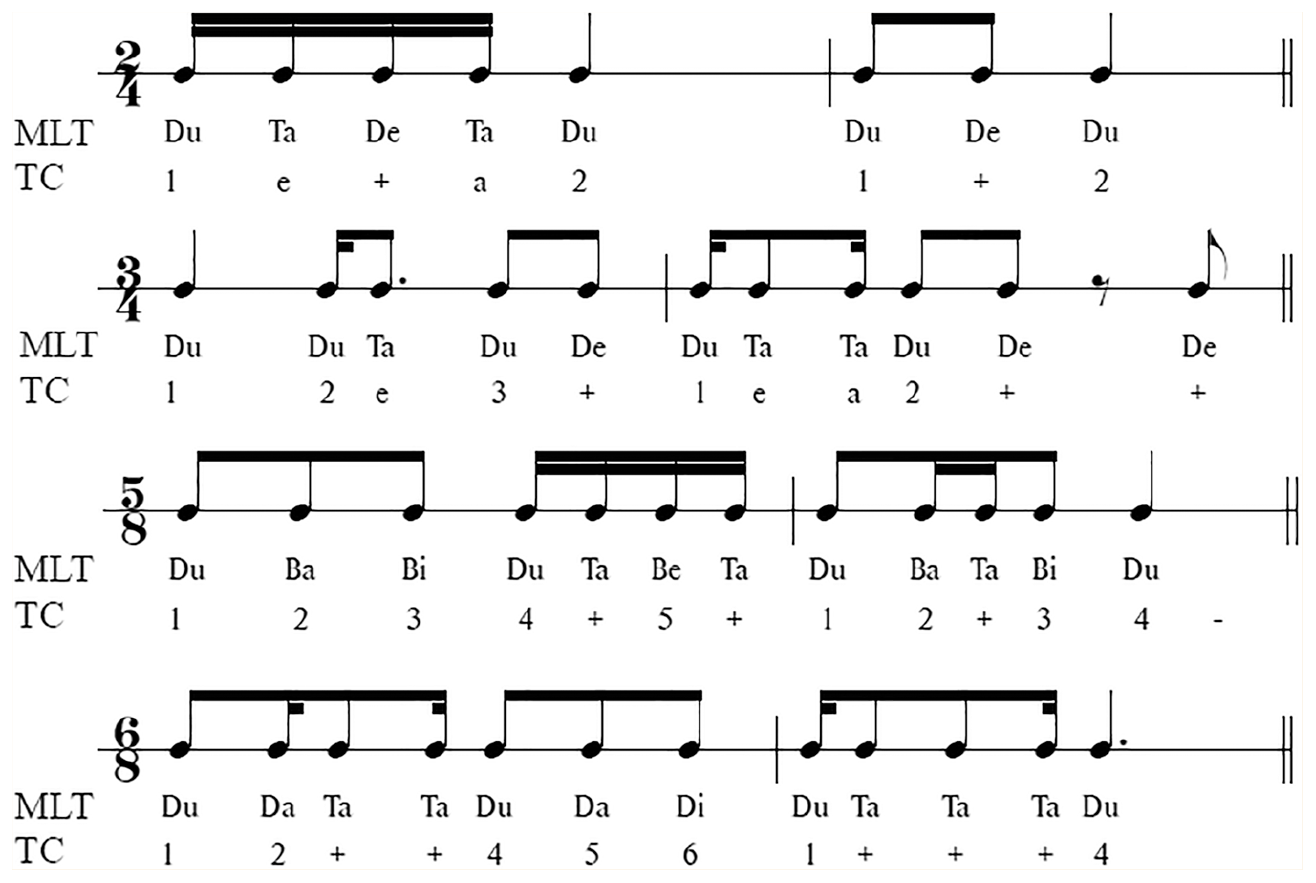
Macrobeat, Microbeat, Division, Odd, and Elongation Patterns
Dictation Development
AP and college music theory instructors have made various recommendations for teaching students how to do melodic and harmonic dictation. Many high school music teachers believe that students who develop familiarity with common pitch, rhythm, cadential, and harmonic patterns can better recognize musical ideas and eliminate options when taking dictation. They have suggested that teachers keep instructions as simple as possible and slowly build dictation skills from small to large concepts, initially isolating pitch or rhythm. 25 Other teachers have recommended similar strategies, such as making predictions about material, hearing implied harmonies, and using a process of elimination. 26 College theory instructors have suggested that students focus on retaining the beginning and end of a selection, sketch rhythms in shorthand, and write solfège syllables. 27 One of the greatest challenges when teaching dictation, however, is that there is no consensus on the most beneficial method of instruction.
High school and college faculty do agree that students struggle with dictation, especially when completing a dictation in compound meter. As a significant amount of popular music is in duple meter and major tonality, it is likely that students face these challenges due to lack of familiarity. Before students will be able to understand compound meter on a theoretical level, they need to experience it through aural activities. However, students in music theory classes are sometimes taught elements of music before they understand a concept aurally. 28 Though AP teachers have used recognizable melodies as teaching material to help reinforce dictation development, 29 students are less likely to have gained confidence for music that is in compound meter. The more experiences students have singing and performing music in challenging tonalities and meters, the more likely they are to recognize and notate those complex rhythms and tonal sequences in unfamiliar music. Teachers should consider alternate musical activities to help students build their aural skills and transfer them to written notation.
Improvisation/Dictation Sequences
AP Music Theory teachers have suggested that students can improve their melodic dictation skills through a cognitive framework of building a musical vocabulary, connecting aural and written theory, and sight-singing. 30 One combination and application of these skills is for students to create their own music. Consider employing improvisation as a pathway to composition and dictation. Improvisation activities can allow for repetition and reinforcement of tonal and rhythm patterns in several meters and tonalities. Rather than only aurally recognizing patterns, students are able to apply their inner hearing in a creative written form. After they have notated a melody, students can practice sight-singing their compositions. According to one AP theory teacher, “[I]f they have heard the melodies, and can sing them a cappella, if they can look at them and then sing them again, they own that pattern.” 31
Students who improvise and compose can practice developing appropriate voice-leading and part-writing skills that can transfer to improve their aural discrimination and notation ability when completing a dictation. Through improvisation, students can connect their aural and written theory skills by performing and then notating various chord types, cadences, and phrases, and they can critically listen to and respond to their colleagues in performance. By including common cadential and rhythm patterns in their own creations, students can better recognize and understand melodic and rhythmic structure. When taking a prescribed dictation, teachers have reported that students had difficulty transferring rhythms from aural to written form and often expressed defeatist attitudes, such as “I can never do this.” 32 Students may be more interested and invested in creating their own music than in copying a dictation exercise yet through related activities are able to practice complementary musical skills. These additional opportunities can also be used to cultivate familiarity with compound meter and minor tonality.
The following are tonal and rhythmic improvisation and dictation activities inspired by personal classroom experiences and the research of Edwin Gordon. 33 Although each has a prescribed teaching sequence, educators are encouraged to modify activities to best meet students’ needs.
Tonal
The tonal activity can be completed using the improvisation sheet or blank staff paper. At the top of the page, ask students to write the chords and pitches for their improvisation. If working on minor tonality, consider beginning with “tonic – i” and “dominant – V 7 .” If students are practicing compound meter, improvising in 6/8 can be appropriate. Although students can independently do this activity, it can become an opportunity for group performance if they are given a specific concert key and meter. In the first full staff system, either provide students with a four-chord progression or let them pick their own, such as i–i–V 7 –i. Progressing one measure at a time, use a syllable system and ask students to sing their note choices for each chord and then write it down. When initially doing this activity, they may experience more success when only notating macrobeats in the given meter. Sing chords two, three, and four, repeating the process and moving on to line two. Once students have notated their improvised composition, accompany them on an instrument and have them sing and play the whole piece. Students can enhance their compositions by adding nonharmonic tones. This can also be an opportunity to practice singing from a notated example and discuss voice leading in the common-practice style.
Rhythmic
The suggested rhythmic improvisation and dictation teaching sequence varies. It can be completed by using a set of dry-erase whiteboards with blank music staves, by laminating and reusing staff paper, or by using manuscript paper and a pencil. Figure 2 illustrates an example of the complete sequence in compound meter. As dictation questions on the AP exam are typically four measures long, 34 students will benefit from dictating four-measure rhythms. Consider the following as a potential teaching sequence:
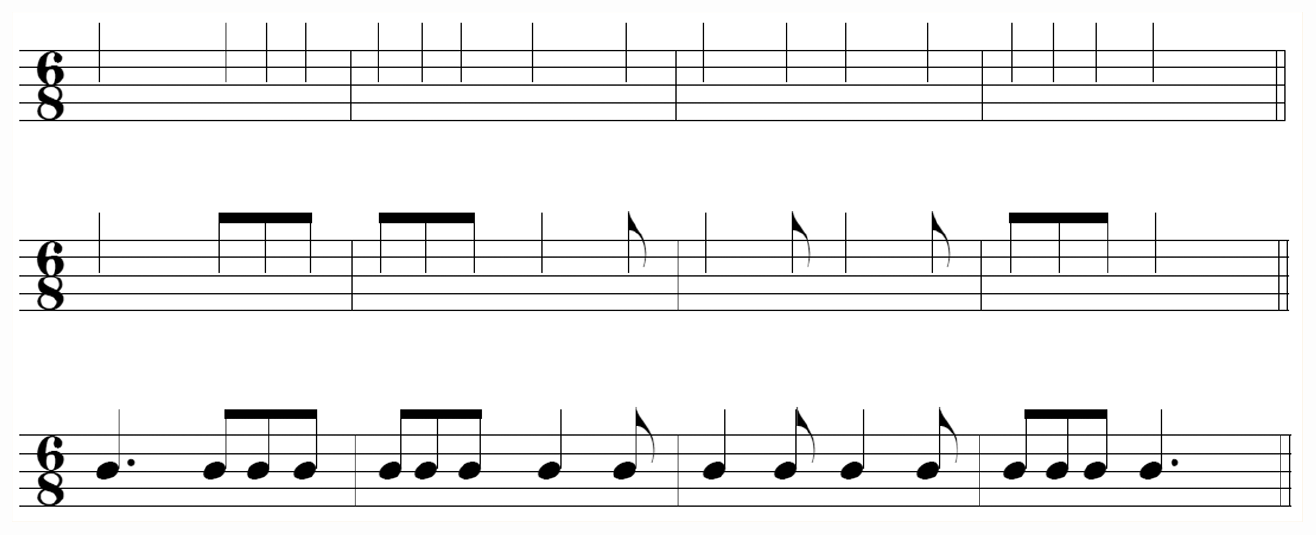
Student Rhythmic Dictation Exercise Example
Provide students a specific meter and number of measures. Students may benefit from keeping a steady big beat in the heels of their feet during the exercise. Chant a rhythm pattern using counting syllables.
If engaging in dictation, students immediately repeat the pattern three times in a row without stopping. Their hand should move from left to right over the staff while they speak, as students will notate different things while chanting. If dictating, students can try to copy the pattern. If improvising, students should respond by chanting and writing their own rhythm while following the same process.
Students:
Notate the stem of each note as it is spoken.
Connect the beams of any small beats and/or divisions.
Add noteheads and dots.
Students may experience greater initial success by first improvising and dictating shorter and simpler melodies and rhythms. Some AP teachers have recommended gradually building the length of dictation exercises, starting with unmeasured groups of notes, or even making measures one and three in an exercise identical. 35 Through sequencing and scaffolding, students can build the skills necessary to dictate extremely complex rhythms and melodies. Diverse dictation activities such as improvisation can help students experientially and intuitively understand music theory. Their experiences singing and chanting pitches and rhythms can also help during the sight-singing portion of the exam, as they may be more familiar with and recognize common patterns.
Using Musical Literature
Traditional music theory courses have often focused primarily on music of the common-practice era and Western art music tradition. 36 Considering the increasing diversity of students in our schools, traditional music theory coursework may not reflect vernacular and popular music styles most relevant to the current generation of students. Teachers, however, must still spend a significant portion of class time teaching music theory of the Western tradition, as AP exam content remains structured around eighteenth-century forms, harmony, and style. 37 Until the test is revised, teachers can use the rhythms and melodies of Western musical literature as authentic aural content for the theory curriculum.
AP Music Theory teachers 38 and college theory faculty 39 have often used classical music as instructional material for dictation and sight-singing. Rather than finding or creating exercises, consider using examples from the Western canon to improve aural and written understanding. Many of the students may perform in a music ensemble. What common rhythmic or tonal ideas can students transfer from their ensemble music to the theory classroom, and vice versa? The following is a list of ensemble literature with potential theory concepts:
Grainger’s Lincolnshire Posy—unique chords
Bach, various—inversions and counterpoint
Ives, Variations on “America”—diverse tonalities
Whitacre, various—nonharmonic tones
Holst’s The Song of the Blacksmith—meter changes
Barber’s Adagio for Strings—several types of cadences
Students may approach a concept differently if they have experienced it before theoretically analyzing it. It is likely that any literature students are performing will contain elements of music that teachers can transfer to the music theory classroom. Teachers may also find that students demonstrate increased interest in discussing music theory when concepts directly relate to music they are performing.
Literature from the Western musical canon can also be used to develop students’ comfort with minor tonality and compound meter. Figure 3 includes choral and instrumental excerpts in minor tonality that can be used for sight-singing and melodic dictation exercises. Students can use a neutral syllable such as “du” when singing rather than adding the complication of lyrics. Two of the excerpts are in duple meter, and two are in compound meter. Two include accidentals, and two are in natural minor. The excerpts include varied intervals, skips and stepwise motion, and common rhythms in duple and compound meters.
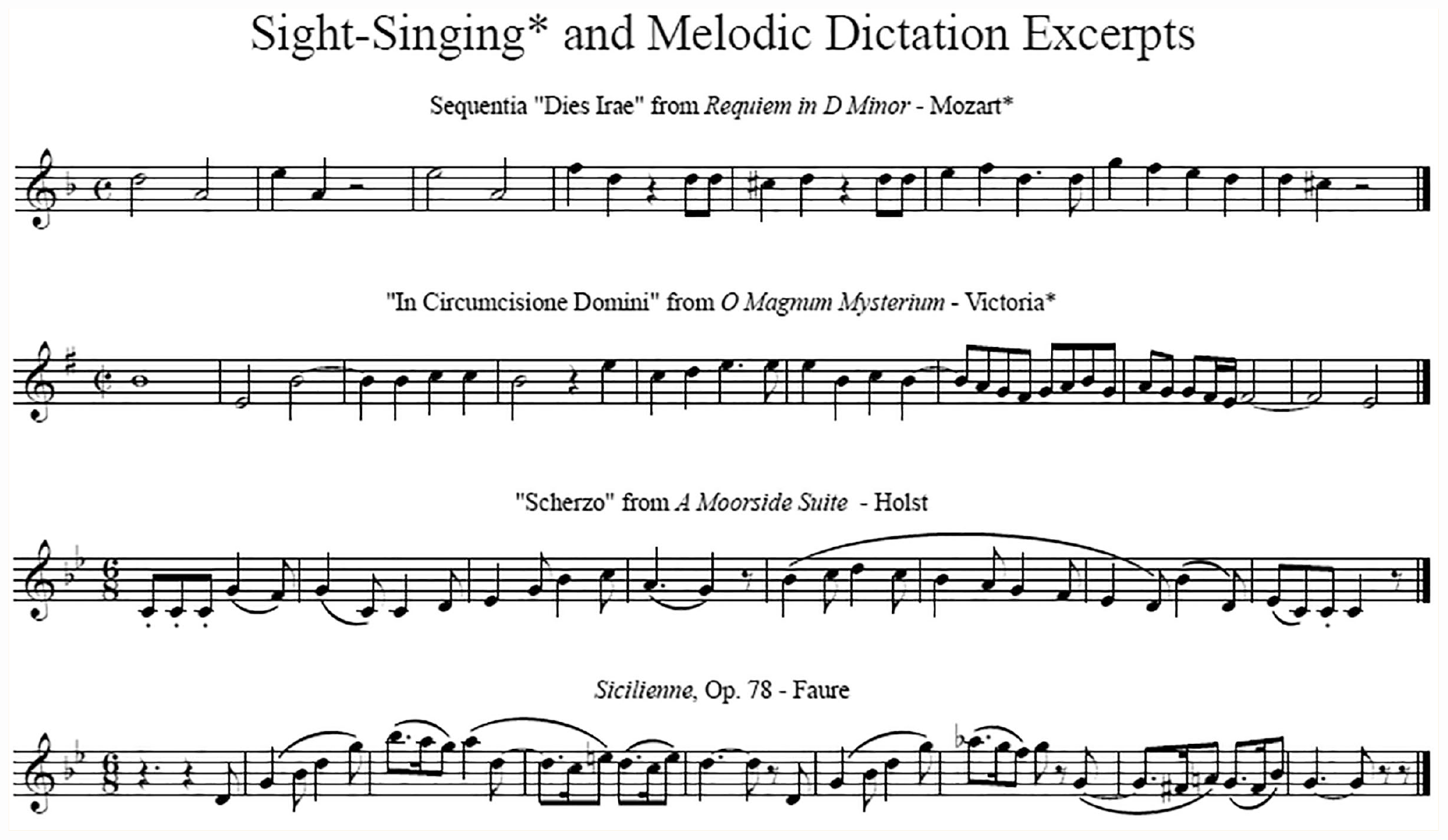
Sight-Singing (Marked with *) and Melodic Dictation Excerpts
Students can benefit from making predictions about melodic, harmonic, and rhythmic content before listening to an excerpt. 40 Consider guiding students to try to visually identify tonality, sequences, and rhythmic motives and anticipate potential cadences. They can then compare their observations of a notated excerpt with what they hear or sing. For example, students may be able to visually determine that the excerpts in Figure 3 are all in minor tonality. If preparing to sight-sing, they can approach example one with the knowledge that there are skips of a fourth and fifth and one type of accidental. In the second example, there is scalar movement that includes a sixteenth-note rhythm. Before dictating example three, they may notice that the first phrase starts on the resting tone but the second begins on the seventh scale degree. In the fourth example, phrases one and two have almost identical rhythms, and it is the tonal content that changes. Using theory knowledge to make decisions and predictions about melodies is a useful dictation strategy 41 and can raise scores by helping students avoid careless mistakes.
Transferring Skills
Researchers have suggested that students can improve their sight-singing and dictation skills through learning a variety of pitch and rhythm patterns and using a syllable system. Through building an extensive vocabulary of patterns, students are more likely to recognize and make predictions about material in sight-singing and dictation excerpts. As students have faced considerable challenges with selections in minor tonality and compound meter, teachers can include those specific types of patterns for students to practice. Educators can consider selecting and making use of a syllable system for teaching patterns that changes based on the context of a musical example. Students may be better at sight-singing and taking dictation in less familiar tonalities and meters when they have experienced a variety of patterns and understand how to use syllabic labels.
Students may reinforce their knowledge of tonal and rhythmic patterns and improve their dictation skills through improvisation and composition. In a tonal improvisation, students must recollect and order appropriate pitches within a given chord and harmonic sequence. In a rhythmic improvisation, students must recognize and chant various subdivisions within a specific meter. A student who has developed a vocabulary of patterns can draw on that knowledge to identify common motives and to combine pitch and rhythm sequences in new ways. Students are likely to be engaged when creating their own music and can gain necessary practice notating melodies and part-writing. These experiences can transfer to improved sight-singing and dictation skills, as students practice singing and notating their creation when they improvise a new composition. After writing a melody, students can add nonchord tones and embellishments, and practice transposition.
As AP Music Theory Exam content is centered around eighteenth-century common practice, teachers should consider using examples from the Western musical canon and students’ ensemble literature. Teachers can extract material from performance literature to create exercises that highlight specific chords, less common cadences and tonalities, and phrase structure, or for sight-singing and dictation. Students who transfer information from their theory classrooms to ensembles can make practical applications of theoretical concepts in a performance setting. Both Western classical literature and ensemble pieces contain numerous examples of music in compound meter and minor tonality that can be used to develop students’ aural skills.
