



Abstract
To increase equity in music education, teachers can strive to know each student as a whole child, proactively remove barriers to learning, and seek to honor students’ multifaceted and intersectional identities. In this article, we first define intersectionality and examine demographics in music education. Then, we summarize three asset-based pedagogical approaches (Universal Design for Learning, Culturally Responsive Education, and Trauma-Informed Education) and synthesize their similarities. Finally, we present implications in the form of generative ideas for music educator praxis, or values-guided action. We hope our suggestions help music educators create music experiences where students (and families) feel seen, safe, welcomed, and valued as musicians and people. We also hope our suggestions can contribute to music teacher collegiality and collaboration by providing educators with tools to develop positive relationships with colleagues who are different from themselves.
Keywords
By critically reflecting on their own biases and teaching approaches and incorporating responsive actions, educators can help more students feel welcomed and valued in the music classroom.
Photo of Mara E. Culp and Karen Salvador courtesy of the authors
All humans occupy multifaceted identities that affect their experiences in various ways. Identities help individuals understand who they are and can be developed through interactions at home, at school, and in other environments. A person’s beliefs about their identities and how they are treated by others can affect their beliefs and actions. Conversely, a person’s actions and achievements and others’ perceptions of those may also affect the person’s perceptions of their identities or self. For example, watching a similar person succeed can increase a person’s self- efficacy (beliefs about their ability to accomplish a particular task). The interplay among one’s environment, characteristics, and experiences creates a circuit of beliefs and behaviors that can influence the construction and expression of identities, which may include whether students identify as musicians.
Someone’s past experiences, beliefs about themselves, and beliefs about others can affect their decisions and how they treat others, which can include biases. For example, there is a preponderance of women in the music teaching profession, 1 and beliefs about women as nurturing caregivers may be a contributing factor. Women may be socialized into ideas of caregiving early in life. This could fuel women’s beliefs that caregiving is an appropriate role for themselves and other women and (consciously or subconsciously) influence their decision to encourage or support women to pursue the teaching profession. Such beliefs may also help to explain why men who teach elementary general music sometimes grapple with expectations related to performance of gender and with their own identities as playful and nurturing. 2 In either case, people who are transgender, nonbinary, or agender may experience gender-normative bias.
Although single identity characteristics (e.g., ability, age, class, ethnicity, gender, language, race, religion, sexual orientation) can contribute to variation among individuals’ lived experiences, the combination of a person’s identities affects the ways in which individuals experience their world. Legal scholar Kimberlé Crenshaw 3 used the term intersectionality to describe this phenomenon. For example, a student may experience barriers or obstacles due to particular identity intersection, such as being a child of color who is also labeled as having a disability. To increase equity in music education, teachers can strive to know each student as a whole child, proactively remove barriers to learning, and seek to honor students’ intersectional identities. In this article, we first discuss intersectionality and examine music student and teacher demographics. Then, we summarize three asset-based pedagogical approaches (Universal Design for Learning, Culturally Responsive Education, and Trauma-Informed Education) and synthesize their similarities. Finally, we present implications in the form of generative ideas for music educator praxis, or values-guided action. We hope our suggestions help music educators create music experiences where students and their families feel seen, safe, welcomed, and valued as musicians and people. We also hope our suggestions can contribute to music teacher collegiality and collaboration by providing educators with tools to develop positive relationships with colleagues who are different from themselves.
Positionality: Our Story
As intentional practitioners who seek to work for equity, we recommend teachers examine biases and work to avoid assumptions by getting to know themselves and others. Reflecting on one’s positionality (how one is positioned in relation to others within a context) is important for all citizens of this world and especially for teachers who wish to examine intersectionality in music education. Recognizing how their own social identities may be afforded more or less privilege and power within a particular context may help teachers learn to notice biased thinking and stop enacting it (see Sidebar 1 for ideas about disrupting bias). Rather than making assumptions about a person’s identities, teachers can provide opportunities for others to self-identify and describe their identities (e.g., race, gender, religion). Doing so could help teachers learn about students, families, and communities in ways that foster empathy and sensitivity.
Although no one is entitled to another’s personal story, we believe voluntarily sharing to one’s comfort level in a particular space or context is a vulnerable act and an important step toward building relationships. When sharing, adults should establish boundaries that preclude flooding others with information or sharing information that is not appropriate for the students/setting. 4 When learning about individuals, we suggest refraining from judging how much or what someone shared or “filling in” blanks. If a person does not disclose certain information about themselves (e.g., sexual orientation, religion, race), it does not necessarily mean that they are different from others who have shared or that they have any particular feelings. Take the time to build trust and slowly get to know each person.
Sidebar 1: Disrupting Bias and Stereotypes
Bias is “prejudice in favor of or against one thing, person, or group compared with another, usually in a way considered to be unfair” (Oxford Dictionary Online). Bias arises from socialization and media influences. Learning to identify assumptions or language that marks something or someone as deficient or lacking (i.e., deficit assumptions) and questioning their use can be an important step toward disrupting bias. Here are some ideas that may help reduce biased thinking and actions:
“Positive” stereotypes are still stereotypes, which dismiss individual differences. Remind yourself and others that no group is monolithic. Characteristics within groups can be just as varied as differences between groups.
When you think in a biased way, such as using deficit language or stereotypes, ask yourself: “Why do I think that? Can I find a basis in fact for that assumption?”
Reflect on times assumptions were made about you. How did you feel when you found out?
Try an Implicit Association Test, such as one offered through Project Implicit (https://implicit.harvard.edu/implicit/takeatest.html).
Use the Cultural Competence Self-Assessment Checklist (http://rapworkers.com/wp-content/uploads/2017/08/cultural-competence-selfassessment-checklist-1.pdf).
Diversify the media and musics you consume, perhaps by visiting The Global Jukebox (http://www.theglobaljukebox.org/).
Broaden your social interactions and the musics you select (for options, see https://www.composerdiversity.com).
Ensure the music you select at school does not perpetuate stereotypes or bias (for ideas, see Waller-Pace, Batislaong, and McCauley, 2020: https://vimeo.com/419122217).
Engage in community asset mapping as a way to locate resources (relational, human, capital, and more) using resources such as the Community Legacy Program’s Community Building Tool Packet (https://naaee.org/sites/default/files/assetmappingworkbook2013.pdf).
Noticing biases and learning to manage them is critical for an intersectional approach to music education. As you work on each of these suggestions, refer to the section in this article on asset-based pedagogies.
To model our continued work toward these aims and provide an example, we believe it is important to share about ourselves to our levels of comfort in this space [professional journal] and how we come to this conversation. Informed by the suggestions noted previously, our descriptions are not exhaustive, and we recognize some teachers or students, like ourselves, may be comfortable sharing more than others. Both authors are married mothers who were born and raised in the Midwest, have doctorates in music education, work at universities, and have taught music in P–12 settings. We have been researching, writing, and presenting together on issues related to inclusion, equity, and intersectionality in music education since 2017. As individuals, Salvador identifies as a White, atheist, cisgender female and does not identify as a person with a disability. Culp identifies as a biracial (Black/White) cisgender female. As such, we occupy identities that allow for certain privileges and positional power within particular contexts and identities that are afforded less privilege or marginalized within other contexts. Although we share similarities, our experiences differ in part because of the complex intersections of our individual identities.
Identities and Intersectionality in Music Education
To provide more equitable and inclusive music experiences, music educators can consider how students’ multifaceted identities influence their experiences in music classrooms. Specifically, the concept of intersectionality 5 can be a useful way to begin to understand student identities and recognize barriers and biases students may face. We use intersectionality to “referenc[e] the critical insight that race, class, gender, sexuality, ethnicity, nation, ability, and age operate not as unitary, mutually exclusive entities, but as reciprocally constructing phenomena that in turn shape complex social inequalities.” 6 Thus, although considering a single identity characteristic, such as dis/ability, as a way to create equity may be a starting point, the intersectional viewpoint recognizes more complexity in each person’s experience. 7 Therefore, we suggest teachers consider intersectionality by honoring the whole child and their unique circumstances.
Demographics in Music Education
Creating inclusive environments begins with understanding individuals, such as teachers and learners, in educational spaces. 8 Although class frequency and length vary widely, 94 percent of U.S. elementary school students have access to general music classes. 9 However, children in places with high concentrations of students from minoritized backgrounds are less likely to have music classes, 10 and children with special education needs may be pulled from music classes to receive services. At the secondary level, researchers have found that students who enroll in secondary ensembles differ from the school population across a number of demographic variables, including gender, special education status, race, and home language. 11 LGBTQ students may find refuge in the arts, 12 yet music and theatre students may also be more likely to experience bullying. 13 Moreover, for any student, being present in a music classroom is not the same as having equitable access to music instruction.
Because music students become music teachers, it is likely not surprising that music teacher candidates and the music teacher workforce have not been representative of the U.S. population. 14 Most music educators are from middle-class backgrounds, White (90%), and female (60%), 15 although women may be underrepresented in certain areas, such as band conducting. 16 Additionally, LGBTQ+ music educators may feel hesitant to reveal aspects of their identity at work. 17 Admission to university music programs often requires specific kinds of music skills, knowledge, and dispositions that privilege certain types of knowledge and access to resources, 18 and few supports are available for music teacher licensure candidates with disabilities. 19 Furthermore, music teachers may not be prepared to teach in inclusive and responsive ways to honor the needs of students in terms of disability, culture, gender identity, or sexual orientation. 20 Music educator diversity and preparation matter because students can benefit from role models they identify with and from inclusive and responsive learning experiences. 21
Asset-Based Pedagogies
Asset-based pedagogies (ABPs) focus on individual strengths to improve learning. Researchers have demonstrated that intellectual development may increase when teachers believe in young students’ potential. 22 As they grow older, student perceptions of their music teacher’s beliefs about their capabilities may be related to persistence in high school music education programs. 23 Across age groups, student self-efficacy was reported as the most important predictor of achievement on music examinations. 24 In the next section, we offer brief overviews for three ABPs. We provide resources (see Sidebar 2) 25 and conclude by synthesizing commonalities.
Sidebar 2: Resources for UDL, CRE, and TIE
Universal Design for Learning
1) a) i) UDL Guidelines, including FAQs: https://udlguidelines.cast.org. ii) A UDL studio: http://udlstudio.cast.org. Visitors can use free resources and get tips on creating content using UDL. iii) Universal Design for Learning: Theory and Practice. For a free multimedia edition of this book, go to http://castpublishing.org/books-media/udl-theory-and-practice/ and scroll to the button: free multimedia edition. iv) Teaching Every Student in the Digital Age (free online book): http://www.cast.org/teachingeverystudent/. b) Hall, Tracey E., Anne Meyer, and David H. Rose, eds. 2012. Universal Design for Learning in the Classroom: Practical Applications. New York, NY: Guilford Press. c) National Center on Universal Design for Learning: www.udlcenter.org/.
2) a) Hourigan, Ryan. 2015. “Understanding Music and Universal Design for Learning: Strategies for Students with Learning Differences.” In Musicianship-Focused Curriculum and Assessment, edited by Colleen Marie Conway, pp. 89–111. Chicago, IL: GIA Publications. b) Glass, Don, Anne Meyer, and David Rose. “Universal Design for Learning and the Arts.” Harvard Educational Review 83, no. 1 (2013): 98–119. c) Darrow, Alice-Ann. “Music Education for All: Employing the Principles of Universal Design to Educational Practice.” General Music Today 24, no. 1 (2010): 43–45. https://doi.org/10.1177/1048371310376901. d) “Rhonda Fuelberth: Universal Design for Learning.” 2014. https://www.youtube.com/watch?v=_tERNkR2UmQ, available from the collaborative music education series.
Culturally Relevant Education
1) a) *Blitz, Lisa V., Denise Yull, and Matthew Clauhs. “Bringing Sanctuary to School: Assessing School Climate as a Foundation for Culturally Responsive Trauma-Informed Approaches for Urban Schools.” Urban Education 55, no. 1 (2020): 95–124. https://doi.org/10.1177/0042085916651323. b) Gay, Geneva. 2018. Culturally Responsive Teaching: Theory, Research, and Practice. 3rd ed. New York, NY: Teacher’s College Press. c) Ladson-Billings, Gloria. “Culturally Relevant Pedagogy 2.0: aka the Remix.” Harvard Educational Review 84, no. 1 (2014): 74–84. https://doi.org/10.17763/haer.84.1.p2rj131485484751. d) Paris, Django. “Culturally Sustaining Pedagogy: A Needed Change in Stance, Terminology, and Practice.” Educational Researcher 41, no. 3 (2012): 93–97. e) Paris, Django, and H. Samy Alim, eds. 2017. Culturally Sustaining Pedagogies: Teaching and Learning for Justice in a Changing World. New York, NY: Teachers College Press.
2) a) Bond, Vanessa L. “Culturally Responsive Education in Music Education: A Literature Review.” Contributions to Music Education 42 (2017): 153–80. https://www-jstor-org-443.web.bisu.edu.cn/stable/26367441. b) Lind, Vicki R., and Constance McKoy. 2016. Culturally Responsive Teaching in Music Education: From Understanding to Application. London: Routledge. c) Shaw, Julia. “The Skin That We Sing: Culturally Responsive Choral Music Education.” Music Educators Journal 98, no. 4 (2012): 75–81. https://doi.org/10.1177/0027432112443561.
Trauma-Informed Education
1) a) Chafouleas, Sandra M., Taylor A. Koriakin, Katrina D. Roundfield, and Stacy Overstreet. “Addressing Childhood Trauma in School Settings: A Framework for Evidence-Based Practice.” School Mental Health 11, no. 1 (2019): 40–53. https://doi.org/10.1007/s12310-018-9256-5. b) Gaffney, Carrie. “When Schools Cause Trauma.” Teaching Tolerance 62 (2019). https://www.tolerance.org/magazine/summer-2019/when-schools-cause-trauma c) National Child Traumatic Stress Center: https://www.nctsn.org. d) Preventing Adverse Childhood Experiences |Violence Prevention|Injury Center|CDC: https://www.cdc.gov/violenceprevention/childabuseandneglect/aces/fastfact.html e) Substance Abuse and Mental Health Services Administration. 2014. SAMHSA’s Concept of Trauma and Guidance for a Trauma-Informed Approach (HHS Publication No. (SMA) 14-4884; p. 27). Substance Abuse and Mental Health Services Administration. http://store.samhsa.gov/product/SAMHSA-s-Concept-of-Trauma-and-Guidance-for-a-Trauma-Informed-Approach/SMA14-4884. f) Walkley, Meg, and Tory L. Cox. “Building Trauma-Informed Schools and Communities.” Children & Schools 35, no. 2 (2013): 123–26. https://doi.org/10.1093/cs/cdt007 g) Wiest-Stevenson, Courtney, and Cindy Lee. “Trauma-Informed Schools.” Journal of Evidence-Informed Social Work 13, no. 5 (2016): 498–503. https://doi.org/10.1080/23761407.2016.1166855
2) a) MacIntosh, Heather B., Amanda Tetraul, and Jean-Sebastien Vallée. “Trying to Sing through the Tears. Choral Music and Childhood Trauma: Results of a Pilot Study.” International Journal of Research in Choral Singing 8 (2020) 22–50. https://acda.org/2020/04/ijrcs-volume-8/. b) *McEvoy, Carin A., and Karen Salvador. “Aligning Culturally Responsive and Trauma-Informed Pedagogies in Elementary General Music.” General Music Today 34, no. 1 (2020): 21–28. https://doi.org/10.1177/1048371320909806 *Both CRE and TIE
Universal Design for Learning
Universal Design for Learning (UDL) is a framework to create inclusive learning environments characterized by equitable access to and participation in learning by all children. UDL reflects developments in architecture that sought to design universal access to spaces (e.g., ramps used for wheelchairs, strollers) and brain research that recognizes neural variation as the rule. 26 In considering strategic, affective, and recognition neural networks, researchers Tracey Hall, Anne Meyer, and David Rose 27 proposed that learning environments should include universal approaches that create multiple means of engagement, multiple means of representation, and multiple means of action and expression. Because all children have the potential to face barriers to learning, using the UDL framework to anticipate student needs and remove barriers from the outset has the potential to help all children.
Culturally Responsive Education
Following music education scholar Vanessa Bond’s example, 28 we use the term Culturally Responsive Education (CRE) to encompass culturally informed approaches to teaching. These include Culturally Relevant Pedagogy 29 and Culturally Responsive Teaching, 30 which focus on responding to students by using “cultural knowledge, prior experiences, frames of reference, and performance styles of ethnically diverse students to make learning encounters more relevant and effective.” 31 Building on this work, education scholar Django Paris and H. Samy Alim, an anthropologist, advanced Culturally Sustaining Pedagogy as education that seeks to sustain student and community cultures. 32
Music teachers who use CRE practice cultural humility, by “engaging power dynamics between their school and the communities they serve and refusing to stereotype,” 33 cultivating critical awareness of their own culture, and resisting to position it as “neutral” or the norm. CRE also requires that teachers strive to know families and communities and recognize community cultural wealth by “focus[ing] on and learn[ing] from the array of cultural knowledge, skills, abilities and contacts possessed by socially marginalized groups that often go unrecognized and unacknowledged . . . [including] aspirational, navigational, social, linguistic, familial and resistant capital.” 34 Enacting CRE requires developing critical awareness (awareness of sociohistorical influences on the trajectories of students who have been marginalized), building on students’ cultural knowledge (e.g., prior knowledge, stories, musics), and employing cultural content integration (integrating knowledge that validates student experiences). 35 In these ways, music teachers who use CRE facilitate instruction that places student, family, community, and school cultures on a more equal footing by responding to students’ needs and sustaining cultures. CRE often requires that teachers reshape curriculum to reflect what they learn about students and communities.
Trauma-Informed Education
Trauma-informed care emerged from practices used when working with military veterans. 36 Because trauma-informed educational approaches have a variety of names (practices, pedagogies, etc.), we emulated Bond’s use of CRE as an umbrella term by referring to all these approaches as Trauma-Informed Education (TIE). Trauma 37 can be understood as an injury that “has lasting adverse effects on [an] individual’s functioning and physical, social, emotional, or spiritual well-being.” 38 Scholars have observed relationships between childhood trauma and difficulty in school. 39 Because all students have the potential to face trauma, using TIE can help teachers create safe environments before or after a traumatic event occurs.
According to the Substance Abuse and Mental Health Services Administration, six principles are key to a trauma-informed approach. 40 First, children who have experienced trauma need safety. Teachers enacting TIE practices work to help children see school as a place where they are physically and psychologically protected from harm. Guided by the second element, trustworthiness and transparency, teachers build the sense of safety through warm, supportive interactions coupled with predictable, clearly communicated expectations. Teachers can also foster peer support, the third element, which can be accomplished through thoughtfully planned family projects or “buddy” systems. Following the fourth element, collaboration and mutuality, teachers work together with students toward shared educational goals. By using the fifth element of empowerment, voice, and choice, teachers work to ensure students know that their ideas, comfort, and preferences are considered, valued, and acted on. Finally, teachers allow cultural, historical, and gender issues to inform TIE. 41 This sixth element reflects the idea that people with particular characteristics have been more likely to experience trauma due to how they have been treated. Furthermore, due to intersections of identity characteristics, trauma may affect particular individuals more than others and in different ways.
Shared Principles of UDL, CRE, and TIE
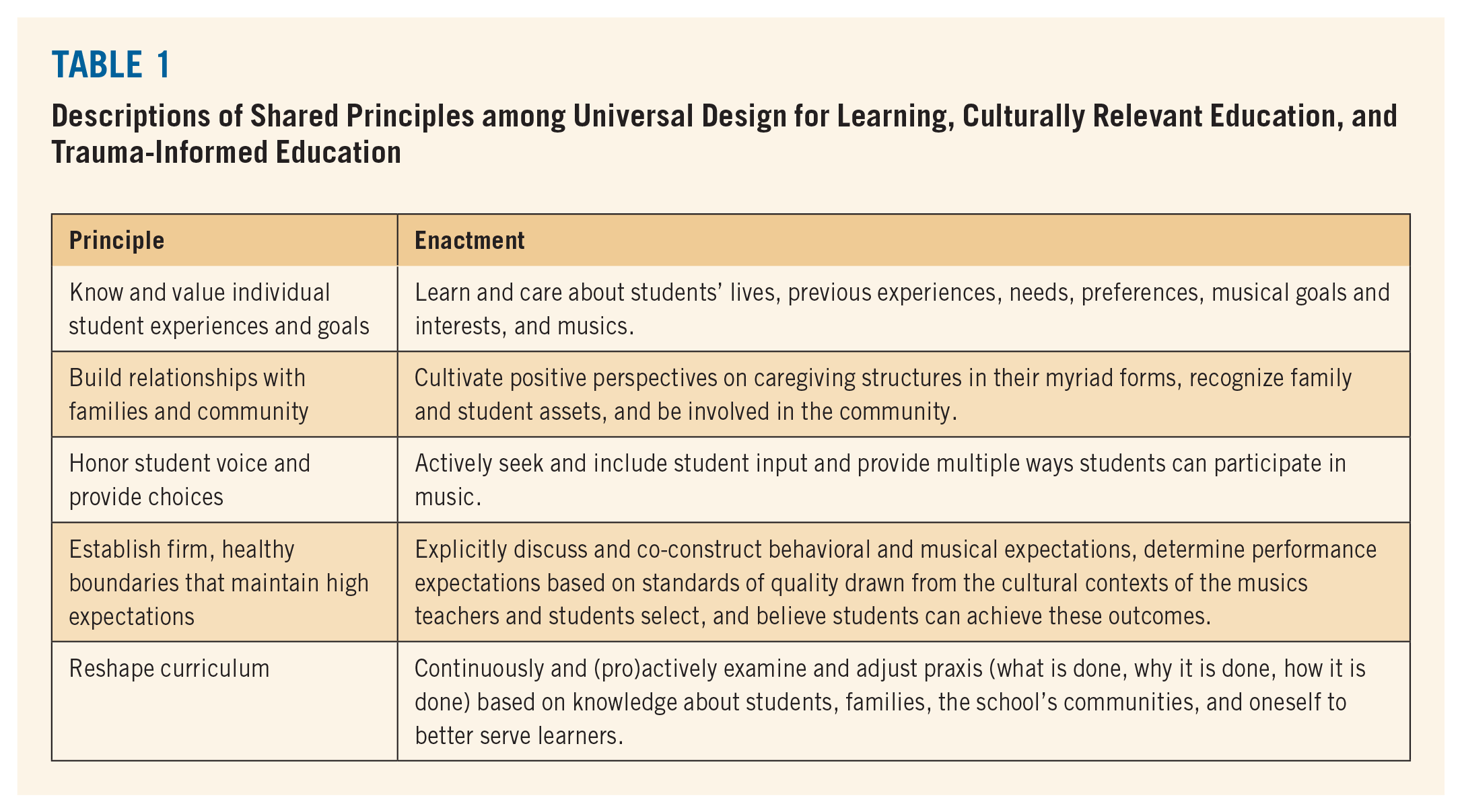
In summary, ABPs focus on learner strengths, recognize diversity in learning and experience as the rule, and foster student self-efficacy and agency to help improve learning. Teachers utilizing ABPs consider child, family, and community resources and design learning environments that welcome strengths and support differences to help children achieve. In these ways, ABPs stand in opposition to deficit-based approaches, which focus on assessing deficiencies and designing remediation, often accompanied by blaming the child or the child’s culture for these supposed deficiencies. 42 In Table 1, we outline shared principles that we have identified among UDL, CRE, and TIE. We believe these common elements present opportunities for music educators to create more inclusive and equitable music education.
Descriptions of Shared Principles among Universal Design for Learning, Culturally Relevant Education, and Trauma-Informed Education
Suggestions for Music Teachers
In this section, we offer six principles that currently guide our praxes. Our ideas about and approaches to creating equity in music education spaces have evolved over time, are informed by the principles we believe are central to ABPs, and extend our previous work. 43 Table 2 offers generative ideas and suggestions for music educators, recognizing that teachers are the experts in their classrooms. Therefore, we suggest teachers select and adapt strategies for their particular contexts, which may necessitate involving other school personnel (e.g., principals, counselors).
Generative Ideas for Praxis

In addition to the shared principles listed in Table 1, we suggest teachers begin by practicing cultural humility. This practice is aided by developing self-knowledge, which is why we encourage teachers to recognize their identities, understand the interplay of those identities, and identify their positionality. This process of self-examination is not about evaluating oneself or one’s culture as good or bad because such dualistic thinking is not helpful. 44 Instead, practicing cultural humility allows teachers to create spaces (and equal footing) for musics, social practices, and ways of learning that foster equitable treatment among student, family, and community cultures.
Conclusion
In this article, we offered information and suggestions intended to help music educators develop strategies to meaningfully engage with others in educational spaces. Recognizing intersectional identities is one way to begin to honor the uniqueness of an individual’s experiences, see the whole child, and welcome each individual into music class. Rather than seeing differences as obstacles, embracing students’ unique and multifaceted identities can provide valuable opportunities to create, perform, and respond to music in ways that allow students to personally connect with the content and enrich their and others’ musical experiences. Employing such practices also could raise engagement among students who are not currently participating in school music, leading to increased and diversified enrollment and participation in musical activities. Furthermore, these strategies may assist music teachers in building meaningful relationships with families, communities, and colleagues, which could ultimately serve to improve instruction and create a more inclusive, diverse, and supportive professional environment.
