



Abstract


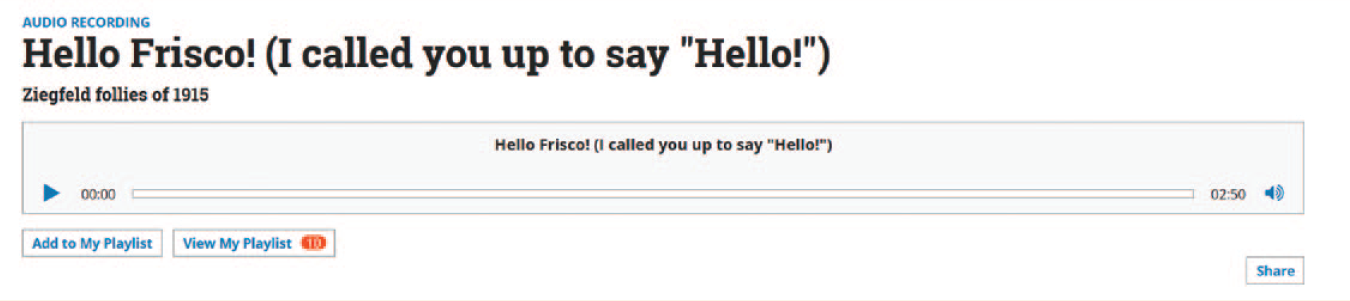
You may already know that on January 25, 1915, the first transcontinental telephone call was made by Alexander Graham Bell in New York to Thomas A. Watson in San Francisco. But did you know that this historic moment motivated a song? Indeed, the piece “Hello, Frisco! (I Called You Up to Say ‘Hello’)” (loc.gov/item/jukebox-13852), was recorded in 1915, released by Victor Records, and is currently accessible via the Library of Congress National Jukebox.
This three-minute song could motivate your students to learn more about the significant phone call between Bell and Watson—a sequel to a call they first made in 1876 when the telephone was first demonstrated. It can also engage them in a study of historical recordings and early twentieth-century music (including musical theater) while providing an interdisciplinary bridge and opportunities for research. More broadly, it can serve as an entry point into the National Jukebox and other sound recordings that the Library of Congress makes available.
National Jukebox: loc.gov/collections/national-jukebox/about-this-collection
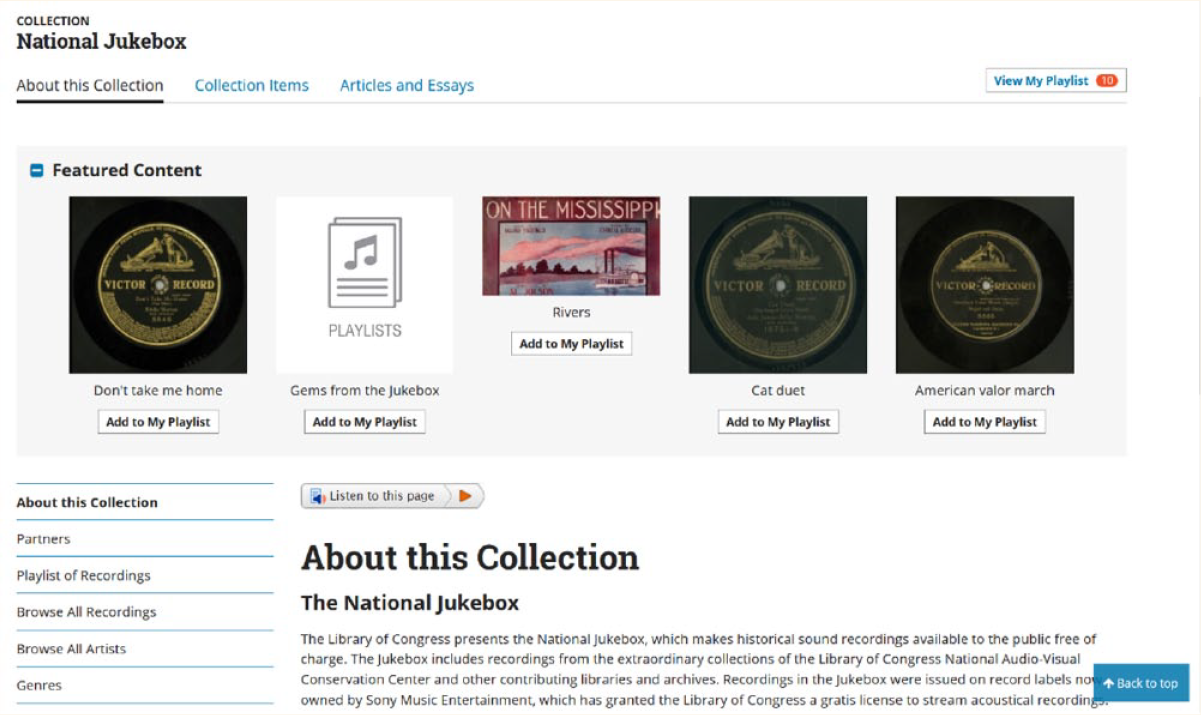
The National Jukebox (loc.gov/collections/national-jukebox/about-this-collection) is a collection of more than 16,000 historical audio recordings that were produced under record labels within the Sony Music Entertainment umbrella, including Victor Records. The collection also reflects the contributions of other organizations and individuals. The recordings span numerous genres, including classical, opera, musical theater, and jazz, and date from 1900 to 1925. On January 1, 2022, as a result of the Music Modernization Act, recordings published before 1923 became public domain material and therefore can be used without copyright restrictions.
There are a number of points of entry through which students can approach the National Jukebox collection. They might begin by exploring one of the curated playlists (and later, create their own). They can also browse and search the collection by date, genre, subject, language, composer, or another facet. Additionally, they can experiment with the “Jukebox Day by Day” feature (loc.gov/collections/national-jukebox/about-this-collection/jukebox-day-by-day), with which they can see which recordings were published on a particular day of the year. However they choose to approach the National Jukebox, they will be able to explore examples of early twentieth-century recorded music and history broadly, with possibility for interdisciplinary study and deeper learning and reflection. As students explore, they may also wish to record any observations, reactions, questions, and areas for further research.
Indeed, the National Jukebox does offer opportunity to explore aspects of history, society, and culture through the lens of recorded sound. As you consider how you might use this resource with students, it is also important to be aware of the potentially offensive or problematic historical material included in the collection. As the disclaimer on the National Jukebox website states: “These selections are presented as part of the record of the past. They are historical documents which reflect the language, attitudes, perspectives, and beliefs of different times. The Library of Congress does not endorse the views expressed in these recordings, which may contain content offensive to users.”
If you think sharing “Hello, Frisco!” with your students might capture their attention and imagination, here are some additional suggestions:
Begin by playing the first sixty seconds of the song for your students. Ask them what they notice, what sounds new or familiar, and what is surprising to them. They may notice a familiar “crackling” sound at the beginning of the recording. They might comment on the instrument choice or the bell dinging in the background, which may be reminiscent of the iconic San Francisco trolley. They may hear the singer use terms like “central,” “long distance” or phrases like “please connect me” and “I can hear you now” and wonder what those mean.
Next, play the remainder of the song, encouraging students to record their thoughts (perhaps using this Primary Source Analysis tool for sound recordings—loc.gov/static/programs/teachers/getting-started-with-primary-sources/documents/Analyzing_Sound_Recordings.pdf—to organize their thinking). As students listen to the song, ask them what they think it is about. They might pick up on the urgency and expression in the singers’ voices as they strive to speak with each other, sometimes overlapping, as they converse from “opposing coasts,” trading “Hello, Frisco!” and “Hello, New York” back and forth.
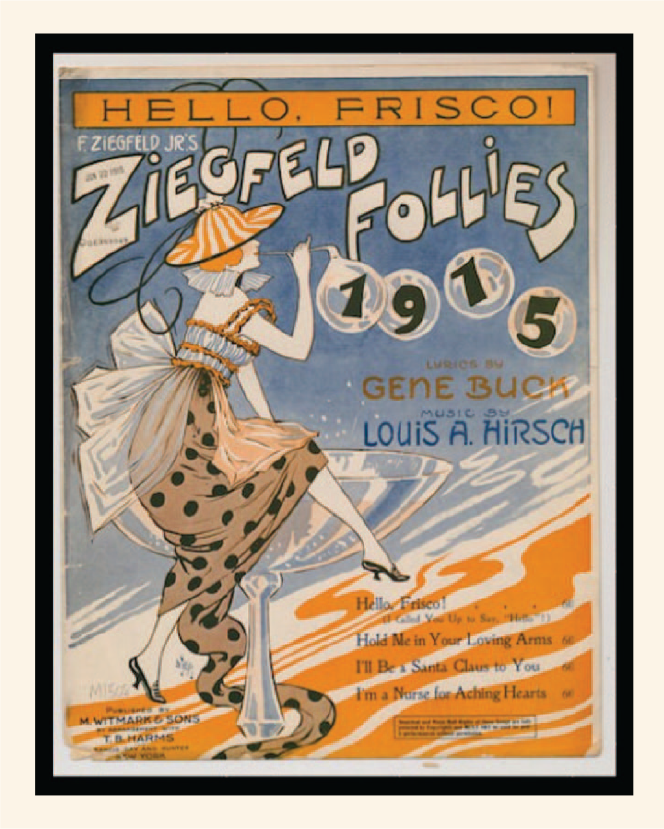
Then, you might share the title of the song and let students know that it was written by Gene Buck and Louis Hirsch, recorded in 1915, and was featured in the Ziegfeld Follies (an early twentieth-century yearly series of musical theater comedy shows) of that year. (You might also let them know that the Library of Congress holds versions of sheet music for this piece that could serve as intriguing points of comparison, for example, this version: loc.gov/item/ihas.200004970.)
Finally, continue the discussion by asking students what they know about the year 1915 and what may have been happening in the country and world at the time. They might think of World War I or other political, societal, or cultural events. Once they have had some time to reflect and speculate, let them know that in 1915, the transcontinental telephone line was formally unveiled, with a long-distance phone call between telephone inventor Alexander Graham Bell (who was in New York) and his assistant Thomas A. Watson (who was in San Francisco).
“Hello, Frisco!” loc.gov/item/ihas.200004970
“Hello, Frisco! (I Called You up to Say ‘Hello!’)”: loc.gov/item/jukebox-13852
If students wonder who the audience for this song might have been, and indeed how they might have reacted, you can share this Library of Congress essay, Songs of Work and Industry (loc.gov/collections/songs-of-america/articles-and-essays/historical-topics/songs-of-work-and-industry), which indicates that this piece is just one example of a song inspired by technological innovation of the time. You can also let students know that some of these recordings, including “Hello, Frisco!,” can be found in the Library of Congress’s National Jukebox.
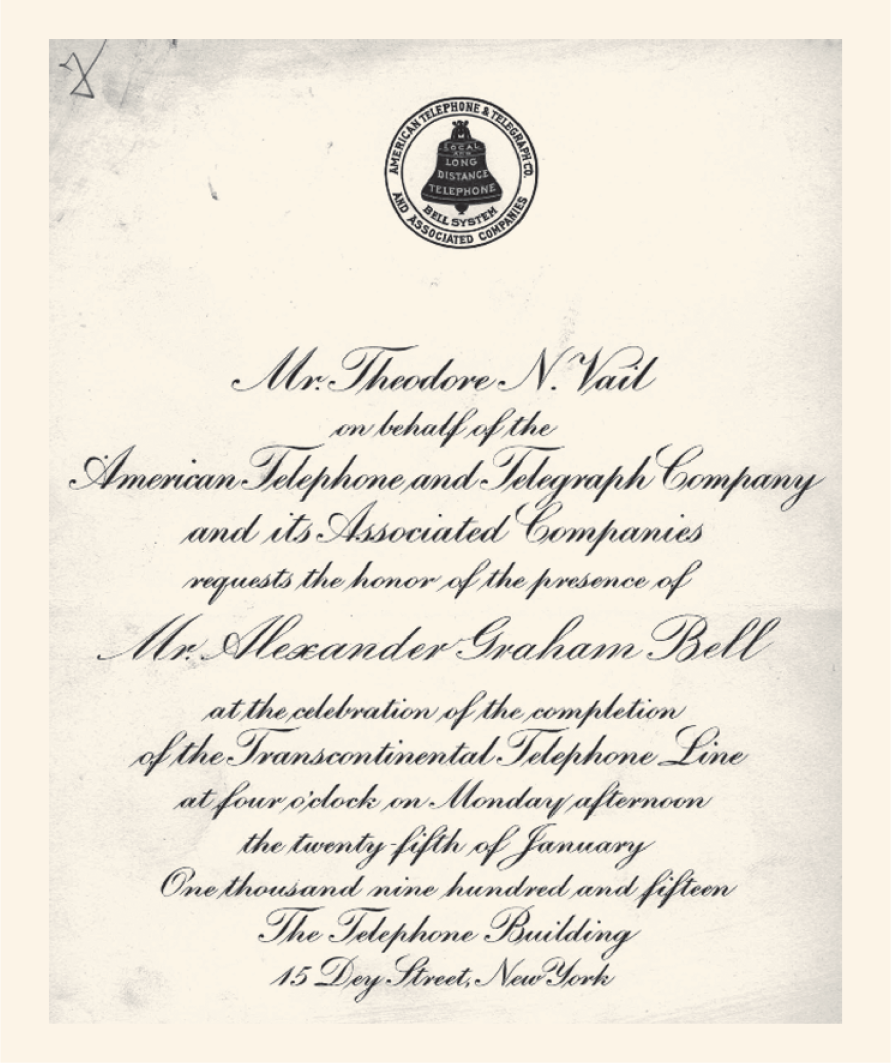
To bring in more historical insights, students can explore various additional items from the Library of Congress digital collections. For instance, in the Alexander Graham Bell Papers, they can find a “celebratory” 1915 invitation from the president of the American Telephone and Telegraph Company, Theodore N. Vail, to Bell (loc.gov/item/magbell.12900103) and a 1914 letter from Watson (loc.gov/item/magbell.12900209).
If students have further questions about the evolution of the telephone or the transcontinental line, they can explore this related resource guide (guides.loc.gov/chronicling-america-telephone-invention). For additional perspective, including how the American public at the time may have responded to this technological feat or reflections on the significance of this long-distance line, students may wish to browse the Chronicling America newspaper database (perhaps searching with the phrase “transcontinental telephone line” and narrowing the search to the year 1915). Encourage students to explore widely on their own and invite them to share their findings!
Invitation from Theodore N. Vail to Alexander Graham Bell, 1915: loc.gov/item/magbell.12900103
Fragments from a letter from Thomas A. Watson to Alexander Graham Bell: loc.gov/item/magbell.12900209
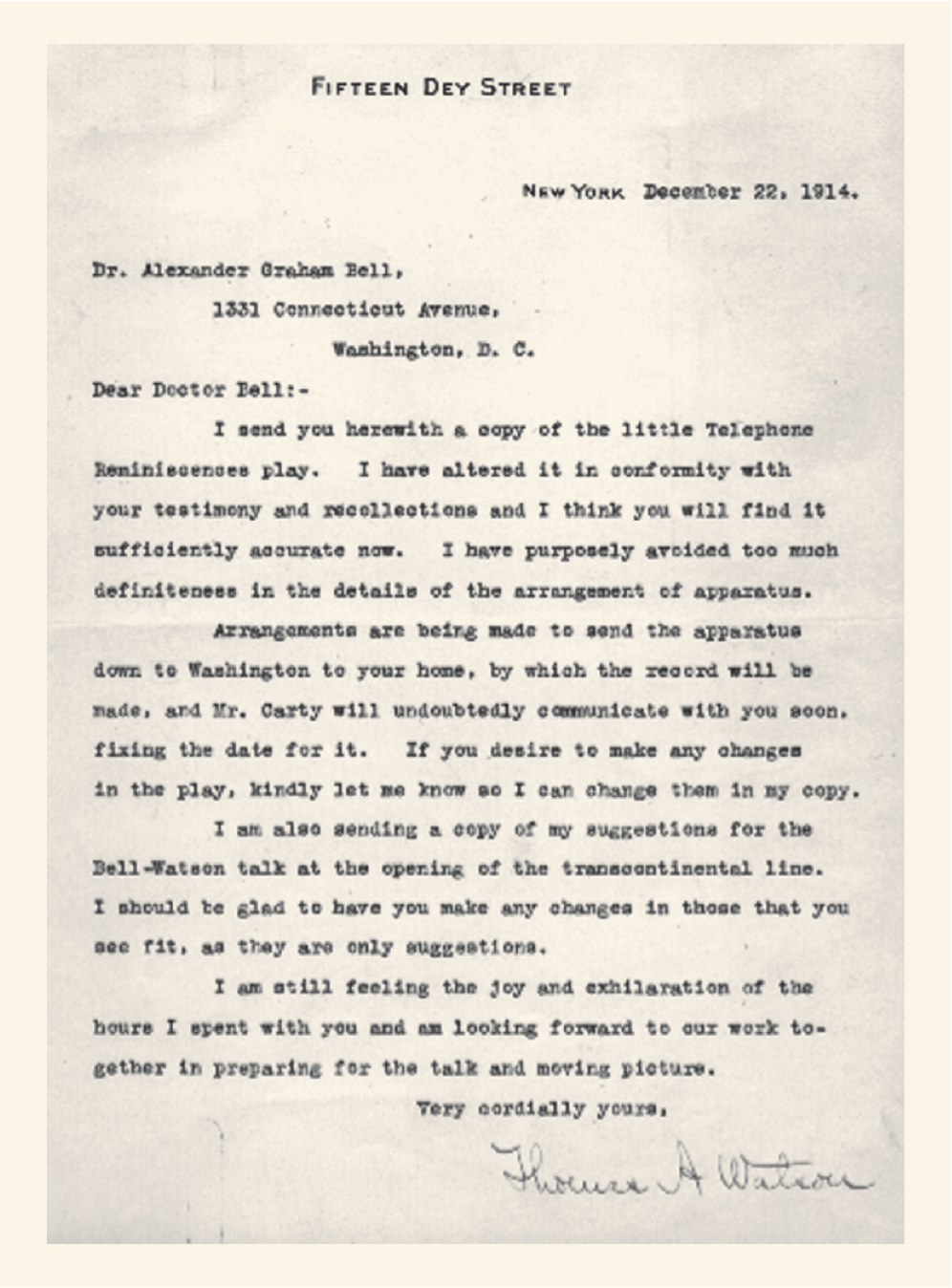

Fragments from a letter from Thomas A. Watson to Alexander Graham Bell: loc.gov/item/magbell.12900209

Footnotes
Kaleena Black wrote this article in 2021 during her work as an educational resources specialist with the Library of Congress of the United States in Washington, DC. Any questions about the topics and materials presented can be directed to the “Ask a Librarian” portal at https://ask.loc.gov/teacher-resources . The author would like to acknowledge Matthew Barton, curator of the Recorded Sound Division at the Library of Congress, for his suggestions of materials from the National Jukebox, which contributed to the development of this article.