



Abstract
An essential element of creative musicianship is the ability to seek, provide, and respond to feedback. This article presents a method of teaching elementary music students to respond to creative work in a way that is productive and uplifting, using a discussion protocol. Grounded in the work of Lerman and Borstel’s critical response and Seidel’s collaborative assessment conference, this protocol is designed to give young students the language to participate in creative discourse. This protocol can be used in the revision or assessment stages of a project, and it allows students to take ownership of their own creative community while laying the groundwork for meaningful and authentic assessment.
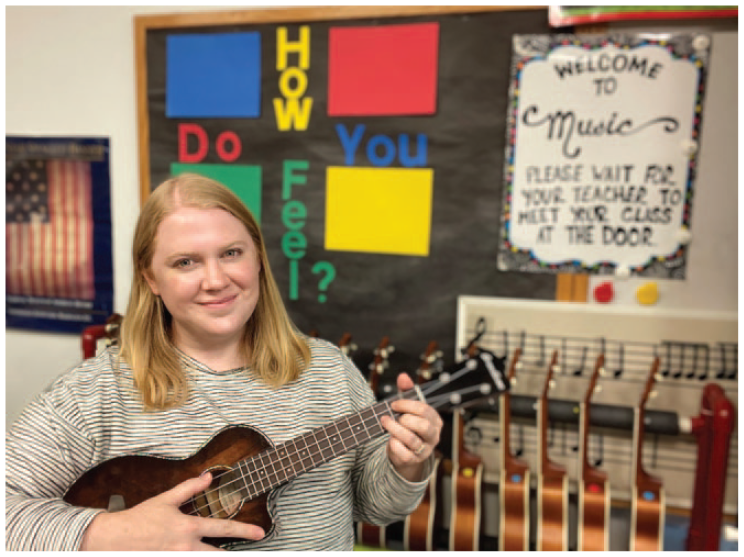
Photo of Megan DiSciscio by Jean-Paul DiSciscio
Over time and across disciplines, many have found themselves rendered speechless by a work of art. In fact, this is often considered the highest compliment, a way of expressing awe. Speechlessness serves a secondary function; if someone is rendered speechless, they are not required to offer a specific opinion that could be misinterpreted as unkind, uninformed, or unsophisticated. How many musicians have been told that a performance was “wonderful” by a well-meaning friend or family member and have been left wishing for a more meaningful conversation? How many museum patrons have walked through a gallery in silence for fear of having the wrong opinion or interpretation? This language barrier between artist and responder can exist in the classroom as well, even with very young students who are engaging in creative work for the first time.
Young music students can foster an interactive creative community using these techniques.
For music educators, evaluating and assessing creative work can be difficult and stressful and can even feel antithetical to the creative process. Under pressure to measure student growth and achievement, educators run the risk of creating rubrics that are more complex than the assignment itself. Additionally, the National Core Arts Standards 1 charge music educators with teaching our students to revise their own creative work and respond to the work of others. In this context, speechlessness is not an option. So how do we teach our students to respond to creative work and to incorporate those responses into their own work in a way that is productive, affirming, and feasible? Is there time in the day to facilitate these conversations while also meeting the already long list of demands on music educators? Can these conversations be equitable and uplifting for students from diverse needs and backgrounds? This article presents a discussion protocol, designed in the classroom and grounded in research, that empowers students to collaborate, critique, and evaluate creative musical work. Sometimes called “structured conversations,” 2 a discussion protocol provides students and educators with roles and specific language to facilitate otherwise difficult conversations. The goal of this discussion protocol is to teach young students how to respond to the work of their peers and how to receive feedback from peers. In doing so, the intent is to form an engaged and collaborative community of musicians in the classroom and beyond.
Response as Assessment
Writing on classroom composition in Music Outside the Lines, 3 music education researcher Maud Hickey explains that creative projects benefit from more open parameters and thus should be assessed using nonevaluative feedback to reduce anxiety and increase creativity. Additionally, research indicates that the parameters and means of assessment have an observable effect on creativity and intrinsic motivation. 4 For example, students might be highly motivated to succeed on a college admissions exam but would likely not risk being very creative because the stakes are too high. Similarly, if an assignment is very complex but students know it will only receive a mark for completion, both motivation and creativity will suffer. Figure 1 illustrates this relationship and provides some examples in different contexts. If the intent of an assignment is for students to be intrinsically motivated and creative, it is crucial that students understand exactly how their work will be assessed before setting out.
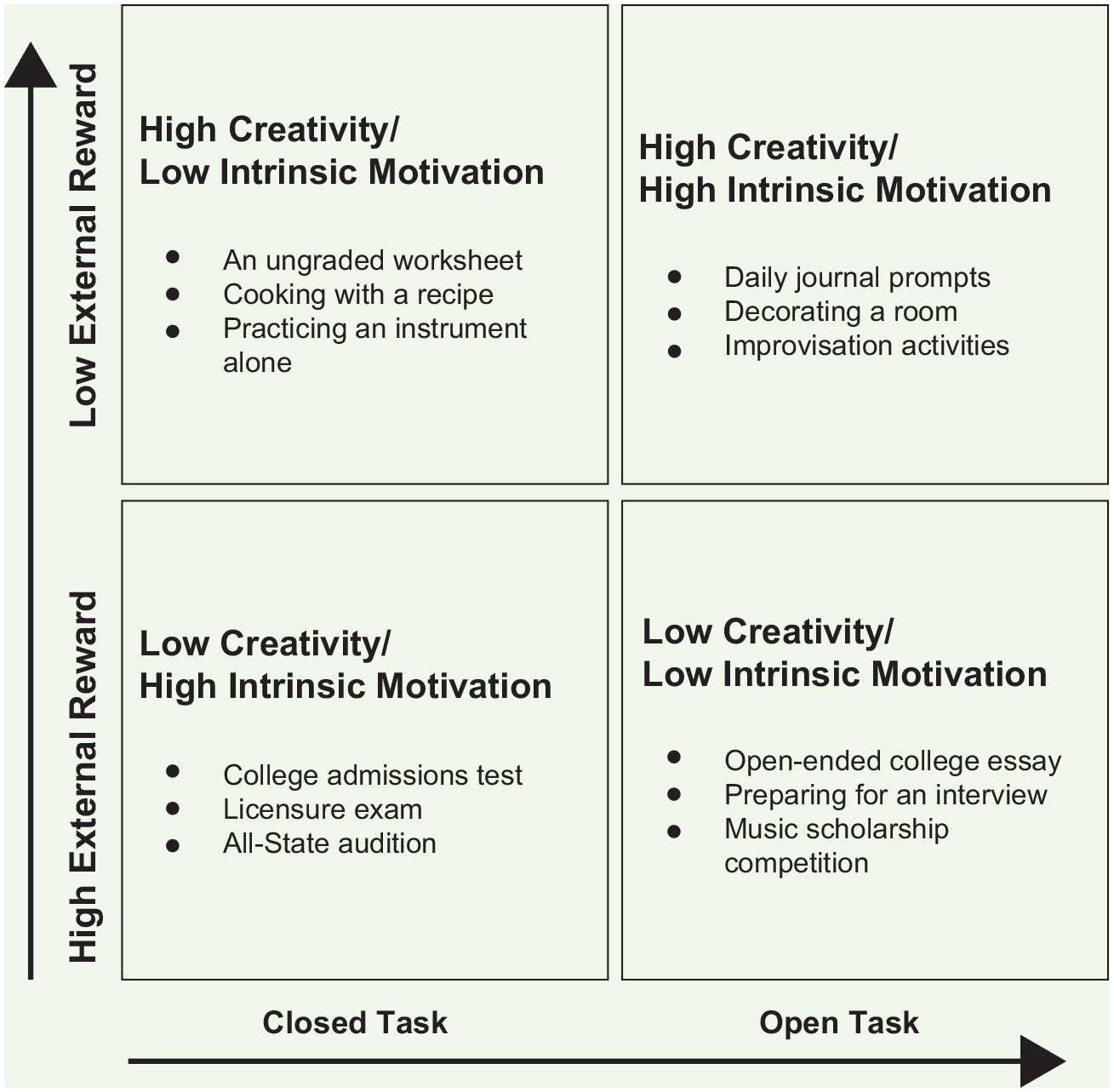
An Illustration of the Findings Represented in “The Interaction between Instructional Set and Levels of External Reward and Its Effect upon Creative Output and Intrinsic Motivation” 23
One way to assess creative work outside of classroom environments is to talk with the artist about it. For the curious consumer, getting answers directly from the artist can be enlightening and even cathartic. For works in progress, this discussion can help the artist understand how the work is impacting an audience. The artist might have specific questions or simply want to hear how friends, colleagues, and audiences react before opening up the work to critics. Among performing artists, the transitive verb workshop is often used: “To develop or improve (something) by means of a workshop (workshop n. 2); spec. (Theatre) to stage an experimental or preliminary performance of (a dramatic work) in this way, typically incorporating improvisation and group discussion, in order to explore and refine aspects of the production prior to formal staging.” 5 The protocol presented in this article is intended to guide young music students through the process of artistic workshopping.
One purpose of this protocol is to strengthen the connection between the first three artistic processes of the National Core Arts Standards: (1) Creating, (2) Performing/Producing/Presenting, and (3) Responding. 6 Specifically, when students are creating new work, this provides a structure for them to present incomplete work, receive peer feedback, and make revisions. The students who are not presenting are practicing how to respond to new and incomplete musical works, which will, it is hoped, inform their own work.
The foundation of this protocol is the creative assignment. The teacher should first work to design assignments with open parameters that incite individualism and creativity. Once this has been achieved, this process is designed to create a comfortable and low-stakes environment for students to present their works in progress to the class and for the class to provide peer feedback through observation, questioning, and discourse. The teacher’s primary responsibility is to facilitate these conversations, to observe, and to learn about students’ processes. By listening to the descriptions and inquiries, we come to understand the work of our students more deeply and are therefore more prepared to assess the work when it is complete.
The Protocol
When working with young students, having routines and clear expectations is an essential ingredient for success. In Learning That Lasts: Challenging, Engaging, and Empowering Students with Deeper Instruction, a protocol is defined as consisting of agreed upon guidelines for reading, recording, discussing, or reporting that ensure equal participation and accountability. When everyone understands and agrees to using the procedures of the protocol, participants are able to work more effectively both independently and collaboratively, often in ways they are not in the habit of doing. Protocols hold each student accountable and responsible for learning. They teach students how to lead their own learning.
7
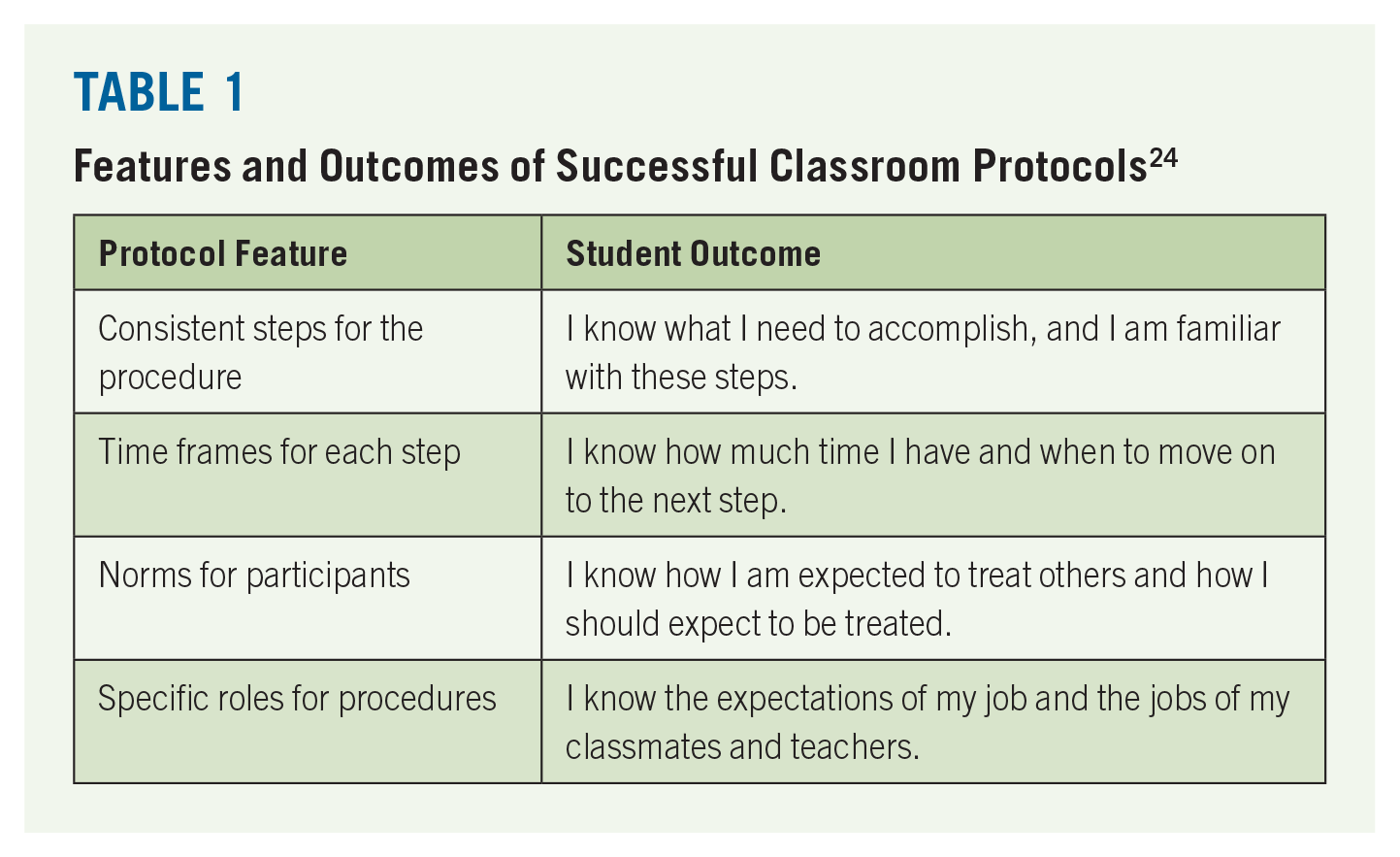
In this case, having a discussion protocol for responding to creative work aids both student and teacher in navigating through what can be a challenging and foreign process. The long-term goal for such a protocol is that students are able to participate in meaningful discussions, presentations, collaborations, or critiques independently. Table 1 visualizes and summarizes a suggested framework for successful classroom protocols.
Features and Outcomes of Successful Classroom Protocols 24
The protocol for creative discourse with young musicians is adapted from two sources, abbreviated, and uses language appropriate for students in grades three through five. The first comes from arts education researcher Steven Seidel’s Collaborative Assessment Conference, 8 which was designed as a way for teachers to meet and discuss student writing. This protocol is used at ROUNDS, a group of artists and educators who meet once a month at the Harvard Graduate School of Education (HGSE). Hosted by Seidel, and part of HGSE’s Project Zero, the idea is “based on the medical model of ‘rounds,’ where doctors young and old come together to share knowledge and practice clinical diagnostic skills.” 9 At these Saturday meetings, one group member brings an example of student work, and the entire group participates in the protocol. Occasionally, the student will be present, but most often, the teacher will answer questions on the student’s behalf.
The second source comes from choreographer Liz Lerman’s Critical Response, 10 a protocol designed to help artists elicit meaningful praise and critique from others. Lerman was motivated by what she saw as a lack of meaningful critique in artistic disciplines and a tendency for artists to shut down in the face of harsh, unproductive critique. Like the Collaborative Assessment Conference (CBC), emphasis is placed on describing and questioning the work before offering opinions or critique.
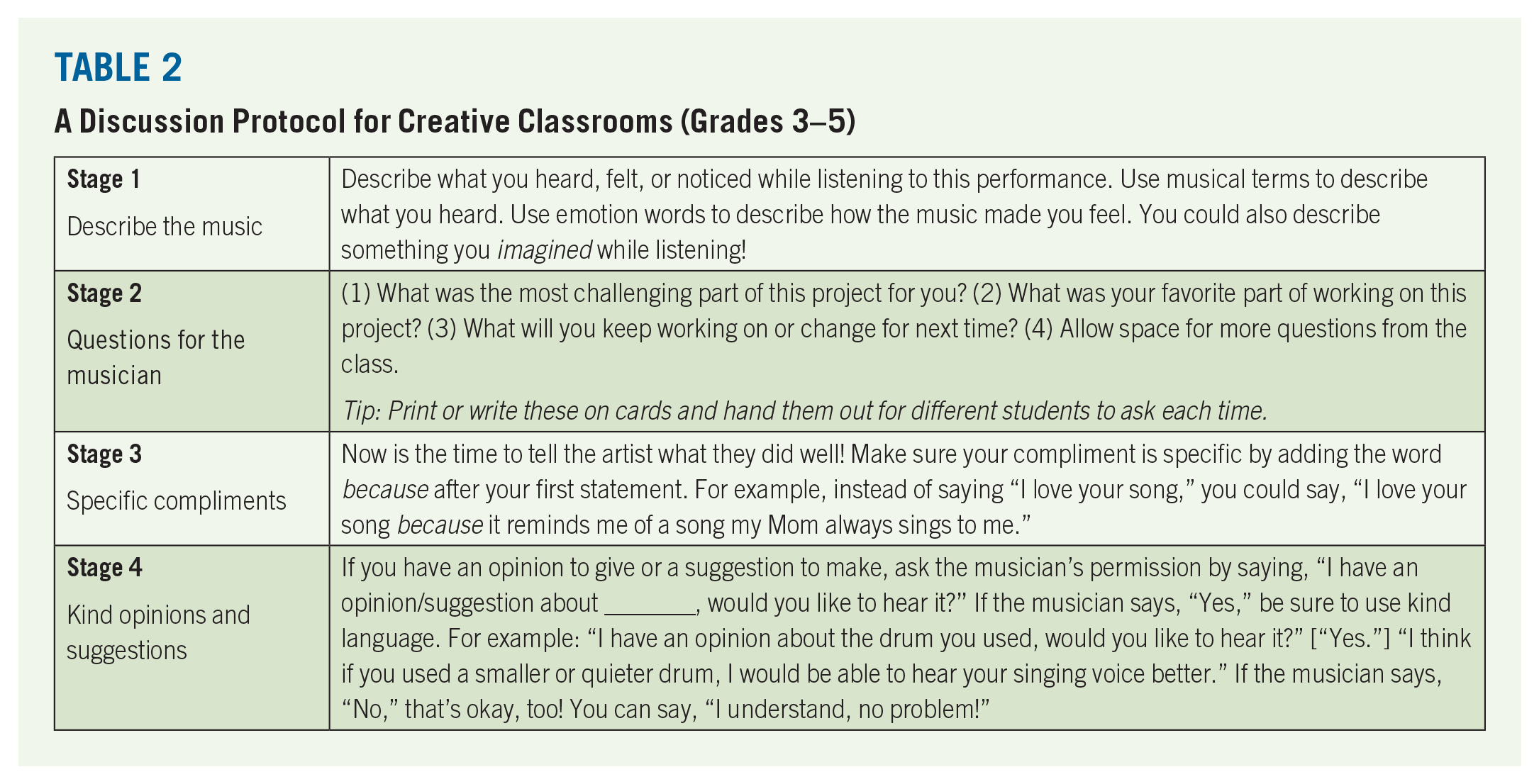
Both of these protocols were designed to be used by adults, not children. This is evident both in the language and length of each. Additionally, neither is specific to music, so it is necessary to make adjustments appropriate to the elementary music classroom. However, the two share a four-stage structure that guided the development of the following protocol for creative discourse with young musicians (Table 2). The protocol presented here is intended to be flexible. When writing the steps, educators should use language that reflects the ways students speak to one another. What is most important is consistency so that students become comfortable and familiar with the steps. Additionally, using familiar and consistent language works to ensure that the protocol is accessible to all students. Having visual aids and translations on hand can also help with this.
A Discussion Protocol for Creative Classrooms (Grades 3–5)
Once the steps and language of the protocol have been clearly laid out, take care to remind students that they will be assuming new roles. Critical Response 11 begins by establishing the roles of artist, respondent, and facilitator. Lerman is careful to clearly delineate these roles to ensure that the artist feels supported by the process. When describing the role of the responders, Lerman states, “Whoever they are, it is important that these observers sincerely want this artist to make excellent work.” 12 Additionally, the facilitator’s role is simply to walk the artist and respondents through the steps of the process. One natural way to translate this to the music classroom is for students to take turns being the presenting artists while the other students serve as respondents and the teacher facilitates. In this case, the teacher offers no critique or feedback.
Stage 1: Describing the Music
Both Critical Response
13
and CBC
14
recommend beginning by asking the audience or respondents to describe what they have just observed. By describing the work instead of attempting to evaluate it, the respondent can let go of the notion that they need to have a correct or informed opinion. Additionally, by doing this as a group, each respondent learns from the observations of others. One student might observe that a composer used three different instruments, while another might have noticed that the lyrics rhymed. In both cases, the students are demonstrating that they were listening and observing closely, but they also might not have noticed what the other student described. In “Wondering to Be Done,” Seidel shares the reflections of one teacher-participant on the benefits of collaborative description: Even in the first session, I observed an interesting phenomenon. Reflecting on the first conference, Julie Carter noted the effect of describing the work collaboratively. “It made me see a lot more than I would just sitting alone. And the more you looked, the more you saw.” This seemed true to me as I noticed that their first hesitant observations led slowly but surely into a long sequence of more specific descriptions.
15
Collaborative description allows students to learn from one another about what they have just observed. It also allows the teacher, working as the facilitator, to gain insight into how students experience and process new music.
Stage 2: Questions for Musicians
The protocol lays out specific questions using prescribed language. This is an important element of any discussion protocol or structured conversation 16 because it allows students to rehearse the protocol and ensures that the presenting artist has time to think of answers to the questions in advance. Another benefit to having scripted questions is that it can fill in the empty, awkward silence after a performance. How many of us have attended a Q&A after a performance or presentation only to sit in agonizing silence, waiting for the first brave soul to raise their hand? The last benefit to this structure is that using consistent, predictable language is an evidence-based approach to teaching English language learners (ELLs). 17 ELLs can practice both asking and answering the questions, and they will know that the questions and vocabulary will be the same each time.
Stage 3: Specific Compliments
When I first began trying to engage with students about their creative work, I struggled to get more out of them than “good job” or some other popular affirmation of the moment (“That was fire!” “You’re a beast!”). This is a good first step because it indicates that the students are ready to be respondents because they “sincerely want this artist to make excellent work.” 18 However, I noticed that these vague compliments were not helping anyone in the room grow and would sometimes stunt creative discourse before it even began. To try and solve this problem, I created a new rule: All compliments must include the word because.
One day, a fifth-grade boy named Jael was presenting his project to the class. All students had added their own music and sound effects to the same short animation clip. Jael figured out how to make his project look and sound grainy and old. He chose ragtime music and a sepia filter and even put a “radio” filter on the sound-effects track. He really went above and beyond the assignment requirements, and the students were very impressed. During the specific compliments stage, a student named Racquel demonstrated that she knew the expectation for giving compliments: “I thought it was dope. It was dope because you made it look and sound old.” She even rushed to get to the because and cast a quick glance over to me as she said it. This brief comment led to a rich discussion. Jael explained how he manipulated each element to get this effect. Some students opened their own Chromebooks to test it out themselves while others looked over their shoulders. The short ragtime clip that came preloaded in the app became a useful reference for when ragtime music came up in a completely different lesson later in the year. Most importantly, I forced myself to sit and watch this all happen. My instinct was to explain to the students why his piece felt old or to launch into an appreciation of ragtime music and why it was a great choice for this comedic, animated clip. Instead, what I learned from trusting the protocol is that the students already understood the essential elements of this discussion. They wanted to know how to do it, and for that, Jael was the expert they needed that day. If not for Racquel’s because, Jael might not have had the opportunity to teach us.
Stage 4: Kind Opinions/Suggestions
One challenge of opening up room for creative discourse in the classroom is that our students are still learning about kindness and opinions. Generally, it is difficult for both adults and children to navigate the waters between being kind and offering a critical opinion. Berger, Woodfin, and Vilen describe critique protocols as “essential for teaching students how to offer and receive kind, helpful, and specific feedback.” 19 Lerman 20 suggests saving opinions for last and asking the artist for permission. The language laid out in this protocol is, “I have an opinion about X; would you like to hear it?” This serves two purposes. First, it requires the student to consider what they have an opinion about before giving it. This might seem obvious, but identifying the elements of a work is exactly what Stage 1 of the protocol helps us do. An example of an unstructured opinion is “I think the ukulele part sounds weird.” An example of a specific opinion is “I have an opinion about the chords you used on the ukulele, would you like to hear it?” [Artist consents.] “It sounded like some of the chords didn’t fit well with the way you were singing it.” Finally, because kindness holds an important place in our classroom and school, a specific and kind opinion states, “It sounds like some of the chords didn’t fit well with the way you were singing it. I think trying different chords will help us hear how great your melody is.” Because of the framing, the student had to figure out what about the ukulele sounded “weird” before offering an opinion.
Requiring the artist’s consent for opinions serves many purposes. Lerman explains, The artist may have several reasons for not wanting to hear the opinion: perhaps he has already heard enough opinions about [x] and wants to move to something else; perhaps he is very interested in hearing about [x], but not from that responder, or perhaps the opinion is irrelevant because of factors not yet established by a neutral question.
21
This phase also comes last so that the students have already experienced positive feedback and meaningful discussion of their work. It can take a while for young students to master this, but I have found that the desire to be kind is a true motivating factor for most students. Often, what prohibits young students from offering or soliciting critique is the fear of hurt feelings. Giving students the language to give opinions while also being kind is a challenge that is worth the reward. As is true with every step in this protocol, it can be useful to role-play this part so students can practice on the teacher or an imaginary artist before trying it with one another.
Making the Time
In school, time is always a limiting factor. No matter how much time you have, it is helpful to consider the benefits of discussing even one student’s work after a creative project. If you only have one project this year where students create and present their own work, consider drawing names from a group of students who volunteer. Although this will not help you assess the work of every student in the class, it will give you the chance to assess your own assignment, and it will allow all of the students the opportunity to participate in creative discourse. For those with more time, I recommend carving out time for every student to participate in this process at least once during the school year. It is unrealistic to expect that every student presents their work for feedback after every project. As Berger et al. note, “Critique protocols often take an entire class period; in that sense the protocol is the lesson for that day,” 22 but it is possible to spread these experiences out over three or four projects during the year by keeping track of who has presented.
Shifting Responsibility
This discussion protocol, although grounded in research, was ultimately developed in my own elementary music classroom and while working with preservice music educators. It is a response to frustrations similar to what Lerman describes in the introduction to Critical Response, but it is also informed by countless conversations with my peers and colleagues over the years. I found that I was no longer struggling to design creative projects that my students were excited about, but I was often unsure of what to do when they ended. My students were pouring their heart and souls into these projects, and I hardly had any time to give them my thoughts and feedback. The paradigm shift in my own teaching came when I realized that I could delegate some of that responsibility to the students and that we would all be better for it.
Because this protocol was designed with my own classroom, school, and students in mind, it should serve as a framework and is meant to be modified and extended as needed. The language is suitable for grades three through five but can easily be adjusted to suit both older and younger students. With some minor adjustments, it could be used for concert reflections or for talk-backs with guest performers. When making modifications, keep in mind the four stages and remember to be consistent with the language.
Finally, although using this protocol is not a replacement for formal assessment, I do believe it works as a type of scaffolding to support meaningful assessment. Primarily, by positioning ourselves as facilitators instead of respondents, we are given the freedom to listen to and learn from our students. As creative music educators, our job is to not only teach our students how to listen but also make time to listen to them.
Footnotes

Notes
Megan T. DiSciscio is a doctoral student in music education in the Department of Music and Dance of the University of Massachusetts Amherst and an elementary music teacher for Waltham Public Schools in Waltham, Massachusetts. She can be contacted at