




Abstract

When the Music Stopped: Willy Rosen’s Holocaust
by Casey J. Hayes, the Netherlands: Amsterdam Publishers, 2022; https://amsterdampublishers.com/
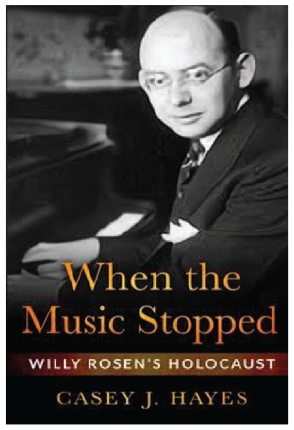
I could not put this book down. Casey J. Hayes has written a powerful, meticulously researched biography of one of the most popular and successful songwriter/performers in 1930s’ Germany, Willy Rosen. Hayes describes his book as a “work of creative nonfiction” because he created the dialogue and renamed some of the characters, although all the events are based on documents he gathered over many years in the Netherlands and Austria (p. xii).
Willy Rosen was a Jewish composer born in 1894 in Magdeburg, Germany. Music was his life: Composing, performing, and producing musicales and revues with a group of Europe’s top artists kept him going even during the onset of the Nazi regime. Having been a war hero who was awarded the Iron Cross in the First World War, Rosen clung to the belief that the Nazis would leave him untouched, and he seemed to live a life oblivious to the horrors occurring daily around him. When reading how Rosen continued composing and producing prolifically in the ghetto and, eventually, inside the Westerbork concentration camp, I was shocked at his single focus and his productivity amid these horrors. Yet I came to see how creating and performing was the only way Rosen was able to make sense of his life.
While reading this book during the COVID-19 pandemic, I reflected that we each construct a reality we can live with despite the challenges we face. Those of us fortunate enough to have music in our lives can immerse ourselves in it and block out the rest of the world for at least some moments. Rosen was a master of this while living in a world gone mad. He was a supremely gifted man whose life and those of nearly all his friends and family were cut short by the Nazis. Willy Rosen was murdered at Auschwitz in 1944.
Casey J. Hayes is a wonderful storyteller, and I highly recommend this book for students of history and lovers of music.
—
Associate professor of music, Lehman College, City University of New York, New York City;
Teaching with Vitality: Pathways to Health and Wellness for Teachers and Schools
by Peggy D. Bennet, New York, NY: Oxford University Press, 2018; https://global.oup.com
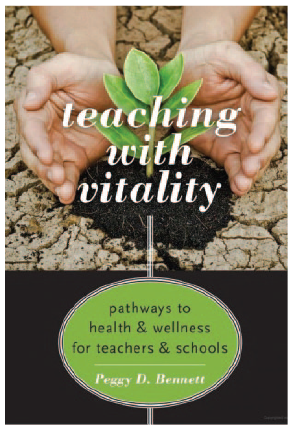
Teaching with Vitality: Pathways to Health and Wellness for Teachers and Schools by Peggy D. Bennett, according to its front cover, addresses ways to “minimize conflict and maximize vitality” in classrooms, schools, and teachers’ daily lives. The stated purpose of the book, says the cover text, is to provide tips for lessening these conflicts so that teachers can “choose daily pathways that lead to health, wellness, and vitality.” This book was written, this cover text continues, for “junior and seasoned teachers” who teach any age level or subject area.
The back cover includes reviews claiming that the book is inspiring and provides practical resources for teachers to stay motivated throughout a long teaching career. These seemed like lofty promises as I started to read the first few pages. However, I found Bennett’s book to be a delightful and enjoyable read while also full of useful ideas for teachers at all stages of their careers.
The book consists of 101 “mini-chapters,” each addressing key topics for teachers (e.g., behavior, assertiveness, feedback that feeds, resilience) that the author refers to as “nuggets” (pp. 1–2). As a former K–12 music teacher and current music teacher educator, I appreciated the fact that some chapters reinforced components of the teaching philosophy that I already practice in my daily interactions with students. For example, in chapter seven, “Praise in the Classroom,” Bennett encourages teachers to provide feedback with “neutral, observational, and encouraging comments” (p. 18).
Other chapters caused me to pause and think carefully about how I approach certain aspects of my teacher role. For example, in chapter ninety-seven, “Be Impeccable with your Word,” Bennett urges us to reflect on the power of language. She states, “Being impeccable with our words means that we are closely attentive to their meanings, their power, and their lasting effects. Are we vigilant about the words we use to instruct and converse?” (p. 205). Although I have made a conscious effort recently to focus on my phrasing in class, Bennett’s examples brought new insight on this topic for me. Throughout the book, Bennett offers numerous important moments of reflection like this example, not as a harsh critique of teachers but rather to challenge us to do our best work on a daily basis.
I concur with the reviews on the back cover and the author’s own statements about the purpose of this book. New teachers will benefit from the countless practical tips on topics ranging from daily interactions in schools to personal health and wellness provided throughout the book. Seasoned teachers will find a renewed sense of purpose and will be inspired to pause to reflect on their daily practices in their schools and their lives. This book is easy to read and digest yet packed with great ideas. Impressively, the text would be equally appropriate if integrated into a student teacher seminar or included as a choice for a teachers’ book club in a school community.
—
Associate professor and director of music education, Boise State University, Boise, ID;
Creative Musicking: Practical Real-Life Ideas to Get Your Learners Creating Their Own Music
by Steve Giddings, Prince Edward Island, Canada: Steve’s Music Room Publishing, 2020; www.stevesmusicroom.com
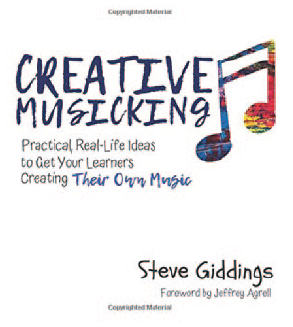
Does the word creative resonate with who you are as a musician? At the heart of most art classes is the act of creating original works. Yet the focus in music classes is often on re-creating the works of others. In Creative Musicking, author Steve Giddings questions the cycle of school music and music educator preparation programs that leave musical creativity largely unaddressed. More important, he offers fun, simple, and meaningful solutions to music educators desiring an infusion of creative engagement for their students.
The author’s upbeat and accessible writing style invites readers to rethink creativity in music education and notice the creative opportunities available every day. As a workshop presenter and journal contributor who is still in the classroom, Giddings offers lesson strategies that work with students of all ages and in a wide range of settings. This book is perfect for current and future music educators (K–12 and university) who have forgotten how to create and play, have no idea where to start, or just need some refreshers.
In the cogent yet playful opening chapter, Giddings explores creativity’s complicated role in music to ease readers through unlearning internalized beliefs and restoring its place in music classrooms today. Ten chapters are each devoted to different avenues of creative musicking applicable to nearly any grade level and setting. These include group compositions, improvisation for classical musicians, learning by ear, songwriting, and accessible ways to leverage technology.
Not limited to general music settings, these ideas will surely spark curiosity and shake things up in performing ensembles. Among many highlights, Giddings demystifies songwriting to empower students and simplifies creating, composing, and recording with technology. The book concludes with a handy reference section for chord charts and lyric diagrams, basic patterns for guitars and drums, and a variety of notation systems—be sure to check out the Nashville Number System!
Although some strategies—including thoughts on assessment—may require a bit of preparation, he includes tons of ideas that can be applied immediately to any setting. Giddings is clearly a champion for students and reminds readers that the traditional model of music education does not work for everyone. But perhaps the strongest part of his message is that creative work will actually benefit all students.
On a crusade to flip the script in music education, this book represents a pedagogical fusion of his own musical journey that spans traditional and informal musicking. Giddings avoids scripted lesson plans to model what he preaches. The descriptions are informative enough to get started, but their use is limited only by imagination. Some ideas may be lost on readers who have not experienced the power of creative musicking themselves. But perhaps that is the point. Smart and earnest yet playful, Giddings asks music educators to get curious about transforming his examples to fit their context. My only real critique is that this book was not written sooner.
This book is a must-have on every shelf in every music classroom around the world. Scratch that: This book should be folded, bent, written in, dog-eared, covered with coffee stains from daily use, and left open on every desk in every music classroom around the world.
—
Facilitator of music learning, orchestra, Illinois State University Lab Schools, Normal;
Honoring Trans and Gender-Expansive Students in Music Education
by Matthew L. Garrett and Joshua Palkki. New York: Oxford University Press, 2021; https://global.oup.com
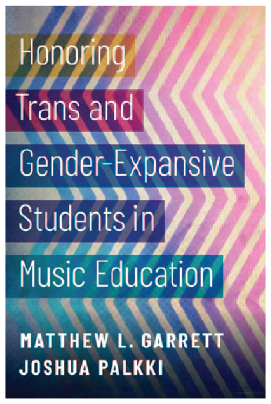
Honoring Trans and Gender-Expansive Students in Music Education is exactly the resource music teachers everywhere have been seeking as we navigate understanding, celebrating, and advocating for trans and gender-expansive (TGE) students in the music classroom. Intended to serve as a resource for preservice music teachers, professional music teachers, and music teacher educators, this book will soon become a staple in all music libraries. It is organized in two parts: content and praxis. In the content section, authors Matthew Garrett and Joshua Palkki establish a context for learning about TGE students, including appropriate terminology and vocabulary. In the praxis section, they provide an enormous service to the profession by discussing practical applications for implementation in music classrooms, including thoughtful selection of curricular materials and the impact of school policies on TGE student life. Each chapter concludes with recap and reflect/remember sections, making it an extremely valuable book that can be used for initiating important class discussions.
Garrett and Palkki, who are both well-established and well-respected scholars, have approached this book with a student-first philosophy (“who we teach and what we teach, in that order”). The emphasis throughout the entire work is on student safety and developing relationships, with music engagement a secondary goal. Quoting from the introduction: “Imagine a music classroom in which students are motivated to learn because they felt heard and valued as people, before engaging in the art of music” (p. 2.). This student-centered approach is one to which all educators can aspire, no matter what the curricular focus.
At every opportunity, Garrett and Palkki use their positions of privilege in positive ways to help amplify the voices of TGE persons in the profession. They conducted interviews with thirty TGE individuals and several parents and teachers of TGE musicians, truly seeking to understand the varied TGE experiences in music classrooms. Rather than an afterthought, specific illustrations directly quoted from these collaborators are woven throughout the entirety of the book, centering those voices consistently. Furthermore, the companion website, www.oup.com/us/htgesme, includes the recorded voices of each interviewee sharing their stories.
Speaking from my own perspective, it can be difficult sometimes for music educators who want to “get it right” but do not quite know how. What I really appreciate about this book is the research-supported practices that help well-intentioned educators with these goals. For example, there is a whole chapter devoted to policies that either support or diminish TGE voices. Garrett and Palkki provide practical, real-world suggestions specific to choral teachers regarding honor choir rooming policies, inclusive performance attire (“Is an ensemble looking cohesive more important than ensemble member comfort?”), names on concert programs, seating and standing arrangements, use of pronouns in rehearsals, ensemble names, and contextualizing heteronormative and cisnormative texts, to name just a few. This particular chapter was exceedingly useful in giving choir teachers a starting place for considering established practices that have heretofore been traditional and unquestioned. Understanding that we will undoubtedly make mistakes, they relay a wonderful example of a teacher who mistakenly called his tenors and basses “gentlemen.” Later, he tells the students “My apologies, tenors and basses….” He recognized the need for change, and it outweighed the temporary discomfort of admitting a simple mistake. The choir continued singing. We can all learn from that display of humility when interacting with students.
The lives and experiences of our TGE students are critically important and, if we are to remain relevant as a profession, it is incumbent on each of us to engage in practices that are inclusive of TGE musicians in our classrooms. Whether you are already very familiar with these practices or just beginning to learn about them, this book will serve as a fantastic resource for you.
Professor of choral music education, Conductor, concert choir, University of North Texas, Denton, TX, USA;