




Abstract
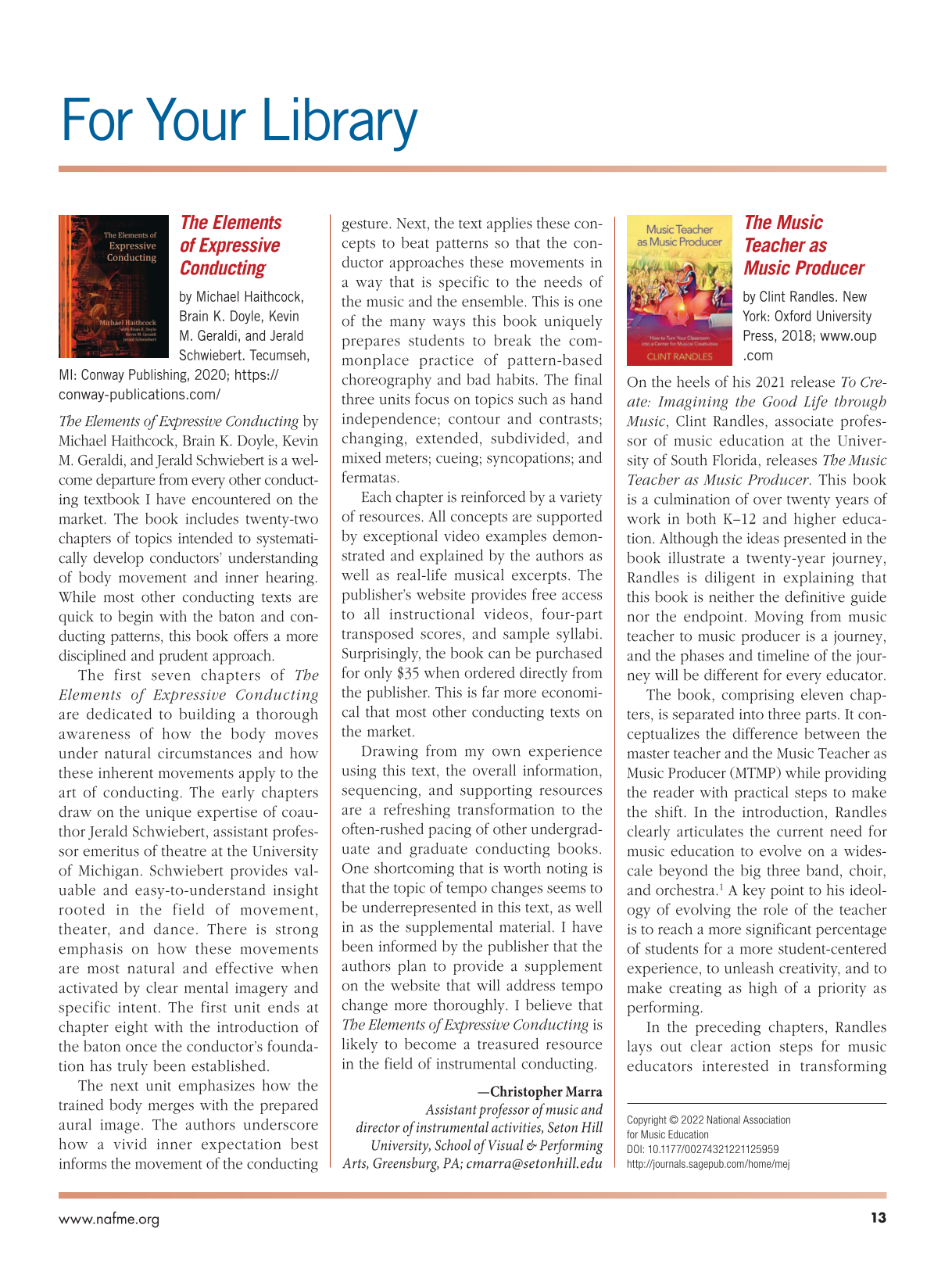
The Elements of Expressive Conducting
by Michael Haithcock, Brain K. Doyle, Kevin M. Geraldi, and Jerald Schwiebert. Tecumseh, MI: Conway Publishing, 2020; https://conway-publications.com/
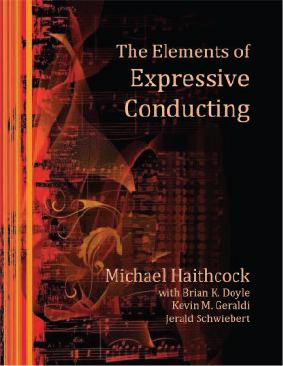
The Elements of Expressive Conducting by Michael Haithcock, Brain K. Doyle, Kevin M. Geraldi, and Jerald Schwiebert is a welcome departure from every other conducting textbook I have encountered on the market. The book includes twenty-two chapters of topics intended to systematically develop conductors’ understanding of body movement and inner hearing. While most other conducting texts are quick to begin with the baton and conducting patterns, this book offers a more disciplined and prudent approach.
The first seven chapters of The Elements of Expressive Conducting are dedicated to building a thorough awareness of how the body moves under natural circumstances and how these inherent movements apply to the art of conducting. The early chapters draw on the unique expertise of coauthor Jerald Schwiebert, assistant professor emeritus of theatre at the University of Michigan. Schwiebert provides valuable and easy-to-understand insight rooted in the field of movement, theater, and dance. There is strong emphasis on how these movements are most natural and effective when activated by clear mental imagery and specific intent. The first unit ends at chapter eight with the introduction of the baton once the conductor’s foundation has truly been established.
The next unit emphasizes how the trained body merges with the prepared aural image. The authors underscore how a vivid inner expectation best informs the movement of the conducting gesture. Next, the text applies these concepts to beat patterns so that the conductor approaches these movements in a way that is specific to the needs of the music and the ensemble. This is one of the many ways this book uniquely prepares students to break the commonplace practice of pattern-based choreography and bad habits. The final three units focus on topics such as hand independence; contour and contrasts; changing, extended, subdivided, and mixed meters; cueing; syncopations; and fermatas.
Each chapter is reinforced by a variety of resources. All concepts are supported by exceptional video examples demonstrated and explained by the authors as well as real-life musical excerpts. The publisher’s website provides free access to all instructional videos, four-part transposed scores, and sample syllabi. Surprisingly, the book can be purchased for only $35 when ordered directly from the publisher. This is far more economical that most other conducting texts on the market.
Drawing from my own experience using this text, the overall information, sequencing, and supporting resources are a refreshing transformation to the often-rushed pacing of other undergraduate and graduate conducting books. One shortcoming that is worth noting is that the topic of tempo changes seems to be underrepresented in this text, as well in as the supplemental material. I have been informed by the publisher that the authors plan to provide a supplement on the website that will address tempo change more thoroughly. I believe that The Elements of Expressive Conducting is likely to become a treasured resource in the field of instrumental conducting.
Assistant professor of music and director of instrumental activities, Seton Hill University, School of Visual & Performing Arts, Greensburg, PA;
The Music Teacher as Music Producer
by Clint Randles. New York: Oxford University Press, 2018; www.oup.com
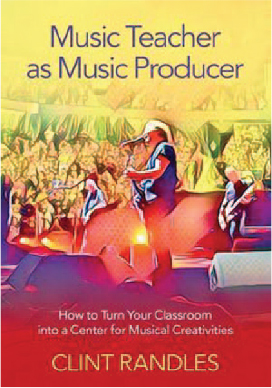
On the heels of his 2021 release To Create: Imagining the Good Life through Music, Clint Randles, associate professor of music education at the University of South Florida, releases The Music Teacher as Music Producer. This book is a culmination of over twenty years of work in both K–12 and higher education. Although the ideas presented in the book illustrate a twenty-year journey, Randles is diligent in explaining that this book is neither the definitive guide nor the endpoint. Moving from music teacher to music producer is a journey, and the phases and timeline of the journey will be different for every educator.
The book, comprising eleven chapters, is separated into three parts. It conceptualizes the difference between the master teacher and the Music Teacher as Music Producer (MTMP) while providing the reader with practical steps to make the shift. In the introduction, Randles clearly articulates the current need for music education to evolve on a widescale beyond the big three band, choir, and orchestra. 1 A key point to his ideology of evolving the role of the teacher is to reach a more significant percentage of students for a more student-centered experience, to unleash creativity, and to make creating as high of a priority as performing.
In the preceding chapters, Randles lays out clear action steps for music educators interested in transforming their teaching practices. Part one, titled “Organizing Your Space,” provides the reader with ideas for classroom organization, integrating technology and electronics, and potential instruments to utilize outside of those you would typically see in a traditional secondary music class.
In part two, “Living with Live Performance,” Randles explores the world of live performance. He further breaks down the importance of room size and the need to have the necessary equipment to achieve the best sound in live performance. In my opinion, one of the more exciting parts of the book is how a music teacher can assume many different roles as an MTMP, similar to a music producer. According to Colquhoun, 2 a producer can take on the role of a director, advisor, artistic driving force, or agent of credibility. Sometimes this occurs independently, while other times, it happens simultaneously. Similarly, the role of an MTMP shifts depending on the classroom environment and the needs of the students. With shifting roles, one of the critical traits of the MTMP is flexibility.
In part three, “Making Tracks and Albums,” Randles ties everything together by giving the reader a step-by-step guide to creating a masterpiece: the album. The album represents the final piece of the creative process that will live forever in a tangible form.
As displayed throughout this book, a certain level of vulnerability must be expected and accepted as an MTMP. Throughout the book, Randles highlights the challenges of becoming an MTMP while maintaining a positive and encouraging tone. He also does a masterful job of giving much information very efficiently. As I read through the chapters, I saw myself in many of the examples and vignettes shared. As the MTMP, you will have to shift from master teacher to lead creative. I firmly believe this is a valuable resource for any music educator interested in stretching themselves beyond what most of us are taught in the academy.
Assistant professor of music technology and contemporary music styles, Alabama State University, Montgomery, AL;
Design and Analysis for Quantitative Research in Music Education
by Peter Miksza and Kenneth Elpus. New York: Oxford University Press, 2018; www.oup.com
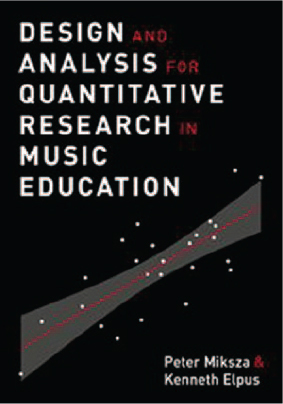
Approaching quantitative research can be an intimidating task to the uninitiated, especially graduate students learning about research for the first time. Design and Analysis for Quantitative Research in Music Education by Peter Miksza and Kenneth Elpus makes engaging with this type of research much less daunting. This volume is a welcome addition to available research methodology texts and would be a valuable resource to anyone interested in quantitative research in music education regardless of their experience level.
Miksza and Elpus are established and respected scholars who have extensive experience conducting and teaching quantitative research. Elpus is an associate professor of music education at University of Maryland School of Music. Miksza is a professor of music education at Indiana University Jacobs School of Music and is also affiliated with the Indiana University Cognitive Science Program. Notably, both authors have experience using large preexisting data sets to investigate music education–related issues related to equity and policy issues. The authors aimed to create a book that would assist new and more experienced researchers to plan and conduct research in an informed scientific manner. This is accomplished in a focused and accessible fashion. The text clearly describes the basic information needed to collect and interpret quantitative data in the context of music education.
The book is divided into two parts. The first is focused on concepts essential to quantitative research such as design, different kinds of analysis, and experimental research. The second attends to more advanced concepts such as multilevel models and exploratory and confirmatory factor analysis. Each section contains clear explanations of concepts balanced with examples that apply a specific design or analysis topic in a real-world context. The prose, overall, is concise and remarkably jargon-free. When specific terminology is needed, terms are clearly defined. The authors also highlight and deconstruct common pitfalls and misunderstandings that happen within our field and others. Two of the helpful places where they do are in the careful explanation of statistical significance and also in the detailed discussion of random sampling, both of which are important and not always well understood.
There is a companion website of thoughtfully chosen supplementary materials that includes sample data sets and videos of how to perform specific analyses in SPSS. The text does not include directions for the step-by-step process of statistical calculation either by hand or with software. Instead, readers are directed to other books, websites, and this curated collection of resources. This is not a weakness but rather a strength because it keeps the text accessible.
In writing this book, Miksza and Elpus have provided an excellent resource to music education scholarship. The quality and clarity of this book make it a welcome addition to available texts on the subject. It would be a worthy course textbook and a valuable addition to the library of anyone interested in music education research.
Music teacher, Our Lady of Angels School, Cleveland, OH;