



Abstract
Open education and related terminology have not gained widespread interest within the music education community. Despite this, music educators demonstrate open practices by leveraging digital technologies to share, collaborate, and innovate their teaching practice for student engagement and achievement. This article introduces open education terminology while highlighting related practices described in existing music education literature. Music educators will then have an opportunity to examine their teaching practices with an open education perspective moving forward.
Keywords
Photo of Tanya R. Allen courtesy of the author
Open education was a term used to describe progressive pedagogical behaviors observed in classrooms during the early twentieth century. 1 Behaviors such as student choice and small-group instruction are no longer progressive but represent research-based instructional practices found in many classrooms today. Similarly, the term open education has also evolved and is now used to describe resources and practices involving digital technologies that enhance instruction and provide access to education in open and collaborative ways. Practices such as using and sharing online lesson plans or exchanging teaching ideas on Facebook or Twitter are examples of teacher behaviors that fit within the new open education paradigm.
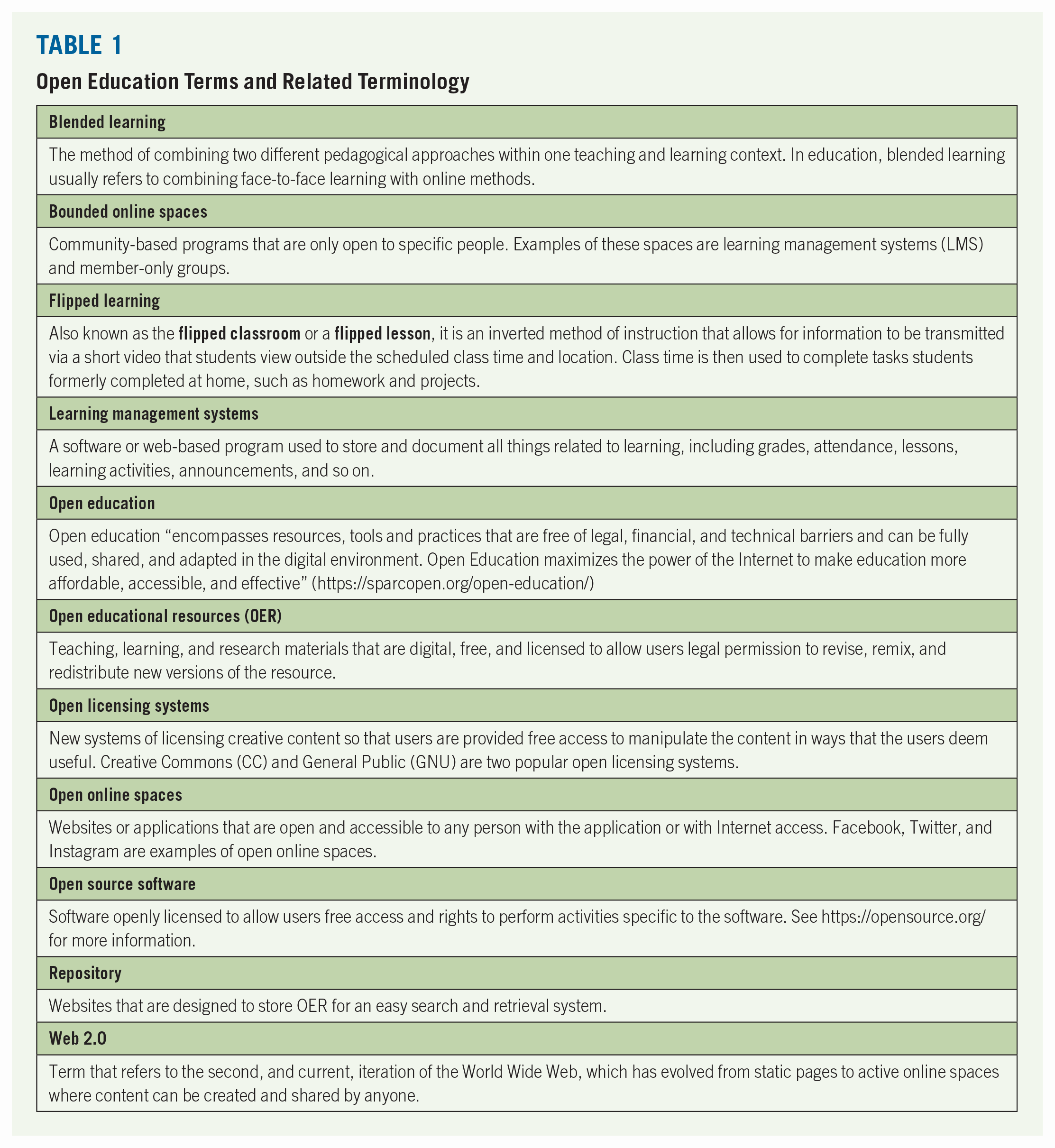
Early innovations in open education include the Massachusetts Institute of Technology’s OpenCourseWare, active since 2002, and a community college initiative that minimizes educational costs through degree programs that only use open educational resources 2 (see Table 1 for a list of some current open education–related terminology). Open educational resources, also known as OER, are foundational to the current landscape of open education and are free materials with minimal limitations on how they can be used. Several researchers have examined the impact of OER and open educational practices on teaching and learning outcomes as well as equity in education. 3 One practical investigation aimed to help postsecondary educators implement open teaching practices using a framework called the Open Educator Factory (OEF). 4 The OEF framework provides a guide for educators by highlighting a hierarchy of open behaviors within four areas: learning design, resources, teaching approaches, and assessment.
Open Education Terms and Related Terminology
Despite the continued interest and growth in open education, there has been minimal examination of the topic in music to date. Therefore, the purpose of this article is to introduce terms and practices associated with open education within the context of the music classroom. The remainder of the article will highlight the four areas outlined in the OEF framework, followed by practical examples so that music educators at all stages and levels will consider designing, instructing, and assessing learning in new and more open ways.
Open Design
Open design involves a collaborative planning process and the sharing of lesson ideas and materials using digital technologies such as social media and Web 2.0. Web 2.0 was first used in 2005 to describe the current iteration of the World Wide Web, which allows for the collaborative activities typically associated with open education. 5 Although Web 2.0 enables convenient collaboration and music education literature documents the benefits of it, 6 a review of national data by Sharyn Battersby, a music education professor, suggests that music educators collaborate less than other public school teachers. 7 Because of this, Professor Battersby aimed to encourage collaboration by sharing success stories within professional learning communities (PLCs).
Creating a working group of educators through a PLC is one approach to collaboration for music educators who typically design their instruction alone. Whether connecting with close colleagues in the same school, district, or even globally, collaborative partnerships can assist music educators in creating meaningful learning experiences for students while gaining valuable insight at every stage of planning. PLCs are ideal for achieving open design goals related to curricula, lesson planning, resources, and best practices. For those new to PLCs, Professor Battersby 8 suggests using free software, such as Google Docs, for brainstorming outcomes with other music educators.
Music educators looking to fully open their design practice can begin to share instructional and curriculum ideas on social media with colleagues and students. Social media applications provide an ideal mode of sharing due to their structure as open online spaces. 9 Learning management systems (LMS) commonly used in education, such as Blackboard, Google Classroom, Canvas, and Moodle, are bounded online spaces because of who has access to the LMS: usually only the educator and their students. Conversely, applications such as Facebook and Twitter are open online spaces and can be accessible to anyone. This openness broadens the educators’ influence as a designer and their ability to improve their practice with greater community feedback and reviews. Music education articles written to highlight social media as both a resource and collaborative tool, along with a new handbook, 10 can provide points of entry to social media for music educators at every level of social media use.
Open Resources
Teaching and learning resources are essential for both teachers and students, and choosing to be open in resource adoption requires purposely searching for OER and sharing adopted OER on social media. Although many music educators utilized free online resources during the COVID-19 pandemic, the Institute for the Study of Knowledge Management in Education found that many free collections of online music content were not OER. 11 OER are explicitly “licensed in a manner that provides everyone with free and perpetual permission to engage in the 5R activities.” 12 The 5R activities refer to a user’s ability to Retain, Reuse, Revise, Remix, and Reshare the resource, with the last three Rs differentiating OER from other free, online resources.
Open licensing systems, such as Creative Commons, 13 provide clear guidance on how resources may be legally used. Figure 1 provides a hierarchy of available creative commons licenses. While resources in the public domain are familiar to music educators and legally easy to use, this is not true for all free resources found online. It is important to remember that accessing content online, even if free, does not negate copyright law, and unless items are OER, there may be limitations to how that content can be used that are not explicitly clear. What open licenses do that copyright licenses and fair use do not do is provide educators with more opportunities to make the content work for their students and teaching situations while still acknowledging and respecting the original content and creator.
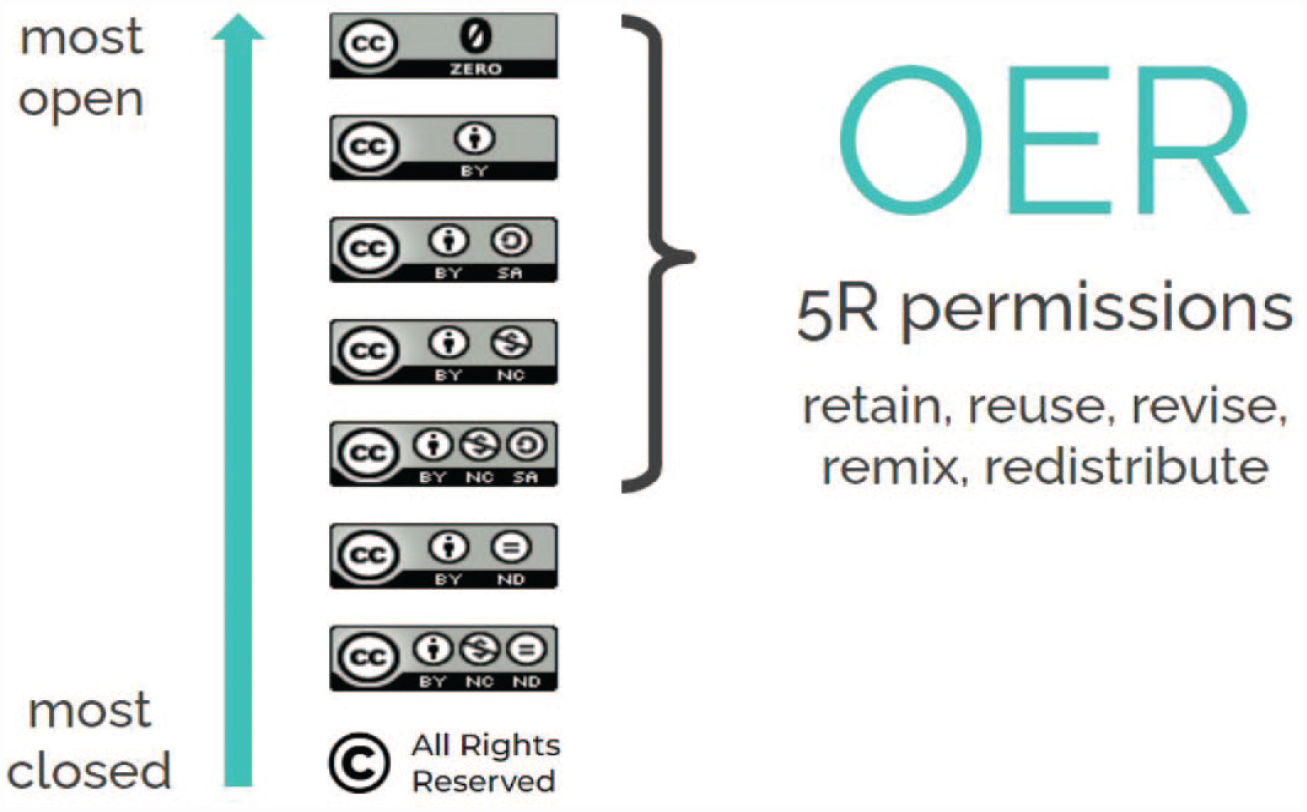
Hierarchy of Creative Commons Licenses
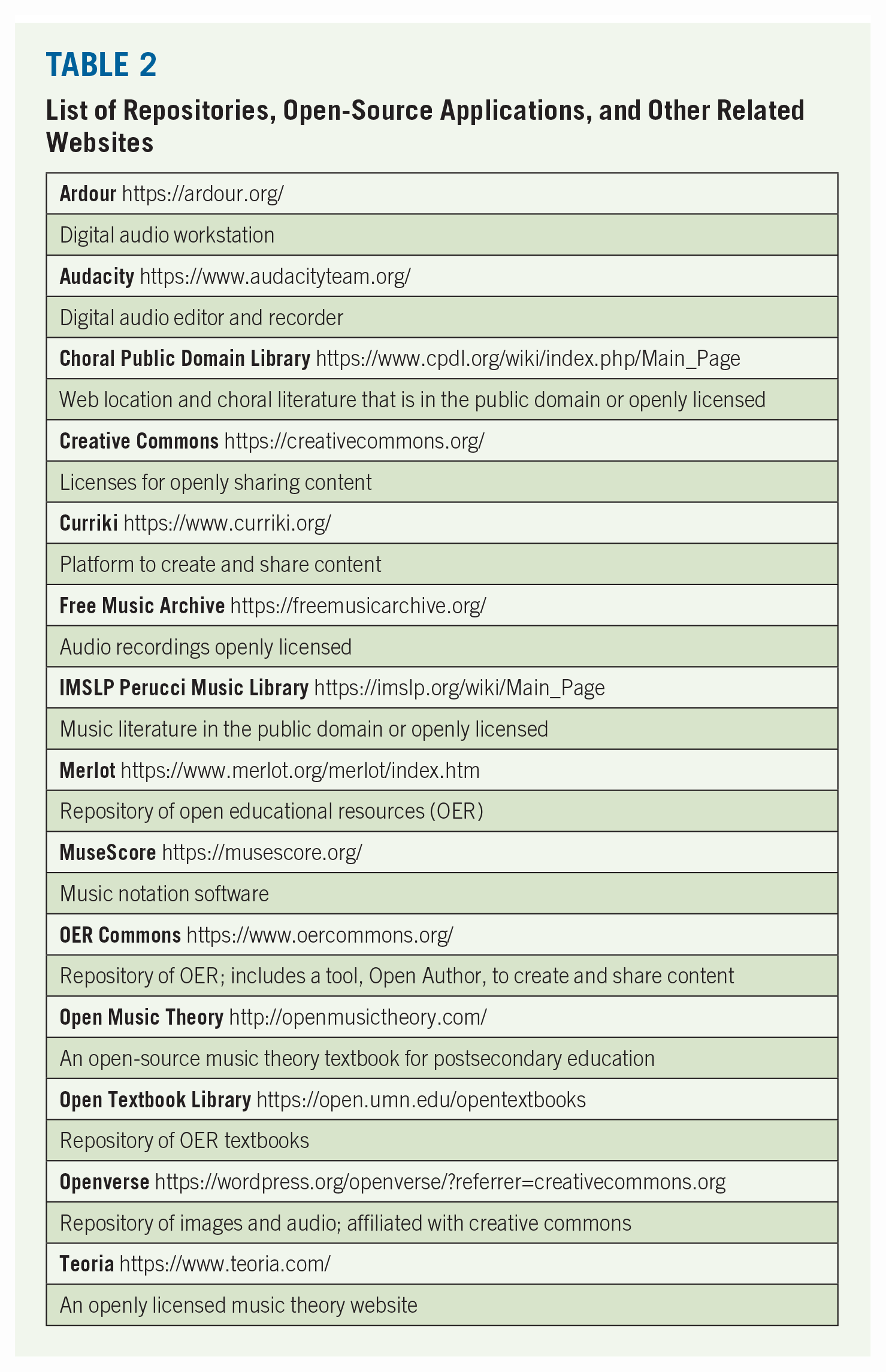
Music educators interested in adopting OER for their classroom should begin by locating relevant resources applicable to their teaching situation. This can be done by locating repositories of OER such as the Open Textbook Library. 14 Resources in the Open Textbook Library are most appropriate for high school and postsecondary learning spaces and includes all textbooks formally published with an open license. As of May 2023, there were twenty-two music-specific textbooks available, including music theory and music appreciation texts. This repository provides a more streamlined search experience compared to other locations and includes a peer-review process for the textbooks with Likert-style ratings and detailed commentary across ten areas. Additional open resources and repositories can be found in Table 2.
List of Repositories, Open-Source Applications, and Other Related Websites
Postsecondary education remains a hub for OER and open educational practices; however, the lack of awareness of OER in postsecondary music education 15 may be why collections of music OER lack depth compared to other content areas. This can be changed by individuals who are interested in becoming an OER expert. The first step would be to regularly share links to OER through social media. This will provide resources to others while helping to increase the awareness of OER in music. The next step would be to openly license materials that you have created and found success in your classroom. Although many original activities and plans may be unique to each teaching situation, sharing materials such as lesson plans, simple songs, and activity directions may provide music educators at every stage of experience with fresh ideas on how to engage students and innovate their teaching practice.
One other type of resource worth mentioning in this section is open-source software. 16 Open-source music software programs are openly licensed for free use and free access to the program’s code; this creates a community of users who are working to improve the software for the benefit of every user. While coding may be beyond the scope of many music educators’ ability, it can create opportunities for music students to demonstrate other skills and interests within a music class. Familiar open-sourced music software includes Audacity for music editing and Musescore for music notation.
Open Teaching
Teaching is the heart of what music educators do. An open teacher uses digital technologies to differentiate the modes and methods of instruction to ensure that all learners are appropriately engaged. In addition, open teachers allow students not formally enrolled in their classes to access learning content they create. Music educators who are traditional in their teaching approach can transition to more open pedagogy by regularly using the LMS to share resources with students. This may simply include posting digital copies of presentation slides or activity information that was presented in class. Also sharing links to websites and exemplar performances on YouTube can extend learning and ignite students’ interest in a topic.
The aforementioned suggestions create ways to gain comfort utilizing digital technologies and provide a mix of instructional methods aligned with blended learning. 17 Blended learning usually refers to combining a face-to-face class structure with online methods but can also refer to any melding of methods and approaches that innovate learning. One such approach is flipped learning, 18 also referred to as the flipped classroom and the flipped lesson. Beginning with a flipped lesson, the teacher creates, or curates, a short video for students to view before they attend class. This prelesson increases time in class for students to actively engage with learning material in ways not possible with traditional teaching approaches. Although documented use of flipped learning in the music classroom is scarce, music educator Erich Weiger shared that students were satisfied and preferred this method when implemented in several types of music classes, including the applied studio and a music history course. 19 The author also provides ten strategies for implementing flipped lessons, such as understanding the time commitment necessary to plan and create videos and limiting videos to ten to fifteen minutes in length. Although the article was written for the performance-based music classroom, the strategies offered would be helpful to any music educator interested in this method.
One other open teacher behavior worth revisiting is the collaboration and sharing within professional communities. Engaging with communities of practice for our development is paramount to our longevity and growth as professionals. Especially for singular music educators on campus, social media and other online platforms offer access to these communities in ways not possible before Web 2.0. For members of NAfME, Amplify is one such online platform. 20 Amplify currently houses twenty-seven subject-specific communities formed around topics important to many music educators. Similarly, Facebook remains an active social media platform for such communities of practice as well. Content groups, such as one developed for band directors described by music educators Wesley Brewer and David Rickels, 21 can provide insight and suggestions for the myriad of topics related to the day-to-day teaching practices of music educators.
Open Assessment
Assessments are opportunities for students to demonstrate their achievement in learning and can become open when individuals outside the student–teacher dyad provide relevant and timely feedback to students. Music educators interested in implementing an open assessment approach should begin with peer assessments. Peer assessments provide a simple, straightforward way of encouraging collaboration and critical thinking skills within the classroom, even with the youngest students, and these assessments work in tandem with other reflective practices encouraged of students, such as self-assessments. Although implementing peer assessment may seem challenging, statistician Christopher Valle, professor of educational and counseling psychology Heidi Andrade, executive director Maria Palma, and director of professional development at ArtsConnection Joanna Hefferen describe self- and peer assessment models successfully created and implemented at the elementary level. 22 One example from the article highlighted a teacher who cocreated a checklist with her third-grade students that included not only recorder playing skills but also specific strategies for improving each skill. These checklists guided both self- and peer assessments and highlight additional benefits gained from this assessment practice, including 21st-century skills.
Based on the OEF framework, evaluation practices become fully open when voices outside the classroom contribute feedback to improve student learning. Although this community sharing is most commonplace in postsecondary education, an effective place to start in elementary and secondary schools would be the school community. Begin by choosing an assessment task that is not what OER expert David Wiley calls disposable, 23 but a task that could be used for evaluative purpose while creating lasting impact at the school. For example, students in a music production class can create original tracks that are played during the morning announcements or for a school infomercial. Other tasks may allow for nonmusic teachers and school administrators to provide written and verbal commentary that is constructive, yet supportive, related to a music performance. Last, plan adjudicating sessions throughout the school year that invite various music experts from the community to contribute to an ensemble’s musical development.
In postsecondary education, community involvement is central to teacher preparation programs through field experiences and clinical practice placements with mentor teachers. Other projects commonly seen in teacher preparation can also provide opportunities for community feedback, such as e-portfolios. The e-portfolio has developed as a method to showcase artifacts and other evidence of growth and development by preservice teachers. 24 E-portfolios as an evaluative product are transferable to almost all music teaching contexts, both for a single student and whole-class projects, and Web 2.0 and free web services provide methods to create and share portfolios in an open way. Before beginning an e-portfolio task online, be sure to check that the website operator is COPPA-compliant 25 and that personal information from students is not requested or shared.
Related to portfolios, but on a smaller scale, is the creation of infographics or other picture-based artifacts as assessment products. 26 Students can highlight key information from a research project by creating an infographic that includes the information in a visually appealing way. Small picture files would be easy to share on social media and could limit the amount of information related to the student that is openly available.
Increase Your Collaboration!
Open education is a movement rooted in digital technologies and innovative practices that provide access to education through open sharing and collaboration. Although the bulk of this movement has centered on behaviors of postsecondary educators, many practices are transferable to any level with careful planning and consideration. Collaborating in the design process, adopting and creating music OER, sharing lesson ideas on social media, and using peer assessments are all first steps that any music educator can do successfully. Although some practices highlighted in this article were unique to open educational pedagogy, most described common practices through an open pedagogical lens. I hope this article will encourage music educators to learn more about open education and grow in their digital capacity to share in ways that elevate their teaching practice and increases student engagement and achievement in music.
