



Abstract
Nearly all music educators assign grades to students. However, not all methods for grading are equally effective at reporting student achievement. This article describes one approach to grading, standards-based grading, that has the potential to support music educators’ efforts to achieve grades that are honest, meaningful, and fair. General principles and specific recommendations for ensemble music teachers are discussed.
Photo of Brian P. Shaw courtesy of the author

For grades to be educational and equitable, they should report students’ success with course content as demonstrated through valid summative assessment.
Most ensemble music educators are required to assign final grades to their students, 1 but not all teachers feel prepared to assign grades that are honest, just, and meaningful. Research has shown that music educators tend to develop grading practices based more on tradition or intuition than on guidance from grading experts or school administrators, 2 and many ensemble grading policies today are similar to those that existed decades ago. 3 Grades are consequential for students, and as educators we are called to assign grades in a thoughtful and educational manner. This article is intended to prompt reflection on existing and possible grading practices in ensemble classes in order to help teachers accurately and fairly communicate student learning. While critics contend that the very idea of grading is inherently flawed and that the solution is to abandon grades entirely, 4 well-crafted reports on student achievement can provide useful information to students, families, teachers, schools, and external audiences such as colleges and universities. This discussion assumes that readers are in a situation where grades are an expectation.
Grading and Assessment
Although they are both related to appraisals of student learning or achievement, assessment and grading are not the same. Assessment refers to the process of gathering and interpreting information about student performance, whereas grades are “the symbols, words, or numerals that teachers assign to evidence of student learning to signify different levels of achievement.” 5 A chorus of experts agrees that grades should be based on evidence of content mastery as demonstrated through summative assessment. 6 A primary reason to incorporate frequent, individual, formal assessment into ensemble classrooms is the need for trustworthy information about student achievement, without which grades are unreliable. 7
To be sure, ensemble music teachers face assessment challenges, such as large numbers of student contacts and busy performance calendars. It is certainly more convenient to assign mostly high grades based on concert punctuality than it is to paint comprehensive portraits of each student’s achievement relative to curricular benchmarks, but convenience is not the same as fairness. One reason that many music educators derive grades largely from nonachievement considerations like attendance and attitude 8 may be that they do not yet have tools for acquiring reliable, valid, and useful information about individual students’ content mastery. In order to base grades on musical achievement and understanding instead, educators need to have well-developed assessment methods. Still, even the best assessment information needs to be summarized for external reporting, which means that music educators need thoughtfully crafted grading practices as well.
Standards-Based Grading
One set of grading policies that has untapped power to transform how ensemble music educators assign their grades is standards-based grading (SBG). As its name implies, SBG is an approach to grading that emphasizes achievement relative to standards. Full implementation of SBG involves reporting achievement with each course goal separately and avoiding overall grades on the theory that information is lost when teachers aggregate reports about different kinds of proficiency. 9 In a music class, for example, a teacher might report separate grades for technique, music literacy, creativity, and solo performance. SBG reports also frequently eschew letter grades in favor of criterion-referenced performance descriptors, such as “proficient,” “nearly meets standards,” and so on.
While some music teachers work in schools already using standards-based transcripts, 10 for most ensemble music educators, the question is how to incorporate principles of SBG into traditional reporting formats. 11 Even if it does not live up to the SBG ideal of disaggregated reporting, the single letter grade can still be “based on” standards. Teachers can also create their own standards-based achievement reports that can be shared with students and families. 12 One vivid analogy from the late legendary education author Grant Wiggins is a “baseball card” report conveying information about various musical competencies over time. 13
CALM Grades in Ensemble Music
Ken O’Connor, a leading expert on SBG, lists four principles for effective classroom grading: that grades be consistent, accurate, learning-focused, and meaningful (CALM). 14 The next section describes ways in which standards-based grades in ensemble music can live up to these ideals.
Grades That Are Consistent
According to O’Connor, for grades to be consistent, students with the same level of achievement in music should receive the same grades regardless of which teacher they happened to have. 15 Currently, there is no single accepted system, or even a set of common principles, for translating students’ achievements into letter grades in ensemble music. Furthermore, as a whole, music teachers grade in a way that is different from teachers in other school subjects. 16 In order for music grades to be consistent, they would be figured similarly to how students are graded in their other classes. Hopefully, our profession’s disparate grading policies will also coalesce into an informed and consistent approach across schools. SBG provides an ideal starting place for such a movement.
Grades That Are Accurate
In O’Connor’s framework, accuracy refers to the ways that assessment results are translated into grade reports. This is often accomplished with a simple average of points, but averaging points is far from the only way to synthesize diverse assessment information into an accurate report about student achievement. In fact, schooling does not require points at all. Conventions like points, percentages, late penalties, and zeros are entrenched in many American schools, but they do not need to be, and traditional approaches often yield grade reports that do not align with students’ demonstrated proficiency with the course goals. Gradebook software produces averages efficiently, but a raw average is no substitute for careful consideration of a term’s worth of assessment evidence by a professional educator. 17 Music teachers can ensure that their grades accurately portray student achievement by reviewing each student’s record of performance on summative assessments at the end of a term and making a professional judgment about the student’s accomplishments relative to the content standards. 18 O’Connor recommends that grades be determined rather than calculated. 19 Suggestions for determining grades appear later in this article.
One convention that is likely to result in inaccurate grades is the recording of a score of zero for missed work. A student who fails to turn in an assignment is not a demonstrably worse musician than they were the previous day, yet that is the message communicated by the punitive zero. A zero also has a mathematically outsized effect on averaged grades: a 0 on a 10- or 100-point scale isn’t just an F; it is effectively an F------. Instead of recording a zero, teachers can mark work that has been missed as “incomplete” or “no information.” Students who miss a formative assessment may or may not need to make it up, depending on the circumstances, and teachers have available strategies to ensure that summative assessments are completed. Deductions for late work similarly reduce grade accuracy because they conflate timeliness with achievement. In SBG, the only operative question is whether the student demonstrated the desired proficiencies by the end of the term. Some of these issues are solved in schools with full implementation of SBG, where there is often a reported grade for work habits that is distinct from curricular achievement.
Another critical consideration is what factors to include in grades and what to exclude. Using nonachievement factors to determine grades lessens their accuracy. 20 In music classrooms, this means that attendance, perceived effort, so-called “participation,” and other related considerations—even while they are important to ensemble success and are worthy of emphasis—disconnect grades from achievement. These important topics can be addressed and communicated through means other than grading.
Grades That Are Learning-Focused
Grading practices can frame students’ relationships with the teacher and the subject in profound ways. Many teachers’ approaches to grading leave students with two choices to get a high grade. The first approach is to play the “grading game” of performatively being the teacher’s ideal of a good student, and the second approach is to play the “learning game” of mastering the course content. 21 If nonmusical aspects of ensemble participation, such as turning in permission slips and coming to dress rehearsals on time are a “back door” to achieving high marks without meeting performance standards, they can shift students’ focus away from music learning. When the only path toward an A is to sing or play well, read music well, and so on, it encourages all students to focus on learning.
A first step toward learning-focused grades is to embrace a foundational premise of SBG: excluding formative assessment practices intended to support the learning process from final grade determinations. Formative assessment is a powerful tool for guiding student learning, but its inclusion in grades makes no more sense than sports teams qualifying for the playoffs based on how well they did in their practices. 22 Basing grades on summative assessment of the most important course goals is a foundational premise of SBG.
Grading policies about redos and makeups can also support and encourage learning. 23 Rick Stiggins, a prominent advocate for assessment reform in education, powerfully describes many students’ quiet resignation when they receive yet another low score from which they feel unable to recover. 24 When students are allowed, encouraged, or even required to redo tests and assignments on which they did not perform well or that are missing, they can see that the teacher is invested in their success. When they cannot try again, the message is instead that the teacher is unconcerned with whether the student ever succeeds. Rather than teaching “responsibility,” many policies effectively discourage students from striving toward eventual success. Most music educators desire a culture of sustained effort toward high standards, and their grading policies can be structured to foster—or inhibit—such a culture. Approaches to grading that provide students with second and third chances and that encourage them to keep working until they master the course content can promote student success as well as reporting it.
Grades That Are Meaningful
Assigning meaningful grades involves examination of one’s teaching philosophy. Reading many music educators’ advocacy materials, handbooks, and websites, one might understand American music education to involve artistry, leadership, self-expression and self-actualization, and community. Reading music educators’ grading policies, however, one can frequently infer that music education is primarily about punctuality, paperwork, wearing the correct uniform, following the rules for behavior, and other mundane considerations. This disconnect may result from the fact that some teachers view grades as tools for motivation or control. 25 Unfortunately, however, research shows that low grades are often ineffective motivators and can actually be harmful for certain students. 26 Meaningful grades are instruments of communication rather than motivation.
Music teachers often express the perception—however correct it may be—that low grades affect student retention. 27 However, to simply record an A for most students regardless of their achievement ignores an educational responsibility and makes our grades less meaningful. The perception that an A in music more or less means “you showed up” can lead to school music itself being seen as less serious or rigorous. 28 Grades that are thoughtful and educationally sound can demonstrate to administrators, families, and students themselves that music courses have important content and that we take pride in helping all our students master it.
Three Ensemble Grading Practices to Reconsider
The following three ensemble grading practices are incompatible with SBG. An examination of music grading practices is incomplete without reconsideration of participation grades, concert grades, and practice grades.
Participation Grades
Music teachers hoping to make their grades more standards-based and equitable would do well to begin by eliminating participation grades altogether. Often vaguely or capriciously defined, so-called “participation” is not content and is not learning in the arts. Rather, it often connotes a performance of enthusiasm and compliance. 29 Participation is difficult to assess in a reliable and valid manner because teachers necessarily rely on their own perceptions of students’ attitude, effort, attentiveness, and so on. The ways that students act and represent themselves are heavily influenced by ethnoracial identity, personality (such as extroversion), belongingness, trauma, (dis)ability, and other factors, 30 rendering teachers’ impressions suspect. 31 As a result, participation is probably the aspect of music grades that presents the biggest opportunity for bias.
Of course, we do want classroom environments that are conducive to learning and rehearsing, and we do want students to have their pencils and folders at their seats. One productive approach is to formally assess, but not grade, certain expectations of ensemble members. The results of such assessments could be communicated to students and families outside of a transcript, for example, as a telling entry on a student’s “baseball card” report. There are many effective ways besides academic grade deductions to achieve productive learning environments in an ensemble classroom. 32
Concert Grades
Grading concert attendance is a mismatch with SBG because concerts are not good opportunities for the evaluation of individual student performance. While concerts are foundational musical experiences, they are designed for sharing, not for summative assessment of students’ abilities. 33 Because teachers are unable to assess students’ musical achievement at concerts, student evaluation is usually based on attendance and uniforms. However, just like participation, attendance and attire are not arts standards and are not elements of standards-based grades in music. Many families can easily make plans to attend performances and purchase the proper uniform, but this is not the case for all. 34 SBG reports on students’ achievement, not their family circumstances. Music educators wishing to assign grades based on students’ performance abilities can assess solo or chamber performances during class, and those wishing to promote concert attendance can take proactive steps to help all students participate. 35
Practice Records
It is understandable that music educators want to encourage at-home practice, but grading based on practice time is at odds with SBG. Not everyone benefits equally from the same amount of practice, and not everyone requires the same amount of practice to meet a given performance standard. Furthermore, not all students have living situations that are equally conducive to after-school or at-home practice. Graded practice time can also involve students and families in a dilemma regarding honesty. Imagine this approach in another subject, such as language arts students being graded on the amount of time they spent writing an essay but not on the quality of the essay.
Teachers can certainly assess students’ practice process without grading it, and there are excellent practicing resources available. 36 One straightforward solution is to conduct regular live or recorded individual performance assessments instead; then, teachers can uphold expectations directly through performance evaluation rather than indirectly through practice evaluation. Yet another approach is to explicitly bring practicing into the course curriculum as a content standard. The ability to identify and apply strategies in order to make independent progress is indeed a goal that many music educators value, and grading this ability is much more defensible than counting minutes.
Getting Started with Standards-Based Grading
Figure 1 illustrates a five-step process that music educators can use to incorporate SBG into their classrooms. Readers are likely to discover that several of these steps involve only minor adaptations to their existing practices. As a result, implementation of SBG tenets is easy to begin.
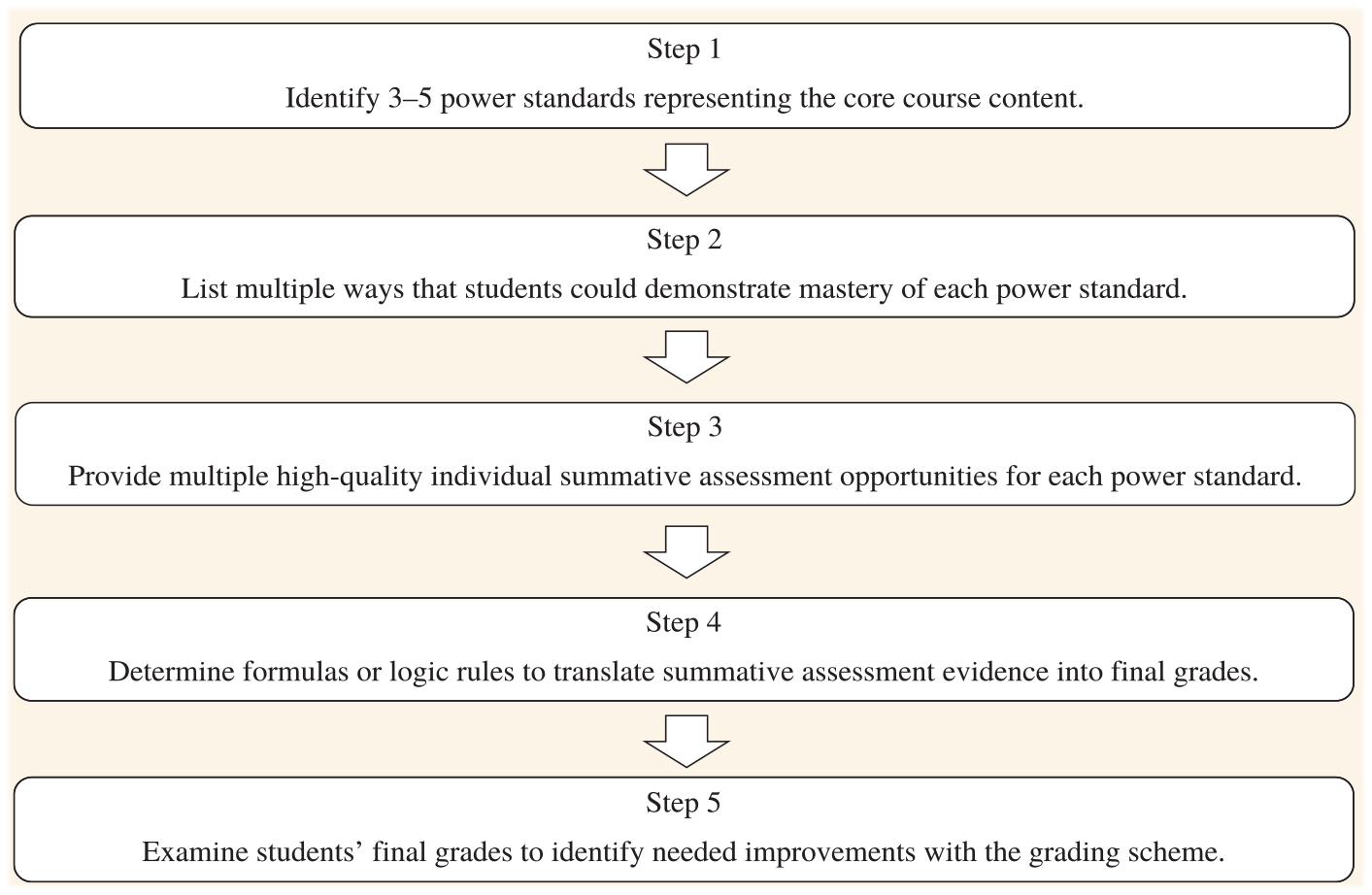
Recommended First Steps for Ensemble Grading
Step 1: Identify Power Standards
The first step is to identify the three to five core (“power”) standards around which the gradebook will be organized. Examples of power standards appropriate for many ensemble courses include music literacy, musical knowledge or terminology, technique, artistry, creativity, “music in your life,” and other curricular themes. All of the subsequent steps will flow from this decision, so it is worth taking time to prioritize the individual student learning outcomes for each course. Valid grade determinations will require multiple summative assessments of each power standard, so it is wise to be judicious when deciding which standards to use for gradebook organization.
Step 2: Determine Evidence of Mastery
Standards do not always include granular descriptions of what constitutes student success. An often-overlooked but worthwhile pursuit is for teachers to establish straightforward lists of the markers of content mastery for each standard, commonly called “evidence of mastery” or “success criteria.” An instructive guiding question for teachers is: “What would I expect to see from someone who is proficient with this standard?” For example, a teacher could establish success criteria for a power standard called “singing technique” as demonstrating (1) healthy posture and breathing, (2) healthy and appropriate vocal tone and placement, and (3) ability to navigate expected vocal registers.
One reason to have a well-developed curriculum is that SBG is impossible to faithfully implement without clear performance standards upon which to base the grades. “Success” in this context need not imply that a student is ready for All-State. Rather, it is usually a standard of proficiency that is attainable for most, if not all, students in the class who invest reasonable effort. Teachers who teach students with varying levels of experience may well establish different sets of expectations for students according to age or prior involvement, even if they are in the same classes.
Step 3: Select Summative Assessment Strategies
The next steps involve crafting summative assessment strategies to capture students’ progress at the end of the term or unit. Each power standard should be formally (i.e., individually) assessed, formatively and summatively, on multiple occasions so that everyone knows how well each student is performing throughout the class and to give students the opportunity to improve their performance before the final grade is issued. Because instructional time is always a concern, assessment can be designed to efficiently highlight the success criteria identified in step 2.
Step 4: Establish a System for Translating Assessment Results into Grades
Teachers who follow the recommendations of the many experts who advocate against averaged grades will need another system for synthesizing assessment evidence into a summary report. There are excellent resources for teachers looking for guidance about grade determinations without averages. 37 One recommended approach is to consider students’ overall performance on the summative assessments within each standard, with more recent work given more credence. Some teachers are skeptical of grades that are determined rather than calculated due to concerns about objectivity, but calculated grades are not objective either. Even when there are well-specified policies and precise averages, teacher judgment influences the nature and difficulty of the assessments, what is regarded as sufficient tone quality, and so on. Grading necessarily involves teacher judgment.
Unless a school is using SBG transcripts and reporting separate grades for each standard, the performance on each standard will need to be aggregated using formulas or logic rules. For example, in my own classes, I use the system in Figure 2. When making these determinations, I look at each student’s summative assessment scores (which are each graded Proficient, Nearly Proficient, or Not Yet) separately by standard, looking for modal scores and assigning more recent evidence more weight. I include the applicable standard or standards in each assessment’s rubric and use the Proficient–Nearly Proficient–Not Yet levels for all summative assessments to make it easier to summarize each student’s performance at the end of the term. Other approaches are also possible (see Table 1). Furthermore, if a certain standard is the predominant standard in a class, such as “instrumental technique” in orchestra, teachers can use formulas that weight that standard more heavily. 38

Sample Rules for Final Grade Determinations
Sample Grade Determination Formulas Using a Proficient/Developing/Beginning Scale

Step 5: Reflect and Update as Needed
No grading system is perfect, particularly when it is first designed and used. It is always instructive to examine final grades before submitting them. Any grades that seem unwarranted in the teacher’s professional judgment should be rectified. Any trends that emerge can lead to revisions to the grading process for the future. Over time, a system will emerge to help ensemble teachers assign final grades that serve as just and justifiable reports about students’ achievements in their music classes.
Time for Action
It is up to us as music teachers to ensure that the thought and effort we invest into grading match the grades’ consequences for our students. SBG is one approach that can lead to ensemble grades that are meaningful, well-conceived, and student-centered. Movement toward SBG in music education has already begun, 39 and music educators at all levels are encouraged to adopt some or all of its principles as they consider how to approach reporting students’ achievement in music.
