



Abstract
In this article, we, culture bearers and music educators, discuss ways of using East Asian virtual musical instruments to promote culturally diverse music activities in classrooms. We introduce affordable tablet-based virtual instruments (Korean hyang-piri, Chinese erhu, and Japanese koto) and hands-on music activities to help students gain deeper understandings of East Asian music cultures. We provide an introduction of each instrument in its acoustic and tablet-based form, appropriate instrumental techniques to express unique musical and cultural characteristics (e.g., mode, vibrato, and ornamentations), and a teaching sequence of a sample piece. Such a performance-based and culturally diverse musical experience is intended to cultivate students’ intercultural sensitivity and attitudes that honor diverse cultures.
Photo of Sangmi Kang courtesy of Stephanie Romero

Photo of Hyesoo Yoo courtesy of the author

Photo of C. Victor Fung by Yizhi Xi

Photo of Koji Matsunobu provided by the Education University of Hong Kong

In the past decade, development in digital technologies has made available new ways in which music is performed, created, responded to, and distributed in a global environment. 1 Digital technologies have also radically transformed music instruction and learning because digital information resources are available to learners and educators. 2 Among changes made from the original Standards for Music Education (1994) to the New Core Music Standards (2014) is the embracing of technology in the classroom, not only as an aid but also as an active tool for music-making. 3 For instance, note-input programs (e.g., Noteflight, MuseScore, and Flat) and music production software and applications (e.g., GarageBand, Soundtrap, and BandLab) enable students to create their own music, arrange and edit music, and render their music as MP3 files that can be played on all digital audio devices. Using circuitry 4 or coding, 5 students can also make musical instruments to play in a group. 6 Furthermore, virtual instrument applications allow students to make music using mobile devices as instruments (e.g., laptop orchestra or iPad ensemble). 7
Recently, digital technologies have offered new potential to music teachers to design culturally diverse music activities for students to engage in musical “doing” in classes. 8 Music philosophers David Elliot and Christopher Small stated that one of the most powerful ways to gain deep understandings of music is through the process of active music-making. 9 Among various music-making activities (e.g., performing, improvising, composing, arranging, and conducting), David Elliott emphasizes performing as one of the primary activities as musical “doing.” 10 Despite the importance of active participation in musical experience, music teachers often confront realistic constraints, particularly performing on instruments from diverse cultures. Ideally, music teachers should utilize various instruments from different cultures in class to expand students’ music experiences with rich music sounds. In reality, however, most music classes cannot afford to locate various musical instruments. One possible solution would be to take advantage of technology. 11
There is a great number of non-Western instrument apps available in the Apple and Android app stores that can be played on mobile devices. GarageBand has also launched a world music category that includes several percussions (Chinese drum kit and Japanese taiko) and stringed instruments (erhu, koto, guzheng, and pipa). Users can download musical instrument applications on mobile devices and play them via the touchscreen. All musical instrument apps introduced in this article are either free or available at a reasonable price. With advancing technologies, these virtual instruments sound similar to their acoustic counterparts, although subtle differences still exist in terms of timbre and tone control. Therefore, it is advisable to allow students to listen to the sounds of the acoustic instruments to associate them with sounds produced by virtual instruments, 12 through which teachers can create hands-on classroom experience without worrying about an enormous budget for sets of world instruments.
In this article, we who are all culture bearers and music educators introduce virtual musical instruments from three countries in East Asia: South Korea, China, and Japan. Among numerous virtual instruments from these countries, we selected the hyang-piri (South Korea), the erhu (China), and the koto (Japan). We introduce each instrument in acoustic and tablet-based form, appropriate instrumental techniques to express unique musical and cultural characteristics (e.g., mode, vibrato, and ornamentations), and a teaching sequence of its example piece. We also provide teachers with a full lesson plan for each instrument (see the Appendices).
Introduction of Hyang-Piri and Hyang-Piri App
The hyang-piri is a small, cylindrical, double-reed bamboo oboe from South Korea that is about 10.6 inches long with seven finger holes. Hyang-piri is one of three types of piri: the hyang-piri (the “native” piri for court music and folk music), the se-piri (the “thin” piri for small ensembles), and the Tang-piri (literally meaning the “Tang dynasty [618–907] piri” from Chinese court music). Among them, the hyang-piri produces the loudest, roughest, and most nasal sounds, so it is considered the lead instrument for playing the main melody for both folk and court music (Figure 1, Appendix A). 13 To create sounds in an acoustic hyang-piri, a player should sit up, pull the chin in, hold the instruments with both hands, put the reed in the mouth, and blow controlled and intensive air into the reed between the flattened lips. 14 By varying the pressure on the lips and the position of the reed, a player can create vibratos and dynamic embellishment including sliding tones and grace notes.
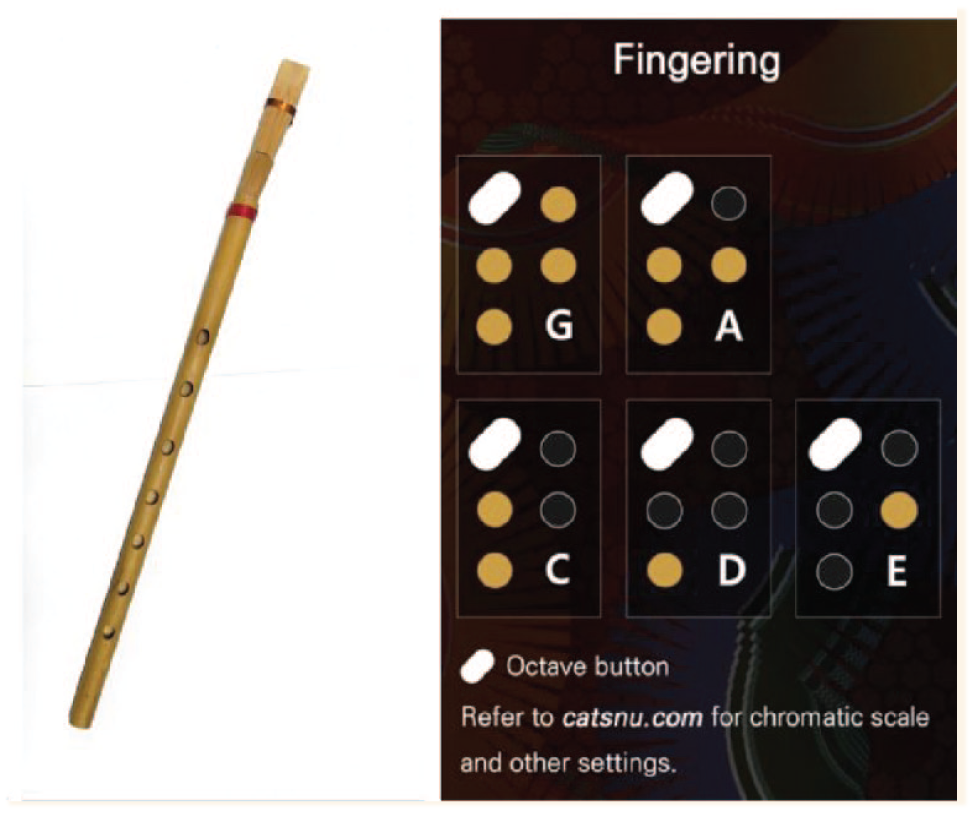
Hyang-Piri (left) and Hyang-Piri App (right)
We recommend the iPad and iPhone versions of the tablet-based hyang-piri for classroom activities. Unlike the acoustic instrument, the tablet-based hyang-piri is played by placing fingers on the hole on the tablet screen either with or without blowing air in. Players can adjust the performance mode in the setting to actually blow air into the instrument through the mic input. By vibrating or sliding up or down the tablet, the tablet-instrument can also create vibratos and embellishment representing Korean musical styles.
Performance-Based Activity with the Hyang-Piri
Classroom repertoire with hyang-piri: “Arirang”
“Arirang” is a well-known traditional Korean folk song worldwide. Its main melody was introduced to major elementary series books (Share the Music, The Music Connection, etc.) and arranged to multiple ensemble musical pieces. In particular, Variations on a Korean Folk Song by John Barnes Chance is one of the popular pieces in U.S. classrooms. “Arirang” means “my beautiful lover” or “my beloved one,” and the song depicts the sorrow of lovers parting. 15 “Arirang” includes a pentatonic scale, compound meter, and a call-and-response form. 16
Sequence of teaching “Arirang.”
Before playing “Arirang” with hyang-piri, students are encouraged to learn to sing the song (Figure 2, Appendix A). The hyang-piri app is designed to play Korean folk songs first in C major because its menu includes the notes G–A–C–D–E as the fingering for the Korean pentatonic scale. 17 Using the C-major “Arirang” score, students will be able to play the song based on manual fingering. To play the G an octave higher, students should click the octave button along with the normal G fingering.
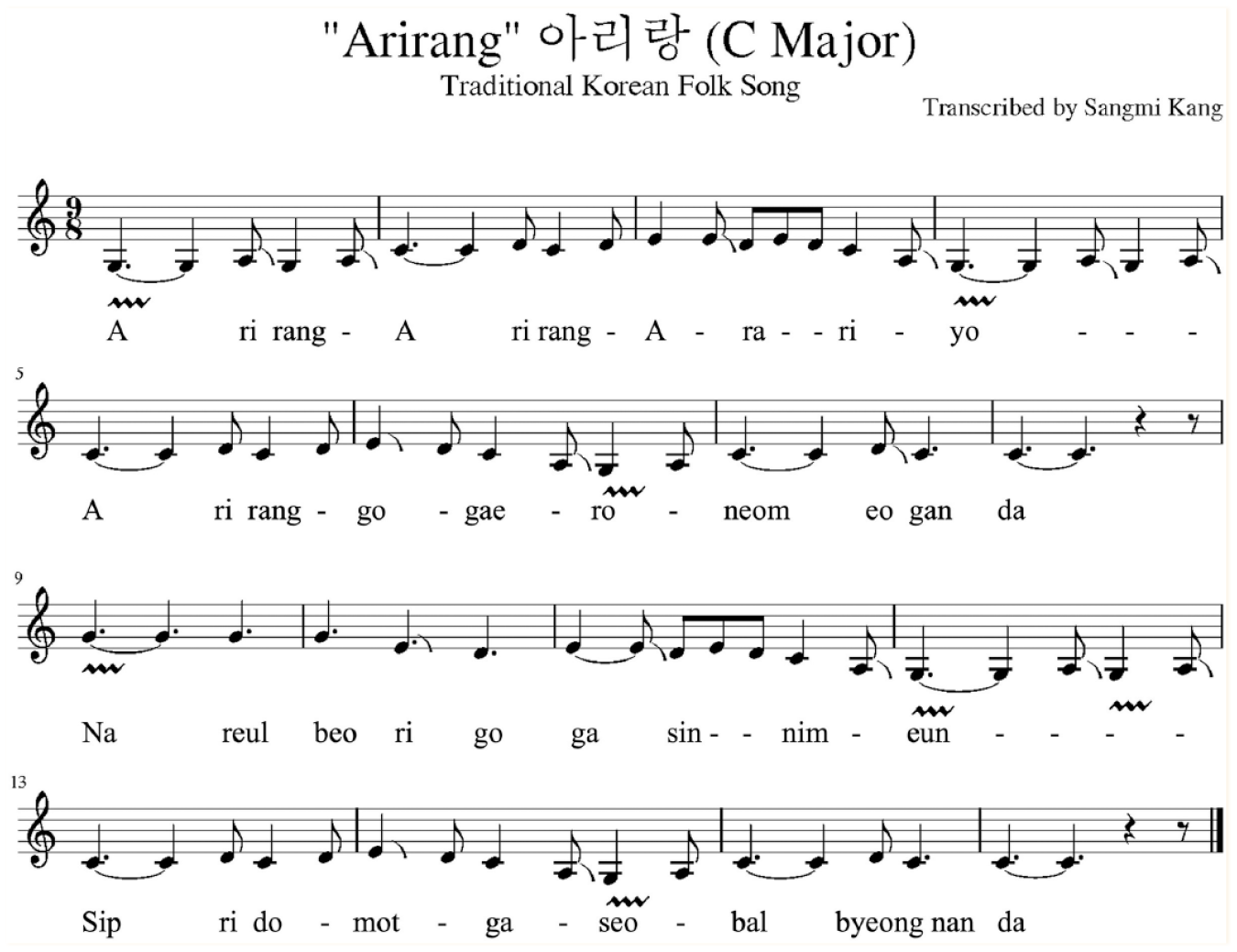
Notation of “Arirang” with Tablet-Based Hyang-Piri
After students can play “Arirang” in C major, the teacher plays the recording of the piri solo “Arirang,” which includes vibrational sounds and ornamentations, 18 and has students discuss the differences compared to their own playing. Students may notice the quavering sounds and grace notes in certain places of the melody in the recording. The tablet-based hyang-piri can also create vibrato sounds by shaking the tablet itself up and down. The teacher can encourage students to put vibrations on the note G by shaking the tablet and to play sliding sounds on A and E notes by lowering the tablet; the students would be able to create similar ornamentations. 19 To prepare students to play the tablet with the recording, the setting of the app should be adjusted to transpose hyang-piri to its original pitch range. To do this, A2 should be set as the lowest note; then, students can play “Arirang” in E-flat major by keeping the same fingering. First, have students play the hyang-piri app with the piri solo music. If the teacher wants to broaden their experience to a more authentic ensemble setting, then have students play the app with other traditional Korean instruments when playing “Arirang.” 20 A detailed sample lesson plan for the hyang-piri is presented in Appendix A.
Introduction of Erhu and the GarageBand Erhu
The erhu is a two-stringed instrument played with a bow that moves between the two strings (the bow hair is inserted in between the two strings, which are played one at a time). It has evolved in China for over a thousand years (since the Tang dynasty, 618–907), but not until the early twentieth century did the name erhu (二胡) become settled (predecessor: xiqin 奚琴). A wide range of playing techniques were developed and established as well. It is the most popular instrument in a family of Chinese bowed stringed instruments of different sizes, using various materials, and for distinctive styles. Some refer to the erhu as the Chinese violin or Chinese fiddle. It is used as a solo instrument and in small or large ensembles. Sometimes, it is part of the contemporary popular music instrumentarium also. Tuning of the two strings is typically D4 and A4, as in the middle two strings of the violin. The erhu has a playing range of two and a half octaves (D4 to A6). Because the acoustic instrument has no fingerboard, the player controls the pitch by pressing directly on the strings using the fingers on the left hand. The player can play sliding tones and vibrato with ease. Another feature of the erhu is that the player can control the tension of the bow hair with the right hand in real time when playing.
The tablet-based erhu for iOS devices is easy to use and has advantages that the acoustic instrument does not offer. We recommend the iPad and iPhone version in GarageBand, which comes with the device. The desktop or laptop version is just as easy if a music keyboard is attached. The erhu is found in the category of “world” “stringed” instruments. The outstanding features of the tablet-based instrument parallel those of the acoustic instrument, such as the vibrato and the horse-calling sound using sliding tones. To ensure in-tune playing, the tablet-based instrument allows users to choose a scale. No note between neighboring scale tones can be produced. The version on the iPad and iPhone has scales grouped as major (major, major pentatonic, major blues, mixolydian, and klezmer) or minor (minor pentatonic, minor blues, Japanese, minor, harmonic minor, Dorian, and South-East Asian). This fixed-scale setting allows players to play different keys and styles with ease. The tablet-based erhu only goes straight from one note to the next even when the finger is sliding on the string on the touchscreen. For this reason, teachers are encouraged to take advantage of the preset scales for in-tune playing and the flexibility of playing in different keys for the traditional repertoire and for a variety of contemporary, world styles.
A Performance-Based Activity with Erhu
Classroom repertoire with erhu: “Molihua” (“Jasmine Flower”)
Although the title of the song “Molihua” (“Jasmine Flower”) is well known throughout China and around the world, it has many different versions throughout China and worldwide, with two dominating versions. A search online can bring in various audio and video recordings of the song. 21 The lyrics describe the beauty and fragrance of the flower, so delightful that everyone praises it and likes to take it as a gift to others. The version introduced here is among the most widely circulated versions. The melody in G major is presented in Figure 3 and Appendix B. It is legato and has seven phrases.
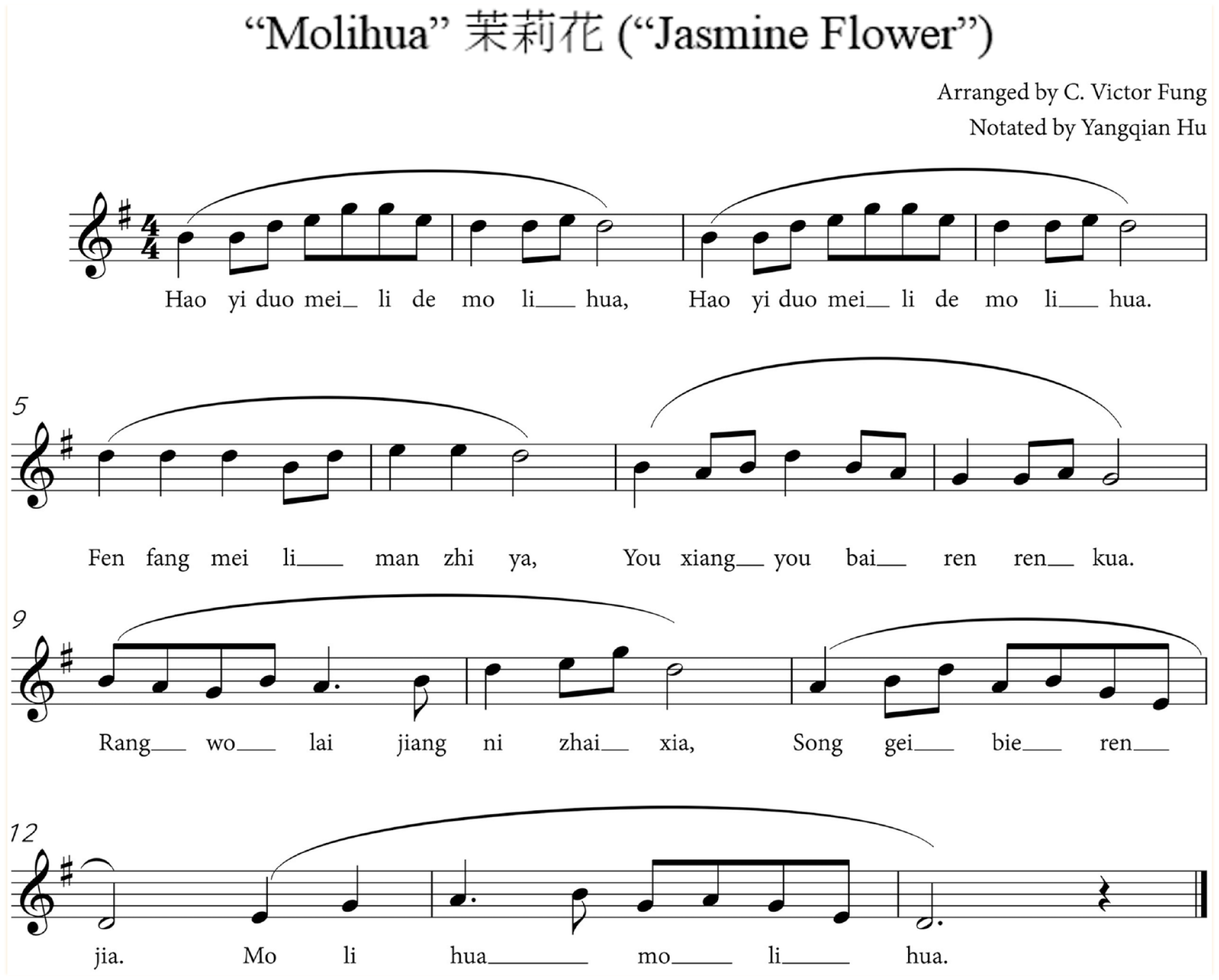
Notation of “Molihua” with Pinyin Lyrics
Sequence for teaching “Molihua”
We recommend that students listen to the song and familiarize themselves with its expressivity, then sing along with a recording using the pinyin of the lyrics (Appendix B). Because the lowest note of the erhu is D4, it is suitable to play the melody in the key of G major. The teacher may adjust the key accordingly because a different key may be better suited for students to sing along. For introductory playing, the tablet-based erhu should be set in “major pentatonic” in the key of G major. Some vibrato is recommended to prevent the sound from being too dry. The teacher can play one phrase at a time for students to echo-play until all seven phrases are accomplished. The entire melody can be played on the D string alone. They can play an octave higher too using the A string alone. An important technique that students should develop is to play legato within a phrase. When there are no repeated notes, students can simply slide a finger up and down the string smoothly; when there are repeated notes, students should lift the finger and put it back on the string quickly with minimal gap between the two repeated notes.
Once students are comfortable playing the entire melody, the teacher can assign part of the class to play and the rest of the class to sing, given the key is appropriate for both singing and playing. The two groups can switch roles. And finally, if students are comfortable singing and playing separately, the teacher can have all students sing and play simultaneously. It may be necessary for students to memorize either the playing part or the lyrics so they can look at the part that they have not yet memorized. Class activities may be extended by having two groups of students play in different octaves and having a third group sing. The teacher can arrange an accompaniment on a chord instrument (e.g., guitar, piano) or a small electronic or acoustic ensemble. See Appendix B for a sample lesson plan.
Introduction of Koto and iKoto HD
The koto is a Japanese version of the Chinese zither, the guzheng. The standard 13-string koto is about 72 inches in length and is made from paulownia wood. 22 Strings are strung over movable bridges, allowing for tuning in different scales and keys. While the standard instrument uses 13 strings, 17-string kotos are also often used in modern music. The player plucks the strings using three fingerpicks (tsume) worn on the thumb and the first and second fingers of the right hand. By pressing the string using the left hand, the player can raise the pitch (oshite technique). Pulling the string lowers the pitch. This downward pitch-bending (hiki-iro) is executed in the middle of a note. These glissando techniques add colors to otherwise straight notes.
Koto music was developed and transmitted by blind people who also played shamisen (an instrument resembling a three-stringed banjo). Many landmark pieces were composed by blind musicians of the highest rank (called Kengyo) in the government-protected association Todo-za. This is why many koto music composers tend to have the same name (Kengyo). In the early Edo period (1603–1867), Yatsuhashi Kengyo, known as the composer of many popular pieces such as “Rokudan no Shirabe” (“Music of Six Steps”), developed hira-joshi, the original solo koto tuning adapted from shamisen music. Hira-joshi is essentially the same as miyako-bushi, one of the four major Japanese pentatonic scales 23 (e.g., D–E-flat–G–A–B-flat in D; E–F–A–B–C in E; G–A-flat–C–D–E-flat in G). Hira-joshi in the E mode on the 13-string koto is tuned as follows: String 1 (E4), String 2 (A3), String 3 (B3), String 4 (C4, which is middle C), String 5 (E4), String 6 (F4), String 7 (A4), String 8 (B4), String 9 (C5), String 10 (E5), String 11 (F5), String 12 (A5), and String 13 (B5).
Performance-Based Activity with Koto
Classroom repertoire with koto: “Sakura”
“Sakura” (also known as “Sakura-Sakura”) is a traditional Japanese folk song about a cherry tree. It is included in Japanese music textbooks and major elementary series books in the United States (e.g., The Music Connection) as Japan’s most representative folk song. The piece is played in the miyako-bushi pentatonic scale in quadruple meter and consists of three parts (ABBAC) stretched over 14 bars (2 + 4 + 4 + 2 + 2). “Sakura” is often the very first piece that koto beginners learn because they can play each phrase by plucking nearby strings without jumping to distant strings. There are multiple tuning modes that correspond to the miyako-bushi scale on the koto. Among them, hira-joshi is used for “Sakura.”
Sequence of teaching “Sakura”
The iKoto is a tablet-based app designed to sound like a real koto: It enables executing the oshite and hiki-iro expressions, easy tuning in 12 settings with further adjustment through bridge-position movement, demo play of traditional and popular pieces, the recording function of the performance, and most notably, the “practice” mode through which students can follow the demo performances with visual aid. 24 All the functions in the iKoto settings (e.g., oshite, hiki-iro, pizzicato, sukui-tsume, and guide) should be turned on. The recommended selection for “string information” is “scale” (or “number” if students are familiar with Japanese/Chinese characters for numbers). Under “tuning,” select “hira-joshi” and set in E. Touching a string on the iKoto can produce a tone like what can be created with GarageBand. However, students should be guided to learn how to pluck the strings using the thumb, just as they play the acoustic instrument so that the tablet-mediated performance experience becomes more authentic. It is also important to cut across the string as if students are plucking it rather than pressing it. iKoto can recognize the difference between upward plucking (standard) and downward plucking (sukui-tsume) when the sukui plucking mode is turned on. The subtlety of these plucking differences in tone color should be noticed.
First, students are encouraged to learn to sing the song (Figures 4 and 5; Appendix C). Then, watch the YouTube video 25 and pay attention to how the strings are plucked. As students become used to playing the piece on iKoto, more advanced playing can be introduced, for instance, adding sukui-tsume and pizzicato by following the YouTube video. 26 More advanced students can try the “Sakura Variation.” First, listen to the piece using the “play” function of iKoto (slow playing is recommended). Then, try the piece using the “practice” mode. The guiding signs indicate notes for oshite on the left side. This piece has many more notes and takes a long time to learn.
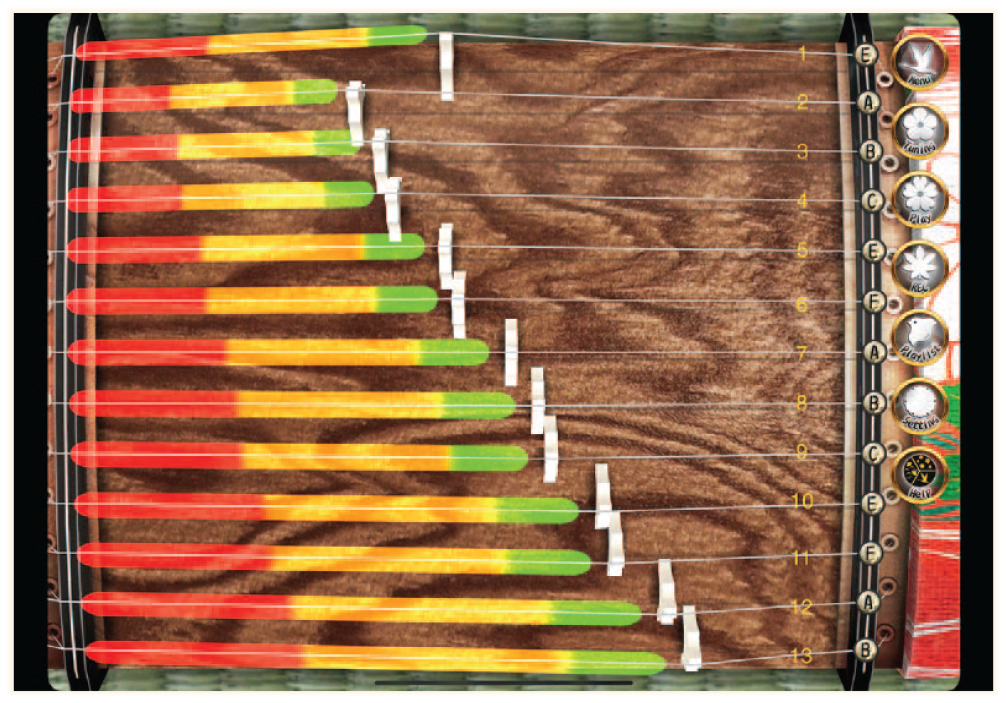
Screenshot of the iKoto App

“Sakura” Notation
GarageBand has a setting for a koto scale and sound. However, the performance experience on GarageBand Koto is different from playing on the acoustic koto. 27 In contrast, the iKoto is more similar to the acoustic koto: It enables instrument-specific techniques and expressions. This means that it can facilitate a smooth transition from studying on a tablet to performing on an acoustic instrument. A detailed sample lesson plan for the koto is presented in Appendix C.
Epilogue
We acknowledge that playing tablet-based virtual instrument experiences would not be the same as playing acoustic instruments. Nevertheless, virtual instruments can invite students to explore musical and cultural characteristics and interact with them. Moreover, performing activities would open new possibilities for students to cultivate intercultural sensitivity and attitudes that honor diverse cultures through active musical doing. Teachers can facilitate student musical and cultural exploration by posing critical questions. Virtual ensemble is inevitably a new cultural product in contemporary global society. Students can compare and contrast the similarities and differences between authentic acoustic renditions and virtual ones. Moving onward, performing activities with virtual instruments can also be scaffolded to creating activities because students now have the tools to create culturally diverse musical sounds.
We have introduced virtual instruments from three East Asian countries. As culture bearers, we would like to provide more resources to the field. If readers find any other virtual instruments from the three countries, contact the authors; we would be glad to assist you in designing a lesson using that virtual instrument. We would also like to hear your stories of incorporating virtual performing activities from East Asian music cultures. Readers are welcome to reach out to us to share the meanings that you have found in the process and product. Such collective efforts between music teachers and culture bearers will advance our profession and help us all to become more culturally diverse and inclusive.
Footnotes
Appendix A
Appendix B
Appendix C

Notes
Sangmi Kang (