




Abstract
Modern band programs have spread throughout the United States to create learner-centered and culturally affirming school music experiences for children. The four key concepts of modern band, (1) approximation and scaffolding, (2) decision-making, (3) iconic notation, and (4) culturally sustaining (music education), are congruent with many elementary general music philosophies and pedagogies. This article examines intersections of modern band and general music practices and demonstrates how typical classroom instruments (e.g., unpitched percussion, ukuleles, xylophones, and metallophones) can be used to implement key modern band concepts in an elementary school general music setting.
Elementary general music students can enjoy music-making using some of these modern band principles.
Photo of Matthew Clauhs courtesy of the author

Photo of Beatrice B. Olesko by Hana Cai

Photo of Martina Vasil by Stacey Gish

The Tonight Show with Jimmy Fallon featured a segment with Carly Rae Jepsen and the Roots performing “Call Me Maybe” on classroom instruments in June 2012. 1 The segment went viral, and Fallon and the Roots later performed classroom instrument versions of other songs with other popular artists, including Adele, Metallica, Meghan Trainor, and the Backstreet Boys. These performances demonstrated, on a global stage, how popular music can be performed with inexpensive and accessible instruments often found in elementary school general music classrooms (such as unpitched percussion, ukuleles, xylophones, and metallophones). The Tonight Show collaborations could serve as an example for elementary school music teachers who are interested in ways to “bridge the gap” between school music and the musical preferences of individual learners using readily available resources. 2 This can be accomplished by using general music instruments to explore key concepts of modern band pedagogy, which serve as guiding principles for popular music education in school music programs across the United States. The four key concepts of modern band, (1) approximation and scaffolding, (2) decision-making, (3) iconic notation, and (4) culturally sustaining (music education), are congruent with many elementary general music philosophies and pedagogies. In this article, we examine intersections of modern band and general music practices and demonstrate how typical classroom instruments can be used to implement key modern band concepts in an elementary school general music setting.
Popular Music Education and Informal Learning
According to the Grammy Music Education Coalition, nearly four million children in the United States attend a school that does not have a music program. 3 Music Will (formerly Little Kids Rock) is a nonprofit organization dedicated to creating music programs in school districts that have none—or in schools seeking to broaden the curriculum to increase accessibility—while providing instruments and professional development to teachers to get them started. Modern band programs have quickly spread to benefit underserved students in low-income school districts across the country, reaching over one million students in 300 school districts to date. 4 Over the past 20 years, modern band programs helped change the landscape of music education, increasing participation as historically marginalized student populations have gained access to new school music experiences that better reflect a greater diversity of interests and musical preferences. 5 Despite what the name might imply, modern bands are led not by ensemble directors but instead by facilitators who engage their students in democratic processes and learner-centered activities. In fact, one survey of Music Will teachers found that over half of modern band programs are facilitated by elementary school general music teachers. 6
The advancement of popular music education in general music settings is certainly not limited to the United States. Musical Futures was founded in 2003 with a mission to “find new and imaginative ways of engaging young people in meaningful and sustainable music activities.” 7 The program originated in the United Kingdom and has expanded to 100 countries worldwide, now under the name Musical Futures International. 8 Musical Futures programs are inspired by the research of music education scholar Lucy Green and her landmark book, How Popular Musicians Learn, which introduced the idea of informal music learning. Green defined informal music learning as “a variety of approaches to acquiring musical skills and knowledge outside formal educational settings.” 9 This approach leverages inherent musical skills in children to create school music experiences that reflect musical values, traditions, and preferences of the community.
While the democratic nature of informal music learning is an important consideration for all music teachers, general music teachers are particularly well positioned to include student voices and choices in the development of a general music curriculum.
10
In the United States, ensemble programs are often driven by performance expectations at festivals and concerts with recommended (or required) repertoire lists determined at the state level. A student of Lucy Green and a prolific music education scholar, Gareth Dylan Smith pointed out the absurdity of Eurocentrism found in U.S. schools that center Western art music (WAM) at the expense of styles enjoyed by most students. In his Sound Advice blog, Smith wrote,
The persistent primacy of WAM in repertoire and curricula in school is called Eurocentriscm. This term seems strangely out of place in a country so patriotic as the United States, whose proud exceptionalism often seems aimed at distinguishing it from Old-World ideals. Nonetheless, this centering of a narrow set of marginal musical practices has had the effect, in turn, of marginalizing majority musical styles like hip hop, R&B, country, heavy metal, pop, and rock.
11
The marginalization of these nonclassical musical styles may be driven by educators who come from primarily classical backgrounds and believe WAM is the most appropriate genre for school music education. 12 However, music teachers have an opportunity to leverage musical styles that students enjoy to increase engagement in school music programs and include greater diversity of composers and songwriters in the curriculum.
Music education scholars have examined how Green’s informal learning approaches may be applied to elementary and secondary classrooms in the United States, suggesting that student-selected activities and instruction informed by student preferences are “beneficial, learner-centered practices.” 13 A group of general music teachers participating in one study expressed that informal music learning “provided a new avenue for them to help students develop independent musicianship.” 14 Independent musicianship is a key attribute of music literacy in the Core Arts Standards, which the National Coalition for Arts Standards defines as the “knowledge and understanding required to participate authentically in the discipline of music by independently carrying out the artistic processes of creating, performing, and responding.” 15 Moving beyond the act of decoding five-line staff notation, this new definition leads the way for general music teachers to foster independence and lifelong engagement through popular music education. 16 Much of this literature to date has examined implications for informal music learning in general music classrooms; there is less scholarship on the intersections of recently developed modern band pedagogies and general music approaches.
General Music Approaches
Before connecting key concepts of modern band pedagogies to general music classrooms, we must first understand prominent methods in general music education. Many elementary general music teachers have been educated in Orff Schulwerk, Dalcroze, and/or Kodály approaches. Orff Schulwerk is a child-centered approach to building musicianship through the integration of music, movement, speech, and drama. Creativity is central to the approach, and children’s musical abilities are held in high regard. “Imitate, explore, and create” is a common pedagogical process in Orff Schulwerk. Dalcroze is a movement-centered approach that builds musicianship through eurhythmics (responding kinesthetically to rhythmic and dynamic concepts), solfège, and improvisation in movement, voice, and instruments. Kodály is a singing-centered approach that builds musicianship through aural training, the use of high-quality music and music from students’ cultures, and music literacy. A common teaching process in Kodály is “prepare, present, and practice.” 17 We make connections between key modern band concepts and each of these general music methods throughout this article.
Teaching Modern Band Concepts with Classroom Instruments
The instrumentation of modern bands is flexible and wide-ranging. Some modern bands feature dozens of students on guitars and a few students performing keyboard, bass, and drums. Other modern bands include much smaller groups of students, such as a power trio of guitar, bass, and drums. Many modern bands include technology such as computers, sequencers, and virtual instruments. The adaptability of modern band instrumentations allows for a broad spectrum of differences in school size, student interest, budget, and equipment. Just as Jimmy Fallon and the Roots explored possibilities for performing popular music on a typical set of classroom instruments, elementary general music teachers could employ modern band pedagogies in a classroom without the use of guitars, basses, drums, and technology.
Modern band classrooms do not typically use a fixed curriculum but are instead guided by a set of principles that allow for flexibility and multiple pathways toward musical understanding. Leaders from Music Will identified the following key modern band concepts: (1) approximation and scaffolding, (2) decision-making, (3) iconic notation, and (4) culturally sustaining (music education). 18 We examine each of these concepts and consider implications for typical elementary general classroom instrumentations and approaches in the following sections.
Key Concept 1: Approximation and Scaffolding
Approximation
Approximation is “an approach through which teachers modify performance expectations to accommodate developing students’ needs.” 19 Applied to popular music, this means that students of varying experience levels can perform an approximation of a song (ideally selected by the students) rather than an exact replication of that song. For example, teachers may offer different ways for students to play the same chord on guitar (e.g., G major). Beginners may play a simplified G major chord, using one finger and strumming the highest three strings, while more advanced students may have the finger dexterity to play a full G chord across all six strings of the instrument. Less experienced students might also strum a chord just once per measure, allowing for more time to change between chords. This approach would allow for an approximation rather than a replication of a recording.
While approximation is not a new concept in music education, as songs from many styles and traditions have been adapted for children in elementary general music classroom settings, modern band teachers tend to approach approximation through the aural transmission of music, supplemented by iconic notation. For example, students may learn a simple guitar riff, such as “Seven Nation Army,” by singing the pitches and the fret numbers as they play. This may be supported by a picture of numbers on a guitar fret board. This is similar to the Kodály approach, which builds musicianship through aural training and the use of iconic notation, such as hearts, to represent a steady beat. Approximations are likely not to be expressed in five-line staff notation but rather created in response to individual student needs in a specific classroom. Students may even create their own approximations of their favorite songs, demonstrating agency by taking control of the learning process. This is consistent with the student-centered Orff approach, which encourages student autonomy and creation. In Orff classrooms, students often create their own iconic notation to facilitate their learning.
Because modern band teachers seek to approximate rather than replicate songs, a typical set of classroom instruments may be appropriate for students to satisfy the roles of the keyboard, guitar, and drum kit in an elementary general music setting. Ukuleles have become increasingly popular in modern band classrooms as a substitute (or addition) to the guitar. Orff instruments can function in the role of a bass or chordal instrument. Classroom percussion instruments can replace individual instruments of the drum kit. These classroom instruments are accessible to players with little to no experience, and students can participate in a meaningful way that is appropriate for their skill level. 20 See Figure 1 for a list of recommended classroom instrument substitutes to approximate the role of the kick drum, snare drum, hi-hats, electric bass, guitar, and keyboard.

Approximating Modern Band Instrumentation with Classroom Instruments
Modern band approaches to approximation are grounded in conventional general music practices. Several modern band resources describe the value of using body percussion when approximating popular music grooves. Figure 2 illustrates how instruments of a drum kit could be performed using body percussion, with the right foot performing the kick drum part, the right hand performing a hi-hat pattern on the shoulder, and the left hand performing a snare drum pattern on the left thigh. Orff and Dalcroze approaches also utilize body percussion, as students snap, clap, pat, and stomp to externalize a rhythm before applying it to an instrument. General music teachers, already familiar with the role of body percussion in their classrooms, can introduce popular music grooves through body drumming.
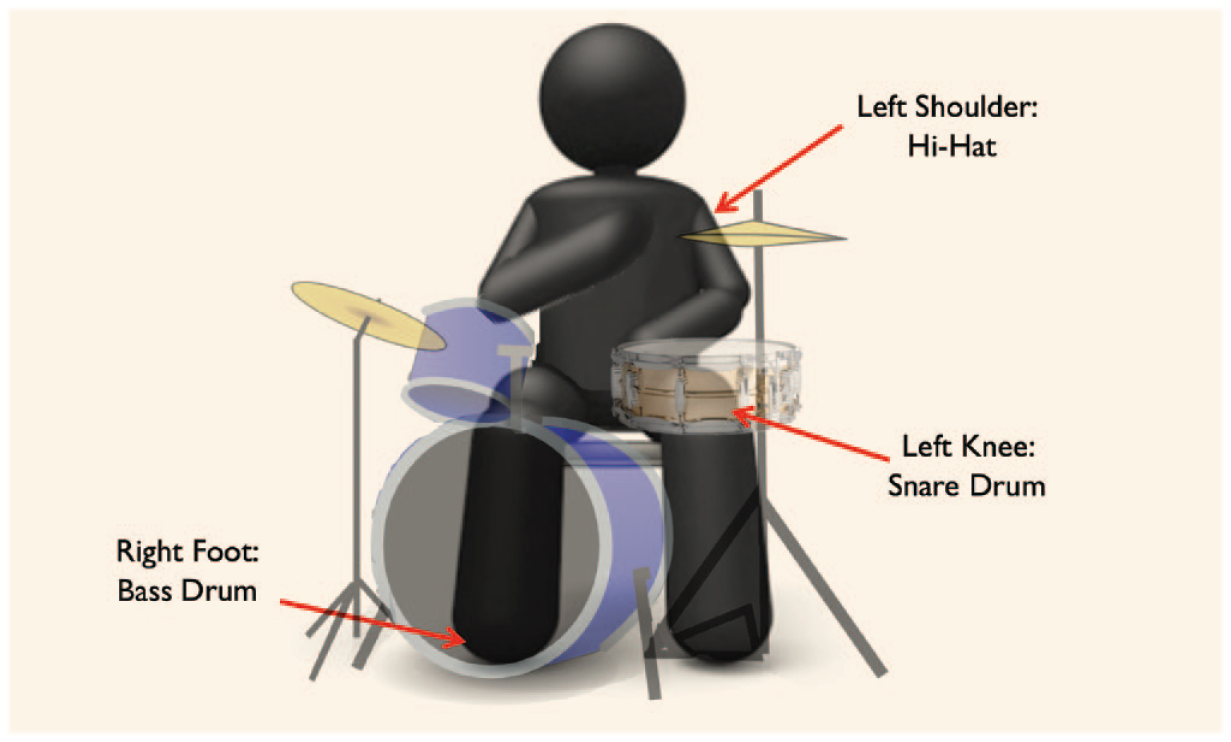
Body Drumming
Scaffolding
Scaffolding occurs when “teachers provide appropriate support that enables students to move beyond their current skill or knowledge, in small and attainable steps.” 21 This key modern band concept clearly intersects with general music pedagogies as well-constructed curricula with sequences that build skills over time. Notable examples of this in general music practice include Orff’s four stages of learning (imitation, exploration, literacy, and improvisation) and the Kodály process of “prepare, present, practice.” 22 In an Orff classroom, students learning a melody on xylophone might first start with a singing game, such as in “Step It Down” from the New England Dancing Masters. Children play the game and imitate the teacher clapping on the words “remember me,” which include the pitches mi–mi–re–mi and mi–mi–re–do. Students may then transfer body percussion rhythms to the xylophones and explore how these pitches can be applied to their rhythm. Creation occurs when students use the same three notes to create a new tonal pattern for “remember me” (e.g., do–do–re–mi or mi–re–do–mi). Not unlike Orff and Kodály, modern band scaffolding strategies are designed to move students from the most fundamental levels of listening toward creativity and musical independence.
Music education scholar Jackie Wiggins explains that scaffolding occurs when “a novice works side by side with an expert, with the novice performing the portions of the task in which he is competent and the expert filling in and providing support where necessary.” 23 In both modern band and elementary general music classrooms, teachers can add scaffolding, such as using a dry-erase marker to write the names of pitches on a plastic keyboard. 24 As students play the keyboard, the pitch names begin to disappear. If students continue to need the scaffolding support, the teacher rewrites the names on the keyboard, “filling in and providing support,” as Wiggins wrote. If students still need support, the teacher can ask them to use dry-erase markers to write the pitches on their own. Eventually, students will realize they have memorized the pitch names and no longer need that scaffold to identify the keys on a keyboard.
Key Concept 2: Decision-Making
The second key concept of modern band is decision-making, whereby students are empowered to make choices about the music they perform. This concept is one that distinguishes emerging modern bands from many existing school music ensemble experiences, where the director is primarily responsible for making decisions. The following section explores how modern band approaches and resources may be used to help students make their own decisions about accompaniment patterns, improvisation, songwriting, and repertoire.
Accompaniment Patterns
Before students generate their own original accompaniment patterns, they should be familiar with a variety of patterns demonstrated by the teacher or found in familiar songs. The accompaniment (or comping) patterns in modern band song charts are like chord borduns and broken borduns found in Orff Schulwerk. The keyboard part in Figure 3 is separated with the left hand (performing the root) and the right hand (performing the root, third, and fifth in a broken pattern). This approach to playing accompaniment patterns in modern band could be adapted for classroom instruments by having students perform alternating roots and fifths, typical of a broken bordun pattern, or an ostinato of roots, thirds, and fifths played in a sequence.
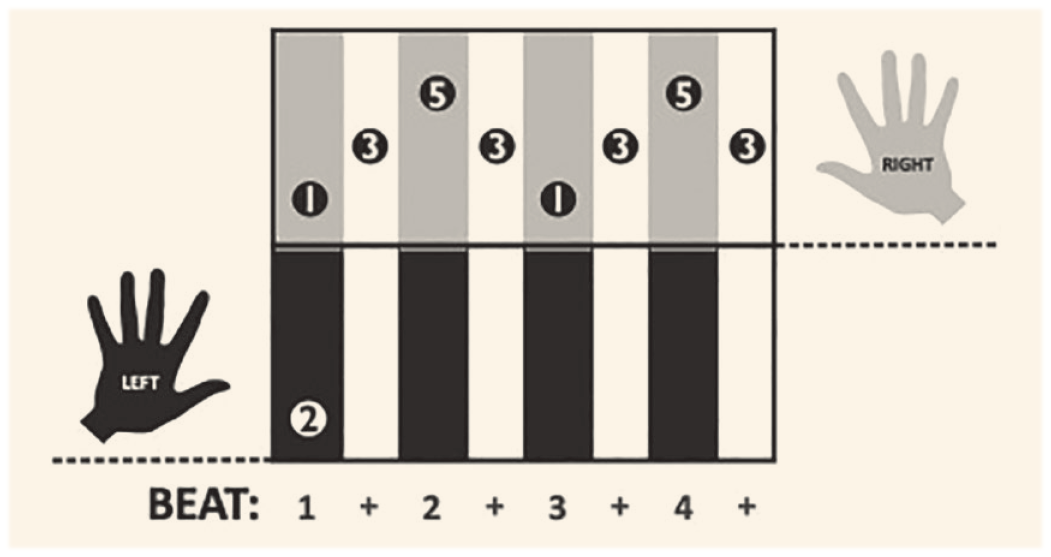
Keyboard Comping Pattern for Modern Band
Once students have mastered a variety of accompaniment patterns, whether played on a xylophone, ukulele, keyboard, or other classroom instruments, they should begin making musical decisions about which accompaniment patterns work best with a given song. Students can also create their own original accompaniments by varying the rhythms of familiar patterns. These choices lead to learner agency and empower students to have more control over their own music-making experiences. Students of varying skill levels may choose to perform accompaniment patterns that are most appropriate for their level of experience, allowing for differentiation.
Improvisation and Songwriting
Improvisation and songwriting are inherently creative and require students to make musical decisions about pitch, rhythm, phrasing, and dynamics. A simple way to scaffold this creative process for students is to limit the note choices for an improvisation or composition. Students can create simple pentatonic melodies over a diatonic chord progression, building from one- or two-note melodies to the full selection of the five-note scale. Guitarists in a modern band setting often learn to play a pentatonic shape (e.g., consistent hand position and fret relationships), which can be transposed to any key. Keyboard players in a modern band setting may learn to improvise and compose by using a pentatonic scale Jam Card (see Figure 4). This card is placed behind the keys of a keyboard, revealing which notes belong to a pentatonic scale on any starting note.
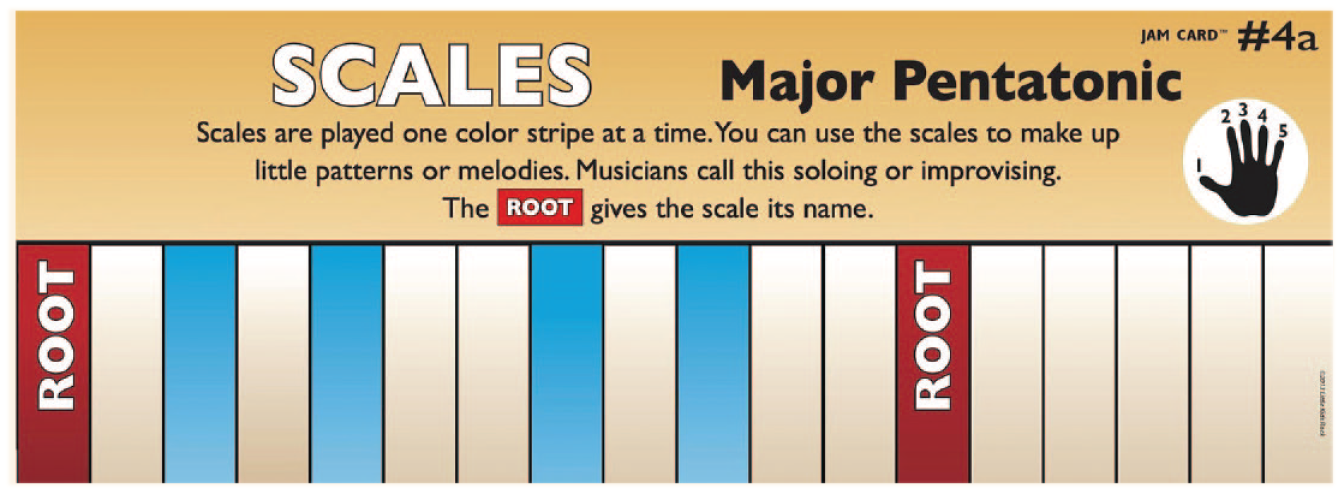
Pentatonic Scale Jam Card
We can apply these modern band principles to classroom instruments by removing bars from a xylophone. General music teachers may wish to limit the choices on the xylophone to one note as a starting point to improvisation and composition, gradually adding bars as students become more comfortable crafting original melodies (see Figure 5).
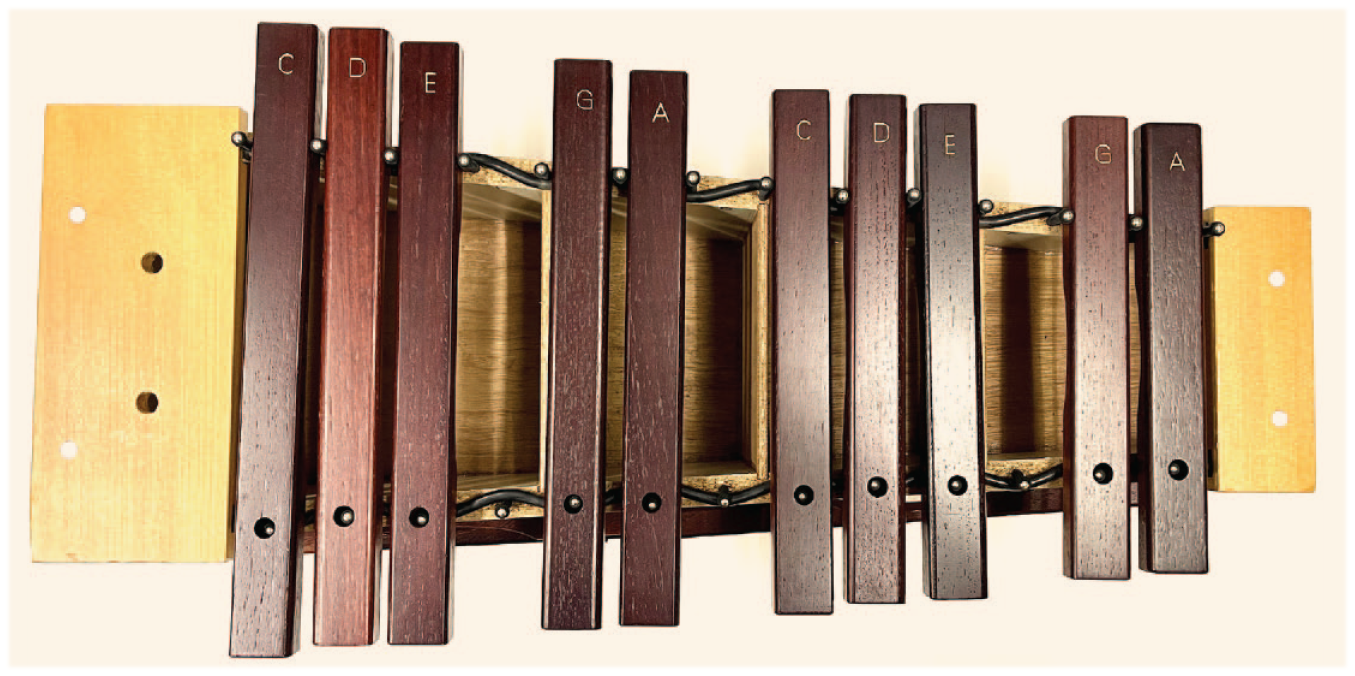
A Xylophone with Bars Removed to Perform a Pentatonic Scale
This emphasis on improvisation and songwriting found in modern band contexts is consistent with general music approaches, including Orff Schulwerk. Orff believed that children have innate musicality that can be channeled through musical play, experimentation, and improvisation through hands-on experiences early in a child’s music education. Reflecting on the composition process, Orff explained, “In my teaching I tried to bring the students to the point where they could invent music of their own. . . . They grew out of spontaneous improvisations in which a student could freely express himself. Our pieces were not first written out and afterwards performed. They were extemporizations.” 25 The composition process that Orff described is strikingly similar to how students in modern band settings form original songs from improvisation and experimentation.
Elementary music teachers and scholars may also recognize improvisation as a key element in the Dalcroze approach. Teachers who utilize Dalcroze methods often improvise accompaniments on the piano or guitar. Students in a Dalcroze classroom are encouraged to improvise with their voice, instruments, and body movements. Many musical elements, such as intervals, meter, rhythm, harmony, and phrasing, are introduced and developed through improvisation activities in the Dalcroze approach. 26
Repertoire Selection
Students in a modern band setting play a major role in choosing material, often with guidance from a facilitator teacher who can recommend how popular songs may be adapted to match the student’s ability level (transposition/capos, modified form, simplified comping patterns, etc.). Modern band scholars explain that the term popular means ‘‘of the people” and in this case “of the students.” 27 Similarly, both Orff and Kodály advocated for repertoire selection that reflected the child’s own heritage. 28 Rather than prescribing a fixed set of repertoire and musical examples, the Dalcroze approach encourages teachers to use and adapt music materials that are responsive to students’ learning needs. 29 It may be tempting for music teachers to select popular music that they personally enjoy for inclusion in the classroom, but if this music is not relevant to the child’s experience, then the teacher is reproducing their own values and preferences in an entirely undemocratic fashion.
Elementary school general music teachers often teach every child in the school building (or multiple buildings), so it may not be feasible to have each child pick their own individual song for study as a class. However, teachers should gather input collectively to inform repertoire choices. This can be accomplished by talking to students informally (e.g., during lunch duty, recess, and car line), sending out a parent survey about music their children like, and paying attention to current music in children’s movies, TV shows, social media, and the radio. After collecting repertoire ideas, teachers need to review the lyrics and the meaning of songs to ensure they are appropriate for school settings. If not, teachers can choose another song by the same artist, can use an instrumental version of a song, or may work with students to rewrite lyrics. The popular group Kidz Bop often rewrites lyrics to make songs more appropriate for younger audiences. This group may be a useful resource and model for elementary school settings. Teachers also need to listen repeatedly to songs to determine which songs have clear musical elements that can easily be explored and expanded upon in lessons. Eventually, students should be encouraged to play a role in creating their own original repertoire, building on the improvisation and composition activities described previously.
Key Concept 3: Iconic Notation
Students in modern band settings often learn music by listening to a recording and reading iconic notation in the form of chord charts, tablature, and other graphical representations of music. The National Association for Music Education recognizes multiple forms of notation in the 2014 Core Arts Standards framework and specifically includes iconic notation, which is defined as “representation of sound and its treatment using lines, drawings, pictures.” 30 Not only is iconic notation the most appropriate form of notation for many popular music settings; it also provides scaffolding to students who need that support. For example, a chord diagram illustrating the G chord of a guitar may be interpreted much faster by a beginning student than a G chord notated on a five-line staff (see Figure 6). This chord diagram also helps students identify exactly how to play the chord, using numbers 1, 2, and 3 to indicate the correct placement of the fretting hand on the fretboard. Similarly, tablature tells the student how to perform the appropriate note on a fretted instrument. For example, middle C can be performed in five different places on a standard guitar; tablature eliminates the guesswork and helps the student identify exactly how to play the note.
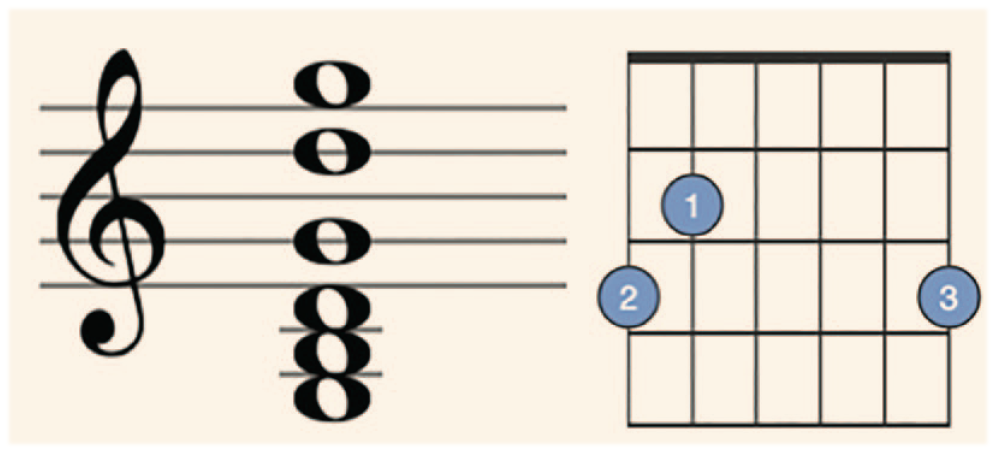
G Major Chord for Guitar
In addition to the ukulele chord diagrams in Figure 6, iconic notation for percussion classroom instruments may appear in the form of instrument pictures placed on a grid representing the macrobeat and subdivisions of the macrobeat (see Figure 7). This form of notation is like drum kit notation used in modern band settings and helps students identify how their instrument part fits within the larger context. Iconic notation should be used in conjunction with recordings, as accompaniment patterns and other stylistic elements are not often expressed in this form of notation. As students develop their aural skills over time, they should become less reliant on iconic notation to approximate or replicate the songs they enjoy.

Iconic Notation for Hand Percussion
While iconic notation and tablature may be less familiar to teachers with a formal music background, they are consistent with a standards-based curriculum and are appropriate tools for reading popular music in elementary settings. Elementary general music materials have utilized iconic notation for decades as a way of introducing music reading for younger students, particularly through the Kodály approach. Many general music pedagogues advocate that all students should learn iconic notation as part of elementary music curricula. 31
Key Concept 4: Culturally Sustaining (Music Education)
Culturally sustaining (music education) means that students “see themselves, their music, their ways of learning” reflected in the school music program. 32 This key modern band concept is already familiar to elementary general music who learn how students engage with music outside of school to inform in-school learning experiences. As students in general music classrooms help select repertoire, develop creative skills, and engage with forms of notation that decenter Western European classical traditions, teachers have an opportunity to provide experiences that affirm a diversity of cultural identities in the general music classroom. In addition to performing and creating music on classroom instruments, students might also consider how musical choices reflect their own identities. Students might explore the question, “How is the music performed in our classroom personally meaningful to my life?” Regarding classroom instruments, music teachers should be mindful of the cultural associations and contexts in which these instruments exist. Many classroom percussion instruments are derived from other African, Latin, or Afro-Cuban instruments (e.g., guiro, maracas, claves, cabasa, djembe, agogo bell), and great care should be given to treating them with respect for associated traditions.
An Inclusive Experience
Modern band in elementary general music may engage a larger population of students with diverse musical preferences. The four key concepts that guide modern band pedagogies, (1) approximation and scaffolding, (2) decision-making, (3) iconic notation, and (4) culturally sustaining (music education), are consistent with general music pedagogies and philosophies. By using classroom instruments that are highly adaptable and age-appropriate, general music teachers can engage students with songs from their homes and communities at an early age. Our field may grow the body of inclusive school music education experiences as teachers leverage the musical interests of the child to support learning objectives in the elementary general music classroom. Carl Orff believed that every child is musical, 33 and general music teachers can implement modern band pedagogies to engage the strengths of children from a diversity of racial, economic, and musical backgrounds to provide inclusive school music experiences for all.
Footnotes

Notes
Matthew Clauhs (