




Abstract
How can orchestra teachers diversify curricula to engage young musicians in project-based learning experiences that build their musicianship and confidence? This action research study explores how the author fostered project-based learning experiences that incorporated student reflection and assessment within chamber music ensembles. By incorporating opportunities for students to build skills through chamber music ensembles, music teachers can foster students’ engagement, develop students’ confidence, and improve large-ensemble performances. Included as well are recommendations for implementing a chamber music unit that incorporates structured student reflections and authentic assessment.
Photo of April Troglauer courtesy of the author

Photo of Anna Morrison courtesy of the author

We hit a wall as my middle school orchestra students prepared for their spring concert. I could see it in their eyes: they were not excited or engaged in the rehearsal process. While refining details in their performance literature was very important, the students were having a difficult time seeing the rewards of their work. We worked day after day with minimal improvement. Fewer and fewer students were taking their instruments home for individual practice. How could I find a way for students to take ownership of their learning? What instructional strategy could I implement that would be engaging and rigorous and improve students’ musical skills? In reflecting on my own music learning experience, chamber music came to mind as a strategy to boost engagement, incorporate student choice, and build independence. Student-driven experiences, like working in a chamber ensemble, have been shown to increase student achievement and engagement. 1 With a concert rapidly approaching, I set aside the concert music. We began a project-based learning experience that intentionally incorporated student choice, reflection, and assessment through small-ensemble performances. These combined strategies resulted in active participation, peer teaching and coaching, reflection and thoughtful evaluation, and, overall, students who were highly engaged in their own music learning.
Why Chamber Music?
As I began planning for this learning experience, I realized that chamber music was closely related to the educational idea of project-based learning. Project-based learning is an educational framework in which students identify a project or problem to work on, engage in sustained inquiry, gain feedback to support continued learning, and reflect on the process throughout. 2 At its core, chamber music is group work. When combined with group work, project-based learning often capitalizes on the social nature of students to further increase student engagement and mirror the real-life experience of participating in a chamber ensemble. 3 While working in a chamber ensemble differs from that in a traditional large ensemble, the experience yields important learning for students, including developing self-pacing skills, collaborative discussions, and more attention to detailed technical and musical skills. 4 Similarly, the enjoyment of working with peers has been demonstrated as a motivating factor that can foster greater student engagement in chamber ensembles. 5 Students are more engaged when they feel they are contributing to the group’s overall success, and learning to play in a chamber music setting ensures all students have an important role in the music-making process.
My goals for this chamber music unit were multifaceted, including increasing engagement in the rehearsal process, improving students’ attention to details in the performance of their concert music, and igniting a renewed excitement for making music together. It was important to me that students had some power in the decision-making process because I was confident that it would lead to stronger engagement and more motivation. 6 As we began this learning experience, I gave my students the following guidelines for establishing their own chamber ensembles within our classroom:
Groups may consist of four or fewer people, with any combination of instruments.
The music you choose must be a piece published for the instrument(s) in your group.
With such open guidelines, students chose to work in groups with their friends, which was to be expected. This allowed students of vastly different proficiency levels to be in a group. For my students, selecting a piece of music that they would enjoy playing was easy, but it was far more challenging to find repertoire appropriate for their playing ability as well as that of their peers. I evaluated students’ music choices to ensure the music suited each student’s musical abilities but would still challenge them as they learned. Choosing music within the students’ zone of proximal development is crucial for ongoing learning, but that must be balanced with what is aesthetically pleasing and enjoyable for the students to perform. 7 Students had access to my library of chamber music books, many of which could be adapted to any instrumentation, and I steered them toward level-appropriate literature when needed. Music collections with flexible instrumentation are available at a variety of skill levels and are easy to utilize in mixed-instrument groupings. To choose music, students did some quick sight-reading, counted through the rhythms, or sang the melodic and harmonic lines to get a sense of the piece. I found that students paid particularly close attention to the key signature to ensure it was familiar to everyone in their group. After choosing music, some students decided to research the composer and history of their piece, looking for different ways to interpret the style of the pieces they were playing.
The students enjoyed choosing their music, and doing so gave them ownership of the learning experience. Students focused on teamwork and collaboration, which was essential because the ensemble groups were composed of students of mixed ability levels. Many groups also looked to the teacher for confirmation that their music choice was appropriate. This was to be expected, as teacher approval provides positive reinforcement for students learning music and increases their attentiveness. 8 Students employed sight-reading techniques they developed in large-ensemble rehearsals and helped one another as they were learning, leveraging the different strengths of the group members. For instance, students who had a good understanding of rhythm would count rhythms as needed while other students would help with pitch discrepancies. During these rehearsals, students remained engaged because the music within their capabilities, and advanced students aided the beginning students. These supports provided the scaffolding necessary to bridge the gap between what students already knew and what they needed to know in order to perform a piece of music successfully. 9 Lara, an eighth-grade viola player, shared, “My favorite part about getting to work in a chamber ensemble was I got to work with a group of people who were willing to help me when I was confused on how to play the ensemble music. We all worked together to help one another in figuring out how to do something, whether it was trying to figure out a note, or if someone was trying to figure out how to play a certain rhythm.” Small-ensemble performance opportunities nurture self-respect, cultivate peer learning, and improve engagement as individuals work for the group’s betterment. 10
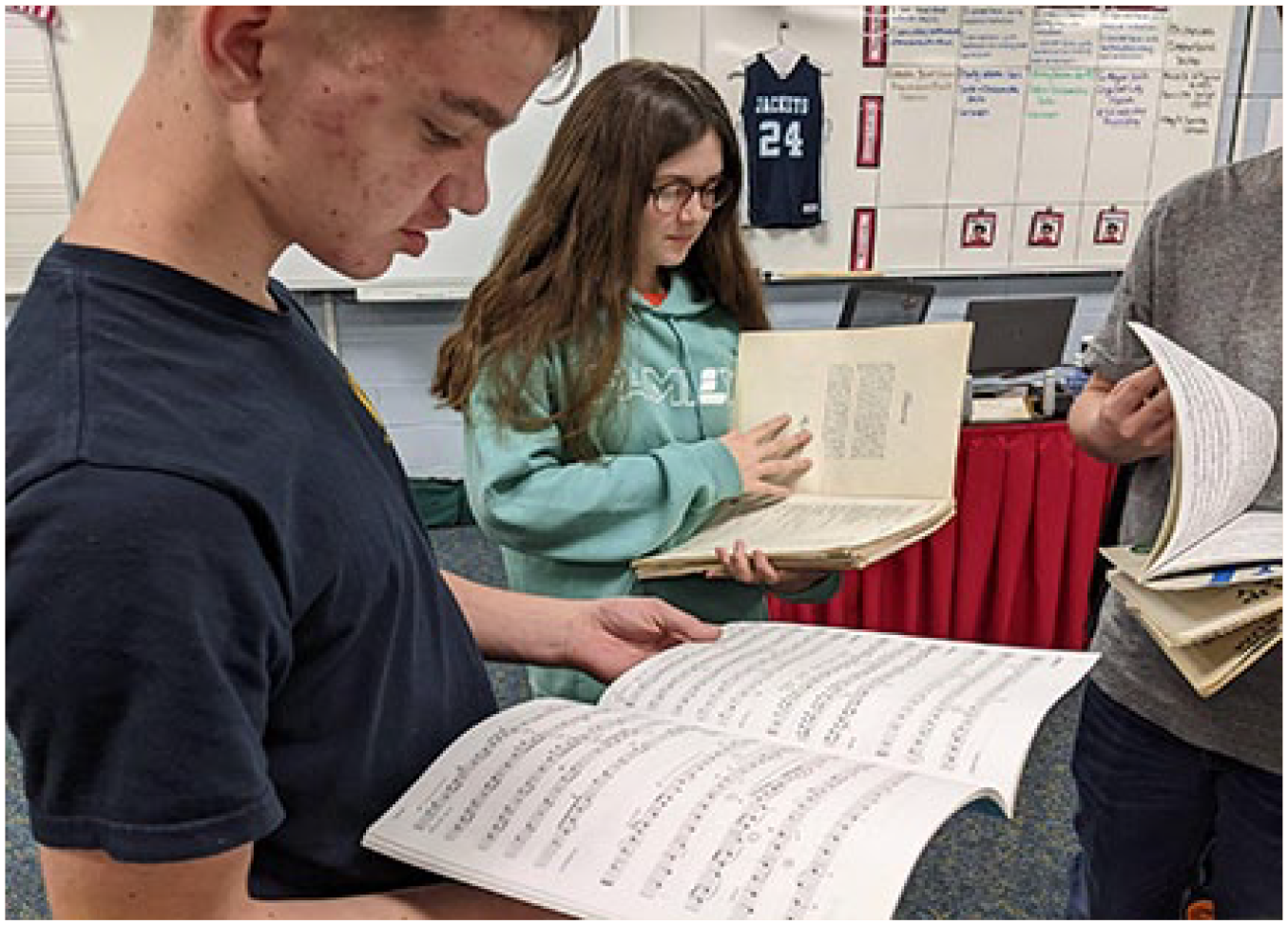
Students worked with their chamber music groups to choose their music. Students had to take into account everyone’s playing ability and music preferences when choosing their own music.
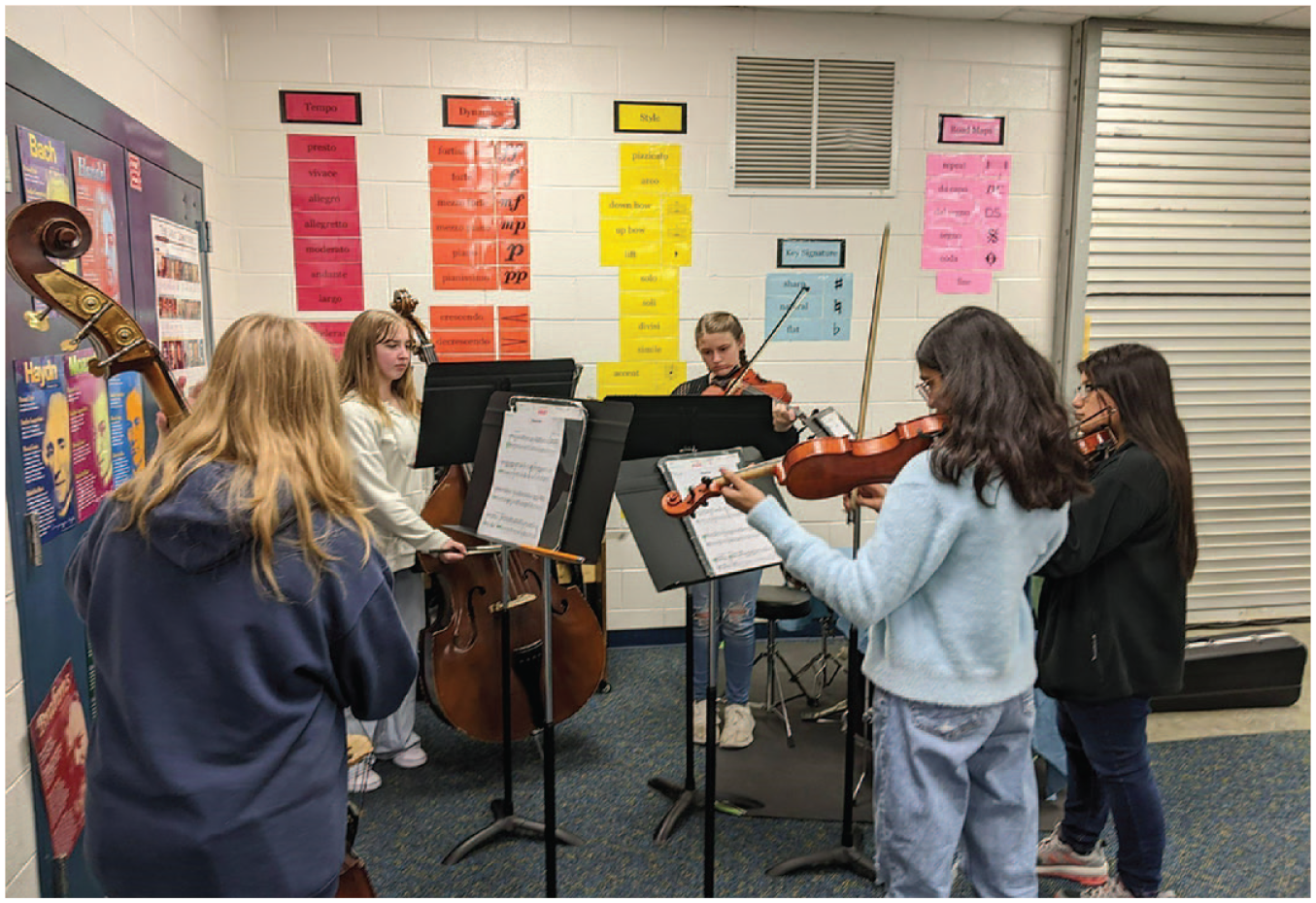
During rehearsal time, students worked with their chamber ensemble to learn and refine their music. Students assisted each other as they learned their music, and the teacher provided coaching throughout this process.
As students develop their musicianship skills, they often lean heavily on their teacher, looking for guidance on basic skills like counting rhythms and pitches, despite having already learned these concepts. Changing the learning environment from teacher centered to student centered pushed students to rely on their own growing skill set and their fellow students. Students began relying on support systems beyond the teacher to prepare for their performance. Some students used an online metronome as they were rehearsing, and many groups elected to use audio-capture capabilities on their laptops to record themselves performing and listened to the recording to conduct informal self-evaluations. Students chose their repertoire, setting their own goals and self-assessing their performances. This shift in responsibility from teacher-centered to student-centered learning made students more confident in their ability to play independently—an essential skill for any music ensemble. Utilizing scaffolded instruction and student choice coupled with an authentic music-making experience for students has the added benefits of increasing student agency and promoting lifelong musicianship. 11
Why Include Reflections?
Students reflected throughout the learning experience so I could better understand their perceptions of their own playing abilities. I wanted students to become reflective musicians with the hope that this would also increase engagement in the large-ensemble rehearsals. Reflection opportunities like this, which include open communication, celebrating successes, and goal setting, have been found to build engagement in students participating in school music programs. 12 Before students began working together on their chamber music, they completed a reflection rating their confidence level in core areas of music performance, such as their ability to read rhythms and play independently. This reflection was completed using Google Forms (Table 1). Answers from students were illuminating. An eighth-grade bass player, Carol, said, “I would like to improve my confidence. Confidence is key when playing as you could be playing everything correctly but sound terrible if not confident.” Cameron, an eighth-grade cello player, summed it up best when explaining why he wants to improve his playing of syncopation: “I want our music to sound great.” When students are thinking about their own contributions to the ensemble, engagement improves.
Preperformance Reflection

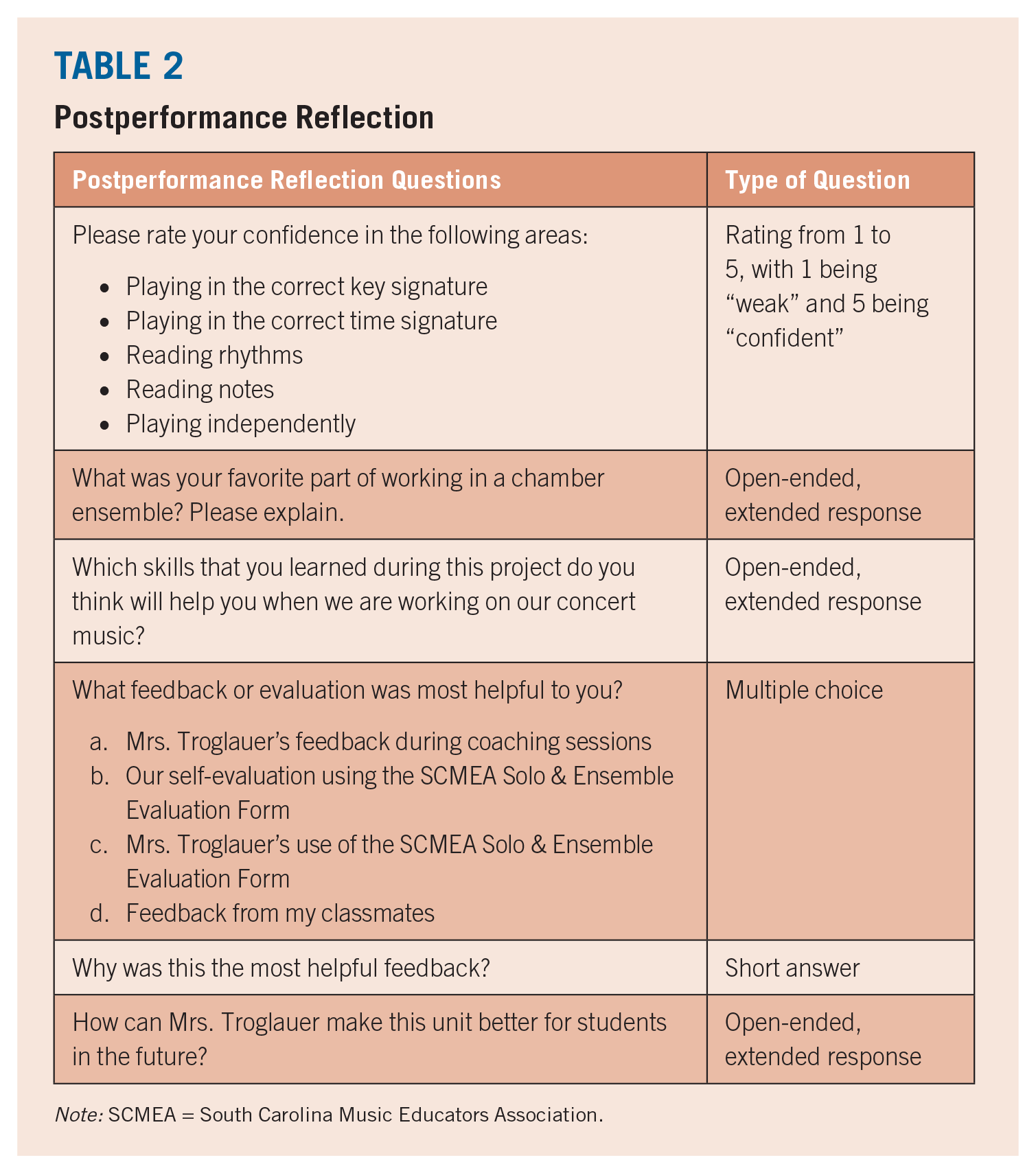
Regular, informal reflections were utilized to refocus and highlight important concepts. Students responded well to strategies such as “highs and lows,” where students share something that is going well in their group (a high) and something that still needs improvement (a low). This helped students set goals as they resumed their rehearsals. During the unit, students completed more formal pre- and postperformance reflections (Tables 1 and 2). For students, the act of simply sharing goals makes them more manageable and achievable. “I would like to improve my ability to perform in front of others due to the importance of the skill,” said Jeremy, a seventh-grade violinist. Teachers can extend the practice of reflections by asking students to share what they are interested in learning or have questions about. In my experience, seeing their teacher respond to their interests can further boost student engagement and expand their knowledge of music-related subjects. It is important to note that students have varying levels of self-efficacy, thus the sophistication of the reflections will vary. 13 Modeling thorough reflections; sharing, with permission, the reflections of others; and asking follow-up questions are excellent tools for expanding and deepening students’ reflections.
Postperformance Reflection
Note: SCMEA = South Carolina Music Educators Association.
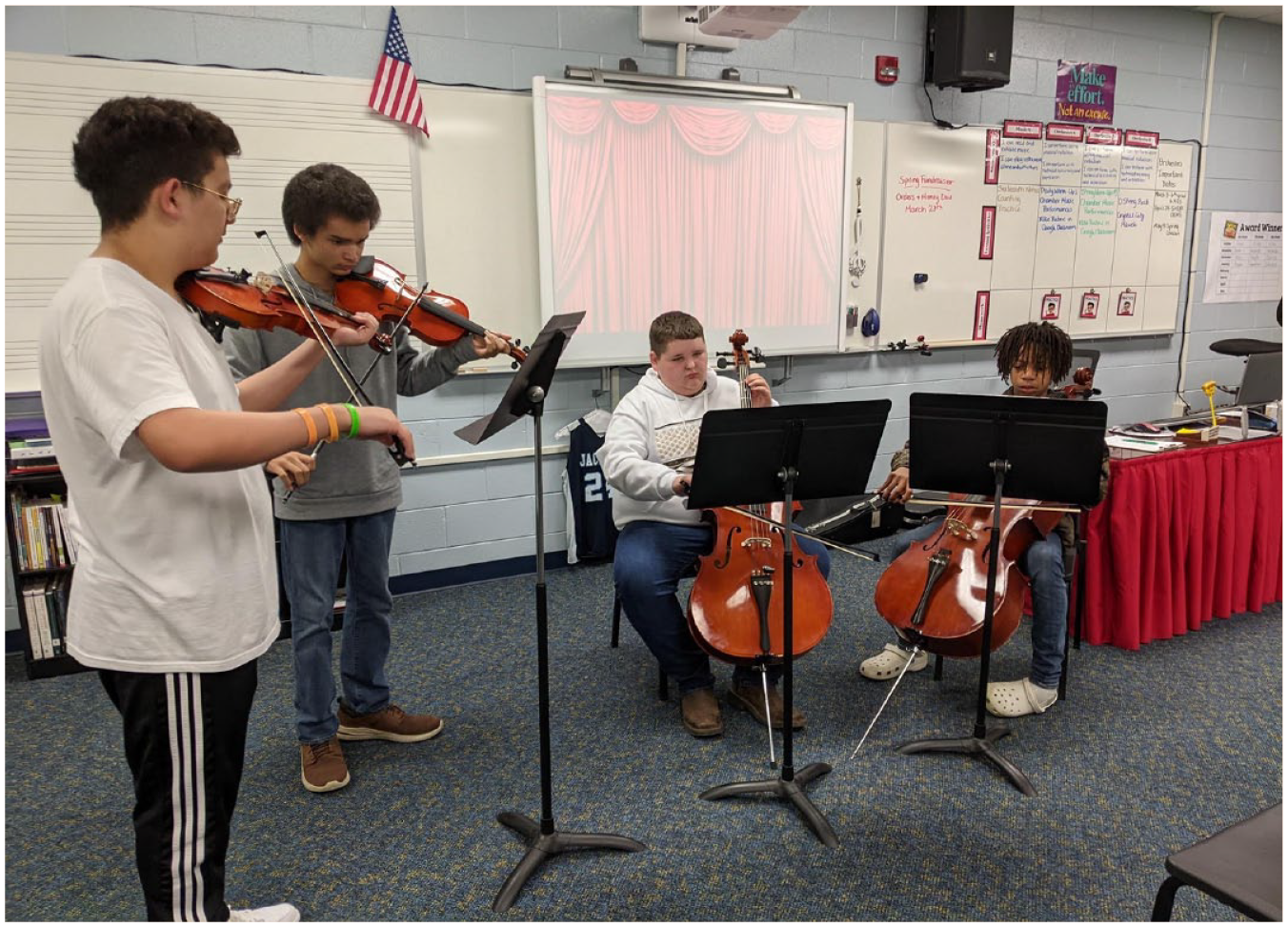
For the final assessment, students performed in their chamber ensembles for their class, teacher, and guests, including other teachers and administrators.
In their final reflection, students were also able to give suggestions on how this learning experience could be improved. To model a growth mindset and a reflective approach, I shared with students that I would use their suggestions to revise future learning experiences. Responses were varied but insightful. Some students wanted more coaching time, while others wanted a larger audience for which to perform. Sean, an eighth-grade viola player, shared, “This unit can be made better for students in the future by having more feedback before our performance evaluation. This could either be feedback by the teacher or by other students before our official performance.”
What Is the Role of the Teacher?
This chamber music unit was designed using a project-based learning framework, with the final performance serving as the project. The traditional orchestra large-ensemble rehearsal is very teacher centered and does not often involve students as musical leaders. Students can benefit from a constructivist approach in orchestra rehearsals, where learners construct knowledge by doing rather than passively taking in information. 14 Constructivist practices can both promote musical achievement and increase engagement. 15 Because most learning opportunities were structured to take place through collaboration between members of the groups, the role of the teacher was to provide structure and coaching throughout the experience. Table 3 shows how I began each class with mini lessons focused on a specific need of the students. The topics of the mini lessons were selected based on my observations and the needs of students that were presented through their reflections. Practicing student agency—in this case, through reflections—increases independence, both educationally and musically. 16 The mini lessons could be as short as 10 minutes, with the remainder of the class time spent in rehearsal. During rehearsals, I functioned more as a coach than as a teacher. I would listen, make suggestions, and ask leading questions to help scaffold student learning, but I did not engage in direct instruction. Scaffolding is necessary to bridge the gap between what students already know and what they need to perform a piece of music successfully. 17 In the small-ensemble setting, both the teacher and fellow musicians can provide scaffolding for less advanced students.
Lesson Overview

Note: SCMEA = South Carolina Music Educators Association.
Participating in this learning experience as a coach also allowed me to make more detailed observations about students’ strengths and weaknesses, provide individualized feedback, and set new goals for more advanced students during this extended time. Directly observing students’ time management and social interactions during practice time was important because it allowed me to see firsthand their practice techniques, as opposed to relying on self-reporting, which can be inaccurate. 18 With students working in smaller groups, there were more opportunities to engage in individualized, detailed observations and give feedback. Angel, a seventh-grade viola player, reflected on the feedback from my coaching by stating, “It is good to get advice from people your own age, but professional advice is always better. . . . You get more strict feedback, and more real world criticism. I personally work better with harsh criticism because it sets you up for life.”
What Does Assessment Look Like?
While the objective of this learning experience was for students to develop independence and be more engaged in rehearsals, it is also important that students strive for high-quality performances. The experience provided opportunities for students to give and receive feedback, including self-assessments, peer feedback, and coaching from the teacher. Self-assessments and peer feedback served as formative assessments (Table 3). The South Carolina Music Educators Association (SEMEA) Solo & Ensemble Evaluation Form was used for the summative assessment and for a self-evaluation the students completed as a group earlier in the unit. Many of the students participating in this learning experience went on to participate in the SCMEA Solo and Ensemble Festival, and using this rubric helped better prepare them for this adjudicated performance. Students reviewed this rubric during one of the mini lessons. This helped students set goals for their own performance, and using this rubric for a self-evaluation ensured students were aware of the expectations for their performance. Self-evaluations demonstrated that students were keenly aware of the strengths and weaknesses of their performances, and this information was used during subsequent coaching sessions. Aligning my feedback with the weaknesses identified by the students made students highly receptive to the feedback, and many groups made major improvements during and after their last coaching session.
For peer assessment, students completed the peer evaluation rubric for each performance (Table 4). This rubric includes many of the same qualifiers as the larger rubric, but it was simplified for student use. As part of the peer evaluation process, students offered constructive feedback to each group, just as they had practiced by evaluating their own performance earlier in the unit. The language in the rubric was familiar to the students, and in one of the mini lessons, students observed and practiced giving constructive criticism. It is important for the teacher to model appropriate and constructive criticism to encourage students to give “music-focused and specific” comments that would be helpful to the performers. 19 After the performances, I sent a copy of my feedback and scores, along with selected constructive feedback from their classmates, to each group member via email. This allowed students to process the feedback individually before completing the final postperformance reflection (Table 2).
Peer Evaluation Rubric

The assessments demonstrated how students had grown throughout the course of the experience. In the pre-unit reflection, 66 percent of the students rated themselves at a level 3 or above on the scale for confidence in playing independently. On the postperformance reflection, 100 percent of students rated their confidence level in playing independently at a level 3 or above. Additionally, in the postperformance reflections, 100 percent of the students rated themselves at a level 3 or above in their confidence in reading their notes and playing correct rhythms. Sean, an eighth-grade viola player, shared the importance of learning experiences like this: “Being able to perform confidently is a skill that takes time to develop and opportunities like this help us work on our performing skills.”
Recommendations for Implementation
The results of this learning experience are far-reaching and profound. Students are excited to come to orchestra class, and many have asked when they can play in their small ensembles again. Angel, a seventh-grade viola player, said this about future learning experiences in orchestra: “More group work! This Solo and Ensemble visibly helped so many people by working with their friends and learning to stay on task and have fun!” After returning to large-ensemble rehearsals, I observed that students were more engaged, offering more suggestions to improve their musical performance. One interesting result was that students became more aware of how important the choice of literature is for a performing ensemble. Students now ask why I have chosen pieces for us to play, and many are suggesting pieces for me to review for future performances based on their observations of the musical skills of their classmates. Further interest in the entire rehearsal process is an indicator of more engagement and excitement for learning, 20 which was one of my goals for this unit.
The following recommendations may assist music teachers wishing to create a similar experience for their students:
This learning experience was exciting for the students, which helped open them up to feedback from the teacher and peers. Setting aside time in the classroom for chamber music expands students’ skills as musicians, and skills honed through this type of learning will enhance and improve large-ensemble rehearsals. Helping students develop the practice of reflection and self-evaluation through chamber music will also foster engagement in large-ensemble rehearsals for the school orchestra. Many students discovered a love of chamber music through this experience as well!
In the open-ended questions on the reflection form, students shared what they learned most during this experience. The insight shared by the students was impactful. For example, Wendy, an eighth-grade bass player, shared her understanding of the importance of communication when playing in the orchestra: “One of the main skills I’ve learned during this group performance assignment is that communication is way more important in music than I thought it was. Before, I thought that we could just play together and we’d all be able to follow along, but it takes so much more communication for it to sound right.” This is a goal for all teachers: for their students not to just follow along as they learn music but to communicate with each other and with the audience. This is what brings a performance to life!
Footnotes

Notes
April Troglauer (
Anna Morrison (