




Abstract
Music educators are required to support the learning needs of those they teach. Some students may require additional or specific learning supports through individualized education programs (IEPs), also known as individualized education plans, to ensure their academic success. Music educators may struggle to transfer IEP goals, accommodations, and/or modifications into the music setting. In this article, we explain the IEP process and document, offer tips on accessing IEPs, and provide recommendations for implementing IEPs in the music setting.
Keywords
Photo of Rachel Grimsby courtesy of the author

Photo of Sara Jones courtesy of the author

The Individuals with Disabilities Education Act (IDEA) is legislation meant to ensure that all students with disabilities receive a free, appropriate public education in the least restrictive environment possible.
1
The zero-reject principle of IDEA means that all students should have equal access to the curriculum and that no student can be excluded from learning, regardless of the nature or type of disability.
2
IDEA determines how special education services are provided to students with disabilities, including early intervention, special education, and related services. The law states, Disability is a natural part of the human experience and in no way diminishes the right of individuals to participate in or contribute to society. Improving educational results for children with disabilities is an essential element of our national policy of ensuring equality of opportunity, full participation, independent living, and economic self-sufficiency for individuals with disabilities.
3
As of the 2021–2022 school year, 7.3 million students received special education services. This number accounts for 15 percent of total public school enrollment. 4 Once a student qualifies for special education services, a school team of administrators, teachers, and related service providers works with parents, and sometimes the student, to develop an individualized education program (IEP). 5 An IEP is an agreement between the student and the school outlining academic, behavioral, and social goals and expectations to promote the individual’s success.
Music education researcher Alice-Ann Darrow notes that in the field of music education, disability is “often forgotten, dismissed or overlooked as an important part of what we consider to be diversity.” 6 Music teachers have indicated that they feel underprepared to teach in inclusive settings and a level of discomfort with IEPs. 7 Consequently, many music teachers do not fully understand the IEP process or how to read, interpret, and implement IEPs in their classrooms. 8 Music educators who are informed on policy and the IEP process may be better situated to include students with IEPs in their classroom. 9 In this article we hope to help music educators better understand the IEP process, key personnel who participate in that process, and how to implement IEPs into the music setting.
The IEP Process
IEPs have been mandated by federal law since the Education for All Handicapped Children Act (EAHCA) in 1975. EAHCA was eventually reauthorized as IDEA in 1990. A link to the history of IDEA reauthorizations may be found along with a glossary of terms and related websites in Appendix A. While states must adhere to IDEA legislation to receive funding for special education, interpretations of IDEA differ from state to state. 10 As we cannot be specific to individual states’ IEP documentation in this article, a state-by-state resource has been provided in Appendix B that links to online IEP templates as well as each state’s department of education special education website.
The process for developing the IEP is often murky for people who have not gone through it themselves. The first step in the IEP process is for schools to identify students who may need special education and related services through a process called “child find.” 11 This is a statewide comprehensive system through which students who may need services are located. Students also can be referred for evaluation by school professionals and parents or caregivers. Caregiver consent is required before a student can be evaluated. 12
The next step is evaluating the student to assess strengths and challenges based on baseline data collected, such as observations during instructional time, observations of social interactions, classroom evaluation data, testing data (e.g., Stanford-Binet IQ and Wechsler Scale, DRA-2), class work, and speech and language evaluations. These data also help stakeholders establish a present level of performance (PLP; also known as the present level of academic achievement and functional performance, or PLAAFP). A student’s PLP includes documentation of how the student’s disability affects their engagement in the general education classroom and progress toward learning targets. A PLP may include functional, academic, and social-behavioral goals depending on the individual student’s needs. The evaluation must be completed either within 60 days of receiving parental consent or within the state’s established timeline. 13 If a caregiver disagrees with an initial evaluation, they have the right to request an independent educational evaluation.
Once the student is evaluated, school personnel and the caregivers meet to determine the student’s eligibility for special education services. 14 If the student is found eligible, the IEP team is required to schedule an IEP meeting within 30 days. 15 The school is required to contact the participants to notify them of the meeting, provide details of the meeting (i.e., time, location, purpose, attendees), and inform caregivers that they may invite people to the meeting who know the student well or have applicable knowledge about the individual. Each student with an IEP is assigned a case manager, who is the point of contact for caregivers and teachers. The case manager is usually a special education teacher or another member of the IEP team.
After the meeting is held, the IEP is written, and caregivers have given consent for special education services, the school begins implementing the IEP. 16 Caregivers receive a copy of the IEP and, in most states, have the option to refuse services or request edits within 10 days. 17 While the federal law has specific requirements for IEPs, states and school districts may design their own document to include additional information that may be pertinent. 18 This means that each IEP form may be different from school to school, but the basic content should be the same. Each of the student’s teachers and service providers also must have access to a copy so that they can carry out the required accommodations, modifications, and supports as applicable toward the student achieving their learning goals. Services can include special education in small groups and one-to-one learning in a resource room or teacher consult services within the classroom. Other examples of these services could include counseling groups (social/behavioral goals), speech and language (academic/social goals), or occupational therapy (functional goals). The need for assistive devices and/or support personnel (e.g., paraprofessional) also is included in the IEP. These services, accommodations, modifications, and potential device needs are what structure the student’s least restrictive environment (LRE).
Depending on the student’s age and grade level, the IEP will include a section regarding whether the student will participate in required state- and district-wide testing or if alternative testing is necessary. If a student is able to participate in state- and district-wide testing, the list of accommodations would be provided. These accommodations may include an alternative testing room, having the test read aloud to them, having extended time, or being allowed the use of assistive technology.
Other items within the IEP include participation with peers who are not disabled, transition services, and transportation. Depending on the state in which you teach, the section describing the student’s LRE includes information on participation with or the need for learning spaces that do not include students without disabilities. Transition services may relate to transitioning the student from elementary, middle, or high school or adult education programs and/or transitioning the student out of the public school system, but they must include the latter. These transition goals also may be written as independent-functioning or independent-living goals. Transition goals may be referred to as “postschool” goals. 19 Classes or activities to support postschool goals as well as transportation needs are typically listed at the end of the IEP document.
Once the IEP document is approved and the 10-day change period has passed, the student will then receive services provided by the local education agency to support learning in that student’s LRE. The school is required to measure the student’s progress toward their goals annually, give reports to caregivers, and review the document at least once a year to determine the student’s growth and make revisions. Students with an IEP should then be reevaluated at least once every three years. 20
Accessing and Translating IEP Goals into the Music Context
Accessing the IEP
Everyone who is involved in a student’s education should have access to the student’s IEP and understand their role in its implementation. 21 This includes music teachers; however, recent studies indicate that many music educators either lack full access or are denied access to student IEPs. 22 Some administrators and case managers deny music teachers access because they assume that the music classroom is more experiential than academic in nature. However, as music educators work directly with the student, it is illegal not to receive full access to the IEP document (i.e., more than a goals sheet or IEP summary). 23 According to IDEA, “any other service provider (such as a paraprofessional) who will be responsible for a part of the student’s education . . . needs to know what [their] specific responsibilities are for carrying out the child’s IEP.” 24 IEP access may be provided by a printed copy placed in the educators’ school mailbox or through an online IEP retrieval system. Music teachers may need to educate administrators and special educators about the importance of the IEP in the music classroom. This could happen through sharing learning goals and assessments, documenting student growth, requesting more support for implementing IEPs, and asking to engage more fully with the IEP process. 25 If access to the IEP is still a difficulty after taking these steps, teachers may want to contact the district administrator who oversees the special education program to ask for guidance.
Once music teachers gain access to student IEPs, it is important to consult the document periodically. We recommend that teachers use a spreadsheet or create a summary document in which they note which students have IEPs, track goals for each student, indicate the required accommodations and modifications, monitor which supports work best for students, and log how frequently supports are utilized by the student (see Table 1). In some districts, educators may be prohibited from placing IEP information in separate documents, such as spreadsheets. In this case, we recommend using a different system, such as color coding or symbols on a seating chart, to provide the educator with reminders of a student’s learning needs.
Spreadsheet Example
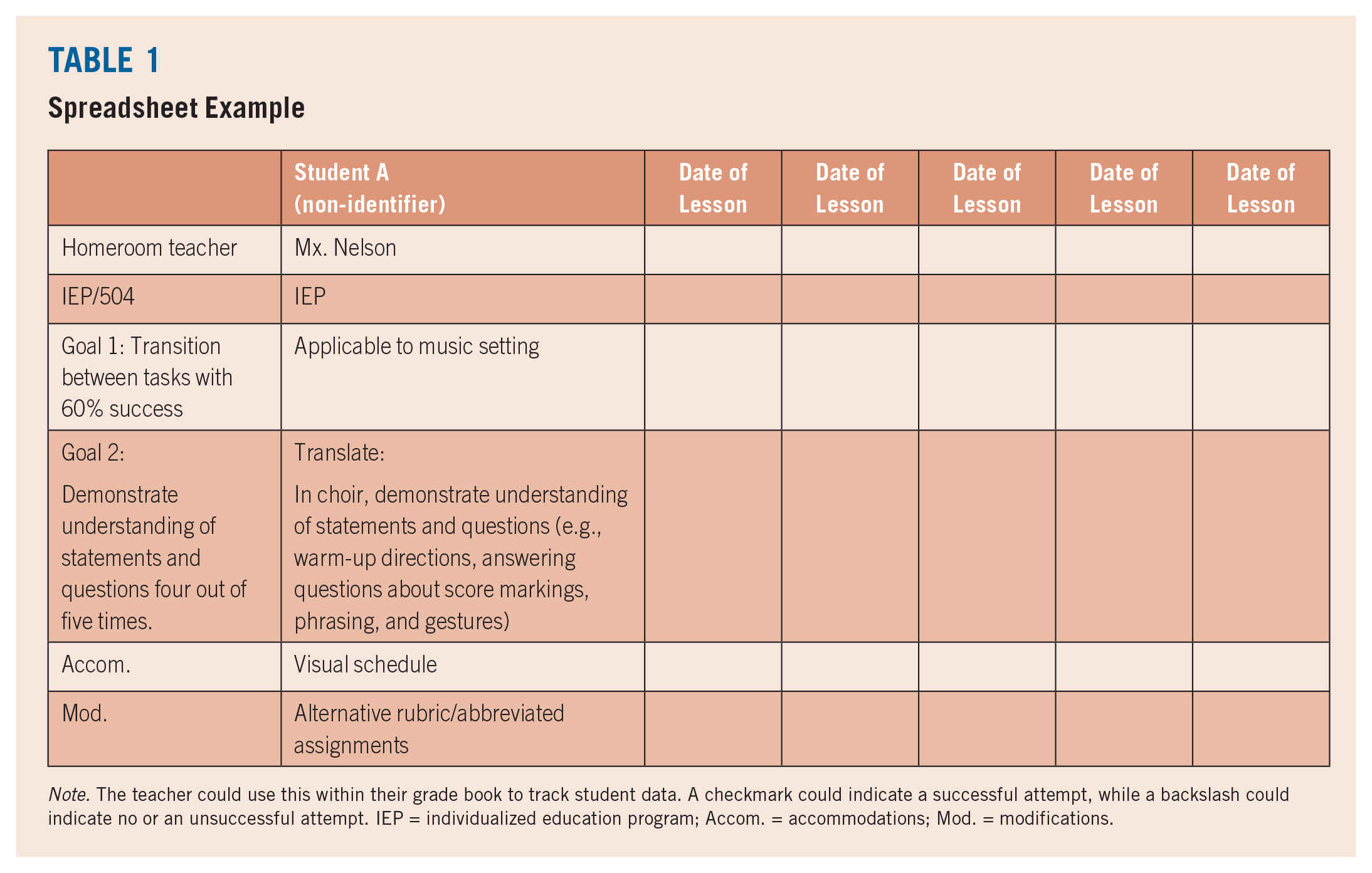
Note. The teacher could use this within their grade book to track student data. A checkmark could indicate a successful attempt, while a backslash could indicate no or an unsuccessful attempt. IEP = individualized education program; Accom. = accommodations; Mod. = modifications.
This information is useful for the teacher, but it also is helpful information to share with the IEP team or case manager when they ask about student performance and progress. If items such as adaptive devices or large-print music are needed for student accommodations, most schools have a special education budget that can be used to fund those purchases. These requests are usually sent to the IEP team or special education area. When communicating with the case manager, IEP team, or special education area, it is important to make sure that everything is documented in writing and saved. Emails are a particularly effective means for documentation due to the time-and-date stamp. Teachers may also want to put a monthly reminder into their calendars to check in on student progress with the case manager.
IEP meetings, depending on the district, may be scheduled throughout the week or on specific days when all stakeholders (case manager, classroom teacher, speech language pathologist, school psychologist, etc.) are available. Floating substitutes often are utilized to allow these stakeholders to attend the IEP. As these meetings must be scheduled with advanced notice, a music educator could request a floating substitute be assigned to them so they can attend the IEP meeting.
However, it is not realistic for music educators to attend IEP meetings for each student they teach since many music educators teach every child in the school. That does not mean they cannot or should not participate in the process. As music educators see students daily or weekly, and over contiguous years, depending on their teaching level and specialty, they are essential to the IEP process. In addition, a music educator who can consistently implement nonmusic goals into the music setting provides students with extra support in achieving their learning goals (see Table 2).
Example IEP Goals
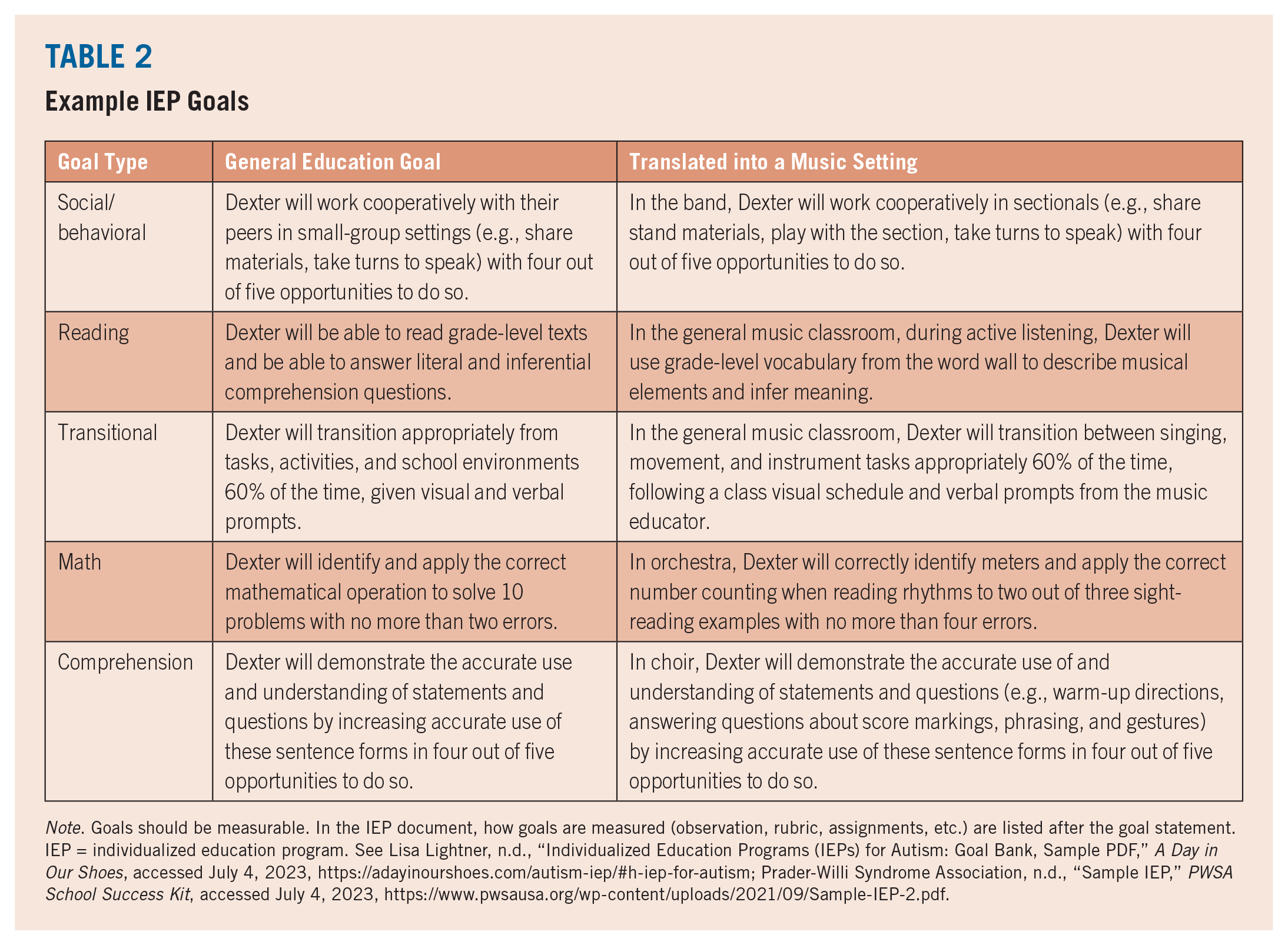
Note. Goals should be measurable. In the IEP document, how goals are measured (observation, rubric, assignments, etc.) are listed after the goal statement. IEP = individualized education program. See Lisa Lightner, n.d., “Individualized Education Programs (IEPs) for Autism: Goal Bank, Sample PDF,” A Day in Our Shoes, accessed July 4, 2023, https://adayinourshoes.com/autism-iep/#h-iep-for-autism; Prader-Willi Syndrome Association, n.d., “Sample IEP,” PWSA School Success Kit, accessed July 4, 2023, https://www.pwsausa.org/wp-content/uploads/2021/09/Sample-IEP-2.pdf.
Translating the IEP
Some music teachers have indicated that they have difficulty with the IEP because they feel IEP goals and objectives are written with general education in mind and are not applicable to the general music classroom or ensemble setting. 26 To assist the reader with translating IEP goals into the music setting, we would like to introduce Dexter. An eighth-grade student with cerebral palsy and a language delay, Dexter loves music and is enrolled in multiple music classes. They have an IEP to scaffold their academic success. A common practice in developing annual IEP goals is to make them SMART: specific, measurable, achievable (or attainable), relevant, and time bound. 27 An example of an annual goal for a student with cerebral palsy might be “Dexter will demonstrate and maintain appropriate bow hold for five minutes for three out of five attempts each rehearsal throughout the first nine weeks.” This goal is specific because it addresses bow hold, and it is measurable because the music educator can observe and track the number of times Dexter demonstrates correct bow hold. The goal is achievable because five minutes is a short amount of time and relevant because it is related to a possible functional/academic goal. Finally, this goal is time bound as it is measured within a class period over a nine-week period. The IEP also outlines how goals are measured. In the example, Dexter’s orchestra teacher would collect data through observation and track data through something as simple as a sticky note with tally marks. Other means of measuring could be teacher-/specialist-developed rubrics, checklists, and/or student check-ins. How the annual goal will be measured and the timetable for measuring each goal (e.g., every two weeks, monthly, quarterly) are included for each goal within the IEP.
Accommodations and modifications for the student follow the list of learning goals and are provided for the student in each IEP. These may include, but are not limited to, additional time, learning space, and the accessibility and presentation of learning materials. Accommodations are supports that “level the playing field.” They focus on how instruction is provided. When a student is unable to find success with accommodations, then modifications to the environment, instruction, and/or curricula are necessary. Modifications are changes to what is taught, ensuring that learning objectives are appropriate and attainable for the student. 28 The need for assistive devices and/or support personnel (e.g., paraprofessional) also is included in the IEP. These services and accommodations and modifications are what structure the student’s LRE. Sample lists of instructional accommodations and modifications may be found in Tables 3 and 4.
Examples of Accommodations
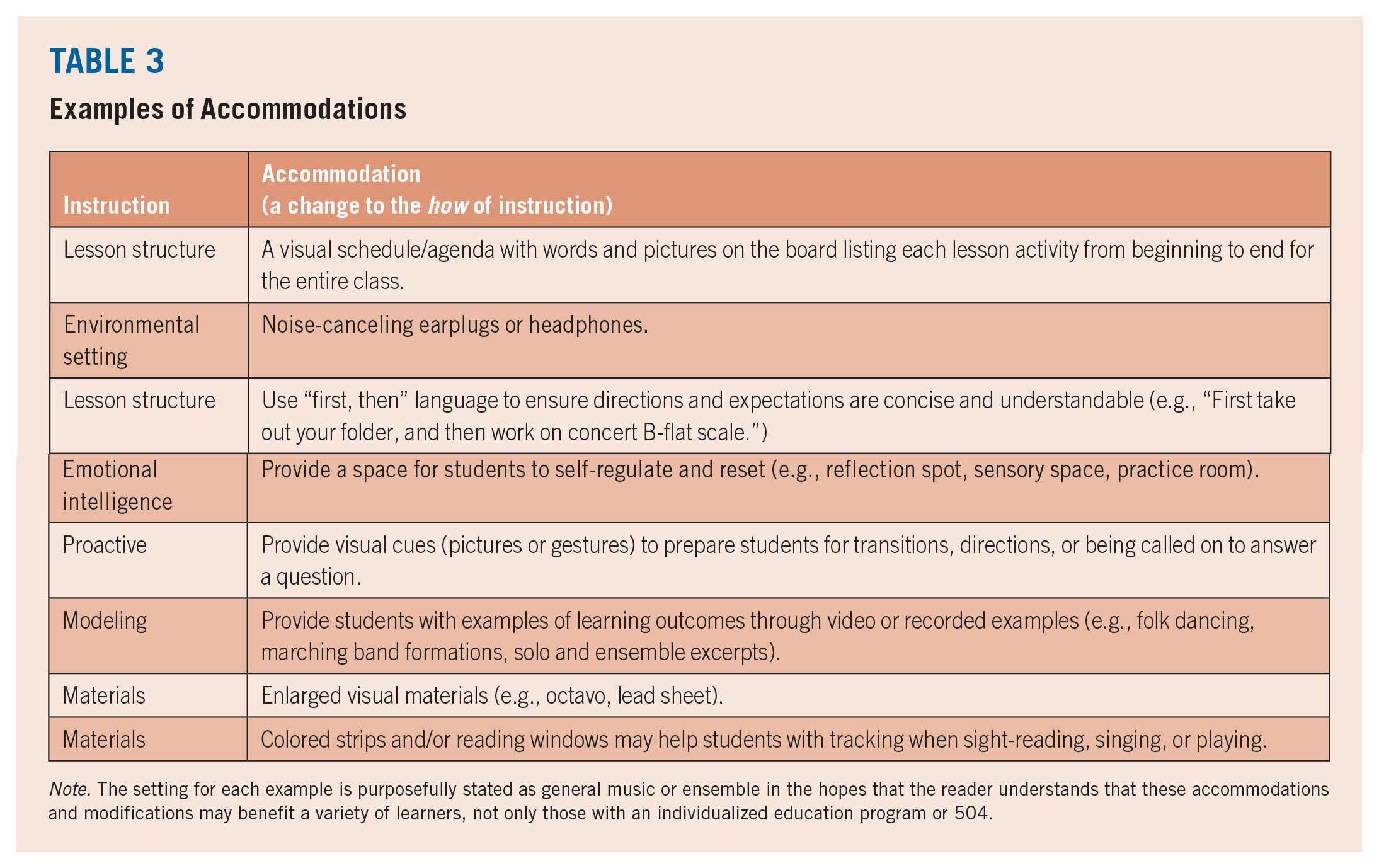
Note. The setting for each example is purposefully stated as general music or ensemble in the hopes that the reader understands that these accommodations and modifications may benefit a variety of learners, not only those with an individualized education program or 504.
Examples of Modifications
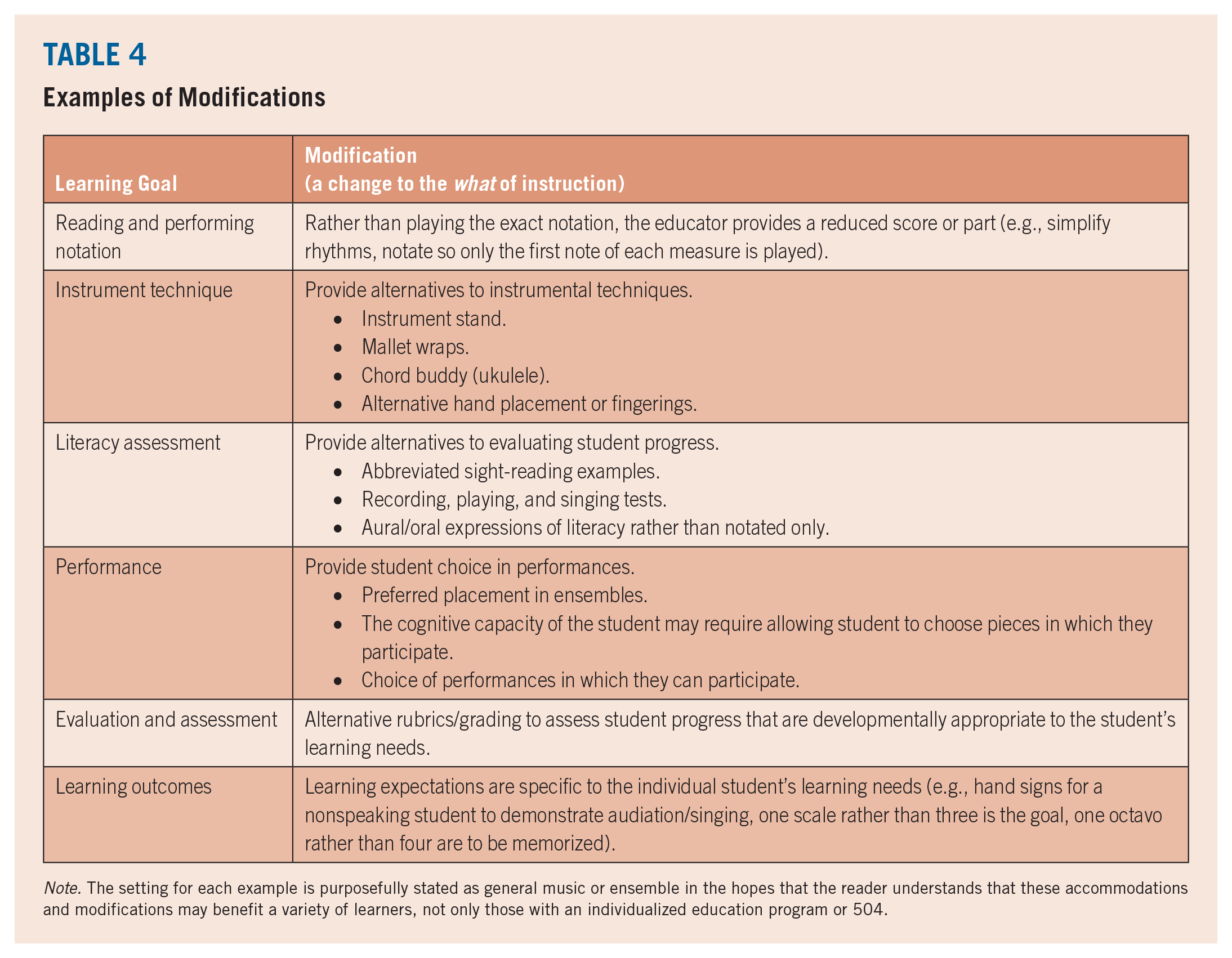
Note. The setting for each example is purposefully stated as general music or ensemble in the hopes that the reader understands that these accommodations and modifications may benefit a variety of learners, not only those with an individualized education program or 504.
Tracking Data and Advocating for Services
A music educator can also track data in their classroom to support a student’s progress toward meeting their annual goals. Tracking data does not always have to be through “rigorous” measures. A seating chart, paper or electronic, or dated lesson plan, where one may tick each time a student models expected behavior, provides valuable data. A tally mark within a score or octavo where the student successfully demonstrates meeting a goal (bow hold, embouchure, fingering, or phrasing) also can be valuable data. Assignments such as recordings of solo singing/playing, scale tests, or sectional work can be considered evidence. Simple written observations, such as “Dexter transitioned between each activity, waited their turn for the singing game, and demonstrated comprehension of musical elements during active listening. Dated 9–18–24,” also are valuable evidence. These seating charts, lesson plans, or scores with tally marks can be copied and placed in the student’s case manager’s mailbox, or written observations of this progress could be emailed before a student’s IEP meeting. The data a music educator collects can provide valuable information to the IEP team on a student’s progress toward meeting their annual goals.
A music educator does not have to wait for a student to have an IEP to collect data. Any teacher can recommend students for child find based on observations of communication, behavior, and movement in the music classroom. Noting a student’s inability to cross their midline may indicate a reading, language, or writing delay. 29 Younger students who struggle to synchronize on the beat may have auditory and/or communication differences, such as stuttering. 30 While this is not the case for every student who cannot cross the midline or maintain a steady beat, the observations a music educator collects may serve as additional supporting data that will allow a student to qualify for needed educational support services.
Conclusion
The purpose of this article was to outline the development of the IEP document and its implementation in the music setting. We have reviewed each section of the IEP, what information it holds, and how to translate learning goals into the music setting. Finally, we shared suggestions on how music educators may participate in the process, advocate for access to the IEP document, and track meaningful student data to support and/or identify learning needs.
While the IEP process can seem overwhelming, a music educator is a vital component of developing and implementing the IEP document. Music educators often are part of a student’s life for contiguous years and may have a deeper understanding of student learning needs. A music educator’s insight, data, and knowledge of students can provide useful information in developing and implementing IEP goals. When music educators are included in the IEP process and have a better understanding of their role in how to implement IEP goals across instruction, the success of the student is impacted both in and outside of the music classroom.
Footnotes
Appendix A
Appendix B

Notes
Rachel Grimsby (
Sara Jones (