




Abstract
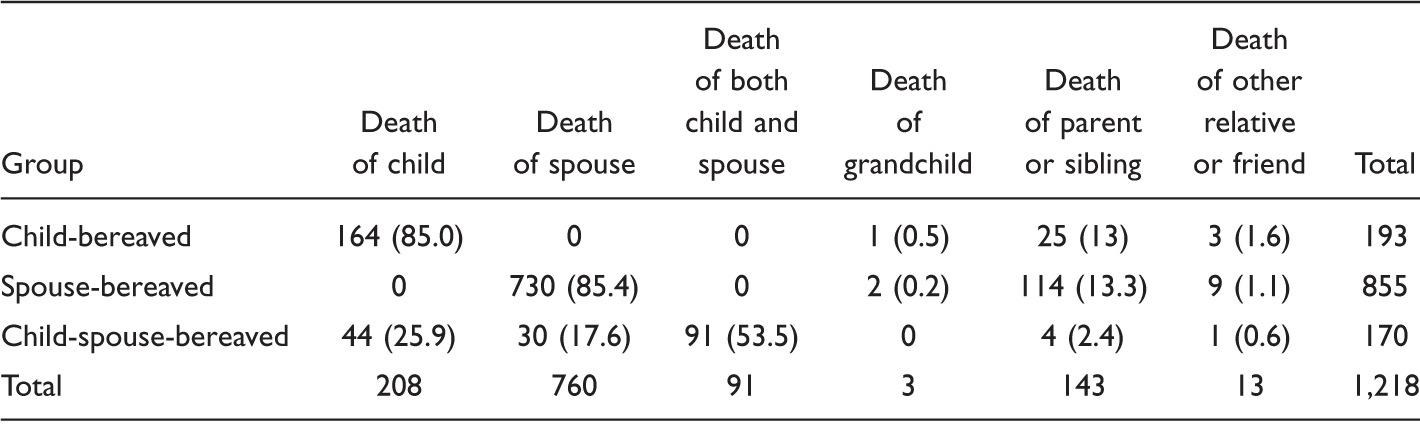
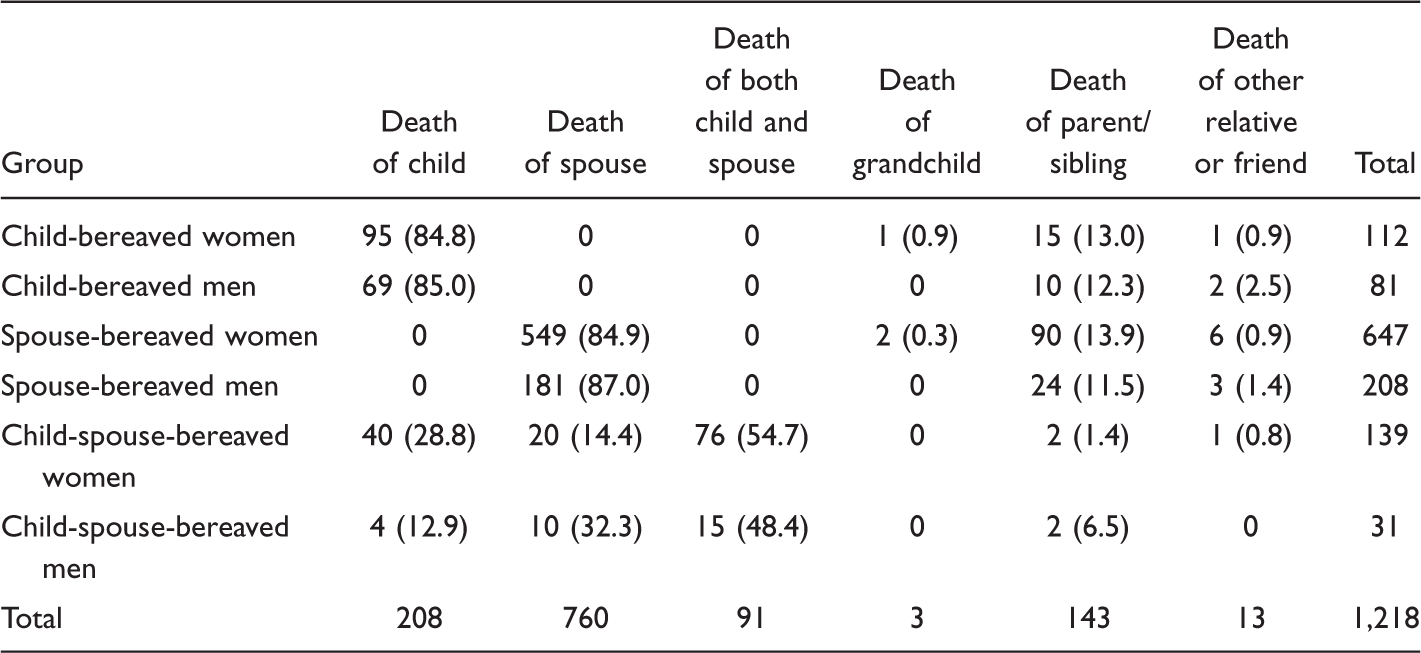
Losing a child or a spouse is described as the worst of experiences. However, it is not known whether older adults bereaved of a child, spouse, or both child and spouse experience these losses as among the most important negative events in their lifetime. The aim of this study was to investigate whether the 1,437 older adults bereaved of a child, spouse, or both included in the southern part of the Swedish National Study of Aging and Care mentioned these losses when asked about their three most important negative life events. Gender differences in their choices of important negative life events were also explored. About 70% of those bereaved of a child or a spouse mentioned these losses as among their three most important negative life experiences. In the child-and-spouse-bereaved group, 48% mentioned both the loss of their child and spouse, while 40% mentioned either the loss of a child or a spouse. Gender differences were only found in the child-and-spouse-bereaved group, with a few more women mentioning the loss of the child but not the spouse, and the men showing the opposite pattern.
Introduction
During the past five to six decades, research has been conducted regarding which life events are rated as negative or stressful—words often interchangeable used in this research tradition and the loss of a loved one has, in this context, been described as highly negative (Aldwin, 1990; Holmes & Rahe, 1967; Miller & Rahe, 1997; Sutin, Costa, Wethington, & Eaton, 2010). However, a circumstance that may contribute to methodological problems is that the ratings in some studies are based on individuals’ opinions about which life events would be most difficult to adjust to (Holmes & Rahe, 1967; Miller & Rahe, 1997). Thus, the respondents had not necessarily experienced the events themselves. For example, the instruction given by Holmes and Rahe (1967) when rating the different life events was as follows: “… use all of your experience in arriving at your answer. This means personal experience where it applies as well as what you have learned to be the case for others” (p. 213).
Research with the original and frequently used scale by Holmes and Rahe from 1967, The Social Readjustment Rating Scale, including such events as job-related issues, marriage and economical problems, the birth of a child, and other events occurring with higher frequency in younger adults, have found the death of spouse to be rated as the most negative event. When loss of a child was included as an event decades later, the death of a child was found to be most negative for women, followed by the death of spouse. The opposite pattern was seen among the men (Miller & Rahe, 1997). However, the same methodological problem as mentioned earlier can be seen in that study.
As the life event research developed, a measure with relevance to older adults, the Elders Life Stress Inventory (ELSI) was developed (Aldwin, 1990). In the ELSI, the older adults reported events they had actually experienced and rated how stressful they were using a scale from 1 (not at all stressful) to 5 (extremely stressful). In the study by Aldwin (1990), two samples were investigated: the California sample including 308 men and women and the Normative Aging Study including 1,487 men. The loss of a child was found to be most stressful in both samples, followed by the loss of a spouse. However, the death of a child was the least reported life event, mentioned only once in the first sample and 14 times in the latter. In the Aldwin study (1990), no gender differences were reported.
Research conclusions describe the death of a child or a spouse as the most negative life events (Holmes & Rahe, 1967; Miller & Rahe, 1997). These conclusions are usually based on scales on which participants choose the most negative event from a prepared list. Still, the participants have not necessarily experienced the events themselves. Gender differences have been found in some of these studies, with women choosing the loss of a child as the most difficult life event, and men choosing the loss of a spouse. However, the results of gender differences, often based on small samples, are inconclusive with findings sometimes indicating that men also find the loss of a child as the most negative event. In addition, there is no information of the experiences of those having lost both a child and a spouse. Furthermore, previous used life event scales do not include other traumatic events such as abuse, accident, and so forth. Therefore, we do not know if the experience of losing a child, spouse, or both, even if perceived as highly negative, is experienced as the most negative life events throughout life.
In this study, the first aim was to explore which life events older adults bereaved of child, spouse, or both choose freely when asked to name their three most important negative life events. The second aim was to explore gender differences in their choices of life events.
Method
Sample
The research sample was drawn from the Swedish national study on aging and care (SNAC), which is a sequential, population-based longitudinal and interdisciplinary study, conducted in four study areas in Sweden. The sample in the present study was collected from two of the four areas: Blekinge (SNAC-B) and Skåne (GÅS, Good Aging in Skåne). Six municipalities were included, one in SNAC-B (Karlskrona) and five in GÅS (Malmö, Eslöv, Hässleholm, Osby, and Ystad). More information about the design of the total SNAC is found in an earlier publication (Lagergren et al., 2004). Survey data were collected in 2001–2003 and a total of 4,333 randomly selected individuals (60.5 %) agreed to join the study. Ten cohorts were selected from the following ages: 60 (n = 901), 66 (n = 879), 72 (n = 471), 78 (n = 426), 81 (n = 427), 84 (n = 438), 87 (n = 349), 90 (n = 288), 93 (n = 136), and 96 years (n = 18). In total, 2,453 (56.6 %) were women and 1,880 (43.4 %) were men. This gender distribution corresponds to similar cohorts in the Swedish population according to Statistics Sweden (2013). Of those who did not participate (n = 2,872), 311 (11%) died before the study started and 2007 (70%) said they were not interested in taking part. Another 288 subjects (10%) declined due to poor health or low functional ability. The research staff could not reach 131 (4%) respondents, and the remaining 135 (5%) were excluded for other reasons such as having moved away from the area or lacking language skills and access to translation help.
Ethics
The study received ethical permission from the Faculty of Medicine at Lund University (LU 605-00, LU 744-00).
Procedure
Initially, an invitation to take part in the study was sent to the potential participants by mail. Those who had not responded were invited again by telephone. If the respondent declined to participate, the reason for this was recorded. Assessments conducted by the research staff consisted of medical examinations, cognitive tests, and survey questions. Informed consent was obtained in writing from the participants. The three most important negative life events were collected by the research staff in a personal interview using the open-ended question: “What have been your three most important negative life experiences in life?” Thereafter, the research staff asked the participants what negative life events had occurred during life with the modified 25 ELSI questions. The age of the participant when the life event occurred was also collected. If the participants were unable to come to the research centre, they were offered a home visit.
Instrument and Measurements
The survey questionnaire contained demographic questions (e.g., age, gender, and marital status), a life event scale, and questions about which three events participants perceived as the most negative from a lifetime perspective.
Information about the loss of a child or a spouse was collected from a modified version of ELSI (Aldwin, 1990) including 25 negative life events relevant to older adults, such as various losses, relational problems, and financial worries. In the SNAC version of ELSI, the participants were not asked to rate how stressful the experienced events had been. Three different bereavement groups were mutually exclusive and were coded as child-bereaved (n = 227), spouse-bereaved (n = 1,023), and child-spouse-bereaved (n = 187).
In the questionnaire, the participants were asked about their three most important negative experiences in life. The different bereavements mentioned were child, spouse, child and spouse, parent, siblings, grandchild, or friend. Two researchers coded the categories independently. Other events mentioned were morbidity in self or loved ones, relational problems (divorce, broken contact, etc.), abuse or sexual abuse, alcohol or drug addiction in oneself or a family member, work-related problems, and other events. The difficult life experiences in the other event category included a variety of events such as memories from World War II, poverty or neglect in childhood, or traumatic life events such as accidently killing a person in a traffic accident. The other event category included also recent events such as moved from home or fell in the bathtub.
Most of the participants in the child-and-spouse-bereaved group had lost their child first and then their spouse (n = 88, 44 women and 44 men). Mean time since the child loss was about 31 years. As many women as men had lost their spouse first (n = 44, 22 women and 22 men). Mean time since the loss of their spouse was 14 years. There were missing values for 53 individuals.
Statistical Method
Chi-square tests were used to investigate the proportions between groups and gender differences regarding the three most important negative life events. The statistical analyses were calculated using SPSS, version 22.
Results
Most Important Negative Life Experiences Reported by Bereaved Groups.
Note. n (%) is within groups.
Most Important Negative Life Experiences Reported by Gender.
Note. n (%) is within groups.
Discussion
When asked to name the three most important negative experiences in their lifetimes, the vast majority of all three bereaved groups mentioned the loss of a child, spouse, or both. However, in the groups who had lost either a child or a spouse, a third of the participants did not mention child or spouse deaths at all. In the child-spouse-bereaved group, only 9% did not mention either child or spouse death among their most important negative life events. There were no gender differences between the groups, except in the child-spouse-bereaved group, in which somewhat more women than men named the loss of their child but not their spouse, whereas the opposite pattern was found among the men.
As far as we know, this is the first study to explore the free descriptions of the most important negative life events of those bereaved of a child or spouse or both child and spouse. The results reflect the fact that relationships and family bonds are important, and harm to or loss of a loved one is painful (Aldwin, 1990; Aldwin & Yancura, 2010). Implicit in the focus of many studies in bereavement research is a direct effect model in which exposure to different bereavements is supposed to have a direct effect on mental health or other outcome measures (Li, Precht, Mortensen, & Olsen, 2003; Rostila, Saarela, & Kawachi, 2012; Stroebe, Schut, & Stroebe, 2007). In two earlier studies conducted by the authors, the effects of child-, spouse-, and child-and-spouse-bereaved on life satisfaction (Bratt, Stenström, & Rennemark, 2016b) and mortality risk (Bratt, Stenström, & Rennemark, 2016a) were explored. The results showed only marginal effects on life satisfaction and mortality, and type of loss did not seem to determine outcome. Even though most participants in the bereaved groups reported the loss of a child or spouse to be among their three most important negative life events, some mentioned the loss of other family members or friends and others did not mention bereavements at all. Some participants in the latter group selected other traumas such as abuse, sexual abuse, and traumatic memories from war. Available life event scales do not include these other traumatic life events, and researchers who use them conclude that the loss of a loved one is the most difficult life event do not compare that loss with other traumas.
Somewhat more women than men in the child-spouse-bereaved group perceived the loss of a child as one of the three most important negative life experiences, while men were somewhat more likely to name the loss of their spouse. In the child-bereaved and spouse-bereaved groups, there were no gender differences. Conclusions from these results should be drawn with care. The finding may support the assumption often made in bereavement literature that women perceive the death of a child to be more difficult than men and that men experience the loss of their spouse as more difficult than spouse-bereaved women (Chipperfield & Havens, 2001; Cleiren, Diekstra, Kerkhof, & van der Wal, 1994; Hansson & Stroebe, 2007). However, in the child-bereaved and spouse-bereaved groups, there were no gender differences. Further investigation is needed to explore differences among the genders regarding child and spouse bereavement.
Strengths and Limitations
The main strength of the present study is that there is no selection bias assumed since having lost a child or spouse was not a criterion for participation. In addition, the sample is large and randomly selected with an even gender distribution. Furthermore, using the open-ended question when collecting the three most important negative life experiences allows the respondents to use their own words and thoughts, which might provide a more accurate assessment than the traditional life event scales of which negative experiences are perceived as the most important throughout life. On the other hand, the format of an open-ended question might also be the main limitation, since the great variety of answers can be hard to interpret. The responses were taken at face value and we do not know the participants’ reasons for choosing the life events they did. Avoidance of talking about difficult life events might have influenced the answers.
Conclusions and Implications for Future Research
Even though death of child or spouse was described as among the most important negative life events experienced in the vast majority of the child-, spouse-, or both child-and-spouse-bereaved older adults, it is important to acknowledge that a substantial number of them did not name these losses at all. Undoubtedly, for most bereaved individuals, the loss of a loved one has profound effects on life. However, of those mentioning negative life events other than the death of a child or spouse, some of them described traumas that were not the loss of a loved one. Additional effects of other traumatic events are usually not controlled for in bereavement studies, but should be considered to be in the future.
Nearly half the group who had experienced the loss of both a child and a spouse reported both of these losses among their three most important negative life events. In this study, we did not investigate whether one loss was perceived as worse than the other. However, bereavement literature ought to be more careful in describing the loss of a child as the worst life experience with more adverse health consequences compared with other familial losses (Murphy, 2008), since this statement might be insufficiently substantiated. Further studies are needed in this field.
Footnotes
Declaration of Conflicting Interests
The author(s) declared no potential conflicts of interest with respect to the research, authorship, and/or publication of this article.
Funding
The author(s) received no financial support for the research, authorship, and/or publication of this article.