




Abstract
This brief report used the mortality data to separately examine suicide rates of the six largest Asian American groups: Chinese, Filipino, Indian, Japanese, Korean, and Vietnamese. In 2000, Japanese American men (13.8 per 100,000) showed significantly higher suicide rate than Chinese, Indian, and Vietnamese American men (7.3, 4.0, and 6.1 per 100,000), whereas Chinese, Korean, and Japanese women (3.7, 3.9, and 4.3 per 100,000) showed higher suicide rates than Indian women (1.2 per 100,000). In 2010, Korean and Japanese American men (19.9 and 15.7 per 100,000) showed higher suicide rates than men of other Asian groups. Korean and Japanese American women (8.1 and 5.0 per 100,000) showed higher suicide rates than Indian and Filipino American women (1.5 and 1.8 per 100,000). The findings challenge the notion that Asian Americans are at low risk for suicide and underscore the importance of examining ethnic variation in suicide behaviors among Asian Americans.
In 2013, suicide was the 10th leading cause of death for Asian Americans (Heron, 2016). Suicide rates among Asian Americans are consistently lower than the national suicide rate (Curtin, Warner, & Hedegaard, 2016), and thus Asian American, as a group, might be considered at lower risk for suicide. Nonetheless, Asian American is a diverse group of people from various cultures with different views toward suicide (Leong, Leach, Yeh, & Chou, 2007). Some Asian Americans emigrated—or have ancestors who emigrated—from countries with high suicide rates, such as Japan and South Korea. In particular, South Korea has experienced an increase in suicide rate in recent years. According to data from OECD (2015), South Korea’s suicide rate was 16.6 per 100,000 in 2000—lower than Japan’s suicide rate (22.3 per 100,000) but higher than that of the United States (10.8 per 100,000). However, by 2010, South Korea’s suicide rate reached 33.6 per 100,000, exceeding those of Japan (21.2 per 100,000) and the United States (12.5 per 100,000). Currently, suicide is the fourth leading cause of death in South Korea (Statistics Korea, 2011). Asia also includes countries with low suicide rates, such as the Philippines and Thailand. One study estimated the suicide rate in the Philippines to 3.59 per 100,000 among men and 1.09 per 100,000 among women in 2005 (Redaniel, Lebanan-Dalida, & Gunnell, 2011). Because suicide rates vary considerably among Asian cultures (e.g., Chen, Wu, Yousuf, & Yip, 2012), there might be differences in suicide rates among different Asian ethnic groups in the United States.
Prior studies on suicidal behaviors among Asian Americans have focused on suicide ideation and attempt (Cheng et al., 2010; Duldulao, Takeuchi, & Hong, 2009; Kuroki, 2015; Kuroki & Tilley, 2012; Wong, Vaughan, Liu, & Chang, 2014) rather than complete suicide. Studies that used the National Latino and Asian American Study dataset found no difference in rates of suicide ideation and attempt among Asian ethnic groups, namely Chinese, Filipino, Vietnamese, and “Other Asian”(Cheng et al., 2010; Duldulao et al., 2009; Kuroki & Tilley, 2012). Wong et al. (2014) used the National Epidemiologic Survey of Alcohol and Related Conditions to examine six largest Asian American ethnic groups—Chinese, Filipino, Indian, Japanese, Korean, and Vietnamese Americans. They found that Japanese and Korean Americans had significantly higher rates of suicide ideation than other Asian groups. Their study highlights the importance of separating Asian American into subgroups when examining suicide behaviors.
Only a few studies have examined the difference in suicide rate among Asian ethnic groups (Hastings et al., 2015; Kalish, 1968; Lester, 1994). Lester (1994), using mortality data from 1980, compared suicide rates of White, African, Native, Chinese, Japanese, and Filipino Americans and found that Japanese Americans had higher suicide rates (13.4 per 100,000) than Chinese Americans (8.3 per 100,000) and Filipino Americans (3.5 per 100,000). Hastings et al. (2015) examined the mortality data from 2003 to 2011 and leading causes of death among the six largest Asian ethic groups: Chinese, Filipino, Indian, Japanese, Korean, and Vietnamese. They found Korean American men had highest averaged suicide rates (15.9 per 100,000) among the six largest Asian ethnic groups. However, Hastings et al. did not report suicide rates among Asian American women because suicide was not one of the leading causes of death. These studies illustrate that there is indeed much variation in suicide rates among Asian ethnic groups.
In summary, the prior studies on the ethnic differences in suicidal behaviors among Asian Americans focused on suicidal ideation and attempt. This brief report aims to contribute the literature by examining the ethnic differences in suicide rate among the six largest Asian ethic groups: Chinese, Filipino, Indian, Japanese, Korean, and Vietnamese.
Method
Data and Procedure
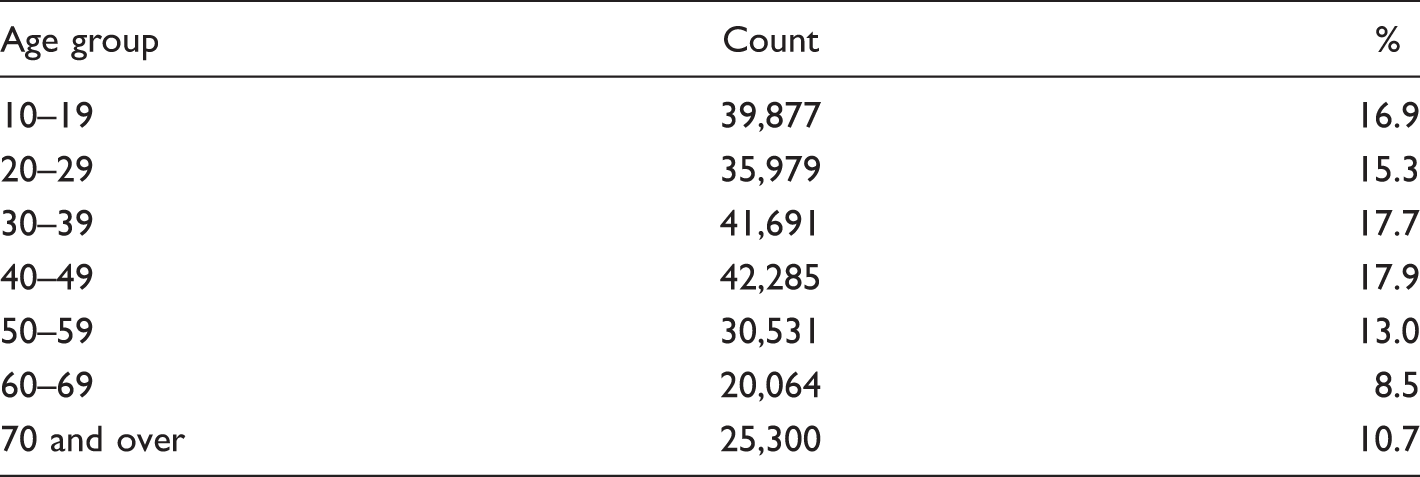
Data are from the Multiple Cause of Death files from the National Vital Statistics System for 2000 and 2010 (National Center for Health Statistics, 2015). Suicide deaths were classified using the International Statistical Classification of Diseases and Related Health Problems (World Health Organization, 2009). In addition to the six Asian ethnic groups, the present study also included non-Hispanic White population as a comparison group. Population age distributions in 2000 and 2010 were obtained from the U.S. Census website (U. S. Census Bureau, 2015). People who reported more than one racial or ethnic group were not included in the population distributions. The suicide rates were adjusted for age using the standard 2,000 population (Appendix).
The mortality data were based on complete counts, thus not affected by sampling error. For analytical purposes, however, the mortality data may be viewed as one of many possible results that could have occurred under the same circumstances. In such view, the mortality data are subject to random variation. Thus, 95% confidence intervals for suicide rates were calculated and used for comparing suicide rates among groups and across time. When the number of suicide deaths is 100 or more, the distribution was assumed to follow a normal distribution. When the number of suicide deaths is fewer than 100, the distribution is assumed to follow a Poisson probability distribution (for more details, see Murphy, Xu, & Kochanek, 2013; National Center for Health Statistics, 2004). R version 3.1.1 (R Core Team, 2014) was used to read the data.
Results and Discussion
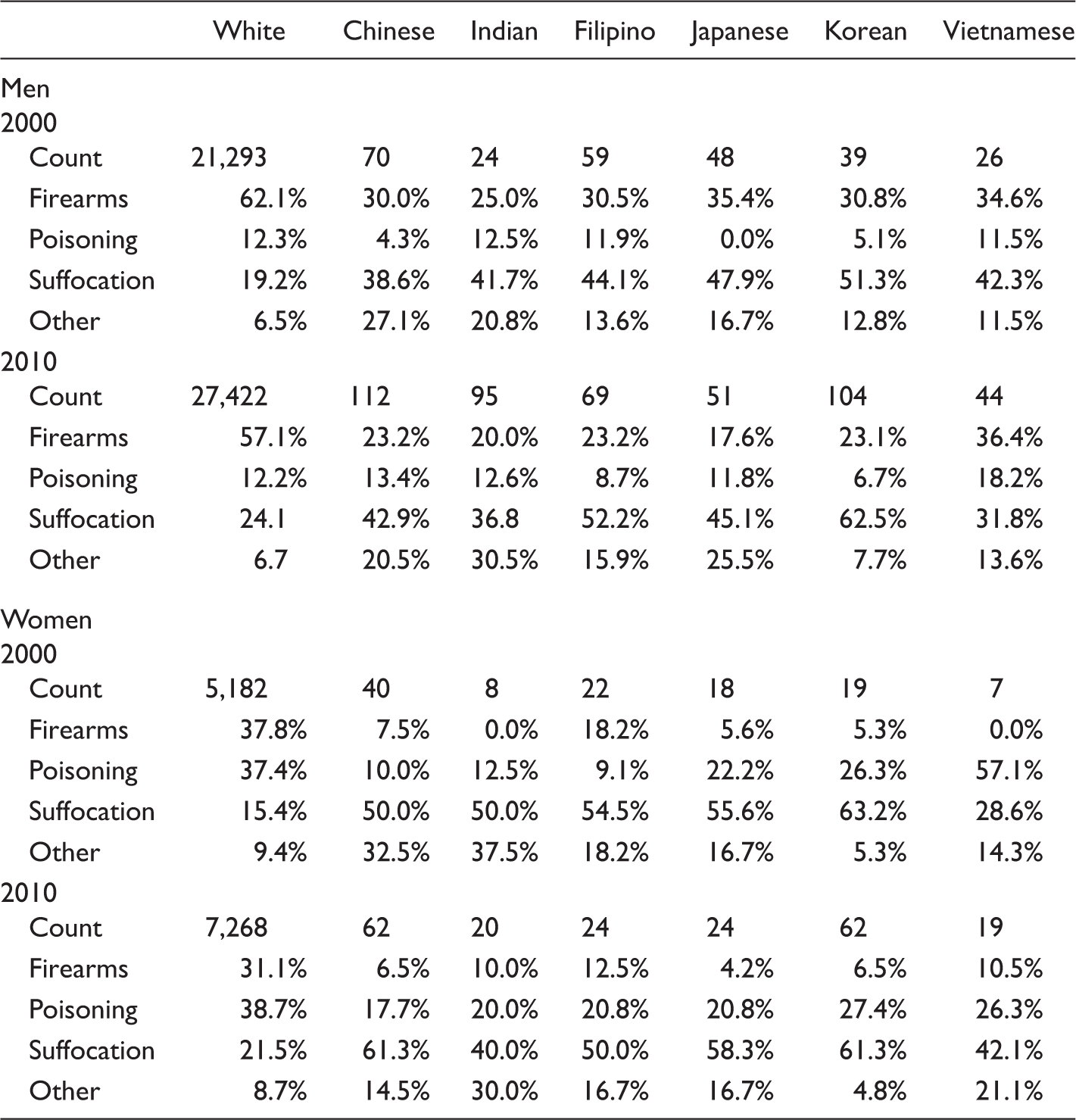
Suicide Methods Among Asian Americans by Gender in 2000 and 2010.
Suicide Rates of Asian Americans per 100,000.

Similar to non-Hispanic White women, women of all Asian groups showed lower suicide rates compared with their male counterparts. In 2000, all, except for Japanese American (4.3 per 100,000), Asian ethnic group showed lower suicide rates than non-Hispanic White women (5.4 per 100,000). In 2010, Korean American women showed the highest suicide rate (8.1 per 100,000) among Asian ethnic groups, even higher than non-Hispanic White women (6.5 per 100,000). In addition, suicide rates among Korean American women significantly increased from 2000 (3.9 per 100,000) to 2010 (8.1), unlike women of other Asian ethnic groups. Indian and Filipino American women (1.5 and 1.8 per 100,000) had suicide rates significantly lower than Chinese (3.8 per 100,000), Korean, and Japanese American women (5.0 per 100,000) in 2010.
Some limitations of the present study must be considered. CDC warns that mortality statistics for Asian populations should be interpreted with caution because misclassification of race reporting on death certificates was found to underestimate death counts by 7% among Asian population (Arias, Schauman, Eschbach, Sorlie, & Backlund, 2008). Suicide deaths may be also misclassified as accident or undetermined (Cooper & Milroy, 1995). The extent to which suicide deaths are misclassified among Asian American population is unknown. In addition, suicide death counts were small (less than 100), especially for women, therefore, the estimates of suicide rates may be unreliable. Future research needs to examine mortality data among Asian Americans as new data become available.
In summary, there are considerable variations in suicide rates among different Asian ethnic groups in the United States. These findings underscore the importance of disaggregating data on Asian American suicide-related outcomes. Researchers interested in suicide in Asian Americans are encouraged to examine publicly available mortality data.
Appendix
Footnotes
Declaration of Conflicting Interests
The author(s) declared no potential conflicts of interest with respect to the research, authorship, and/or publication of this article.
Funding
The author(s) received no financial support for the research, authorship, and/or publication of this article.