




Abstract
This qualitative case study describes the dying process from a purely psychological perspective. The letters of Count Moltke, who was sentenced to death and executed during the Nazi regime, to his wife were analyzed content analytically. A work program of four self-imposed tasks emerged, namely first to avert the death sentence, second to prepare for the ideological and intellectual battle with the chairman of the court, third to support his wife in her anticipatory mourning, and fourth to achieve willingness for his dying by strangulation and for losing his life. Contrasting these findings with two cases of incurably ill men confirmed work and structure as the overarching way of coping. Religious coping is also of central importance. There was neither a linear trajectory nor a sequence of phases; rather, Moltke’s dying process corresponds to a circular model. A consequence of the findings is outlined.
Introduction
The sad tale of Count and Countess Moltke gives rise to look at two public figures of contemporary (German) history from the point of view of thanatology. Their life in anticipation of the death sentence by the Volksgerichtshof (People’s High Court) during the Nazi regime became for him the beginning of the dying process and for her a time of end-of-life care. Although neither ill nor otherwise physically impaired, Count Moltke became a dying man because of fatal circumstances. To demonstrate dying in a purely psychological sense using a prominent case example is the subject of this qualitative study.
Historical Context and the Living Conditions of Count and Countess Moltke
Helmuth James v. Moltke, the member of an old and famous Prussian family mainly of soldiers, was the head of the Kreisau circle, the participants of which developed visions of a new Germany after the end of the Nazi regime. Although not personally involved in the assassination attempt on Hitler, he had connections with some of the conspirators. At the end of September 1944, Moltke was imprisoned in Berlin Tegel. Contact with persons from outside the prison was very restricted, and correspondence without censorship was forbidden. Nevertheless, 177 letters were smuggled by the protestant priest, Poelchau, risking his own life. A bill of indictment was not handed to the prisoner. Thus, Moltke was uncertain about the accusation. In fact, he was accused of his views and convictions that were considered high treason, not, however, of specific actions. There were 12 days from the sentence to the execution. The condemned men were not told about the upcoming execution, not even the day before; from the early morning until late afternoon, they could be taken to the execution at any time. At the time of his death, Moltke was 37 years old. The couple had two sons, Caspar, born 1937, and Konrad, born 1941.
Dying From the Point of View of the Behavioral Sciences
Dying can be looked at from a medical (somatic condition), from a sociological (its construction by experts and society as a whole), and from a psychological perspective, the focus of which is on mental adaptation and coping strategies. As outlined in detail elsewhere (Wittkowski, 2011, pp. 64–72), dying from the point of view of the behavioral sciences depends on two conditions. First, there must be an objective prerequisite that death will occur within a limited time span, that is, earlier than could be expected without the damaging condition. Second, the individual has recognized his or her condition in a way that has an impact on his or her feeling, thinking, and acting, be it conscious or unconscious. In other words, there must be both an objectively given damage or threat and the subjective perception of it to declare an individual a dying person. In this predominantly cognitive view, dying usually is a long process of weeks, months, or even years. This psychological definition of dying is derived from the situation of people who die from an illness; it nevertheless claims general validity. A specific feature of this view that might strike the reader as strange is the reversibility of dying. If the objective threat is gone or the individual has lost his or her awareness of dying, he or she is no longer a dying person. Thus, from the cognitive point of view of psychology, you can die several times.
Key Concepts and Terms
There are four concepts with relevance to this study that to a certain degree are related to each other. Awareness of dying refers to a more or less conscious realization of the threat. This may be of reduced consciousness as in Weisman’s (1972) idea of a “middle knowledge,” which encompasses a kind of uncertain knowledge, an idea that is located somewhere between knowing and not wanting to know and which nevertheless has an impact on the individual’s feeling and behaving (e.g., on defense strategies). Certainty of dying means the clear knowledge about one’s own fatal situation. Its central symptom is the self-concept as a dying person and an additional feature is anticipatory mourning. If such a person is able to accept his or her fate, he or she achieves readiness for dying. Without being suicidal, in his or her thinking and feeling, such a person may actively strive after willingness for dying.
Aim of the Study
The definition of dying from a psychological perspective claims to be valid, among others, for a physically and mentally healthy person. Thus, the general expectation is that the cognitive and emotional processes that are characteristic of dying from an illness should operate in a healthy individual in the same way if there is a vital threat and the corresponding appraisal of it. The situation of Count Moltke being accused of high treason and in danger of the death penalty can be seen as a quasi-experimental condition caused by the political circumstances in a particular country at a particular time. The study material gives rise to the investigation of several aspects, namely the dying process (Count Moltke), the situation of his caregiver (Countess Moltke), and the care for the dying (i.e., the interaction within the couple). This article deals with Moltke’s dying, only. It is guided by three research questions. First, can typical features of dying be demonstrated in Count Moltke’s letters? Second, within the time span of the correspondence, are specific changes in the frequency of incidence of certain features, that is, content categories such as attachment to life or fear of one’s own death, discernable that are stronger than mere fluctuation? Third, in what way does Moltke’s dying process correspond to the dying of terminally ill individuals that are documented in the literature?
Method
Material
The qualitative data base consisted of 177 letters, 112 of them by Count Moltke and 65 by the Countess. The letters varied in length between a few lines and several pages. For this study, I used a slightly shortened version of the collection published under the title Farewell Letters Prison Berlin Tegel, September 1944 to January 1945 (von Moltke & von Moltke, 2013).
Analysis
The analysis of the letters was performed by a content analytical strategy without adherence to a specific school of thought. Instead, it followed procedures of grounded theory (Strauss & Corbin, 1990), a subject- and data-based strategy of building models, as well as general principles of qualitative data analysis (Miles & Huberman, 1994). The analysis focused both on the manifest and on the latent content of the messages guided by the hermeneutic school of interpretation (e.g., Gadamer, 1960/1972; Smith, Flowers, & Larkin, 2009).
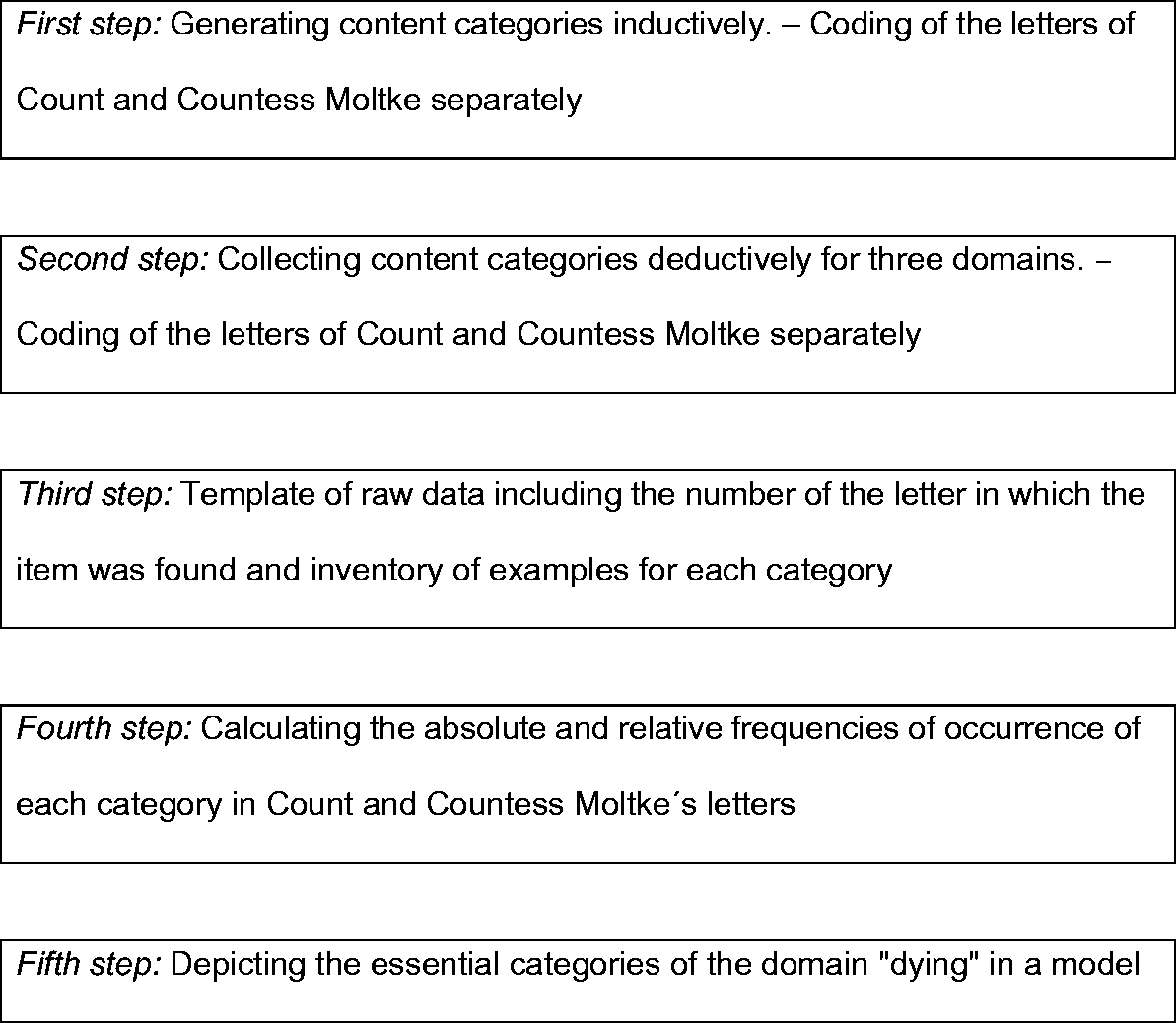
The analysis of the material was carried out in five steps (see Figure 1). First, I identified themes (i.e., contents, features) separately in the Count’s and in the Countess’ letters, respectively. I coded these inductively generated categories in the letters of both partners. This first step included a loop of partial recoding to achieve saturation. In the second step, I compiled a list of key terms on dying, coping, the situation of the caregiver, and end-of-life care from the literature (Balk, Wogrin, Thornton, & Meagher, 2007; Carver & Connor-Smith, 2010; Corr, Nabe, & Corr, 2009; Glaser & Strauss, 1965, 1968; Kastenbaum, 2000; Kellehear, 1990; Lazarus, 2006; Weisman, 1972). After overlappings had been removed, these items formed a body of deductively generated categories in the domains “dying process and coping,” “caregiver,” and “end-of-life care” ready for coding. The advantage of using deductively created categories is, besides the completion of the spectrum of features, the possibility to find out whether certain characteristics that could be expected in the material in fact do not appear.
Content analytical procedure.
Next, for each letter, I registered which categories had been coded. Multiple codings were allowed. For example, Moltke’s letter of November 19, 1944, received six codes, namely SOLUT, INSTR, MEMO, CARE, DYING, and ATTLIFE (see Table 1 for the full depiction of these categories). There was no weighing of categories depending on the frequency of their appearance within a single letter. The number of letters in which the various categories had been coded formed the quantitative raw data of the analysis. It was complemented by an inventory of examples (i.e., citations) for each category. In the fourth step, both the absolute and the relative frequencies of occurrence were determined for each category. I performed Steps 1 to 4 by hand. Finally, I chose categories with a frequency of occurrence of ≥20%, augmented by some additional relevant categories, to constitute the elements of a model that describes and to a certain degree explains Count Moltke’s dying. Categories with a frequency of occurrence of ≤5% were considered as a rare content.
Frequencies of Occurrence in the Domain “Dying and Coping”.
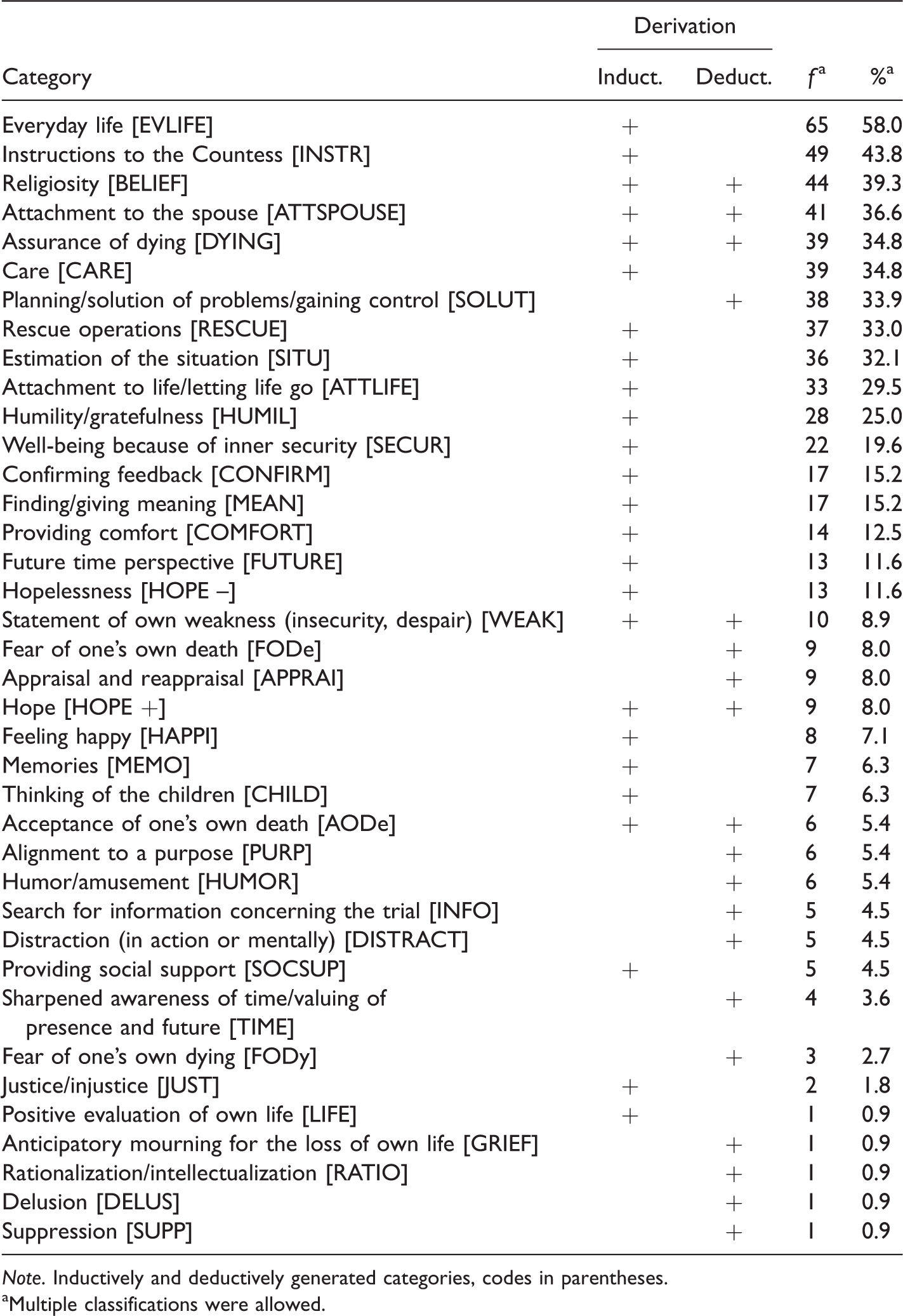
Note. Inductively and deductively generated categories, codes in parentheses.
Multiple classifications were allowed.
In analyzing the course of the dying process, I registered the frequency of occurrence of selected categories in Moltke’s letters over the nearly 4 months of his imprisonment. As the time unit of analysis, I chose 2 weeks because the pre- and posttrial phases in January 1945 lasted 2 weeks each.
I did the content analysis of the Farewell Letters for the domains “dying and coping,” “caregiver,” and “care for the dying.” Solely the first of these domains is subject of this report. The analysis is descriptive, that is, I did not verify differences inference statistically. In an attempt to increase the validity of the results, I performed comparisons by considering two case studies. Thus, I extended the within-case analysis of Count Moltke’s letters to a cross-case analysis (cf., Miles & Huberman, 1994, Chapters 7 and 8).
Results
Table 1 shows the content categories of the domains “dying” and “coping” in the order of the frequency of their occurrence in Count Moltke’s letters.
Dominant Contents
The most frequent category is Everyday life (58.0%). More than every second letter reported on daily routines, the food, the equipment of the cell, and conversations with the guards and the priest. The amount and contents of these reports can be seen as the confirmation of Corr’s (1991--1992) view that nobody can stay in the certainty of dying 24 hours a day. In Moltke’s words, 1 “No human being can have this permanently in mind. Even in my situation, you forget it over and over again because the flesh does not want it to be true” (Letter from November 10, 1944, p. 121).
Right from the beginning of his imprisonment in Berlin Tegel, Moltke showed a strong Certainty of dying (34.8%). Thus, writing to his wife he frankly expressed his conviction to lose his life soon. Every letter I write is considered the last by me. (Letter from October 1, 1944, p. 49) In all probability, […] I will be already dead next week at this hour. (Letter from December 12, 1944, p. 199)
Preoccupation with taking the plunge has a close relationship to another dominant content, namely Attachment to life (29.5%). This category encompasses both clinging to life and letting go of life and the oscillation of the two components. The switch between the willingness for a premature closure of his own life and the fight for rescue was emotionally very expensive. Fact is that this life between death and life is hard work. If you are eventually totally prepared for dying you cannot make a permanent condition of it. [. . .] Thus, you swing back to life, perhaps only a bit, you build up a house of cards and then, when you acknowledge it, you destroy it again and that’s what the flesh does not like at all. (Letter from October 28, 1944, p. 89) When I awoke this night I felt myself close to him [death] and not at all strange and later on he was very little welcome to me. (Letter from November 26, 1944, p. 162) […], just not one more “create” readiness to do the battle besides readiness for dying and recognize, […]. (Letter from December 17, 1944, p. 215) I believe that I am now so ready for dying that […] that walk to the gallows is no big thing for me anymore. (Letter from January 17, 1945, p. 305)
A variety of Moltke’s religiosity is his humility and gratefulness toward God that also emerged as a dominant category (25.0%). For example, “I am grateful for every moment that makes me feel this favour knowing that I did not deserve it and praying that it will be preserved to me” (Letter from November 26, 1944, p. 162).
Was this religious coping strategy successful? According to the content analysis of Count Moltke’s letters the answer is yes. Well-being because of inner security (19.6%) is slightly below the threshold of dominant contents. The expression of security, peace of mind, and confidence stemmed from two sources. The biggest part in it had the belief in God. “Today, I feel like a rock and soft like delicious down. As long as the Lord preserves this condition I am untouchable for […] and the executioner” (Letter from November 12, 1944, p. 129).
In addition, the encounters with his wife or even thinking of her caused well-being in him and a nearly cheerful calmness. “My heart, what a wonderful half an hour did we enjoy. I feel enriched, more secure, and more lucky” (Letter from November 13, 1944, p. 130).
Nevertheless, there are also some hints that “in the underground” or “at the surface” concern and insecurity were simmering. “In its deepest bottom my soul is well secured, only the surface is trembling from time to time” (Letter from January 18, 1945, p. 306).
Drawing a résumé in between, Moltke’s state of mind was characterized by oscillating between attachment to his life and by detachment from it. Being aware of his vital threat, both his belief in God and the relationship with the Countess provided a safe haven. This is the background in front of which further dominant contents have to be considered. Several categories such as Estimation of the situation (32.1%), Planning and attempts to solve problems (33.9%), Rescue operations (33.0%), and Instructions to the Countess (43.8%) can be summarized under the heading “active problem solving.” This configuration of features describes attempts to head off the impending danger—first by analyzing the situation, next by planning adequate steps, and finally by carrying them out.
A further cluster of dominant features can be summarized under the heading “responsibility for the spouse.” It consists of the categories Attachment to the spouse (36.6%) and Care (34.8%). Providing comfort also fits into this cluster, although this item belongs to the less frequent categories (12.5%). The close relationship with his wife is illustrated by his dream of the Siamese twins. I came to Plötzensee for the execution and the executioner said: “How shall I execute the left one alone, without the right one, that does not work.” And when they looked at me, you were attached to my right side like the Siamese twins, so an execution was impossible. It was very sweet and I became quite aroused. (Letter from October 26, 1944, p. 86)
An essential component of Moltke’s care for his wife was to put a damper on her hope for his rescue. His intention in doing so was to prevent her from an intense breakdown after his death. The following quotation is an example of the way he provided comfort to her. “My dear, you do not need to be worried about me. I believe, that I am ready for dying now” (Letter from January 17, 1945, p. 305).
Taken together, Care and Providing comfort with a frequency of occurrence of 47.3% is the most frequent category besides Everyday life.
Rare and Missing Contents
With his imprisonment in Berlin Tegel, for Count Moltke, a period of permanent threat to his life began. In this situation of extreme stress, it seems highly probable that he would show ways of coping that have been established in coping research. Contrary to expectation, however, dysfunctional coping strategies such as regression, rationalization, self-deception, and suppression of threatening thoughts were either not discernable in his letters or they appeared with a frequency of less than 5%. Also functional coping strategies such as distraction and humor were seldom. Although objectively there was a strong social support by the Countess in the form of her letters, in the Count’s perception, however, this played a minor role (4.5% frequency of appearance). Moreover, fear of his own death, that is, fear of losing his life, was surprisingly rare (8.0%) given the Count’s situation. Even more seldom was the expression of fear of his own dying. This is remarkable because Moltke was aware of the cruel execution procedure which actually was strangulation. Finally, there were only few expressions of a sharpened awareness of time (3.6%).
Often observed reactions of dying persons to their situation such as denial, anger, bargaining with God, and depression did not at all appear in Moltke’s letters, as was the case with verbal aggression. Solely acceptance of the approaching end of his life emerged in low frequency. This was an acceptance of resignation, comparable with that of terminally ill persons. Moreover, the following 14 deductively derived content categories did not at all occur in the letters: Autonomy/control of self and situation, Blaming oneself, Close of unfinished business, Dealing with the issue of life after death, Dealing with own past/taking stock of life, Hyperactivity, Impairment of self-esteem, Internal locus of control, Optimism, Passivity, Positive self-instruction, Regression, Resignation, Rumination, and Self-pity.
Further Relevant Contents
Among the categories that appear neither frequent (i.e., more than 20%) nor seldom (i.e., less than 5%) is Hopelessness. This was the result of a reasonable estimation of his situation as far as he could possibly judge, and it went along with a metaphysical “supernatural” hope. Closely related to these features is Future time perspective that was directed toward the time after his death, encompassing the Countess, the children, and Germany’s fate. Moreover, Giving meaning appeared in substantial amount in Moltke’s letters (15.2%). In giving meaning, he interpreted his imprisonment and the prospect of his near death as an enrichment and as a contribution to the development of his personality. Most important was to him his appearance in the trial and his (expected) controversy with the chairman of the court, Freisler, that he considered the climax of his life. It is better to be hanged by Hitler than to die from a bomb. That makes more sense. (Letter from January 1, 1945, p. 247) The mission for which God created me has been accomplished. (Letter from January 11, 1945, p. 280) My dear heart, full of happiness I am thinking toward tomorrow. How wonderful to meet you. Whether it will be for the last time does not matter. (Letter from November 12, 1944, p. 128) Perhaps I am slightly eccentric, for I cannot deny that I am in a high mood. (Letter from January 10, 1945, p. 273)
Model of Count Moltke’s Dying
Figure 2 shows the functional relationships between the essential elements of Moltke’s feeling and thinking according to the content analysis of his letters. The focus here is on his adaptation to the vital threat. Certainty of dying as a consequence of this threat triggered coping strategies both in actions and in mental processes. As to the former, he made it his business to first head off the death sentence and after it had been spoken to achieve a pardon; second to stand the intellectual fight against Freisler during the trial; third to shape his wife’s inner condition to prepare her for her life as a widow. The accomplishment of these tasks made concrete action necessary, namely writing up his ideas. By creating and fulfilling these tasks, Moltke gave meaning to his waiting for the execution.
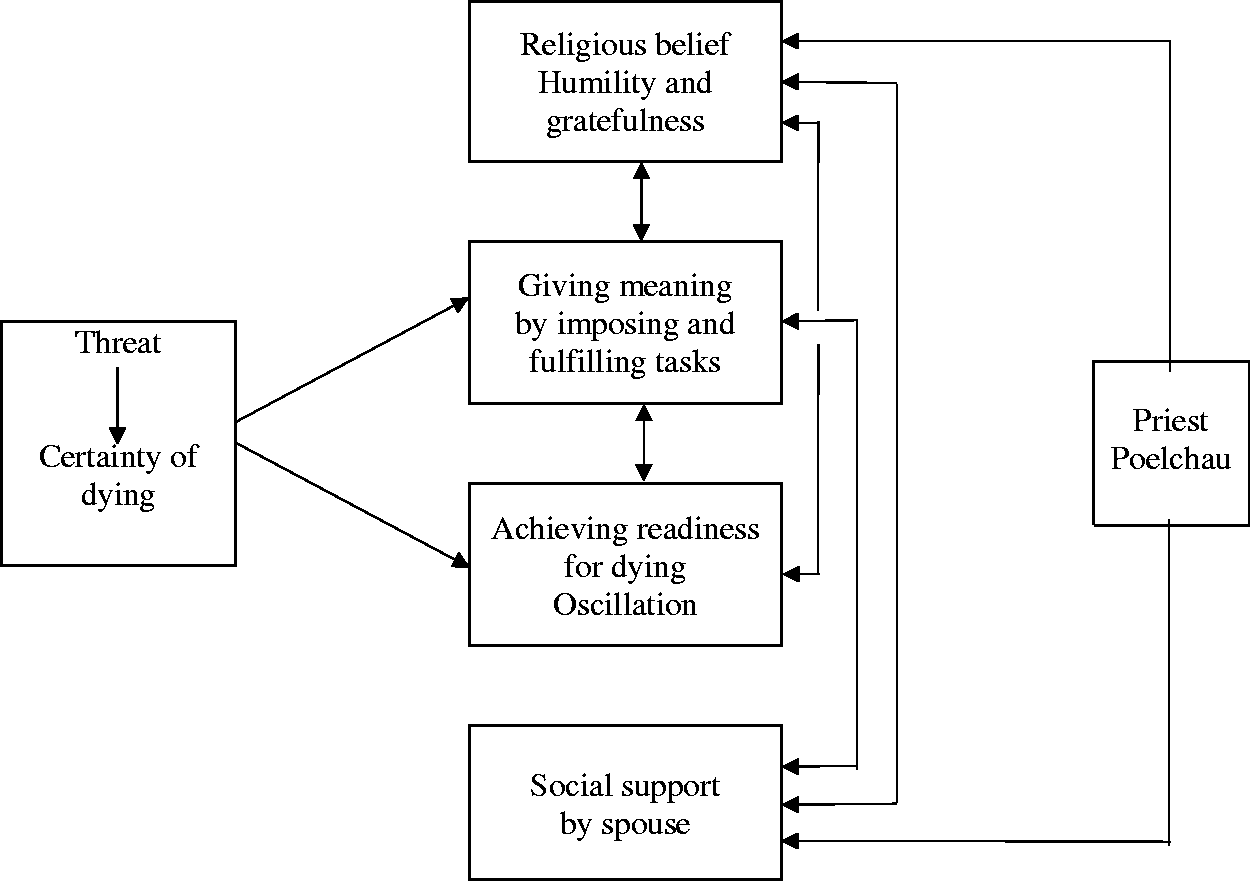
Model of Count Moltke’s dying.
A fourth task referred solely to mental adaptation, namely the creation of willingness to die. The oscillation between attachment to his life and letting it go was a process that absorbed much psychic energy.
Three factors facilitated Moltke’s coping with the existential threat. First, his religious belief in connection with his attitude of humility and gratefulness. Second, the relationship with his wife and the emotional support he received from her. Third, priest Poelchau who not only transmitted the letters but also provided spiritual support to the couple.
Course of Count Moltke’s Dying Process
Figure 3 depicts the combined frequencies of the content categories Certainty of dying, Attachment to life, and Finding meaning over the time of Moltke’s imprisonment. Two principally different phases emerge. During the first extended phase of 2.5 months that was marked by ignorance of the accusation and of the date of the trial, this cluster of adaptational features occurs, although varying, in a medium intensity. The process of adaptation was simmering on low or at most on medium heat. The second comparatively short phase of hardly 6 weeks began with a calming down at Christmas and the end of the year. During the following 2 weeks of intensive preparation for the trial and of the trial itself, a stronger preoccupation with losing his life was stimulated. This faded away abruptly after the death sentence had been passed, and Moltke could have no longer any reasonable doubt about his fate. Thus, triggered by the expected and eventually spoken decision of the court, there was an abrupt boiling up of the coping process. After the adaptation process had already been prepared for a while, its increase in the second phase caused its closure. From Moltke’s point of view, the task of achieving willingness to die was fulfilled just in time. Looking at its formal aspects, this dying process was a combination of a lingering trajectory in Phase I and of an expected quick trajectory in Phase II (cf., Glaser & Strauss, 1968).
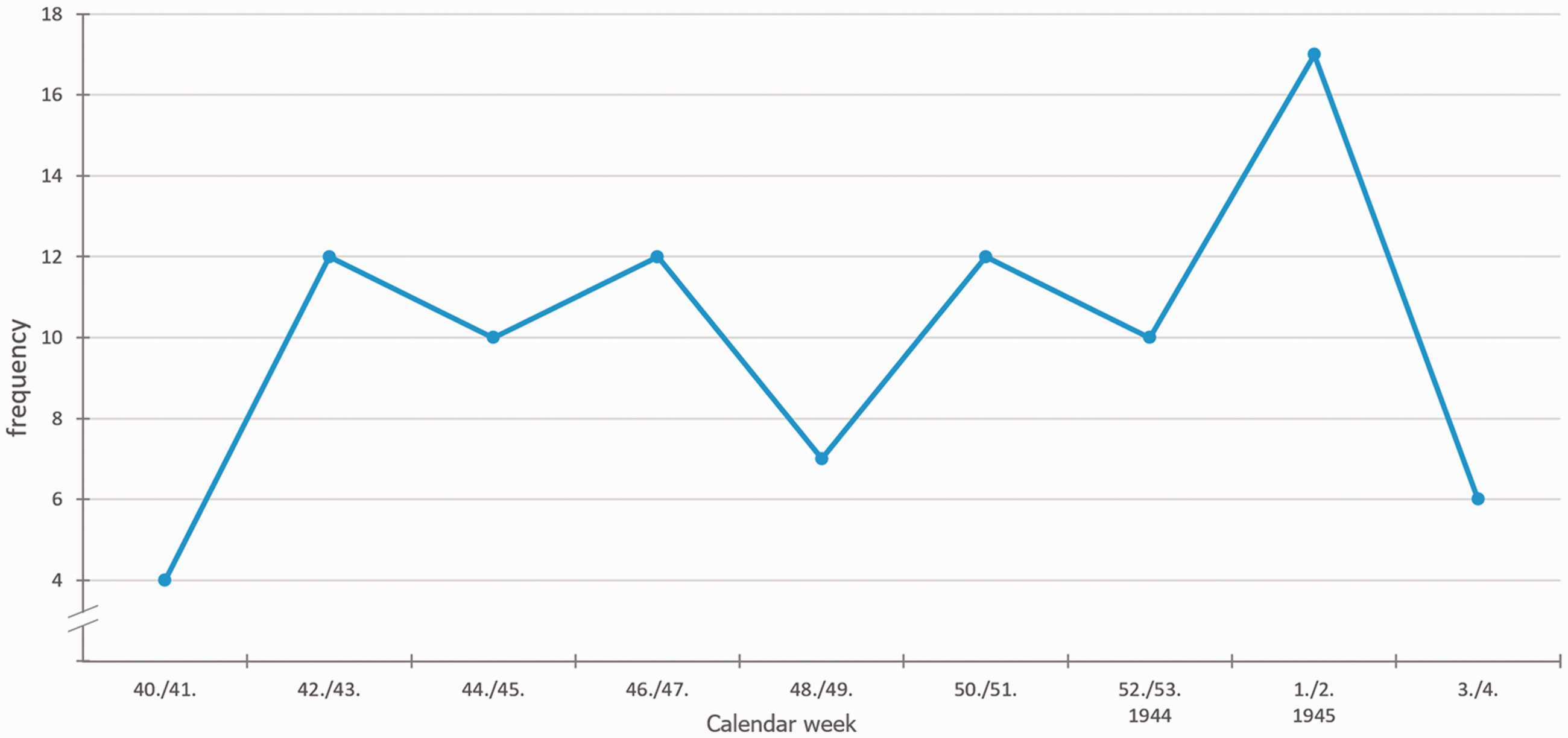
Course of Count Moltke’s dying (DYING + ATTLIFE + MEAN).
Contrasts: Dying Under Dissimilar Conditions
W. McDougall’s Journal
The eminent psychologist William McDougall was diagnosed with cancer in September 1937. His pain became unbearable and eventually forced him to give up his lectures. Although he was given morphine for the pain, he was not able to realize a final comprehensive book that was planned to show the variety of his scholarly work.
About one year after the diagnosis, McDougall began to write a “journal” that was addressed to his colleagues and the scientific public of his university. At this time, McDougall had certainty of dying. His notes, structured in 10 sections, were published and interpreted by Kastenbaum (1995–1996). The last entry is from October 18, 1938, 6 weeks before his death.
McDougall’s implicit model of dying or, stated differently, the way he dealt with the pain and the approaching loss of his life, can be summarized as follows. His thinking, feeling, and acting were dominated by pain, and the morphine had side effects. McDougall was aware that a fundamental change for the better was not to be expected. The forced resignation of his lectures occurred to him as the end of his life. In this situation of a collapse of his former living conditions, his life balance was like an intuitively chosen coping strategy. The detailed evaluation of one’s own life is an intellectual effort, and as a self-imposed task, it can give meaning to the last phase of life.
Four themes emerge in the Journal. First, intellectual effort in dealing with the pain. The cognitive approach that is essential for the life review provided McDougall with a sense of subjective control over his broken living conditions. Second, structural integrity versus breakdown. The preservation of his personality structure aimed at preventing a psychic collapse. Third, success versus failure. His balance was mixed. Fourth, determination versus chance. To him, chance was the principle that explained his illness. The question “Why me?” did not face him.
According to McDougall’s implicit idea of his own dying, it is essential to first determine a path and then follow it. Knowledge and rational analysis are prerequisites to acknowledge, comprehend, and name one’s own situation and to control it. Writing a statement is a method to keep mental control over the situation. The mental effort that is involved can ease somatic and psychic complains not least because it has a distracting effect.
W. Herrndorf’s Diary
The German painter, graphic designer, and writer Wolfgang Herrndorf was diagnosed with a malignant tumor (glioblastoma) in 2010, at the age of 44. During the following 3.5 years, he underwent three operations, received various kinds of chemotherapy, and three cycles of ray treatment. Right after the diagnosis, Herrndorf began a digital diary as an autobiographical project that came to an end 6 days before his suicide by shooting.
In Work and structure (Herrndorf, 2013), the notes are published in 42 sections. Moreover, the book contains 10 flashbacks and 14 fragments. A qualitative content analysis revealed primary contents that are stimulated by the diagnosis and which in turn cause further reactions and secondary contents in the form of recurrent experiences, thoughts, and feelings that can be considered concomitants of the primary contents. Besides Everyday life, the secondary contents are indirect consequences of the diagnosis.
Primary contents were Awareness of dying and the self-concept of a dying person that also played a role in his dreams, a new Outline of his life with the components Work and structure and Exit strategy (i.e., an idea how to commit suicide), Medical treatments, and Self-alienation, the symptoms of which are rejection of the own body with a climax in disgust and self-hate. Secondary contents were Everyday life, Estimation of the situation, Insecurity, Fear/panic, Breakdowns, Regression, Variations in mood while holding on to life and letting life go, Middle knowledge of the own condition, and Coping strategies such as vigilance and distraction. These elements are put together in the model of W. Herrndorf’s dying (see Figure 4).

Model of W. Herrndorf’s dying.
Five relatively independent sections can be discerned to describe the course of Herrndorf’s dying. First, symptoms became apparent, results of medical tests came in, and diagnosis and prognosis were given. This stimulated uncertainty, concern, anxiety, and growing certainty of dying. On one hand, there was a loss of control; on the other, there was social support. Second, determining one’s position and stabilizing through the leading ideas of “Work and structure” and “Exit strategy.” Third, realization of the leading ideas by writing new novels and by preparing suicide accompanied by impairments and strong variations in mood. Self-deception and mental self-manipulation also were part of this section. Fourth, increase in impairments, intensified suffering because of loss of control, fear of a change of own personality, and eventually suicide.
Discussion
Aware of being a dying person, Count Moltke made it his business first to avert the death sentence, second to prepare for the ideological and intellectual battle with the chairman of the court, third to support the Countess in her anticipatory mourning, and fourth to achieve willingness for his dying, thus preparing mentally for his last hours. This was a work program by means of which he created intellectual contents and a structure and also lent his existence meaning under these very special living conditions. In face of his dying by hanging, the physically healthy Count Moltke’s behavior was similar to that of the terminally ill William McDougall and also to that of the incurable ill Wolfgang Herrndorf. The method these three dying intellectuals used for coming to terms with their respective situation may be labelled “work and structure” in connection with the pursuit of a goal. This is a coping strategy that is not enclosed in coping inventories. Thus, the analysis as a whole provides the triangulation of a particular way of coping that was effective for three dying men, one of them healthy, at different epochs and in different living circumstances. Therefore, referring to the first research question, typical features of the dying process appear in Moltke’s letters, and as a consequence, the general definition of dying in a psychological sense is confirmed.
Religious coping (see Pargament, 1997) coupled with humility is an essential element of Moltke’s adaptation to the threat. It belongs to the broader domain of coping research that refers to conditions of uncontrollability such as emotion-centered (Lazarus, 2006) or evaluation-centered coping (Krohne, 1996; see also Carver & Connor-Smith, 2010; Folkman & Moskowitz, 2004). Specifically, achieving willingness to die or, stated differently, acceptance of his own dying and his own death was a means of gaining secondary control in a situation of helplessness (cf., Heckhausen & Schulz, 1995; McCoy, Pyszczynski, Solomon, & Greenberg, 2000). The essential point of this existential coping is to accept what cannot be influenced and to find meaning in suffering (Wong, 2008).
Is there an explanation for this specific way of coping? No doubt, Moltke was an intrinsically religious person long before his imprisonment. Following the mediator model (Baron & Kenny, 1986), it seems reasonable to suppose that the reaction to the threat of his own existence was a religious coping style. In this view, not religiosity as a personality trait makes the effect; rather, it is the specifically religious coping style that out of its own fosters the adaptation (Pargament, 1997, pp. 308–310). An analogous function has humor. Freud (1928/1948a, 1928/1948b) points to the psychological function of humor as a protective mechanism. For a while now, sense of humour is considered a disposition that enables a person via a humorous coping strategy to mentally establish a distance from threatening information (Lefcourt & Thomas, 1998).
Closely related to religiosity is humility that is considered a personality trait not only within positive psychology (Exline & Geyer, 2004; Landrum, 2011) but also in personality psychology in general (e.g., Ashton, Lee, & de Vries, 2014). Humility fosters an undistorted appraisal of one’s own strengths and weaknesses and is regarded as an indicator of a mature personality. The “quiet ego” of the humble person is in contrast to the “noisy ego” of the narcissist (see Wayment & Bauer, 2008). For humble people, it is comparatively easy to accept their own finitude, and in quasi-experimental studies, they expressed weak fear of death (Kesebir, 2014).
The way Moltke came to terms with the prospect of his violent dying corresponds best to Corr’s (1992) task-based model. Of course, physical tasks were not relevant. Psychological tasks such as creating a sense of security and the preservation of autonomy and control, social tasks when dealing with the Countess, and spiritual tasks such as the experience of transcendence are obvious.
The second research question asks whether certain content categories show specific changes in the frequency of their occurrence during the time of the correspondence. The course of Count Moltke’s dying process does not show a linear trajectory of specific phases as some authors have postulated. Similarly, in McDougall’s journal, there is also no sequence of specific phases, and from Herrndorf’s diary, a similarity with the phases postulated by Pattison (1977) and Weisman (1972) emerged, not, however, with the narrower tailored phases of Kübler-Ross (1969). For Moltke’s dying at best, two sections are discernable, the first of which is a long phase of making do very little and a shorter phase of intensive coping and closure. Taken together, Moltke’s dying process at best corresponds to a circular model (see Wittkowski, 2004) in which certain contents and mental processes occur repeatedly over a longer period. Hogan, Morse, and Tasón (1996) found principally similar circular adaptive processes in bereaved adults.
In sum, the picture that emerges from Count Moltke’s farewell letters is in line with Schulz’ and Schlarb’s (1991, pp. 374–375) conclusion on the state of psychological research on dying. According to them, the dying process triggers a variety of predominantly aversive emotions that do not occur in a specific sequence. The way of cognitive and emotional adaptation to one’s own dying depends on dispositions that existed prior to the situation. As can be inferred from Table 2 and in response to the third research question, a self-imposed structured task fulfillment can serve the purpose of a purpose in life and of an adaptation strategy to the upcoming loss of one’s life that can be observed in similar cases as well. “Work and structure” is complemented by religious coping that does not exist in any of the contrast conditions. Religious coping is specific for Count Moltke while waiting for his execution.
Features of Count Moltke’s Dying Process and in Various Casuistries.
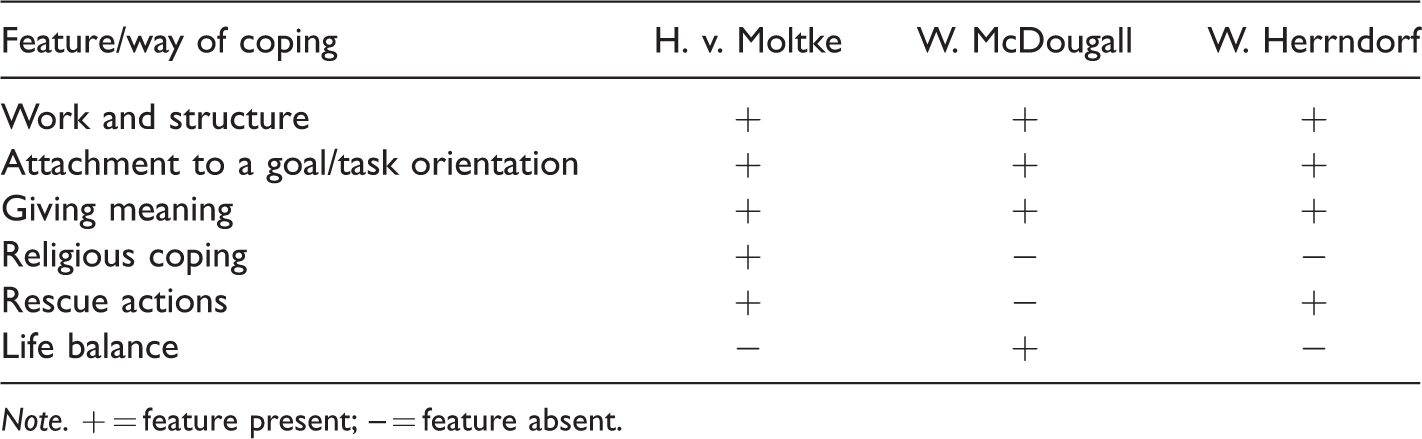
Note. + = feature present; – = feature absent.
Conclusion
Count Moltke’s situation as a defendant who was sentenced to death is at least in two respects different from that of an incurable ill person. He was physically (and mentally) healthy, and therefore, there was no synchronous course of physical decline and detachment from his own life. Moreover, he was facing a cruel killing procedure and not last hours of palliative care. In addition, Moltke was an eloquent person with a talent for introspection who was able to write down his thoughts and feelings in a sophisticated manner. Therefore, his behavior cannot be transferred in a one-to-one relation to that of terminally ill individuals. Nevertheless, a general lesson can be learned from the analysis of the Farewell Letters and from that of comparable documents.
For dying individuals whose way of dealing with their life mainly has been an intellectual one, the systematic fulfillment of self-imposed tasks can provide inner stability and create meaning to their life. The kind of tasks may vary; besides intellectual efforts, artistic activities as well as those concerning interpersonal relationships such as “unfinished business” are suitable. A nonmaterialistic legacy also is to be mentioned here. For caregivers, the challenge is to find out whether their patient belongs to this kind of people and if so to encourage him or her to bring into play this resource in the best interest of dying well.
Footnotes
Acknowledgments
The author would like to thank Danai Papadatou, PhD, for her valuable comments on the first draft of this article.
Declaration of Conflicting Interests
The author(s) declared no potential conflicts of interest with respect to the research, authorship, and/or publication of this article.
Funding
The author(s) received no financial support for the research, authorship, and/or publication of this article.