



Abstract
Veterinary professionals are recognized as an important source of support for many veterinary clients, particularly during companion animal euthanasia and end-of-life care. While many veterinary professionals recognize the importance of their role, many also report feeling unsure about what methods of support are most effective. Furthermore, few evidence-based guidelines currently exist to inform veterinary professionals on the support of grieving clients. To begin bridging this gap, this study qualitatively explored how veterinary professionals currently report supporting grieving clients before, during, and after companion animal euthanasia. Findings suggest that veterinary participants in this study strive to be meaningful sources of support for grieving clients and employ an array of support practice to do so. However, opportunities exist for veterinary professionals to better explore clients’ needs, expectations, and feelings as they relate to companion animal euthanasia, including offering more grief-related resources and access to professional counseling services.
The significance of the modern human–animal bond continues to greatly influence veterinary medicine and clients’ expectations of veterinary medicine (Brown & Silverman, 1999; Knesl, Hart, Fine, & Cooper, 2016; Prasse, Heider, & Maccabe, 2007). Clients’ expectations may be most evident and perhaps even heightened during the practice of companion animal euthanasia. As past research has shown, veterinary professionals are not only responsible for the medical needs of companion animals but also increasingly the emotional needs of clients (Bishop et al., 2016; Fernandez-Mehler, Gloor, Sager, Lewis, & Glaus, 2013; Hart & Hart, 1990; Lagoni, Butler, & Hetts, 1994; Morris, 2012; Shaw & Lagoni, 2007). While previous research suggests that most clients are satisfied with the euthanasia procedure itself (Martin, Ruby, Deking, & Taunton, 2004), one study found that 24% of clients who contacted a pet loss hotline reported negative encounters with their veterinary professionals during a companion animal euthanasia-related interaction (Rémillard, Meehan, Kelton, & Coe, 2017). Findings from that study and others have reported that many of these negative encounters are a result of behaviors displayed by the veterinary professional. Examples of negative encounters described in these studies included a lack of compassion from the veterinarian, inappropriate or emotionally insensitive communication, and a lack of acknowledgment of the existing human–animal bond (Adams, Bonnett, & Meek, 1999; Fernandez-Mehler et al., 2013; Martin et al., 2004; Rémillard et al., 2017). The importance of professional behaviors has been demonstrated in previous research (Martin et al., 2004) where characteristics such as compassionate and caring attitudes were ranked first by clients in a list of traits considered to be essential for a successful euthanasia. Furthermore, when veterinary professionals do not demonstrate these desirable traits or inappropriately manage euthanasia, clients may experience dissatisfaction with their veterinarian, are at increased risk of complicated grief, and may have a decreased willingness to continue a relationship with the veterinarian or veterinary clinic (Adams et al., 1999; Fernandez-Mehler et al., 2013).
While it is recognized that euthanasia can be a source of great emotional stress for veterinary clients, Hart and Hart (1987) suggest that providing emotional support to clients can also be a source of stress for veterinary professionals themselves. Research exploring the impact of euthanasia-related work on animal shelter staff found that euthanasia can contribute to stress, adversely impact staff well-being and job satisfaction (Baran et al., 2009; Reeve, Rogelberg, Spitzmüller, & Digiacomo, 2005). Furthermore, a systematic review of studies evaluating the effect of euthanasia-related work on veterinary staff, shelter workers, and researchers also determined that those directly engaged in euthanasia are at risk of experiencing greater levels of work stress and lower job satisfaction (Scotney, McLaughlin, & Keates, 2015). A key difference between animal shelters and veterinary clinics is that veterinary professionals in clinics are most often performing euthanasia in the presence of the client and have the additional responsibility of addressing the client’s emotional needs (Bishop et al., 2016; Fernandez-Mehler et al., 2013; Hart & Hart, 1990; Lagoni et al., 1994; Morris, 2012; Shaw & Lagoni, 2007). While most veterinary professionals report that providing emotional support is an important aspect of their professional responsibilities (Butler, Williams, & Koll, 2002; Dickinson, Roof, & Roof, 2011), many have also expressed uncertainty as to how they might best address and manage the emotional needs of bereaved clients (Adams, Conlon, & Long, 2004; Butler et al., 2002; Dickinson et al., 2011; Tinga, Adams, Bonnett, & Ribble, 2001).
As companion animal euthanasia is most often performed by a team of veterinary staff members (Shanan, Pierce, Shearer, & Wiley, 2017), it is important that each staff member clearly understands their roles and responsibilities and receives adequate training in methods which may assist them in effectively communicating and supporting clients (Lagoni et al., 1994; Shanan et al., 2017). The ability for veterinary professionals and staff to receive adequate training in their individual roles can assist in fostering a system of teamwork which can assist in ensuring euthanasia proceeds smoothly (Lagoni et al., 1994). A smooth euthanasia procedure which includes support for clients, companion animals, and veterinary staff can lead to improvements in staff confidence and job satisfaction, assist in alleviating client grief, improve client satisfaction, and benefit the practice as a whole (Adams et al., 1999; Fernandez-Mehler et al., 2013).
Currently, there are few evidence-based guidelines supporting veterinary professionals and staff in the management of clients’ emotions related to companion animal euthanasia. A variety of guidelines exist both nationally and provincially; however, many of the current recommendations related to the support of clients are still largely informed by expert knowledge (Bishop et al., 2016; Canadian Veterinary Medical Association, 2014; Leary et al., 2013; The College of Veterinarians of Ontario [CVO], 2016). Considering that many veterinary professionals report feeling unsure about how best to provide emotional support (Adams et al., 2004; Butler et al., 2002; Dickinson et al., 2011; Herzog, Vore, New, & Herzog, 1989; Tinga et al., 2001), it may be reasoned that more specific and detailed recommendations may better assist in preparing veterinarians and veterinary staff to support and communicate with bereaved clients. As such, exploring and learning about the support practices presently used by veterinary professionals during companion animal euthanasia is important. Such insight can help determined which practices might be considered most or least effective, areas in need of attention or change and furthermore, assist in informing future guidelines. A better understanding of these practices is presently needed to assist in informing specific and detailed guidelines about the technical and nontechnical aspects of the euthanasia process with attention to the emotional support of clients. A greater knowledge in this area has the potential to reduce negative interactions between clients and veterinary staff (Fernandez-Mehler et al., 2013; Rémillard et al., 2017), lessen clients’ grief (Adams et al., 1999), and the emotional burden on veterinary professionals themselves (Baran et al., 2009; Reeve et al., 2005; Scotney et al., 2015).
As part of a larger research project exploring how veterinary professionals are currently managing the practice of companion animal euthanasia and addressing the supportive needs of bereaved clients, the findings presented here provide an account of how participants presently address the emotional and supportive needs of grieving clients before, during, and after companion animal euthanasia. Given this is also an underexplored area of research with very limited previous reports and findings, a qualitative methodology was purposefully selected to develop a detailed understanding of veterinary participants’ perspectives on companion animal euthanasia and methods of client support. As such, the research questions are not hypothesis-driven, and hypothesis testing is not possible or necessarily applicable in this instance.
Methods
The purpose of this study was to explore how veterinary professionals currently address the emotional and supportive needs of grieving clients before, during, and after companion animal euthanasia. To gain an in-depth perspective, a qualitative research design utilizing a basic interpretive approach was employed. Study protocols were approved by the institution research ethics board.
Participants
A list of companion animal veterinary clinics (n = 84) within 25 km of the Ontario Veterinary College was accessed from the CVO online Public Register. Clinics were randomized in Microsoft Excel® Version 16.24 (19041401) software and contacted via telephone and invited to participate in the study. Participants from each clinic were collectively provided the option to participate in either a group or one-on-one interview format. Participants from nine clinics selected groups interviews and one clinic selected an individual one-on-one interview format. All interviews took place between March and June of 2016. Consent was provided by all participants prior to interviews.
Interview Structure
Interviews occurred at the location of each veterinary clinic and followed a semi-structured questions guide. The moderator wrote notes during interviews to keep track of conversation and details. Demographic information was collected from all participants using a survey developed by the researchers. All interviews were audio recorded, transcribed verbatim by the first author or a professional transcriptionist, and deidentified to ensure that transcripts could not be linked to individual participants. Quotes belonging to each participant were identified using a sequential number-letter combination, that is, A1 is identified as the interview “A,” Participant 1. The term “veterinary professional” is used to denote all veterinary staff members including veterinarians, veterinary technicians, and other support staff. Specific titles such as veterinarian are used to identify individuals. Data saturation was reached at 10 interviews when it was found that no new information was being collected during the final interview (Braun & Clarke, 2006). One-week postinterview, a follow-up e-mail was sent to clinics inquiring whether the clinic participants wanted to add information they thought was missed during the interviews. Only one clinic responded with minor additional information.
Data Analysis
Demographic information was analyzed using descriptive statistics. Transcripts were organized using in NVivo 11® software and subsequently analyzed using thematic analysis (Braun & Clarke, 2006) by the first author. In brief, transcripts were read multiple times ensuring familiarity, code words were applied to sections of text to represent concepts participants were describing (e.g., opinions, procedures, ideas), and similar concepts were then grouped together, further classified into themes and subthemes, and described in a codebook. As part of the analytical process, the relationships between themes and subthemes were mapped. Themes, subthemes, codes, and the thematic map were systematically reviewed, named, and defined by the first author. The final data analysis process involved a comprehensive review process involving the first and second authors. Authors reviewed individual codes, themes, subthemes, their attributed names, and the overall relationship among themes.
Results
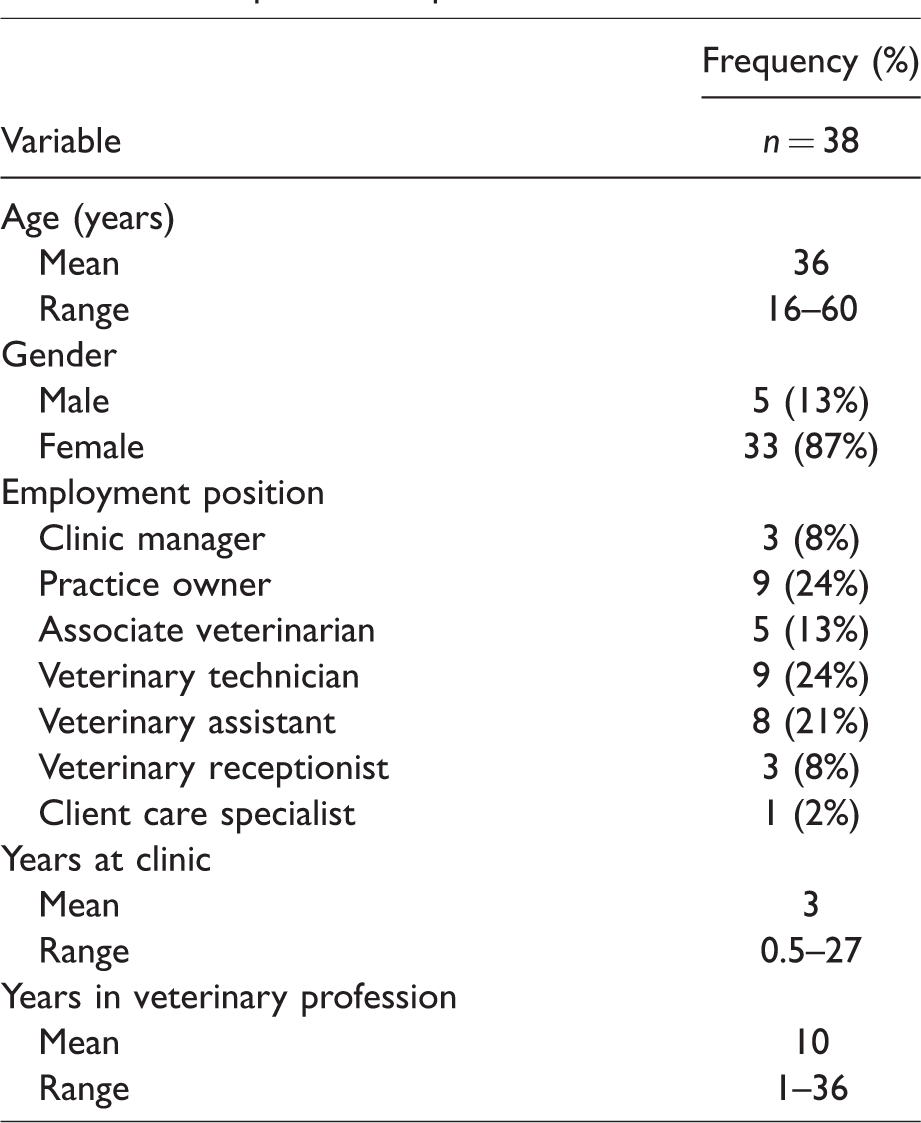
A total of 38 participants, including veterinarians, veterinary technicians, veterinary assistants, veterinary receptionists, practice managers, and client care specialists, participated in 10 interviews. Interviews ranged from 27.3 to 81.5 minutes (mean = 60.18 minutes) in length. Additional demographic information reporting age, gender, employment position, years at the current clinic, and years in the veterinary profession can be found in Table 1.
Participant Descriptive Statistics.
Veterinary Professionals Integrate Client Support Into Almost Every Aspect of Companion Animal Euthanasia
Support by Considering and Accommodating Companion Animal and Clients’ Needs Before Euthanasia
Participants across all interviews described how support is integrated into many different stages of the euthanasia appointment, from the moment the euthanasia is scheduled to when the client leaves the clinic. Participants explained that one method of support before they the client and companion animal have even arrived is to consider and accommodate both the physical and emotional needs of both the companion animal and the client. For example, when scheduling the euthanasia appointment, many participants explained that they try to consider and accommodate the client’s needs by booking the euthanasia appointment at a time which is most convenient for the client, as one participant explained, “I try to do whatever time works for them” (I6). Participants also suggested that certain times of the day, such as the morning before regular appointments begin, over lunch and as the last appointment of the day, are times better suited for euthanasia appointments as they are less busy allowing additional quiet, time and privacy. As a participant explained, “I don’t want to squeeze it in when we are busy…at a time like that or have a loud clinic” (I8). All participants also described the feeling that it was important that clients are never rushed through any stage of the appointment, “we never want to make them feel rushed. We tell them to take as long as you want” (I7).
Participants described preparing the clinic or clinic space before the client and companion animal arrive. For more than half of the clinics, this meant preparing their designated euthanasia room, often referred to as the “comfort” or “quiet” room. Participants described these rooms as being more home-like and comfortable, “it’s kind of more comfortable, more lounge-like rather than the look of a medical appointment room” (A1). Other participants described using existing examination rooms. Regardless of the room used, all participants described preparing these rooms with consideration for the comfort and needs of the clients and companion animal, “we’ll make sure that there's a blanket there for the animal and that it's clean and Kleenex and everything” (I1). Participants felt that it was important that the setting was peaceful and respectful of the experience. In addition to considering the environment, participants also felt that upon the client’s arrival, they would appreciate being greeted immediately and ushered to their designated room so that “they’re not having to wait out front with the puppies and everything else that’s going on” (E1).
Support by Informing and Preparing Clients Before and During Euthanasia
It became clear that providing accurate information was central to client support. Participants described providing information verbally as a way to support or comfort the client. For example, all veterinarian participants explained that they always fully prepare clients for the process of euthanasia and discuss such topics as, the protocols they will use, potential physical reactions from the animal, and the time period in which the animal will take to pass. Participants explained that this conversation is intended to ensure that the client is prepared and aware of what to expect. As described by one veterinarian participant, I usually explain the process, what’s going to happen…then they know what to expect. I think sometimes they just feel a little bit more like, okay this is it, this is what’s going to happen and, are a little more at ease. (G2)
Participants also explained that while informing clients, they wanted to be clear and detailed. For example, as one participant explained, “I want them to understand this is a procedure for humane euthanasia and they are authorizing that, and that means humane death” (F1). Participants expressed that they want to be clear and unambiguous so that clients understand what it means to euthanize an animal and there is no misunderstanding in the terminology used, “so that there’s no words like put to sleep or something that someone could misconstrued” (F1). However, participants also felt that it is important to be sensitive when discussing euthanasia, especially when discussing topics related to the care of the companion animal’s body. Specifically, participants felt that when discussing body aftercare, too much or certain details could possibly be upsetting to clients, “I try to be as specific and kind as I can be, without it being traumatic for them” (F1). Instead, in this instance, participants described the use of terminology they felt was more sensitive, like, “cooling area” or “cold storage” or “body bag.” By using such language, participants felt that they could temper the client’s perception of the process, as a participant explained, “It’s bending to fit what their perception of the experience should be” (H1).
Verbal and Nonverbal Support Techniques During Euthanasia
Participants described using both verbal and non-verbal techniques to support clients, such a offering sympathy and empathy. One of the most commonly used techniques described by participants was reassurance. Participants frequently described using reassurance when helping clients justify their decision to select euthanasia, as one participant explained, “we make the attempt to try and justify it saying, it’s okay you are doing the right thing so that they definitely feel correct” (D1). Across all interviews, participants also described normalizing and validating the client’s emotions. As one participant described, “I say, it’s okay to cry for them because everybody should have somebody cry for them. It’s okay. It’s all, this is all okay. This is sad and awful, but it’s okay” (C1). Participants also described normalizing emotions a client may not be outwardly expressing, such as a sense of relief. As explained, If there's been a lot of caregiving going on too I sometimes say, you know what, sometimes with these things, it’s a bit of a relief you know, because you’ve had to put in so much time and you shouldn’t feel bad if you feel some relief…it’s okay to feel like that. It’s normal. (E3) I first let them know that I have been through it too and what that day was like. It’s very hard. It’s hard to come to that decision. Even being a veterinarian it’s still hard and it’s still hard after. It hurts and it’s a sad day. (F1) I cry right along with the client. And I think they get, I think they honestly get comfort out of that because they realize that it’s okay to be upset because they look at this person beside me who doesn’t even really know my pet and she’s upset. (H2)
Support After Euthanasia Through Follow-Up
Across all interviews, participants described following up with clients after euthanasia. For example, participants from each clinic indicated that they followed up with clients by sending condolence cards. In some cases, additional items such as poems or photos were added along with the condolence card. As a participant described, “Everybody does get a sympathy card with a [poem] and if we have a picture of the pet then I put a picture of the pet on the poem page” (H2). A few participants also described following up by calling clients, I call the people and say, “Hi, I am just calling to check in on you. How are you doing? I am just letting you know that we are obviously thinking about you during this sad time and you know, is there any support that you need?” (A1)
Participants explained that when considering how they follow-up with clients, time is often a limiting factor, “I think we could do better at follow-up phone calls but that is somewhat a staff time limitation” (G1). In addition, participants also expressed uncertainty in which method clients would appreciate, “I think it’s also a hard area to read with clients, many of them would perhaps prefer a card. So, we need to get a better sense of who should be called and who should be given a card” (G1). Many other participants agreed that beyond sending a condolence card, additional contact methods depended on the client. As one participant described, “A lot of it is again, very individualized on a patient, on the person, on the relationship with the clinic as well, that we will send flowers, donations to either the humane society or Pet Trust” (E1). Regardless of the follow-up, many participants agreed that follow-up allows staff to offer additional condolence and also allows continued contact with the client, as a participant stated, “I don’t want you to feel that just because your animal has passed away that our support stops there. Please call me” (F1).
In addition to feeling there were limits on how to follow-up with clients, participants also felt that there are definite limitations on the emotional support they were able to provide. As one participant stated very simply, “There are boundaries. We are not trained as psychologists. We are not trained as grief counselors…there’s a fine line between substituting for a professional counselor and just being there to listen” (F1). This opinion was widely held by other participants, as one succinctly stated, “I think we have to be careful as veterinarian staff to not fall into that trap of thinking we can counsel clients because I don’t think we should” (E1). Further suggesting that when support limits are reached, they should, “assess and refer [clients] if we’re worried” (E1). However, few participants described being aware of any professional resources beyond a pet loss hotline. Some participants reported that their clinic sometimes offers other resources such as pamphlets and brochures on grief and bereavement which were on display in the euthanasia room. Participants felt that they rarely had to provide these resources to clients unless otherwise prompted by a client or if they were previously aware that the client may need additional support. As one participant described, a client had suffered the previous loss of a child and the staff at the clinic felt that they were unable to support the owners to the extent they needed. Thus, the participant felt that a professional counselor would better meet the client’s needs, stating, “they really needed a psychologist” (E1).
Discussion
Findings of this study provide insight into how veterinary professionals currently support bereaved clients before, during, and after companion animal euthanasia. Participants described employing an array of methods to support clients including creating a working environment that caters to the medical needs of the companion animal as well as the emotional needs of the client; using verbal and nonverbal support and communication; and through forms of follow-up such as sending condolence cards or contacting clients by telephone. The various modes by which participants described supporting clients suggest that veterinarians professionals strive to be meaningful sources of support for grieving clients throughout euthanasia. Many of these practices also align with what is commonly known in veterinary medicine as bond-centered care (Lagoni et al., 1994; Ormerod, 2008; Shanan et al., 2017). Described by Lagoni et al. (1994), the mission of bond-centered care is to provide simultaneous medical and emotional care to animal patients and their clients in a manner which acknowledges the human–animal bond. The benefits of bond-centered practices are numerous. Clients who receive bond-centered support are less likely to experience severe bereavement reactions, are more likely to adopt again, and sooner are more likely to remain at the same veterinary clinic and encourage other clients to register with that veterinary clinic (Ormerod, 2008). In addition, teamwork may be improved, reduce staff stress, and increase job satisfaction and more (Ormerod, 2008). Consistent with many bond-centered recommendations (Lagoni et al., 1994; Ormerod, 2008; Shanan et al., 2017) and findings from other research (Dickinson et al., 2011; Fernandez-Mehler et al., 2013; Morris, 2012; Pilgram, 2010), results of this study further reinforces veterinary participants’ commitment to delivering medical and emotional care to animals and their human counterparts. These findings further add to current literature (Lagoni et al., 1994; Morris, 2012; Ormerod, 2008; Pilgram, 2010) and offer an opportunity for veterinary professionals to consider how they currently support bereaved clients within their own practice.
A number of the methods by which participants in this study described supporting clients were through what is commonly known in bond-centered care as “facilitation” (Lagoni et al., 1994). As a facilitator, veterinary participants guide clients through the euthanasia process in a structured manner but also sensitively manage clients’ emotions as they arise (Lagoni et al., 1994; Shanan et al., 2017). In this study, participants consistently explained that they paid particular attention to this role, ensuring that they prepare a comfortable clinic space, display compassionate and respectful demeanors, and inform clients on the process of euthanasia. Other studies have reported similar practices (Morris, 2012; Pilgram, 2010). Bond-centered care researchers suggest that facilitation is one of the most important roles which veterinary professionals play during end-of-life care (Lagoni et al., 1994; Shanan et al., 2017). Indeed, this is also represented in many of the current guidelines which govern the practice of companion animal euthanasia as they also contain many facilitative recommendations (Bishop et al., 2016; Canadian Veterinary Medical Association, 2014; Leary et al., 2013; The CVO, 2016). In this study, participants’ attentiveness to their responsibilities as a facilitator suggests that veterinary professionals also feel that this is a vital component of client support. In their own practices, veterinary professionals are encouraged to reflect on their role as a facilitator and consider how their facilitative practices might support the companion animal, client and even themselves.
In terms of managing the emotions that arose for clients during companion animal euthanasia, participants described employing a variety of verbal and nonverbal support techniques. These included techniques such as offering sympathy, empathy, reassurance, normalizing and validating emotions, and physical contact. While other studies have reported similar findings (Morris, 2012; Pilgram, 2010), research has yet to examine the effectiveness of these techniques in the management of client grief. In veterinary medicine, much of the literature focuses on the use of empathy as an important support technique to establish rapport, build trusting relationships, and demonstrate supportive communication (Frankel, 2006; Shaw & Lagoni, 2007). While empathy is vital to compassionate relationships, more research is needed to better understand how other forms of communication and support impact the emotional experience of clients. The process of grief and bereavement itself can vary widely among individuals (Quackenbush & Glickman, 1984); as a result, future research may also wish to examine the effectiveness of different support techniques based on a client’s background, beliefs, and existing human-animal bond.
Interestingly, while a variety of methods were used to support clients, few participants explained how they interpret or explore the emotions a client may be experiencing. Other research suggests that most times, veterinary professionals rely on their relationship with the client or intuition to assess how a client may be feeling (Morris, 2012). On occasion, participants in this study did explain that they have the ability to assess whether a client may require additional professional support, but this too was selective. In most cases, participants explained that they had prior knowledge that a client may be experiencing intense or complicated grief resulting from a previous loss. These findings suggest that veterinary professionals’ direct exploration of the emotions and feelings a client may be experiencing might be limited. Limited exploration of the client’s feelings has been noted in other research examining communication during the pre-euthanasia discussion (Nogueira Borden, Adams, Bonnett, Shaw, & Ribble, 2010). Thus, there may be more opportunities for veterinary professionals to facilitate conversations which discuss a client’s emotional experience, their grief experience, and bereavement. When addressing the emotional experience of clients, there may also be incidences where clients may not wish to share their feelings (Lagoni et al., 1994; Stoewen, Coe, MacMartin, Stone, & Dewey, 2014). Thus, veterinary professionals may first wish to identify the extent to which clients wish to participate in such discussions.
In addition to limited exploration of the emotional experience of clients, there may also be a limited exploration of the client’s needs and expectations related to companion animal euthanasia. For example, participants in this study suggested that there is uncertainty around which methods of follow-up such as condolence cards, phone calls, or others may be preferred by many clients. Similar findings were also noted by Nogueira Borden et al. (2010) who determined that in addition to limited exploration of client’s feelings, veterinary professionals may not be fully exploring client’s needs and expectations associated with companion animal euthanasia. Current bond-centered recommendations encourage veterinary professionals to explore clients’ previous experiences, expectations, and needs related to companion animal euthanasia (Lagoni et al., 1994; Ormerod, 2008; Shanan et al., 2017; Toray, 2004). Understanding an individual’s preference provides an opportunity for veterinary professionals to customize the euthanasia experience to suit individual needs. In this study, one participant explained that they will ask a client if they have previously experienced euthanasia and if so, they will tailor the depth of information they provide that clients. However, veterinary professionals may also wish to explore clients’ expectations related to other aspects of euthanasia such as the support and follow-up they need, expect or prefer.
Participants from this study suggested that there are limits on the extent and nature of support they feel comfortable providing to clients. Other studies (Butler et al., 2002; Morris, 2012) have noted similar findings in which veterinary participants reported feeling that they are not trained psychologist but medical professionals, and as a result feel that there are limits to the support they should provide. Experts suggest that it is rarely possible for veterinary professionals to meet all of the emotional needs of grieving clients, and they should not attempt to support beyond their own means and skill (Shanan et al., 2017). Lagoni et al. (1994), especially emphasizing that veterinary professionals are not clergy, suicide prevention, therapists, or psychologists.
Participants from this study suggested that if their supportive limits are reached and they feel that a client may benefit from professional counseling, they follow-up and act as a guide to resources and professional counseling services. In this study, most clinics mentioned being familiar with written resources like brochures and pamphlets or with professional support services, such as a pet loss hotline. However, it appeared these tools were not frequently utilized or provided to clients. The reason why veterinary professionals may not be discussing or using resources related to grief and bereavement was not described by participants. It may be speculated that as many veterinary professionals report feeling inadequately trained to support clients in general (Adams et al., 2004; Butler et al., 2002; Dickinson et al., 2011), they may feel equally unprepared to discuss topics related to grief and bereavement. Or equally so, they do not feel that clients require these services or assume that a client may not benefit from them. Research (Lagoni et al., 1994; Ormerod, 2008; Shanan et al., 2017) suggest that veterinary professionals are an important access point to professional counseling services and resources. Thus, following bond-centered practices, veterinary professionals are encouraged to offer grief-related education through verbal or written means, when appropriate (Lagoni, 1997). The use of written resources such as books, pamphlets, and brochures are useful options, as they allow clients to select and engage in the use of these resources on their own accord (Dawson, 2008; Lagoni et al., 1994; Ormerod, 2008). Ideally, resources should also be easily accessible, such as downloadable digital versions from clinic websites or displayed in the waiting room, examination room, and euthanasia room. As such, it is important that veterinary professionals and clinics locate and connect with existing professional support services and resources in their area. Veterinary professionals should also research and remain up-to-date on these resources and services (Shanan et al., 2017).
Recognizing that veterinary professionals feel that their supportive ability is limited, it is important to also consider if it is even practical or feasible for veterinary professionals to take on the role of assessing client’s emotions, needs, and expectations. Some may argue that veterinary professionals are already at their supportive capacity. If this is indeed the case, other alternatives may need to be considered. For example, as the field of animal hospice and palliative care continues to expand, so too does the integration of veterinary social workers (Shanan et al., 2017). According to Shanan et al., (2017), social workers have the ability to assess the history and current mental state of the client, match resources to their individual needs, provide supportive counseling and more. They also have the additional benefit of being an accessible source of support for veterinary professionals themselves (Shanan et al., 2017). While veterinary social workers are well established in the United States, they are less common in Canada (Dulmus & Sowers, 2012). As such, licensed providers are not always available, and clinics may not have the financial ability to afford an additional employee (Shanan et al., 2017). Therefore, another alternative may be certifying veterinary staff in pet loss counseling. A variety of independent pet loss certification programs exist today; however, it is unclear whether the credibility of many of these certificates has been assessed. Veterinary professionals might also consider conducting preliminary euthanasia consultation. This may provide clients with the opportunity to communicate their needs and expectations and allow the veterinary professional and client to develop a plan, build rapport, and improve communication around euthanasia and emotions. Shanan et al. (2017) also suggest that connecting with and referring to professionals in the community may also be a viable option. While each option has its associated pros and cons, more research is clearly needed to determine whether veterinary professionals have the capacity to explore clients’ feeling, needs, and expectations related to companion animal euthanasia including the efficacy and economic impact that this addition may have.
Limitations and Directions for Future Research
Limitations of this study include the small sample size inherent in most qualitative research. Selection bias is also likely as there is a possibility that participants who agreed to be interviewed were more comfortable discussing euthanasia. Therefore, caution should be taken when considering the application of these findings to all companion animal practices. In addition, as data collection involved open discussions among a group of participants, in this case, colleagues from the same clinics, there is always the possibility that participants may answer in socially desirable ways. To address this limitation, we contacted clinics by e-mail 1-week postinterview to provide participants the opportunity to include any additional or clarify information which they felt were pertinent to the study. Only one clinic responded with minor additional information. Findings of this study also reflect veterinary professionals’ self-reported methods of supporting clients during companion animal euthanasia. Future research may want to record and observe euthanasia appointments in real time to determine whether veterinary professionals’ methods of support differ from the ones reported in this study. This may also allow for an assessment of how support practices impact clients. In addition, as this study focused on client support during the euthanasia process itself, future research may also consider exploring support provided during other end-of-life care such as pre-euthanasia consultations, hospice, and palliative care.
Conclusion
Results of this study suggest that veterinary professionals work diligently to provide support throughout and after companion animal euthanasia. Further exploration of the client’s emotions, needs, and expectations related to companion animal euthanasia may allow veterinary professionals to tailor their support and improve clients’ experience. Veterinary professionals are encouraged to connect with local professional support services and provide grief resources to clients. The loss of a companion animal is never easy, but veterinary professionals have the ability to improve that experience for many clients by appreciating clients’ emotional experiences, their background, relationship with the companion animal, and collaborating with clients about their expectations related to companion animal euthanasia.
Footnotes
Acknowledgments
We would like to acknowledge and thank all of the participants in this study.
Declaration of Conflicting Interests
The author(s) declare no potential conflicts of interest with respect to the researcher, authorship, and/or publication of this article.
Ethical Approval
Study protocol was approved by Research Ethics Board (REB16-12–630).
Funding
The author(s) disclosed receipt of the following financial support for the research, authorship, and/or publication of this article: This publication is a part of Alisha Matte's dissertations and was supported by a grant from the Ontario Veterinary College Pet Trust Fund. Alisha Matte's PhD stipend was funded by an Ontario Veterinary College Scholarship, and the Ethel Rose Charney Scholarship in the Human/Animal Bond. Funding sources did not have any involvement in the study design, data analysis, and interpretation, or writing and publication of the manuscript.