



Abstract
This article presents qualitative data to explore the experience of farming family members faced with accidental or suicide death and understand how this is experienced within the farming context. Individual semistructured interviews were conducted with 25 members of Australian farming families bereaved by suicide or accidental death. Qualitative data was thematically analyzed. Three interconnected themes were identified: acceptance of risk, normalization of death, pragmatic behavior patterns and connection to place. Bereavement and reconstruction of meaning following suicide or accidental death for farming families is influenced by the cultural, social, geographical, and psychological contexts of farming families. This article challenges traditional conceptions of suicide and accidental death as necessarily experienced as “violent” or “traumatic,” bereavement as experienced similarly across western cultures, and the reaction to suicide or accidental death as one that challenges people’s understanding of their world and leaves them struggling to find a reason why the death occurred.
The Australian farming population has long been perceived to be physically tough and stoic, with a “she’ll be right” “laissez faire” attitude to health, well-being, and safety (Brumby, Willder, & Martin, 2009; Perceval, Fuller, & Holley, 2011) strong masculine-gendered roles (Alston, 2012) and a focus on practical problem solving (Kolves, Milner, McKay, & De Leo, 2012). Many of these characteristics are thought to stem from the isolation associated with rural and remote living, resulting in an expectation of being able to meet your own needs without outside assistance (Collins, Winefield, Ward, & Turnbull, 2009; Fuller, Edwards, Procter, & Moss, 2000). Yet, suicide and accidental deaths occur more frequently in this population, death rates rising with increasing remoteness (Henley, Kreisfeld, & Harrison, 2007).
Compared with other occupational groups, farmers have long been identified as at heightened risk of suicide (Andersen, Hawgood, Klieve, Kolves, & De Leo, 2010; Gunn, Langley, Dundas, & McCaul, 1996; Page & Fragar, 2002) both in Australia (Kennedy, Maple, McKay, & Brumby, 2014) and internationally (Klingelschmidt et al., 2018). With significant regional variability (Arnautovska, McPhedran, & DeLeo, 2013; Kennedy et al., 2014), this risk also extends to those residing on farms who may not be involved in farming and those residing in farming communities (Miller & Burns, 2008). Recent research suggests that a combination of individual factors, in addition to social and environmental stressors, is most likely to reduce help-seeking and increase the risk of farmer suicide (Perceval, Kolves, Reddy, & De Leo, 2017). These include interpersonal conflict, extreme climatic conditions, physical pain, alcohol misuse, and access to means. Such factors lead to two distinct suicide pathways: an acute situational pathway and a protracted pathway determined by long-term mental illness (Kunde, Kõlves, Kelly, Reddy, & De Leo, 2017). Theoretically based contributions to our understanding of farmer suicide draw on a range of political, social, financial, and environmental influences (Albrecht, 2007; Bryant & Garnham, 2015; Hogan, Scarr, Lockie, & Chant, 2012; Stark, Riordan, & O’Connor, 2011), with Joiner (2005) proposing that a combination of capacity for self-injury, social disconnection, and self-perceived ineffectiveness or burdensomeness leads to an acquired ability to suicide.
Accidental death rates are also consistently higher in rural farming communities—both on-farm and in surrounding rural areas, and often due to vehicle and machinery accidents, animals, fire, drownings, and firearms (Henley et al., 2007; Safe Work Australia, 2018). Farmers comprise 3% of Australia’s workforce, yet are involved in 27% of workplace fatalities (Safe Work Australia, 2018). Although the number of fatalities is reducing (due to fewer people involved in farming activities), the rate of death has remained consistently high over the last 15 years. In 2018, the agriculture, forestry, and fishing industry recorded the highest fatality rate of all occupation groups with 16.5 deaths per 100,000—about 10 times higher than the “all industries” average rate of 1.5 fatalities per 100,000 (Safe Work Australia, 2018).
The common practice of farming with multiple generations of one family working together contributes to the adoption of traditional (seemingly unsafe) work practices (Frank, McKnight, Kirkhorn, & Gunderson, 2004). Multigenerational farm-families may also have older generations who, while no longer officially employed on the farm, continue to help out during busy times and are at increased risk of injury (Alston, 2012; Page & Fragar, 2002). Children are frequently exposed to a range of hazards unique to the farming environment (Franklin, Fragar, & Page, 1999), including driving farm vehicles, using machinery and equipment, and handling animals from a very young age as well as the use of firearms (Courtenay, 2000). A tendency toward high-risk behavior is accompanied by a belief in the inevitability of injuries, due to the nature of the activities undertaken on the farm (Brumby, Willder, & Martin, 2010; Murphy, 2003; Robertson, Murphy, & Davis, 2006). Importantly, given that the majority of Australian farms continue to be family owned (Australian Bureau of Statistics, 2012), these risks can extend across all members of farming families—people currently (or previously) living or working on a farm owned by themselves of their family—not only those defined by occupation as farmers.
Labor demands, intergenerational issues, and the colocation of work and home all influence responses to death (Robertson et al., 2006; Rosenblatt & Karis, 1993, 1993–1994; Scheerer & Brandt, 2001). The sudden nature of suicide and accidental deaths, which are often accompanied by violence or trauma (Currier, Holland, & Neimeyer, 2006), can challenge the bereaved person’s ability to cognitively and emotionally accept the loss (Worden, 2008). Very little is known about the bereavement experience of those living and working within environments where sudden deaths occur more frequently. The literature focused on suicide is limited to the outcomes of rural young people who have experienced the suicide of friend (Bartik, Maple, & McKay, 2015) and the stigma experienced by rural people exposed to suicide (Kennedy, Brumby, Versace, & Brumby-Rendell, 2018; Kennedy, Versace, & Brumby, 2016) even though there is acknowledgment that rural Australians affected by suicide require attention (Maple et al., 2016). Thus, this article presents qualitative data exploring Australian farming families experience when faced with accidental or suicide death to understand how these deaths are experienced within the farming context.
Method
Participant responses to suicide and accidental death were explored from a social constructionist perspective (Crotty, 1998) and within a narrative inquiry framework (Riessman, 2008). This provided the opportunity to investigate participants’ stories; how they were structured and what they represented, within the sociocultural and environmental context and the circumstances of the individuals’ lives.
Human research ethics approval was obtained (No. HE 13–047) and the research was publicized widely in local rural and regional media, social media, agricultural and health industry newsletters, and publications, via community groups and on relevant websites to recruit participants. Eligible participants were required to be aged 18 years or older and to self-identify as a farming family member (a person who, currently or previously, lives or works on a farm owned/managed by one or more members of their family). A range of interview modes were offered (e-mail, face-to-face, or telephone) in order to give access to a wider geographical area of study and provide participants a format with which they were comfortable.
Semistructured interviews were designed to develop a rich understanding of the context of life and work as a member of a farming family. All authors were involved in the development of the schedule and agreed to the interview format. Interviews commenced with open-ended questions about participants’ experience of being part of a farming family and then progressed to ask about the individual’s loss and how they responded to this. An initial broad question—based on similarly framed questions used previously during in-depth bereavement interviews (Dyregrov, Nordanger, & Dyregrov, 2003; Maple, Plummer, Edwards, & Minichiello, 2007; Ratnarajah & Schofield, 2008)—allowed the participant to self-direct the discussion as much as possible. This was followed by prompts and more focused questions using a recursive technique (Minichiello, Aroni, Timewell, & Alexander, 1995). The same questions were asked for those bereaved by suicide as for accidental death. Detail of questions and prompts are outlined in Table 1. On completion of the interviews, participants were invited to choose a pseudonym in order to maintain their anonymity, while at the same time maintaining ownership over their narrative.
Semistructured Interview Schedule.
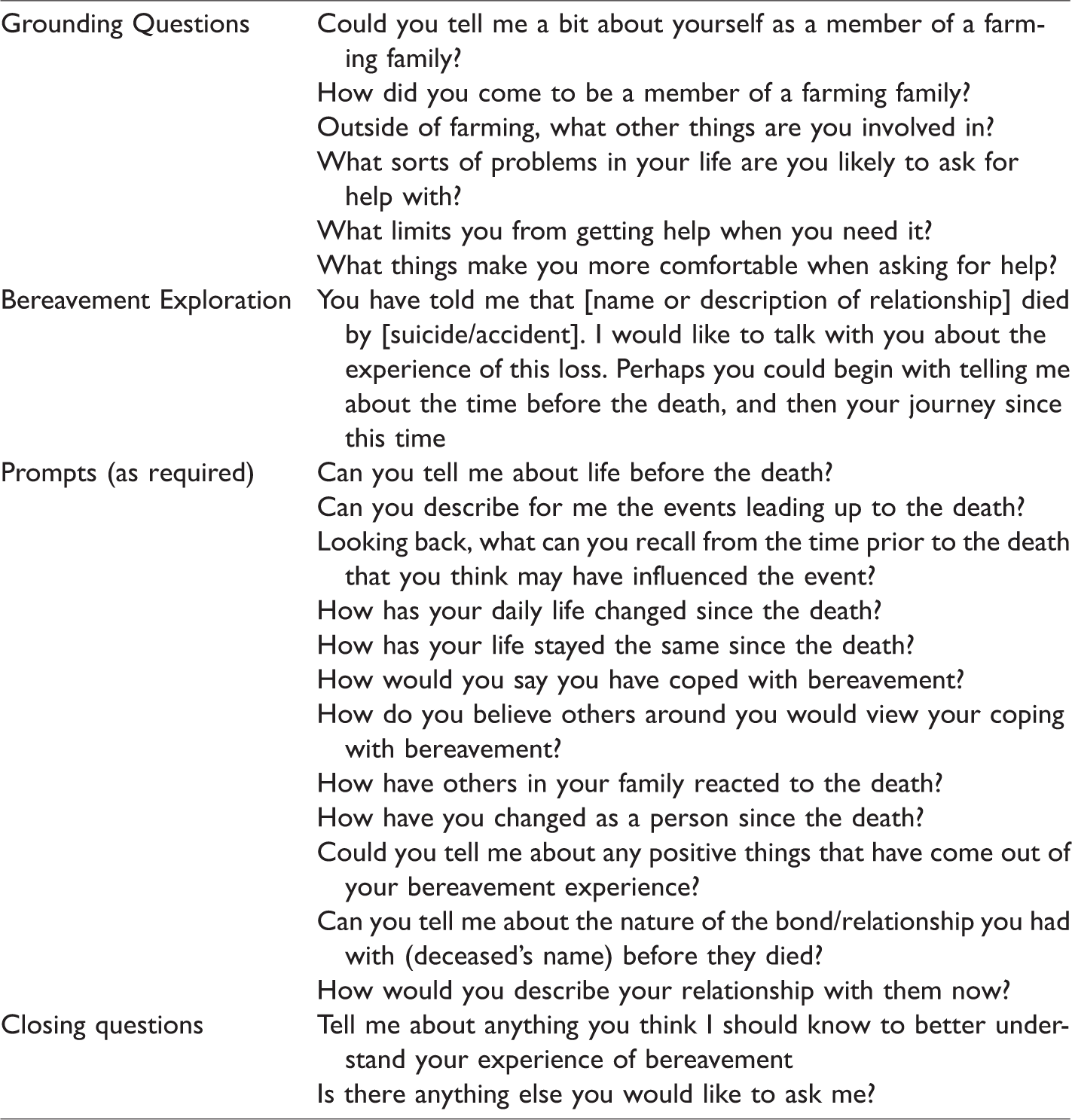
Determining an appropriate sample size was considered at length. Although “theoretical saturation” is the commonly used justification for adequate sample size, the operationalization of this concept has been poor (Beitin, 2012). Saturation has been defined as the point in data collection or analysis when new material produces minimal or no change to the identified themes and has been subsequently estimated as amounting to 12 interviews (Guest, Bunce, & Johnson, 2006). However, without a structured interview schedule, data saturation remains a moving target depending on the content of the discussion (Guest et al., 2006). The authors considered models described by Malterud, Siersma, and Guassera (2016) and Fugard and Potts (2015) when determining sample size, as well as a concern for equitable gender representation of subsamples across two geographical zones—a concern that has been noted in previous bereavement research (Maple, Cerel, Jordan, & McKay, 2014). These requirements were also balanced with the pragmatic boundaries set by the nature of a PhD project including limitations on time, funds, and available personnel (Baker & Edwards, 2012).
All interviews were audio-recorded and transcribed verbatim by the first author. A process of thematic analysis was used to make sense of the narrative data and followed the six-step process described by Braun and Clarke (2006). All authors read the transcripts of the initial interviews to discuss consistency and data quality. Transcripts were read and reread with systematic line-by-line coding. Codes were sorted into potential themes, with subthemes being drawn together to create main themes. Where data remained unexplained by the developing themes, this lack of fit—and how it could be explained relative to (or contrasting with) existing themes—was considered. This “mismatch” often added greater depth and understanding to the narrative picture. The first author undertook this analysis, and all authors reviewed the themes. Discussion between authors led to final coding and themes. Vignettes were written about each of themes, drawing together participant quotes and the analytical narrative to identify what was of interest and why. Analyzing the narratives at a latent (as opposed to semantic) level, allowing for an understanding of how the stories were formed, relayed, and linked within the broader social environment (Braun & Clarke, 2006).
Results
Recruitment resulted in 24 participants (10 males and 14 females) contributing via 11 face-to-face, 11 phone, one e-mail/phone combined, and one e-mail interview. Participants ranged in age from 28 to 82 years at the time of interview and were geographically distributed throughout rural South Eastern Australia. The relevance of the interplay between individual and contextual factors when faced with suicide and accidental death became increasingly apparent throughout the thematic data analysis, aligning with Patton’s (2002) assertion that the context in which people are immersed and socialized has great bearing on how individual experience is shaped, perceived, and understood. This includes a range of psychological, cultural, social, and environmental factors. Given that farming family context was the focus of this study, context was given preference when drawing out the themes. These results explore the interplay of three interconnected themes inductively drawn from the data: acceptance of risk, normalization of death, pragmatic behavior patterns and connection to place. Within the text, participants’ own words are identified through the use of italics, with individual participants identified by a pseudonym, type of exposure, and time since death in (brackets) at the end of each quote. A summary of participant details can be seen in Table 2.
Summary of Participant Details.
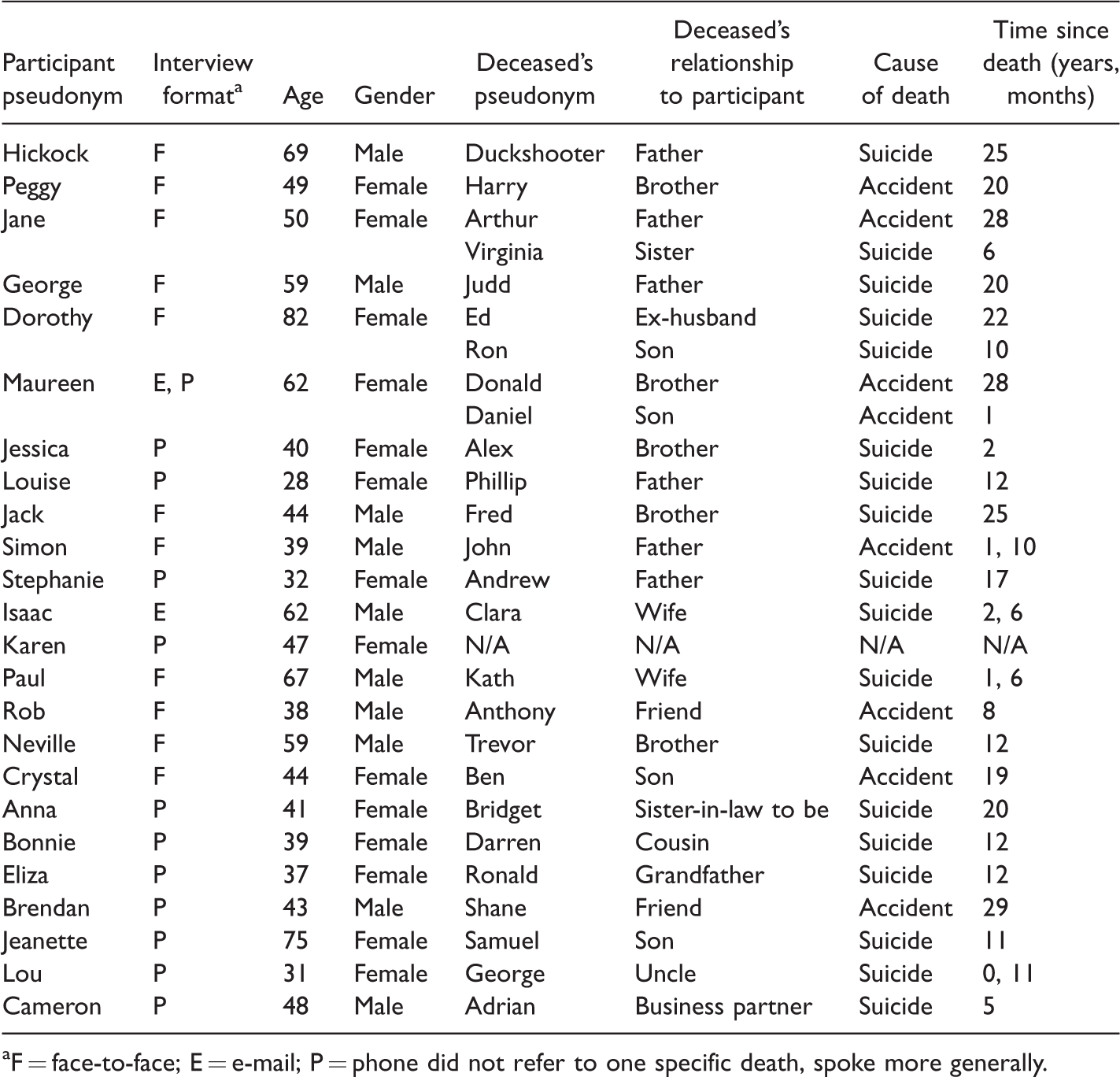
aF = face-to-face; E = e-mail; P = phone did not refer to one specific death, spoke more generally.
Acceptance of Risk, Normalization of (Some) Deaths
Participants were exposed to inherently risky activities as part of farm life from a very young age, frequently describing their childhood involvement in farming tasks involving machinery, vehicles, firearms, and livestock. These tasks, even when performed by children, were not regarded as hazardous. Instead, they were normalized as enjoyable social activities where everyone worked together to achieve a common goal for the betterment of the farm and the family: All our farming operations, like the shearing [clipping the wool off sheep] and that stuff, was all scheduled around holidays. We never, I never, saw any of that as work. That was just all fun. (Cameron, suicide death, 5 years) We were like the three boys and we were always down the paddocks together [. . .] I lived outside on the farm and I begrudged coming into the house. I just wanted to be on the land and outside. I was always on the farm. (Peggy, accidental death, 20 years) There’s plenty of dangerous stuff that goes on. It has never been beyond the realms of possibility that someone could get killed. (Cameron, suicide death, 5 years) I feel reasonably well balanced as far as death and dying go. I attribute that [. . .] to the fact that I have had livestock around me and as a general rule, if you have livestock, you also have dead stock for a variety of reasons. (Isaac, suicide death, 2 years 6 months) When they told me that he died, that he had been shot, I thought he had just been shooting a rabbit and that it had been an accident. Like that was my first thought. That he must have been rabbit shooting and he got shot. (Stephanie, suicide death, 17 years) I never thought for a minute that he would have killed himself. I thought, he was dangerous on a motorbike, and I thought he has come off his bike or done this or done that. (Cameron, suicide death, 5 years)
Pragmatic Behavior Patterns
Participants described a pragmatic, goal-focused approach to facing challenges in their lives, including their experiences of loss and grief. This resulted in continuing farming activities in the immediate aftermath of a death. When Crystal’s father encouraged the family to go on a holiday after her young son’s funeral, Crystal chose to face her grief head-on: It was easier just to stay and work through the process, rather than having to go away and then having to come back to it all [. . .] I am the kind of person who just gets on with it. (Crystal, accidental death, 19 years) You still have to go through daily life. You know, people still need to be fed, you have still got nappies to change and all that. (Crystal, accidental death, 19 years) [I] did all the proper things. I kept my family secure [. . .], helped my sister organize, talking to the lawyer about it and what I should do. Um, and dealt with the police and then you had to clean up the mess [. . .] And I guess that’s the way I have always approached everything. That doesn’t mean you are happy with it. That’s sort of like heat in the kitchen, when the going gets tough, you’ve got to do it, somebody’s got to do it. (Hickock, suicide death, 25 years) I felt like I was standing on the edge of a black hole. So, that was pretty scary to me at that point in time. When I would like to be speaking to someone and I couldn’t bring myself to do it. For fear of my clients finding out that I wasn’t as mentally strong as I needed to be to be their consultant. And I could just see my business going belly up. (Jack, suicide death, 25 years)
Connection to Place
Participants demonstrated a strong connection to the place and activity of farming—a geographic and emotional connection. This element of connection to place—while often very strong—was sometimes difficult for participants to articulate. For example, Rob struggled to verbalize why he had chosen to continue farming rather than pursue a career as a carpenter: [Farming] is just is one of those things if it gets you, it gets you . . . I don’t really know what it is. It’s not the lifestyle . . . It’s more than that. Um, whether it's, when you have grown up with it, I don't know––it's not that you appreciate it, you accept it I suppose. (Rob, accidental death, 8 years)
Perceptions of the Deceased Person’s Connection to Place
To understand the death, participants frequently explained how they perceived the deceased person’s connection to place. This connection to place often stretched beyond a particular location to encompass the broader farming environment. For example, Simon explained this about his father: There was an element of perhaps geographic location of the farm, and the notion that his parents started there [. . .] But it was also farming per se. [. . . He] always had just a strong connection with farming and the land. (Simon, accidental death, 1 year 10 months) I get, I get it. And, you know, if he can’t manage his farm, what else did he have? What else would have kept him alive? They were just the first things that came into my head [. . .] There was no “Oh, no, why?” and things. [That was] the gut feeling that I had straight away. (Jessica, suicide death, 2 years) I was able to accept why it had happened and never blamed Dad and never had any of those ideas like: “Why did he leave us?” and anything like that [. . .] I was able to kind of comprehend it I think. (Stephanie, suicide death, 17 years) All the things he liked to do, he couldn’t do. (Hickock, suicide death, 25 years)
Participants’ Own Connection to Place
Many participants also described their own strong personal connection to place. Peggy described the bond that entwined a geographic and emotional connection to the family farm. This was particularly important while she was living and working away in a major city: I’d come home and then I’d have to go out around the farm. I would usually ride my horse around. I had to do that. Just to get around the farm. Yeah. I needed that dose. (Peggy, accidental death, 20 years) He’s still an important part of our lives. He is not there, but he is there . . . We will drive around [the farm] and we will say “oh look, Samuel did this.” The other day, aren’t they trees that he planted? Aren't they growing so well? (Jeanette, suicide death, 11 years) I think that being on a farm is very therapeutic. And with death, I suppose it is how you feel about farms. But we just walked out in those paddocks and we went and hugged trees and we just wandered through our big garden and, it was home. We just went home, and it was Harry’s. It was just a big beautiful place to be [. . .] We had a big plantation that everyone had contributed to [. . .] People gave us lots of roses so we made an actual, brand new area. We had roses everywhere, but we made a Harry rose garden and a massive Harry plantation. (Peggy, accidental death, 20 years) I notice little things like the beauty of a crop. Or I might see the wheel marks through a crop and think, oh, I wonder who is on that journey. Or, wouldn't Alex love to be driving through that crop [. . .] There is not a day goes by that there is something, generally outside, that makes me think of him or reminds me of him […] I find a lot of those things very comforting. (Jessica, suicide death, 2 years) I couldn’t even go into the shed, nor could [daughter] Lydia [. . .] So the community came and demolished our shed [laugh] and that was good. (Jane, suicide death, 6 years) We still love being on the farm. (Jane, suicide death, 6 years) I had to leave that farm, because I was reminded of it [the accident] everyday. (Brendan, accidental death, 29 years)
Discussion
The aim of this article is to explore the experience of members of Australian farming families when faced with accidental or suicide death within the context of farming life and work. Such context influenced the complex process of bereavement and the reconstruction of meaning following suicide or accidental death and was shaped by a range of cultural, social, geographical, and psychological factors. In many ways, the findings of this study portray participants’ expectation of, and a sense of preparedness for, life and for death—a type of “farming fatalism.” This fatalism relates to preparedness for deaths that in other contexts may be perceived as violent or traumatic losses (Currier et al., 2006), usually associated with greater likelihood of complicated grief (Keesee, Currier, & Neimeyer, 2008). Furthermore, Maple et al. (2007) identified that parents who anticipated the suicide death of their child were more able to make sense of the death—as unwelcome as it may have been—in a way that was consistent with their worldview. The current findings support and expand this understanding to include preparedness for accidental death among farming family members.
Although not necessarily anticipating the death, many participants in this study were rapidly able to accommodate the death. In doing so, these participants were not beset by persistent ruminating about “why?” the death occurred, as is often highlighted in sudden and traumatic death literature—including suicide and accidental death (Jordan & McIntosh, 2011). Rather, they were able to find an understanding for the death that made sense within their worldview—drawing on their pragmatism and their connection to farming.
This also suggests that grief for these participants is not disenfranchised in the way that suicide deaths have been conceived (Doka, 1996)—providing opportunity to more readily acknowledge and mourn the death. This tendency to rapidly accommodate the death did not appear to be effected by the length of time since the death occurred. It is important to note that while able to make sense of suicide deaths within the context of farming, there was no evidence that farming family participants normalized suicide death.
Building on our understanding of meaning making following loss, these findings indicate that the connections to place are important. For farming families—who work, live, play, and socialize on their farm—farms are “locations with history, symbolic meaning, and repositories of emotion” (Quinn & Halfacre, 2014, p. 118). Participants’ understanding of the death and how they incorporated the loss into life moving forward are intricately linked to place. In their work on continuing bonds, Klass, Silverman, and Nickman (1996) recognized the interdependence of people and that this relationship does not cease when one dies. These findings suggest that these bonds extend into the physical and geographic places where the relationship was experienced. This supports previous findings by Quinn and Halfacre (2014), who describe farmers as developing a strong attachment to place—drawing on a sense of safety, peace, reflection, and recuperation from their connection with the farm, particularly during personal hardship. These geographic and physical elements of connection, along with the individual relationships that develop within this context, should be considered if there is to be a comprehensive understanding of continuing bonds within those with deep connection to faming land. Furthermore, connection to the place and activity of family farm(ing) was part of an ongoing life story of which the death was one part. Although these bonds could be threatened by the bereavement experience, they predominantly reinforced participants’ own attachment to place, along with the practicalities of farming activity that require ongoing attention, creating an ongoing cycle of connectedness. This emphasizes the complexity of bereavement shaped by both social and geographical contexts.
The inherent pragmatism of farming family members demonstrated here has traditionally been associated with the dominant male gender role in rural Australia (Alston, 2012)—underpinning the traditional focus on “practical” problem solving as opposed to “seeking help.” The findings here challenge that males only demonstrate this behavior, with females equally pragmatic in their response to bereavement. This has implications for how we understand, engage with, and develop support services in rural communities.
Although there has been a growing response to heightened risks of suicide and accidental death in rural farming communities, little was known about the effect of these deaths on those left behind. These findings suggest a more complex interplay between people and place than what is reported within the broader Australian population (Bourke, 2001). This confirms that bereavement experiences vary and the reaction to suicide or accidental death may not be one that challenges people’s understanding of their world and leaves them struggling to find a reason why the death occurred.
Limitations
The findings of this research must be viewed within the limitations of the design. This was a small, cross-sectional qualitative study using in-depth interviews with a self-selected group of individuals from farming families who had experienced the suicide or accidental death of someone associated with them. The requirement for proactive involvement by participants, although ethically responsible, may have required too much of some grief-stricken people and these potential participants may have been missed (Maple et al., 2014). Other potential participants may have felt a reluctance to share their story, whether due to stigma or other reasons (Maple, 2005). This research design was unable to capture this group.
The cross-sectional design was retrospective in nature and unable to capture the longitudinal experience of suicide and accidental death bereavement at key points. However, combating this limitation to some degree was the representation, across the sample, of a broad range of times since bereavement. These time periods ranged from a few months to over two decades. The capacity of this study to capture information about participants’ ruminating about why the death occurred may also be influenced by the study design—given that this was a particular group of farming family members contributing to the study at one particular point in time.
While providing valuable insight into the context of long-established rural family farming, this research does not represent the experience of non-Anglo-Saxon migrant farming families (particularly first-generation), or those of Aboriginal or Torres Strait Islander descent (a cohort for whom traumatic death is particularly prevalent) due to no participants with this background volunteering to participate.
Conclusion
This research underlines the importance of recognizing context as shaping the understanding and response to loss following suicide or accidental death and challenges the largely homogeneous way in which grief is perceived across western culture. What have long been assumed as traumatic deaths may in fact be experienced differently for farming families due to their pragmatic approach to life and work. This has bearing on how we consider bereavement as well as other potentially traumatic events for farming families. For example, events with a practical impact on running the farm business may have a particularly debilitating impact. This is particularly important given the often highly integrated nature of life and work on a farm, and where succession decisions or the impact of natural disaster can have such a considerable and long-lasting impact on the ongoing viability and existence of farms and family members’ lives.
These results further highlight the importance of connection to place as influencing both the meaning making process following suicide and accidental death and the development of continuing bonds. This has implications for our understanding of bereavement within farming communities with strong connection to place—particularly where the risk of exposure to suicide and accidental death is heightened.
Footnotes
Declaration of Conflicting Interests
The author(s) declared no potential conflicts of interest with respect to the research, authorship, and/or publication of this article.
Funding
The author(s) received no financial support for the research, authorship, and/or publication of this article.