




Abstract
As digital outlets of expression become increasingly accessible, means of conveying grief and commemorating the deceased have migrated online. Online memorial websites such as UK-based Muchloved.com boasts thousands of Tributes created by the bereaved to remember the deceased. Many of these Tributes sketch out a rough picture of the person commemorated through text detailing their personal lives, professions, hobbies, and accomplishments, as well as photographs capturing intimate moments with family and community, and condolences contributed by family, friends, and community members. This article examines how stories of migration figure in this large pool of digital Tributes. We draw from Moncur and Kirk’s “emergent framework” for the study of digital memorials by analyzing 17 Tributes on MuchLoved.com, which commemorated individuals who, according to these Tributes, migrated from one nation to another. We find that the practices and conventions of memorial-writing to commemorate first-generation immigrants perpetuate narratives of exceptionality.
Introduction
This article seeks to examine how migration stories are told on memorial websites, and how these stories figure into practices of digital commemoration. These websites promise flexible and accessible means of online memorialization as they are not limited temporally and spatially like other forms of communal grieving and remembrance. Moreover, the practice of “vernacular memorial-making” (Maddrell, 2012) allows for a multitude of life stories to be told, rendering quotidian experiences into a remarkable narrative that lives on beyond an individual’s death, particularly through interactive and multimedia forms. Although literature on web-based outlets for grief is growing, there has been little investigation into the possibly unique quality of digital memorials created to commemorate first- or second-generation immigrants. Given that memorial websites such as MuchLoved.com are structured to encourage multimedia expressions of grief, our article explores memorials that reveal experiences of migration, which are pertinent to a narrow, but growing subset of the website’s memorialized population.
Literature Review
Online Memorials and the Expression of Grief
Maddrell (2013), among others (Margry & Sanchez-Carretero, 2011; Walter, 2015), examines practices of “vernacular memorial-making” (Maddrell, 2013) to commemorate the deceased. These practices are characterized by memorials that are individual, intimate, and distinct from the physical site of the corpse and institutional sites of grief, such as funeral homes and gravesites. Instead, vernacular memorials may include park benches, plaques, roadside memorials, or any number of places that are chosen to remember the deceased. The vernacular intimacy of memorial-making is also reflected in both content and context of digital memorials. The freedom family and friends exercise in sharing personal details about the deceased is enabled by the technological affordances of digital memorials, including the ability to express grief from the privacy of one’s home, and to openly communicate affect, as opposed to the generic conventions of printed obituaries.
Obituaries in newspapers have traditionally followed a particular and standardized format (Fowler, 2007) and have tended to emphasize noteworthy or notorious figures. Hume and Bressers (2009–2010) note how historically, newspaper obituaries have been defined according to a prescribed format and convey news values. More recently, this trend has shifted to include obituaries of more common folk in newspapers, though there is still little inclusion of minorities or disenfranchised others (Jiwani, 2016). However, this is not to suggest that all online memorials depart radically from those that appear in newspapers. Some online memorials mimic conventional obituaries to varying degrees, and online obituaries are often aggregated from sources such as funeral homes and newspaper announcements, reflecting in part the funeral industry’s adaptation of online technologies. Many of these online obituaries are created as a result of purchasing a print obituary, either through a local newspaper or the funeral home undertaking the funerary processes.
In contrast to the public nature of obituaries, the private and personal benefits of grief-writing have been well-established. Lattanzi and Hale (1985) state that the practice of writing about and to the deceased can serve as an emotional outlet, counteracting the isolation experienced by the bereaved. Cable (1996) claims that grief-writing can also help those affected by a sudden death to make amends and “address unfinished business” by writing directly to the deceased, using the second-person voice. This practice of symbolically reaching out to the deceased has been conceptualized by Klass, Silverman, and Nickman (1996) as a process of initiating “continuing bonds” between the bereaved and the deceased.
Bennett and Huberman (2015) remark on the changes in American memorialization practices, from elaborate rituals surrounding death, to the modern “idea of progress,” located in a cultural impetus to connect the life of the deceased to a larger, positive social movement. This analysis includes recent shifts in the use of online memorials, particularly in maintaining links with the dead through remembering and foregrounding their accomplishments, thus establishing a type of ongoing legacy.
Memorial writing can also provide opportunities for “disenfranchised grievers,” whom Doka and Aber (1989) refer to as “those whose grief occurs in relationships with no recognizable kin ties; those whose loss is not socially defined as significant and those who are perceived to be incapable of grief” (p. 7). These include relationships between nonheterosexual partners, relationships that are regarded as “close enough” to experience grief, people who are excluded from collective mourning because they are at odds with the immediate family, or those who are deemed to be incapable of grief (children, seniors, or people with cognitive disabilities). Furthermore, disenfranchised losses include those whose deaths are stigmatized (in cases of suicide, AIDS, or addiction for example), or those whose losses are not recognized as “grievable” (Butler, 2006) because they are structurally marginalized or deemed socially insignificant (Doka & Aber, 1989).
As opposed to obituaries, which are generally written by immediate family, online memorials can offer disenfranchised grievers a platform to legitimize their grief via an accessible and tangible and public outlet. Examples of this can be found in the online memorialization of the missing and murdered indigenous women in Canada, and the Faces of Suicide website (Krysinska & Andriessen, 2015). These memorial sites not only allow for the expression of continuing bonds with the deceased but can also strengthen community ties among the living. With disenfranchised grief characterized by inadequate social support among the bereaved, digital memorials can function as spaces to negotiate, legitimize, and alleviate grief among an empathetic community (Harju, 2015). For example, online memorials allow for a degree of emotive expression that is not permitted in newspaper obituaries and can widen grieving communities to establish communal belonging among a broader public who is affected, but not necessarily recognized or visible during a time of loss (Harju, 2015).
Moreover, in a Western context, death and grief are sequestered into particular spaces (hospices, cemeteries, the funeral home, rather than inside one’s home) (Walter, Hourizi, Moncur, & Pitsillides, 2012) as well as restricted to a particular time period (to events such as the funeral and burial, and the maximal 1-year grief period that Charmaz (1980) argues Americans are conditioned to abide by); all of these constraints work to conceal and consequently institutionalize death (De Vries & Rutherford, 2004). Death, and the surrounding accommodations, become private “family-specific” responsibilities, removed from community involvement and ultimately “deritualized” (De Vries & Rutherford, 2004). Digital memorials can thus offer the crucial opportunity of allowing one’s grief to live out its due course unrestricted by space and time, maintaining long-term “continuing bonds” with the deceased through the affordances of form and platform.
Roberts and Vidal (2000) and Roberts (2004) initially mapped out the presence of cyber/web memorials and virtual cemeteries as early as 1995, during the nascent stage of the Internet boom. They explain the steady popularity of creating and engaging with online memorials by identifying the following four benefits: (a) Flexible timing—one can write and engage with a memorial at any time, (b) Access—a memorial page is continuously “live” on the web and readily accessible, (c) Visiting—visiting a memorial doesn’t require mobility or geographic proximity, and (d) Sharing—a memorial page can be easily shared across time and space.
Notably, their work establishes two categories of content: static content, such as obituary-style “posts” that remain on a Tribute page, often written by close family; and dynamic content, such as a guestbook where visitors offer written condolences. The presence of both static and dynamic content is a primary feature of most commonly used memorial websites, including Legacy.com, InMemoriam.com, as well the website we examine here—MuchLoved.com.
Following a survey of popular memorial sites tailored to Western customs of mourning (Digital Graveyards Project, 2019), we chose to focus on memorials created on MuchLoved.com for the following reasons: (a) its user-centric operations model, (b) its ability to host a large volume of content, (c) and its technological adaptability. MuchLoved.com distinguishes itself as a “bereavement charity” that prioritizes ease of access, offering customizable pages, and the ability to upload multimedia files including music, video, and photographs. We found that MuchLoved’s hosting capacity is unparalleled when compared to other digital memorial sites—each Tribute comes with 100 MB of free space, allowing users to upload up to 1,000 photographs and submit “virtually unlimited text” in addition to a few music and video files. Those who seek additional memory space can pay a nominal “contribution” fee to cover this cost. Compared to major memorial sites like Legacy.com and InMemorium, MuchLoved is also much easier to browse. For instance, one can choose to house their loved one’s memorial on the “Remembrance Gardens” feature, where different memorials are grouped together on a single page.
Roberts and Schall (2005) have observed that online memorials exemplify a “public private speech” (p. 155). As public-private speech, the appeal of online memorials is largely determined by the temporal and spatial expansion afforded by online platforms. Through the ongoing participation of disparately located contributors, and the incorporation of both static and dynamic content, online memorials are presumed to be able to “live on” indefinitely, possibly even forever, depending on the shelf life of their host websites.
Online memorial sites are more image-based than newspaper obituaries, most of which only allow space for a single picture of the individual commemorated to accompany the text. Conversely, memorial interfaces promote their platforms through customization options in color-scheme, theme, and by encouraging users (both creators and visitors) to upload photos to the page. This feature is significant as Bennett and Huberman (2015) argue that photographs have taken on a more important function in mediating our relations with the deceased in increasingly mobile societies, due to both voluntary and involuntary migration and dispersed social and familial networks. More generally, Bravo (2017) examines the process of transnational grieving by undocumented migrants in the United States who experience the loss of a family member in their home country. As these migrants were not able to be physically present during an illness or after a death because of their lack of legal status in the United States, they relied on digital platforms to be “present.” With the aforementioned privatization of death rituals, digital communication “with” and about the deceased has been incorporated into vernacular practices of memorialization, specifically relevant to grievers with limited access to traditional outlets for memorialization.
Whose Story Is it Anyway?
The public commemoration and celebration of immigrants, refugees, or non-European members of a population in the Western world has a history that is fraught with exclusion and discrimination. For instance, in one of the earliest records of “failed commemoration” of immigrants in Canada, Badgley (1998) relates the story of how, in 1953, the Department of Citizenship and Immigration arranged to celebrate the millionth post-war immigrant with the scheme of finding a candidate that was “male, British and between 14 and 16 years old … [who] should also be ‘the son of a man who has a good employment record in the United Kingdom’” (p. 133). The criteria excluded anyone who did not fit the stereotype of the worthy and grievable (Butler, 2006) immigrant.
Similarly, Motte and Ohlinger’s (2006) discovery of a lieu de memoire that captures the traces of migration into Germany reveals a photograph of Rodrigues de Sa, “the one-millionth ‘guest-worker,’ who arrived in 1964” (p. 149). Although commemorating an immigrant, the photograph, perpetuates the “young and male” stereotype of post-world war labor migrants, rendering the migration experiences of women and families invisible, without providing context for the grueling circumstances of his journey and subsequent death (p. 149). In both these instances, lack of historical knowledge concerning contemporary migration results in a failure to publicly acknowledge the significant contributions of immigrants and migrants. When their contributions are commemorated, this celebration is conditional upon notions of individual exceptionality, governed by the stereotypes and norms of the host culture, and the characteristics make them “deserving” of commemoration and postmortem belonging (Jiwani, 2016).
As such, we recognize that “migration” refers to a broad array of vastly different life experiences, depending on factors that include the conditions and reasons for the move and access (or lack thereof) to social and economic support systems both at home and abroad. Thus, by using narratives of migration as our focal point, we aim to examine the kinds of stories that are being told, as well as the nuances in language (in a broad sense) employed on online memorial websites. Our goal lies in determining thematic patterns emergent in texts that commemorate individuals who have experienced the process of “uprooting” oneself from one place and settling into another.
Method
We examined digital “Tributes” created on MuchLoved.com, a UK-based website founded in 1998 that describes itself as a “pioneering bereavement charity” (About MuchLoved, 2018). Tributes on MuchLoved are free to create and offer users the option of fundraising for a UK-based charity of one’s choice. The site emphasizes itself as a charity, stating that “we work solely to help you,” and remains free of advertising through the support of “500 Funeral Directors and 150 UK charities” (About MuchLoved, 2018).
MuchLoved Tributes feature a standardized format and simple design that is primarily text-based, with the option of posting photographs and uploading music and videos. As such, the site ensures the general accessibility of its services by offering pages that can be created in “seconds,” without any prior knowledge of web design. Unlike similar services offered by other memorial websites, there are fewer opportunities to customize the layout of a Tribute page, with the only customizing option being choice of color palate. Tribute pages include a central homepage and five additional tabs: “Lifestories,” “Gallery,” “Timeline,” “Journal,” and “Contribute.” Written details of the individual’s life are generally included on the homepage, in addition to the Lifestories and Timeline pages. Consequently, the analysis presented here relies primarily on content posted on these pages, particularly in locating explicit mentions of migration. The Gallery includes options to upload photos, music, and a video gallery, as well as options for visitors to leave “Thoughts” (akin to guestbook entries), or to “light a candle” in honor of the deceased.
Throughout this article, the term “Tribute” or “Tribute page” is used interchangeably with the term “memorial” given the language of the MuchLoved website. Individual memorials on MuchLoved consist of standalone webpages, usually with the URL as the deceased’s first-lastname.muchloved.com. The memorials that we accessed are aggregated in Remembrance Gardens that have been optionally made public by their creators who are referred to as “Tribute Guardians.” The Remembrance Gardens possess names inspired by natural or fantastical spaces such as “Heavenly Sanctuary” or “Woodland Trails.” These gardens contain a mix of both secular and religious imagery, although those with more religious or spiritual themes only vaguely allude to any specific faith, with names such as “Heaven’s Gateway,” or “Spiritual Gardens.” Each of the 12 Remembrance Gardens contains four additional “subgardens,” named with similar themes and images. Although the MuchLoved website provides no explanation or source of inspiration for these gardens, the grouping of memorials according to garden alludes to the notion of a Tribute “resting” in a given space, which suggests that they function as virtual “neighborhoods” or cemeteries governed by a distinct theme. While an elaborate discussion of the purpose and structure of the gardens is beyond the scope of this article, we have come to understand them as spaces chosen by the Tribute creator based on perceived qualities that resonate with the deceased (Figure 1).
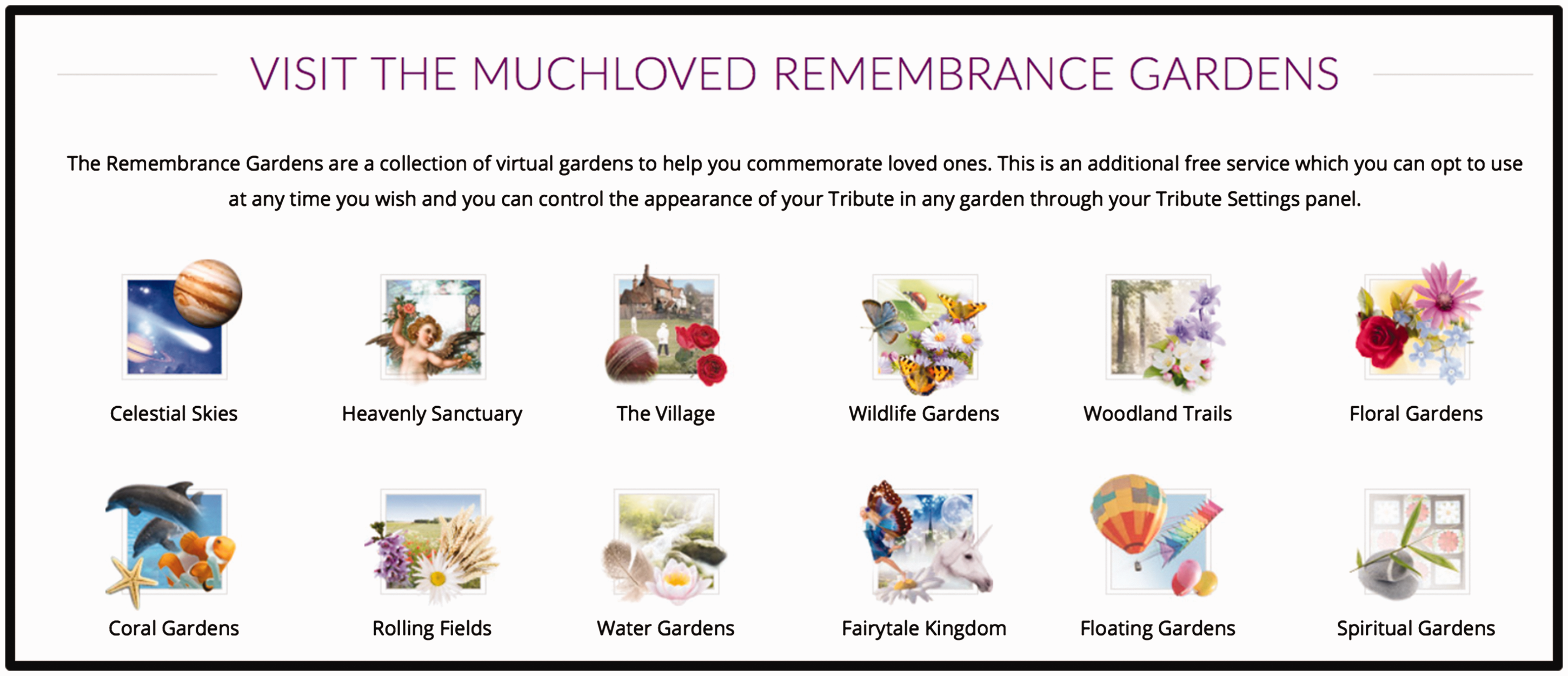
MuchLoved Remembrance Gardens (2019).
Scanning 2,100 Tribute pages, we sought out Tributes from six different Remembrance Gardens to locate those that included mentions of migration from one nation to another. Our criteria consisted of individuals who were born and deceased in different countries, as well as those who were said to have spent part of their lives away from their native country. We located references to migration on different pages of the 2,100 Tribute sites we examined focusing on “Stories,” “Timeline,” and the “Thoughts” left by both the sites’ creators and visitors. Through this process, we located 47 Tributes with both explicit and implicit mentions of migration. From these 47, we narrowed our scope to 17 Tributes to analyze further. This decision was informed by the length and amount of detail in the Tributes, of which the multimedia options allow a Tribute’s creator(s) and visitors to expand on the life stories of the deceased. To narrow our Tributes, we chose to focus on texts that most explicitly fulfilled our criteria of mentioning migration as a long-term geographical journey.
Considering our narrow data set, this article constitutes an in-depth qualitative examination of memorials referring to issues of migration and displacement that is by no means exhaustive and representative of all Tribute subjects that reveal having experienced migration. In selecting our Tributes in this way, we acknowledge that there are many factors that contribute to the “full use” of these memorial websites that exist independently of any mention of migration. These factors include levels of community and familial involvement, access to images and information about the deceased, creators’ degree of technological savviness, or motivations to fundraise for UK-based charities. In other words, the absence of any mention of migration does not necessarily mean that migration and displacement were not significant experiences in the lives of other people memorialized on MuchLoved. Thus, in selecting a small number of Tributes containing explicit descriptions of migration, this article seeks to offer a preliminary survey of the kinds of migration stories that are being told and made visible on memorial websites such as MuchLoved, paying careful attention to the language employed to relay these stories.
To analyze these Tributes, we employed content analysis as well as an informal discourse analysis, reading the entirety of written text posted on each Tribute, while also taking into account the inclusion of other forms of media such as images and music, with the goal of identifying recurring themes, as well as general patterns of usage of the features offered. This process helped us identify how language is used to narrate individual stories of migration, particularly how quotidian or “ordinary” stories of one’s domestic or professional life may be amplified by the “extraordinary” circumstances of migrating to a new country. Webb, Campbell, Schwartz, and Sechrest (1966) stress that one of the most important values of content analysis lies in its “nonreactive” and “unobtrusive” nature as a method of research. This is crucial given the sensitivity of our topic, where speaking directly to grieving memorial makers poses ethical and methodological challenges that are beyond the scope of this article.
In addition, we draw from Moncur and Kirk’s (2014) framework for the analysis of digital memorials. This structure is useful in considering the networked, multimedia capacities of digital memorials, which the authors break down into the relations between actors, inputs, form, and message. Although Moncur and Kirk designed their criteria for the creation of digital memorial platforms, we use them to unpack individual Tributes on the broader memorial site (MuchLoved) and draw comparisons between them, with narratives of migration as a common denominator.
We suggest that this method of close reading, considerations of the parameters of the platform and the affordances that inhere in the MuchLoved site, constitute a form of fragmented curation wherein we, as researchers, seek to draw out the deeper meaning from the “thicker” description of various components of the memorial that comprise each person’s story: photographs, music, location in a specific garden and, most importantly, the written text being produced by those who create and visit a particular web memorial or Tribute page.
In the following sections, we present our findings. However, to respect the privacy of the deceased and the bereaved, we have chosen to identify both the deceased and the bereaved through the use of their initials rather than full names and redact certain identifying information from quotations.
Analysis and Discussion
We examined 17 memorials, commemorating 19 individuals (two were joint memorials for married couples who passed soon after one another). Our sample included 9 men and 10 women. Their ages at the time of passing ranged from 22 to 89 years, where 7 were 70 to 89 years, 6 were 50 to 69 years, 3 were 30 to 49 years, and the youngest was 22 years. Two Tributes did not list birth or death dates but based on information available (dates in biography, photographs), it appears that the deceased individuals were both elderly when they passed.
Countries of birth also varied. Most common were Nigeria (4) and the Philippines (4), as well as India, Italy, Jamaica, Tanzania, Sri Lanka, Kenya, Uganda, China, Thailand, and the United Kingdom. Predictably, there was less diversity in the countries where they settled: eight migrated to the United States, seven to the United Kingdom with one back to Nigeria, one to Canada, and one (NM, aged 22 years) was described as living in multiple places (Kenya, United Kingdom, Canada), leaving it unclear where she intended to settle, or where she eventually passed.
Breaking down these specific memorials into general patterns, we work through Moncur and Kirk’s (2014) framework following their four categories: (a) Actors (who are the actors involved in the digital memorials?), (b) Inputs (what are the inputs?), (c) Form (what form does the memorial inputs?), and (d) Message (what message is being conveyed?) (p. 971). For the purposes of analysis, many of these categories overlap and are informed by one another such as for example, the form (platform and affordances) which allows for multiple users (actors).
Actors
To begin, Moncur and Kirk (2014) describe memorial actors as both the “authors” of the memorial and its “audience”. They state that “authorship and narrative voice are intrinsically linked, with the author adopting a strongly curatorial role: The nature of the memorial is directly affected by decisions of what to include in the story—and what to leave out” (p. 966).
Authors with close ties
On MuchLoved, the primary memorial author becomes synonymous with the Tribute creator, who may or may not be the sole person creating and posting content to commemorate. Creators of the Tributes we examined included close family, relatives, close friends, and colleagues. We identified these relationships through a close reading of the entire memorial, mainly through written content. Although authorship is scattered across entries, we were nonetheless able to find links between a Tribute Creator and the deceased, revealing the nature of their relationship. Given that MuchLoved is a multimedia memorial website that allows contributions from anyone (posted with the approval of the Tribute site creator), multiple people can be authors. For the purpose of this article, we make the key distinction between Tribute Creator as the single curator and gatekeeper of the memorial, and Tribute contributor as anyone that may post content to express condolences. Based on the memorials we examined, we perceived no discernible link between the purpose or intent of a memorial and the nature of the relationship between deceased and memorial creator. All of the memorials, however, serve the purpose of continuous, collective remembrance. In other words, through a variety of contributions, the process of remembering and the motivations to do so are expressed as fragmented, subjective, and interpersonal, with the likelihood of being visited and appreciated by many who may be “silent” noncontributing visitors.
Out of the 17 Tributes, 12 were created by immediate family members, namely, children, partners, siblings, and a niece, which explains the elaborate biographical and intimate details that were recurrent across the Tributes. As Roberts and Vidal's (2000) early investigation of online memorials confirms, the majority of such memorials are created and written by close family members, which is worth noting for a few key reasons. First, memorial creation can have a therapeutic value for those most affected by a death, providing an outlet for multimedia expression that is both private (it can be done in the comfort and convenience of one’s home or mobile device) and communal (Tributes are open to submissions by anyone, encouraging communal grieving). Second, the publication of one’s life information by their kin includes passages that attest to the virtues and positive qualities that describe the deceased, as for example, “[BB] routinely reached out to everyone with love, caring, and respect, and as a result people were constantly drawn to her,” which consists of information that cannot be verified but is generally validated precisely because it is written by close kin, with a recognizable relationship. This lends a degree of credibility and legitimacy to otherwise “ordinary” accounts of the deceased's character.
Fragmented and curatorial authorship
As our corpus of Tributes illustrates, memorial authorship is often fragmented into submissions, including transcribed speeches, photographs, stories, and quotes by multiple people, using a range of voices, styles of writing, and images. Although MuchLoved Tributes can only be created by a single user, all five of MuchLoved’s tabs (Lifestories, Gallery, Timeline, Journal, and Contribute) provide options for others to send their own digital contributions in the form of written text, a photo, a music or video file, a thought, a lit candle, or a donation.
For instance, under the Lifestories section of a Tribute for TA, 12 entries were posted, each written and submitted by a different contributor, relating memories of how they met the deceased. Some titles include: “[TA]’s visit to my house,” “our secondary school days” and “WORKING TOGETHER IN GHANA.” In other instances, authorship is twice-removed as seen in one couple’s joint Tribute [IB and VB], of which most of the entries consist of Lifestories transcribed from funeral speeches delivered by their children, but are all uploaded to the Tribute by the same user.
In the same manner in which authorship is geographically fragmented, clues indicating transnational migration also possess a fragmented quality to them by being dispersed throughout a memorial. As these Lifestories submissions posted on TA’s memorial illustrate, evidence of migration appears in fragments including the aptly named title of a visitor’s post “WORKING TOGETHER IN GHANA,” which reveals the deceased’s lived experience in a country other than the one in which he passed. Other such examples include transcripts of memorial speeches posted on IB and VB’s joint memorial, in which their children reveal details of each parent’s individual past that indicate migration: “Intelligent and articulate, she went on to study microbiology at Elphiston College in Mumbai” or “The first in the [B] family to study abroad, my father, [VDB], then came back to Kenya from Scotland, a qualified pharmacist, and went on to open several pharmacies in Malindi, Mombasa and one in Southend.”
The closeness of the actors’ relationships with the deceased is an essential factor in recognizing the evidentiary value of the stories shared in the memorials. For this reason, these memorial authors position themselves as reliable narrators as they anchor their memories and anecdotes of the deceased as fact. Moreover, Moncur and Kirk’s definition of Actors as both author and audience of a memorial demonstrates how the Actors in our corpus of memorials are undoubtedly aware and conscious of posting content that is read and thus “verified” by other visitors, most of whom belong to the deceased’s close network of loved ones.
Not all the memorials we encountered were maintained by close friends or family members. Some were created by a collective entity or group of people such as the deceased’s workplace or fellow activists. A memorial for DT, for instance, was created by her workplace, with a central page written by the managing director as a letter to the staff announcing her passing. This page offered company staff and others the opportunity to grieve and commemorate their coworker and also acted as a platform to collect their wishes, which were handwritten at a company memorial service, photographed, and uploaded on the Tribute.
As MuchLoved’s model of memorialization illustrates, the role of a Tribute’s primary author can be curatorial insofar as their responsibilities lie in encouraging others to share their grief and condolences. Moreover, Tribute creators play the crucial curatorial role of gatekeeping information that is made publicly available about the deceased, by approving (or rejecting) sent submissions. Hence, the stories published and made available to us were likely vetted by the site’s creator.
Multiple voices, multiple audiences
Of the 17 memorials, seven contain written “primary” memorial texts with all three voices: first person (I, we), second person (you), and third person (he/she, they). By primary memorial texts, we mean long, detailed content published under Homepage, Lifestories, or Timeline. These exclude lit candles and thoughts designed to directly address the deceased or the bereaved, which are thus habitually written in second person voice. Only three Tributes contained primary memorial texts written exclusively in third person voice, while six memorials were written in voices that alternated between first and third person, and one memorial was written in both first- and second-person voice. The usage of multiple voices indicates that memorial writers imagine three distinct categories of readership and vary their form of address accordingly, as evident in the following examples which we quote here verbatim:
Family and friends: [TA], bamgbelu femi and I were very close friend while were [sic] at Olivet heights, Oyo. We spent a lot of time together during school and after school during the holidays at UI in IBADAN then
2. The deceased:
You will always be a incredible mother, who took all our families worries without ever complaining [KP]
3. The public:
“She was always fighting the good fight, advocating for domestic workers …” [CGH])
All three of these categories of readership appear to acknowledge the existence of a geographically scattered audience, likely addressing family and friends who may be visiting the memorial from the deceased’s native country or another place where they visited or lived.
Tone and language
We deduced that an imagined audience of a Tribute was implied through the tone of the written content. We observed two types of recurring tones: either a formal, third-person voice (as illustrated by the above passage of CGH’s Tribute) or a more vernacular first-person voice (seen in the passage for TA’s Tribute). Choice in tone informed how accessible the content was to a visitor less familiar with the life of the deceased. For instance, Tributes using a formal tone usually contained extensive biographical details about the deceased, which suggest that the author(s) likely imagine addressing an anonymous public audience. On the other hand, writing in vernacular with a first-person voice implies a desire to address a close circle of grievers who know one another or were relatively familiar with the deceased and would appreciate more colloquially expressed recollections, focused on the everyday details of their lives.
Inputs
According to Moncur and Kirk (2014), a memorial’s inputs consist of “subject, circumstance and content” (p. 968). Subject and circumstance refer (respectively) to who or the what that the memorial is addressing (namely, a person, place, or even an event), whereas content refers to information that is included in a memorial such as stories that relate memories, material objects, or simply traits that describe the deceased. All 17 of our Tributes share similarities in the subject, circumstance, and content, conveyed primarily through text entries across multiple pages. Among them, nine memorials opened with the site’s generic message stating “[full name] is much loved and will always be remembered by all [her/his] friends and family.” The remaining eight featured an original introductory statement announcing the passing of the deceased and describing them and their life events in additional detail. The length and level of detail varied according to each memorial. At the time of our observations, all of the memorials contained at least one photograph of the deceased, with the majority (11) featuring over 30 photos. All of the memorials also possessed at least one candle lit by visitors.
Subject and circumstance
As stated, the subjects of our sample were the 19 people commemorated across the 17 memorials. Although not all the Tributes reveal the ailment or cause of death of a Tribute’s subject, most of them express surprise at the passing of the deceased—with some explicitly stating that the death took place swiftly and unexpectedly, such as in the case of NM—“We did not see you closing your eyes, and hearing your final say. We only heard that you were gone, gone too soon.” Alternatively, they express prior knowledge of their loved one’s deterioration and eventual passing, such as in the case of JA: “On 17 March 2009, he lost a 6-month battle against cancer and passed peacefully in Oxford, England.”
Content
Content, according to Moncur and Kirk (2014), generally consists of “memories of the living” (p. 969). MuchLoved provides multiple options for visitors to contribute mnemonic content to a Tribute—by lighting a candle, sending a story, thought, picture or video, or in some cases, donating money to a charity chosen by the site creator. As a result, the type of content displayed on the Tributes we have examined are variegated and flesh out a “postself” (p. 969) of the deceased that is nuanced and colored by the memories and recollections of the contributors. Moncur and Kirk describe the postself as “the socially constructed identity of the individual after death” (p. 969) which is vital to our understanding of the subjects’ experiences with migration.
We observed that the combination of textual and audio-visual content worked together in describing the deceased, their life trajectory and their social bonds. For instance, while many of the photographs show the deceased with close family, details on these relationships are often elaborated on in the introductory statement or in the Stories tab, a section designed for visitors to submit personal memories of the deceased. Multimedia content and distinct sections allow visitors to offer condolences according to varying degrees of propriety, depending on their closeness to the deceased. Although anyone can upload any type of content, we observed that small entries, like lighting a candle or offering a thought, were often used by acquaintances or more distant connections (those who had fallen out of touch with the deceased for example). On the other hand, the Stories as well as audio-visual options were used by those who exhibit a sense of familiarity with the deceased. Ultimately, the display of a variety of multimedia content reinforces a common undercurrent that ties together all of the memorials—namely, to convey the sense that the deceased lived a full and satisfying life.
Form: (What Form Does the Memorial Take?)
Moncur and Kirk (2014) distinguish a memorial’s form, as either static or evolving where in the case of the latter, they claim that “the form of a memorial evolves over time, as its content is reformatted, augmented or degrades” (p. 17). Furthermore, a memorial’s form is defined as appealing to sensory stimulation, particularly sight and sound in the case of digital memorials. In the case of MuchLoved’s Tributes, their forms consist of an “active” web page containing audio-visual content (texts, images, and less commonly, audio clips) that are evolving, due in part to the nature of the online memorial as a space inviting commemorative contributions from visitors.
Images and memorialization
Each of the memorials we looked at had at least one photograph of the deceased, but most included many more, with galleries of up to 157 photos (YC). Bennett and Huberman (2015) link the prominence of photographs in contemporary memorialization practices to the development of diffuse familial networks, and many of the memorials we examined supported this claim. For instance, TA’s profile included 35 photographs of his lifespan uploaded by a dozen different users, both digital and analog.
Photographs offer an opportunity to visualize the lives of the deceased across broad time frames and geographies, and could be used in instructive, descriptive, and affective ways. As they were uploaded by multiple users, photos were generally not organized chronologically, but rather offered a wide array of images documenting the lived days of the deceased. Most often, these were family snapshots from later in the life of the deceased, which we assume to be the most readily accessible to those creating the memorial given their digital composition. These were supplemented with scanned photographs from childhood, often from a different time period and place, for example, faded and posed, aesthetically distinct from the vivid, high resolution, and casual photographs posted from later in life. The photographs were not only of the deceased during their lifetimes. Seven memorials contained images from physical memorials and memorial services, including pictures of the funeral, the coffin or urn, the gravesite, as well as textual material such as memorial programs or guestbooks.
Only two of the Tributes we looked at used the video feature. On DT’s Tribute, her colleagues created a video Tribute with spoken testimonies and a slideshow of photographs. BB’s Tribute also included a video slideshow of photographs set to music. Although seldom used, the video feature allows for a different form of narrative control than the photo galleries as these two Tributes illustrate. In a video, images can be arranged chronologically, with added music performing an affective function that allows for a more immersive experience for viewers. Although it is difficult to speculate, we would surmise that the video function was seldom used due to limited availability of video content as opposed to digital photographs, coupled with a lack of knowledge of editing and uploading footage onto the site among contributors. Users also have the option of adding songs to their Tributes in the “Music” gallery, which can also be auto-played for visitors to the site.
The photographic affordance offered on MuchLoved complements textual content by filling in narrative gaps. As a result, photographs can function as evidence of the deceased’s past such as, for instance, childhood photos, which often situate them in their country of birth. In AB’s memorial for instance, her son (the Tribute Creator) weaves key events of his mother’s life into a photo-narrative by including archival photos of places where she lived or worked in the 1930s and 1940s in Naples, during Second World War. These images serve to further illustrate and situate AB’s life narrative, imagined by her son as “images my mother would have recognized as a young lady,” and expressing a temporal and geographical distance with AB’s early life.
Light a candle
The MuchLoved platform encourages the performative revisitation of the site as visitors can light virtual candles that eventually “burn out,” with the opportunity to light one anew. We observed this practice in all the memorials. In several cases, one person (often the creator of the memorial) would habitually return to the site to light a candle over an extended period of time. These acts would accompany a message addressed to the deceased, affirming that they are still thought of and missed, or might include an update about what has happened since their passing, sometimes noting the time that has passed since their death.
This is one of the few features illustrating how the MuchLoved Tributes function as evolving spaces, aside from ongoing user-generated contributions. MuchLoved offers different types of candles to “light,” each with a different meaning and lifespan. For example, a “Thought Candle” lasts one day, while a “Lasting Candle” is intended to burn for “100 years.” These affordances speak to the different forms of ephemeral commemoration present on memorial sites. As users are encouraged to “take care” of the site through these acts—like a gravesite or any other physical memorial—they engage with the changing nature of grief over time, enacting their “continuing bonds” with the dead.
For example, a candle on YC’s memorial, “lit” 5 years after her death, comes with this message from her son: It’s hard to believe that I'm a Grandpa now as well as a Great-Grand Uncle (which elevates you just one more level). As an old person now, I'm seeing how we all have taken on many of the mannerisms and characteristics from you and how we now see similar traits in our children. We have much to be thankful for this year and I have come to appreciate even more the difficulty you experienced raising us and how much you wanted for us what we probably failed to want for ourselves.
Although many of the memorials we visited had no new posts for several years, there was little evidence of them “falling into disrepair” through “broken” hyperlinks or nonfunctional media content. In this way, MuchLoved users benefit from its simple, largely text-based design, which prioritizes the stability and longevity of a memorial, offering credibility to their claim that a virtual candle will remain alight for “100 years.”
Messages
Moncur and Kirk’s final category is Message, which consists of the “intentionality” of the memorial. Simply stated, what is it meant to convey? The message of a memorial is influenced by its author as well as its intended audience. In discerning the intentionality of individual Tribute sites, our data could be supplemented with interviews with their authors; however, this is outside of the scope of this article.
As discussed, the function and purpose of a Tribute varies widely across those that we surveyed. Although some Tributes put forward a biography primarily authored by a single person, others emerged as much more collaborative “spaces” with multiple contributions from other close users, inculcating a sense of community among those affected by the loss. These two models (among others) demonstrate the versatility of MuchLoved, as its flexible structure allows for a variety of messages depending on the circumstances and subject of their creation (which, in Moncur and Kirk’s language, consists of the input). Moreover, memorials could be used for multiple other purposes: to fundraise, as a supplement to physical memorial services, as continuously updated logs, or as relatively stable entities.
Cultural and personal descriptions of migration
In its own way, each memorial offers a glimpse into broader historical narratives by identifying significant moments in the life of the deceased through the situated perspectives and memories of the bereaved. This includes linking intimate details and personal characteristics to publicly recognized achievements related to social status, such as education and career. Across these memorials, the language used in the written contributions is illustrative of how personal experiences are linked with broader cultural narratives surrounding migration.
For example, across the memorials, individual agency concerning the choice to migrate was articulated in five Tributes, through active phrases such as “he decided to try his luck” (JA), “she orchestrated a move” (BB), “he realized his potential” (HH), “[he] pioneered ahead” (CTSL), and “we moved … to seek for greener pasture” (OO). Tribute authors often linked this decision to opportunities for educational and economic advancement, personal and familial growth, as well as positive personal attributes of the deceased, such as ambition, selflessness/sacrifice, or intellectual curiosity (e.g., “[her] agility was a constant in our lives as she traversed continents of Asia, Africa, and Europe as well as the cultures they encompassed” [IB and VB]). The actual process of moving—including arrangements, uncertainty, adjustment, and isolation—was hardly discussed. Instead, generally positive narratives were depicted, with an emphasis on the progression between their natal country and where they moved to and settled, and the opportunities that were afforded throughout their journeys.
None of the 17 memorials we examined spoke explicitly of being subject to forced migration or displacement, although some left the circumstances of their migration relatively ambiguous, particularly those who had migrated at a young age. The five Tributes that reveal marriage or family as a primary factor for moving were all memorials for women (including both couples’ Tributes in our sample). Nine Tributes list the pursuit of educational and professional goals as driving factors for leaving their natal countries, where three of these were memorials of women.
Although these Tributes did not tend to go into great detail describing the migration process, most of the memorials alluded to a sense of transnational belonging associated with experiences of migration, as opposed to “a ‘straight-line thesis’ of diminishing identification with their homeland and increasing belonging to the host culture” (Alba and Nee, as cited in Boccagni & Baldassar, 2015, p. 75). Notions of transnational belonging were articulated both explicitly, relating to how the deceased revisited significant locations across their life, and implicitly, through descriptions of affective connections and community, as well as through locations mentioned in multiple posts by various contributors. For instance, CGH’s memorial posts repeatedly stress her ties to her native Philippines (“She loves to cook Filipino home-cooked meals and share it with everyone at her place” [sic]) as well as her dedicated work for diasporic Filipino communities in Toronto, and how this related to other activist work in both Nunavut and Toronto.
In terms of explicit reference, four memorials describe reestablishing bonds with subjects’ natal countries later in life or even after their death. The Tribute for JA, for example, begins by describing in great detail his aspirations to live in the United Kingdom, “which he considered ‘the center of the civilized world,” as he “even took elocution lessons to get a proper English accent.” In relating his later life and death, his husband “M” (the primary author of the memorial) notes how JA eventually began to routinely visit his family in the Philippines and in the United States (to reconnect with his family after gaining financial stability), and after he passed his ashes were split between three geographical locations: [M] kept a third, and scattered a third in [JA]’s beloved Lake Como at Bellagio (GIS coordinates: [Redacted]), and the last third is in a columbarium in the Ever Memorial Gardens of Meycauayan, Bulacan, Philippines (GIS coordinates: [Redacted]).
Across the memorials, struggle and precarity as they relate to the experience of transnational migration are expressed, but not necessarily explicitly. Rather, these experiences are minimized in favor of stories or claims that attest to the deceased’s resilience and strength in overcoming challenges associated with migration. For example: I remembered how you … encouraged me not to worry about my visa, you told me how your passport stayed with Home office for a year and six months during which time you didn't work and how God saw you through. (OO) I think that is the greatest trait that you have passed on to me: a sense of humor. Very dry humor. It is what masks the pain, heartache, and difficulty that we experience in our lives; and you have experienced far more than I. (YC) Even in his prolonged sick bed he remained an irresistible inspiration to each member of the family who came by, always with words of encouragement, a smile and affectionate humor. (PANN) [W] and [C] led a roller coaster life, but through it all, they instilled in their children the values of family, hard work, integrity, respect, and ‘making do with what you have’. (CTSL)
We discern the message of each Tribute not only through individual posts but also through the cumulative effect of the sum of posts contributed to the Tribute. Although we can assume that the motivations of each author to create and contribute to a memorial were unique and personal, the 17 Tributes we examined and their content had striking similarities. There were recurrent references to migrating for the pursuit of better opportunities, be they educational, professional, or economic. Narratives from all 17 Tributes indicate that the deceased maintained ties to their native land and culture by sustaining connections with family, frequent visits to the homeland, involvement with diasporic community organizations where they settled, or through efforts to continue practicing cultural activities from their mother country.
Conclusion
In this article, we examined how the affordances of MuchLoved interacted with, supported, and framed narratives of migration. In the context of globalization, our study offers a preliminary lens to examine how memorial stories linked by transnational migration can be brought to the fore and considered through the individual memorialization of people who have migrated. As established by Maddrell (2013), digital memorials can be productive spaces to negotiate cultural norms surrounding grief, without the constraints of time and space, as well as some of the stricter generic conventions of obituaries. Online memorial platforms are noted for their accessibility, which Moncur and Kirk argue leads to “the creation of memorials which deviate from mainstream culture and practice, delivering agency to those marginalized by subculture or type of bereavement” (p. 970).
Following the findings of other studies surrounding digital memorials (e.g., Krysinska & Andriessen, 2015; Roberts, 2004), we found that MuchLoved not only allows for the expression of continuing bonds with the deceased, but also provides a space for visualizing community among the bereaved. Implementing Moncur and Kirk’s framework allows us to decipher the specificity of each memorial to uncover how traces of migration are revealed throughout our corpus of memorials. Examples of such traces include photographs of the deceased in different geographical locations, as well as submissions from authors from around the world, in distinct locations from where the deceased eventually settled and passed. This study reveals the potential of digital memorial sites such as MuchLoved as alternative and democratic spaces to harbor the stories of members of disenfranchised communities, as opposed to the conventional forms of “official” memorialization that have historically excluded them. Vernacular memorials such as the ones on MuchLoved also have potential to function as a viable outlet for disenfranchised grief, offering opportunities to memorialize what is often left out of channels that are limited by normative and generic structures, high cost, or socially enforced grieving periods.
Moncur and Kirk’s framework was also beneficial in understanding how stories commemorating the deceased are increasingly being told across multimedia content. In addition, we witnessed continued bonds with the deceased expressed through temporally dispersed entries that span months, if not years. Thus, the spatial and temporal flexibility granted in digital memorials allows for diverse sources of authorship, enabling visitors to piece together a nuanced and multifaceted portrait of the memorialized individual.
As the process of memorializing extends into the web, we would argue that affordances such as sending thoughts, lighting a candle or uploading a photo not only mimic “real-life” forms of expressing grief and sympathy, but also facilitate them, especially for bereaved individuals who are far away from the site of burial or restricted in mobility. Ultimately, MuchLoved and other, similar sites offer accessible forms of commemoration to paint a portrait of the deceased through the memories of the living.
The experiences that were commemorated were overwhelmingly presented as choices to move across borders, rather than of forced displacement. This was generally true not only of the Tributes we selected to examine in-depth but also of the larger pool of 47 Tributes we drew from. Again, this is not to say that the people memorialized did not experience forms of displacement during their lives. The Tributes on MuchLoved revealed the individuality and multiplicity of the people memorialized, including their characteristics, connections, social roles, and accomplishments, with details about the experience of migration dispersed across the memorial, rather than presented as a central, single, or linear narrative. These stories had to be pieced together, through a process of fragmented curatorial practice drawing on the multiple transnational contributions, images spanning different periods, and the key moments that sketched out the migratory movements of the deceased.
The small corpus of Tributes we accessed represented a wide array of experiences and as such cannot be considered representative of commemorative migration stories. We argue that this area merits further examination and perceive opportunities to conduct similar studies on other memorial and obituary websites, to examine patterns across multiple platforms, and to inquire as to how the different affordances of these sites impact narratives about migration.
Footnotes
Declaration of Conflicting Interests
The author(s) declared no potential conflicts of interest with respect to the research, authorship, and/or publication of this article.
Funding
The author(s) disclosed receipt of the following financial support for the research, authorship, and/or publication of this article: This research was supported by funding from the Social Sciences and Humanities Research Council of Canada.