



Abstract
This study aims to investigate the relationship between death anxiety of the Turkish nurses and their attitudes toward the dying patient. This study involved 203 nurses who were working at a university hospital. The data were collected using “Nurse Information Form” (which was prepared by the authors of this research), “Thorson-Powell Death Anxiety Scale,” and “Attitude Scale about Euthanasia, Death, and Dying Patient.” There was a positive correlation between death anxiety and dying patient avoidance behavior and euthanasia score (p < .05). The findings showed that nurses, death anxiety, and death scores were high in the loss of a close relatives (p < .05). Our findings suggest that the situation of the dying patients and their families and also nurses should be improved. Thus, special psychological education/training should be given to the nurses to deal with death anxiety and their attitude to the dying patient.
Introduction
Death refers to the end of life in living creatures in a way that cannot be repeated, end of the life, becoming lost, being in a better place, or being away from this world. Death is inevitable and, dying patients often encounter many physiological, psychological, and social difficulties and become more dependent on receiving help from other people. As health-care providers, nurses play a key role to provide health care for the dying individuals and their families (Bakan & Arli, 2018; Dunn, Otten, & Stephens, 2005; Göriş et al., 2017). Caring for dying people is often considered to be one of the most stressful parts of the responsibilities of the nurses and as the level of exposure to death increases, the professional life quality decreases (Hopkinson, Hallett, & Luker, 2005; Samson & Shvartzman, 2018). Exposure to the death of other individuals makes individuals conscious of their own mortality, which may give rise to anxiety and unease (Nia, Lehto, Ebadi, & Peyrovi, 2016; Peters et al., 2013).
Polat, Alemdar, and Gürol (2013) reported that nurses’ attitude toward death has considerable effects on the health care the nurses provide for their terminally ill patients. Personal, cultural, social, and philosophical belief systems affect the attitudes of individuals toward death; culture and religion specifically could determine particular beliefs about death and dying patients (Bakan & Arli, 2018; Peters et al., 2013). In Muslim societies, like Turkey where this study was conducted, death is considered as the rise of the soul for Allah by removing the soul from the body (Karadag, Parlar Kilic, Ugur, & Akyol, 2019). Among the Muslim people who believe in life after death, negative perceptions may rise aversive effects and death anxiety. Adaptive religious coping may reveal a sense of inner security of the individuals, increased the self-efficacy, and perceptions related with the positive mental health (Sharif et al., 2018). The most important factor that affects death and duration management of the death of the individual is the acceptance of death. If the individual does not feel ready for death, the acceptance of death is prevented and the anxiety of death is felt more intensively (Zimmermann, 2012).
Death anxiety is defined as a feeling of dread, fear, or anxiety associated with the dying period or stopping to be. Death anxiety may negatively affect the quality of health-care services nurses deliver to the dying patients (Nia et al., 2016; Peters et al., 2013). The nurses who provide health care to the dying patient are likely to experience the feeling of death and encounter with the reality of death. Nurses should provide health care both to the patients and the patients’ family (Şahin, Demirkıran, & Adana, 2016). Nurses have a crucial role in fostering the healing process, and also they should help patients and their family members, and sometimes, in some countries, such as the United States and United Kingdom, nurses have a role regarding the end-of-life decision-making, such as Do Not Resuscitate. Nurses may become anxious and feel stressed because their duties are especially related to death and dying. Nurses may feel not prepared to communicate in an efficient way with patients who are dying and their family members (Nia et al., 2016). Nurses are likely to be afraid of being face to face with terminally ill patients and death and would choose to work in health-care units where there are not any terminally ill patients (Polat et al., 2013). Nurses encounter with death in their daily life and it is assumed that people who choose to be a nurse are likely to feel better when death and acceptance of death are approved (Peters et al., 2013).
Examining the relevant literature shows that nurses’ anxiety of death and their attitudes toward death remain underresearched (Ay & Öz, 2019; Karadag et al., 2019). The awareness of nurses regarding anxiety of death and also their awareness regarding their attitude toward patients’ health care are crucial for controlling their negative feelings about death and to plan and apply the proper health care to the dying patients in need. To contribute to the literature, this study aims to find out the relationship and factors between death anxiety of the nurses and their attitudes toward dying patient in Turkey.
Methods
This study was conducted between May 1, 2017, and May 15, 2017, with the nurses who were working at a university hospital (n = 203). The nurses who were not available at the hospital during the research period because of various reasons, such as annual leave, medical certificate, were excluded from this study.
Data Collection and Instruments
In this study, the data were collected through nurses’ “Nurse Information Form” (which was prepared by the authors of this research), “Thorson-Powell Death Anxiety Scale,” and “Attitude Scale About Euthanasia, Death, and Dying Patient.” Data were collected within a 15-minute period using the self-report method.
Nurse Information Form
There were 19 questions which focused on the sociodemographic characteristics of the patients, such as age, gender, marital status, whether they had any children, and also the questions included their work experience, their opinions on the clinics where they were working and their opinion about death.
Thorson-Powell Death Anxiety Scale
The scale was developed by Thorson and Powell (1984) to ensure the validity, and Cronbach’s α (the internal consistency) was .83. This scale was adapted to Turkish for the first time by Karaca and Yıldız (2001). The reliability of the scale and Cronbach’s α was .84. This 5-point Likert-type scale consisted of 25 items and 8 of the items were graded reversely. The score in this scale ranged from 0 to 100, and the high scores show the increase of death anxiety (Karaca & Yıldız, 2001). In this study, the Cronbach’s α coefficient was found to be .83.
Attitude Scale About Euthanasia, Death, and Dying Patient (DAS)
This scale was developed by Şenol, Özgüven, Dağ, and Oğuz (1996), and its Cronbach’s α was .84. These four stages of Likert-type scale consisted of 31 items and calculated as follows: strongly agree = 1, partially agree = 2, partially do not agree = 3, do not agree = 4. In this scale, four items were calculated reversely. In this scale, the following aspects were calculated: euthanasia (14 items), death (9 items), and attitude toward the dying patients (8 items). The total score in the scale were calculated. The total score in the scale was calculated through collecting scores as responses that were given to the items. In this scale, the highest score is 124 and the lowest score is 31. When the total score obtained from the scale is high, the attitude toward euthanasia, death and dying people is more negative. This scale has been used in some studies in Turkey (see İnci & Öz, 2009; Şenol et al., 1996). In our study, the Cronbach’s α was found to be as .73.
Data Analysis
Percentage, χ2, Student’s t test, analysis of variance test, and Pearson correlation analysis were performed to analyze the data using the SPSS 20.0 program. p < .05 was considered significant.
Ethical Approval
Ethical approval was obtained from the local Clinical Research Ethical Committee (dated April 13, 2017 numbered 2017/94). The written consent form was collected from the participants who involved in this study.
Results
The mean age of the nurses was 30.4 ± 5.9 years, 87.7% of them were females, 59.6% of them were married, 50.7% of them had a child, and 45.3% of them stated that their relative died; 40.9% of the nurses worked in the internal medicine clinics, only 18.2% of the nurses received education/training on death, and 48.3% of the nurses reported that fewer than half of the patients to whom they provided health care were dying patients. Moreover, 55.7% of the nurses noted that they were affected negatively with death they encountered in the clinics, among the female nurses who did not have education/training on death and this ratio was higher among the staff in the emergency service (p < .05) (Table 1).
The nurses who lost one of their relatives had higher score of death anxiety (p < .05). The nurses who were working in the internal medicine clinics had the highest score regarding death anxiety, whereas the nurses who were working in the emergency clinics had the lowest score about death anxiety (p < .05). As for other characteristics, there were not any differences regarding death anxiety mean scores (p > .05) (Table 1).
The total score of female nurses regarding DAS was higher than male nurses (p > .05). The total score of DAS was higher among the nurses who lost their relative and among the nurses who were working in the internal medicine clinics (p > .05) (Table 1). When the duration for work increased, the score of DAS increased (p > .05). When the mean score of the subgroups of DAS was evaluated, the findings showed that as the age and work duration increase, the score for death increases (p < .05) (Table 2). Compared with male nurses, female nurses had higher avoidance behavior scores for the euthanasia and dying patients (p < .05). The avoidance behavior scores of the nurses, who lost their relatives, for the euthanasia and dying patients were high among the nurses, in the internal medicine clinics who lost their relative (p < .05) (Table 1). A positive correlation was found between death anxiety and the total score of the nurses from the DAS and also euthanasia and avoidance behavior from dying patients subscores (p < .05) (Table 2).
Discussion
In this study which addressed the relationship between death anxiety and the attitudes toward the dying patients and the factors, the findings showed that most of the nurses did not have any education/training regarding death, and nurses were affected negatively when they encounter with death in the clinics. The nurses who lost one of their relatives and working in the internal medicine clinics had higher score of death anxiety. As death anxiety increased, the avoidant behavior toward the dying patients increased. The findings revealed that the score for the avoidant behavior toward the dying patients among the nurses whose relatives were dead and who were working in the internal medicine clinics was the highest.
Providing health care for the terminally ill patients and helping the dying patient cope with death are among the most challenging parts of nursing. Nurses should be trained to provide patients and families with some foreknowledge about the process of dying (Flaskerud, 2017). Nurses should cope with various societal and technological difficulties, ethical problems, and legal minefields concerning death and dying because they coordinate culturally safe holistic assessment, including family education and support, complex symptom management, and participation in end-of-life decision-making, including discussions on palliative care, advanced instructions, and not-for-resuscitation demands (Kent, Anderson, & Owens, 2012). Providing education and training about death to nurses, which is a difficult concern with its physical, psychological, and social features, are considered to be beneficial for changing negative attitudes toward death, increasing awareness, and obtaining the knowledge, psychosocial skills, and cultural consciousness to develop positive attitudes (Bakan & Arli, 2018; Wang, Li, Zhang, & Li, 2018). In the study conducted by İnci and Öz (2009) in Turkish context, their findings showed that the scores of the nurses decreased regarding death anxiety and depression because of death, who are in death education/training program in terminal state and provided health care to the patients (p < .05). The effects of death education/training program did not show any significant effects concerning the age, duration of the work, how they were affected from the patient health care in the terminal stage, and also the meaning the nurses gave to death (İnci & Öz, 2009). Implementation of an educational program tailored to nurses’ needs could be useful to develop more positive attitudes toward death and dying patients to help nurses provide effective end-of-life care (Lange, Thom, & Kline, 2008).
For health providers, providing health care to the dying patients and his or her relatives is one of the most painful and stressful responsibilities (Bakan & Arli, 2018). Nurses need to know physical and psychological needs of the patients, to develop a positive attitude toward death, and to accept death to provide better health care. A nurse who does not have a positive view of death and does not accept that death is a part of life may have negative emotions and behaviors when he or she encounters with death (Karadag et al., 2019). Nurses who find encounters with death and dying very difficult may undergo feelings of insufficiency, helplessness, defensiveness, or distress; and coping mechanisms, such as prevention, being distant, and avoidance may be adopted (Anderson, Kent, & Owens, 2015). Given that dealing with the problems becomes more challenging, and the qualified and holistic care is affected negatively, the health-care providers may have negative feelings, such as grief, depression, despair, fear and anxiety, guiltiness, and have negative attitudes toward death (Bakan & Arli, 2018; Ceyhan, Özen, Zincir, Şimşek, & Başaran, 2018). Ceyhan et al.’s (2018) study showed the most common emotions the nurses had while delivering health care to terminally ill patients were sadness (81.3%) and despair (38.2%). Dunn et al. (2005) conducted a study and their striking findings showed that the feelings nurses had about death did not have any effects on the professional and qualified care they provide to the patients and patients’ family, which is in line with the findings in this study. In our study, it was very important to find that more than half of the nurses were negatively affected by death, but that there was no difference in death attitudes in terms of being affected negatively by death.
Death anxiety is as an unpleasant emotion that arises from concerns that are caused by thinking about the death (McKenzie & Brown, 2017). Although the positive association of the level of exposure to death with increased death anxiety may be explained by increased acceptance of personal death (Samson & Shvartzman, 2018), nurses can deliver better health care to the patients and families if they are conscious of their own feelings and thoughts about death, and the worries they have regarding death. To provide better health care to the patients, nurses need to be conscious of the needs of the patients and accept death (Ceyhan et al., 2018). A study conducted by McKenzie and Brown (2017) revealed that death anxiety had direct negative effects on the capacity of the nurses to carry out their role effectively. In the literature, it is reported that factors such as age, gender, marital status, occupation, professional experience, witnessing death, beliefs, and coping strategies can affect people’s perception of death, meaning of death and life, attitudes and behaviors related to death, and the degree of death anxiety (Acehan & Eker, 2013; Ceyhan et al., 2018; McKenzie & Brown, 2017). In the study conducted by Acehan and Eker (2013) on the death anxiety of health-care staff who were working in the unit of emergency medicine, the score of the female health-care staff was higher (p < .05) when compared with male health-care staff. Şahin et al.’s (2016) study showed that the medium score of the death anxiety of nursing students was 59.15 ± 14.94, and they reported that nursing students’ death anxiety increased when they encountered death. In this study, the medium score of death anxiety of the nurses was 55.13 ± 12.48, and when nurses lost their relatives, this score was higher. In line with the study conducted by Acehan and Eker (2013), in our study, the score of death anxiety was low in the nurses who were working in the emergency unit. We should note that nurses who were working in the internal medicine clinics had higher score of death anxiety maybe because of the characteristics of the patients who were receiving treatment in this clinic. Because the patients in the internal clinics (e.g., oncology, hematology, and rheumatology) are inpatients in the clinics for long duration due to chronic diseases, nurses tend to have more intimate communication with these patients. Because the nurse sees the patients daily and the patient becomes like a member of the nurse’s family, the nurse may feel that she or he lost one of his or her relatives.
Sociodemographic Characteristics of the Patients, Death Anxiety, and DAS.
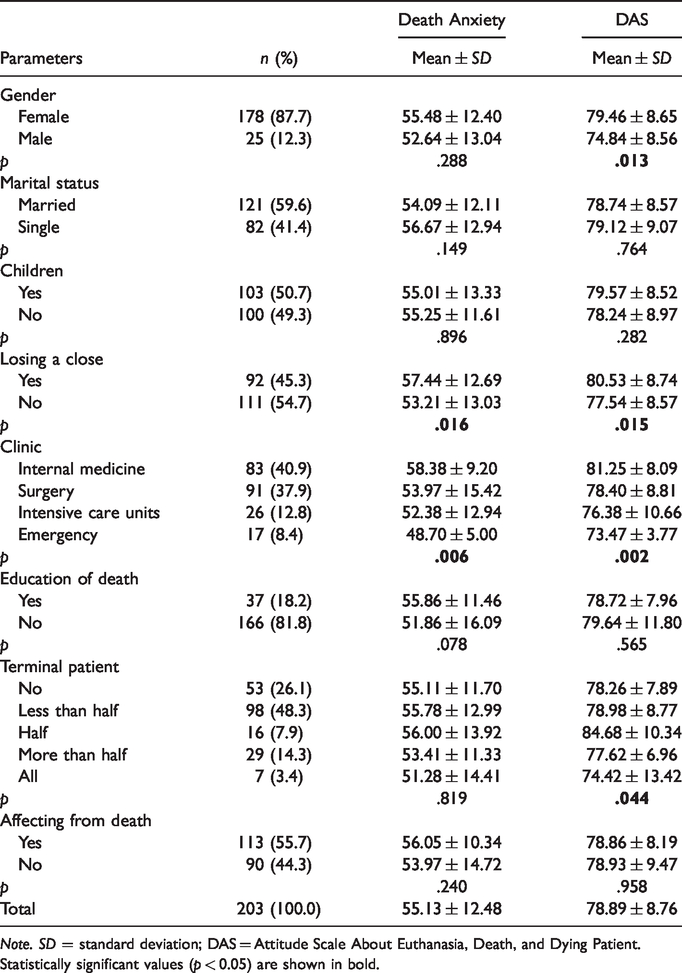
Note. SD = standard deviation; DAS = Attitude Scale About Euthanasia, Death, and Dying Patient.Statistically significant values (p < 0.05) are shown in bold.
Correlation Between Age, Duration of Working, Death Anxiety, and DAS.

Note. DAS = Attitude Scale About Euthanasia, Death, and Dying Patient.
The “good death” is a dynamic concept: a planned, peaceful, and honorable death, at home with the family (Cottrell & Duggleby, 2016, p. 686). Dying with dignity is a basic human right and defined as the maintenance of an individual’s autonomy at the end of his or her life (Guo & Jacelon, 2014; Gurdogan, Kurt, Aksoy, Kınıcı, & Şen, 2017). The components that are often used in the description of a good death and highlighted in the literature are as follows: pain management, fostering autonomy and control, establishing closure, acceptance and awareness of death, not being a burden on family members, reinforcing relationships with family and friends, and being psychologically prepared to die (Flaskerud, 2017). In this respect, the main aim to care for dying patients is to provide the patients with physical and spiritual relief, to increase their quality of life, such as through spending good times without pain, through the end of life, and to prepare them for death (Gurdogan et al., 2017). Health professionals need to be well prepared in knowledge, skill, and attitudes to be able to provide dignified end-of-life care (Guo & Jacelon, 2014; Karadag et al., 2019). Nurses reported regret when unable to provide a “good death” for a patient (Cottrell & Duggleby, 2016, p. 709). Given that nurses could communicate effectively with the dying patient and considering their emotions and attitudes concerning life, death, and loss to provide the support needed by the patient is effective to deliver care to the patients (Karadag et al., 2019). Wang et al.’s (2018) study in China with the participation of 770 nurses from 15 hospitals aimed to examine Chinese clinical nurses’ attitudes toward death and caring for dying patients and also the relationships between clinical nurses’ attitudes toward death and caring for dying patients. Their findings showed that although the majority of nurses were likely to provide care for the dying person’s family, they did not have a positive attitude toward communication with the dying. Attitudes toward caring for dying patients were significantly negatively correlated with fear of death (r = −.120) and positively correlated with approach acceptance (r = .127) and natural acceptance (r = .117). They also found that education level, religious beliefs, previous education on death and dying, and experience with death or dying patients affected nurses’ attitudes toward the care of dying patients. In the previous studies, there was a significant positive correlation between death anxiety and death avoidance (Bilge, Embel, & Kaya, 2013; Şahin et al., 2016; Tranter, Josland, & Turner, 2016; Wang et al., 2018). Moreover, in line with the previous studies, our findings showed that in female nurses who experienced the death of a relative and workers in the internal medicine had more negative attitude toward death and patients with deadly diseases. This finding suggests that the nurses appear not to accept their mortality and the mortality of the people they care for.
Conclusion
The nurse, who provides health care to the dying patient, experiences death closely. The concern over death increases for the nurses who encounter the reality of the death of their own relatives and the people they love. Nurses should provide health care both to the patients and to the latter’s families and when he or she has avoidant behavior toward the patients’ with deadly diseases and these patients’ relatives. However, each death is unexpected and traumatic for the family. The family needs professional support during mourning. Hence, the meaning nurses attribute to disease and to death should be investigated. Nurses should deliver the effective health care that terminal patients have the right to. To ensure proper health care, nurses should be conscious of their own attitudes toward death and how negative attitudes may have an effect on the type of care they administer to the terminal patients The training and education that the nurses should have regarding providing good death and supporting the family properly during their mourning are significant.
Footnotes
Acknowledgments
The authors thank all the nurses who participated in the study.
Ethical Approval
Ethics committee approval was obtained from the local Clinical Research Ethical Committee (dated April 13, 2017 numbered 2017/94). All procedures performed in the study were in accordance with the ethical standards of university ethics committee.
Informed Consent
Informed consent was obtained from all individual participants who involved in the study.
Declaration of Conflicting Interests
The author(s) declared no potential conflicts of interest with respect to the research, authorship, and/or publication of this article.
Funding
The author(s) received no financial support for the research, authorship, and/or publication of this article.
