




Abstract
This feminist qualitative study investigates spousal bereavement experiences of Turkish martyr spouses within the context of gender regime, based on semi-structured interviews with 21 martyr spouses. From on the thematic analysis of these interviews, this study demonstrates that (1) the spousal bereavement process was complicated conjointly by traumatic and military context as well as martyrdom, (2) this complexity created conditions requiring struggle, and (3) coping resources were available to deal with this complexity. Further, it presents “how the Turkish gender regime affected the spousal bereavement process of martyr spouses.” This study finds that martyr spouses’ steps toward back to normal life, namely recovery after loss, were not supported or acknowledged by society. The authors propose the concept of “disenfranchised recovery” to explain this situation, based on concept of disenfranchised grief.
Keywords
The death of a soldier in combat is a rather challenging experience for his young spouse. This death has most likely occurred suddenly, violently, and under “horrid conditions a long way from home” (Carroll et al., 1996, p. 74). This kind of sudden and violent death is seen as the determinant of a grief process that is characterized as “pathological,” “complex,” “prolonged,” or “traumatic” (Kaltman & Bonanno, 2003; Stroebe et al., 2007; Wortman & Pearlman, 2016). However, this grief process is also influenced by the social, cultural, and political context surrounding the death. It is constructed by the social status of both the deceased and the bereaved (Harris, 2010, 2016). Therefore, in military bereavements, the grief process is closely related to the military context as well as the sudden and violent nature of the death.
There is a consensus in the literature that military context complicates bereavement and the grief process. Although the research is limited, we know about military bereavements’ general features (Beder, 2003; Blaisure et al., 2016; Drescher et al., 2009; Lehman & Cozza, 2011; Rubin et al., 1999; Williams & Nichols, 2017) and unique factors surrounding it (Carroll et al.,1996; Harrington-LaMorie, 2011; Harrington-LaMorie & McDevitt-Murphy, 2011; Rolls & Chowns, 2011, 2014). These factors are summarized in Figure 1.
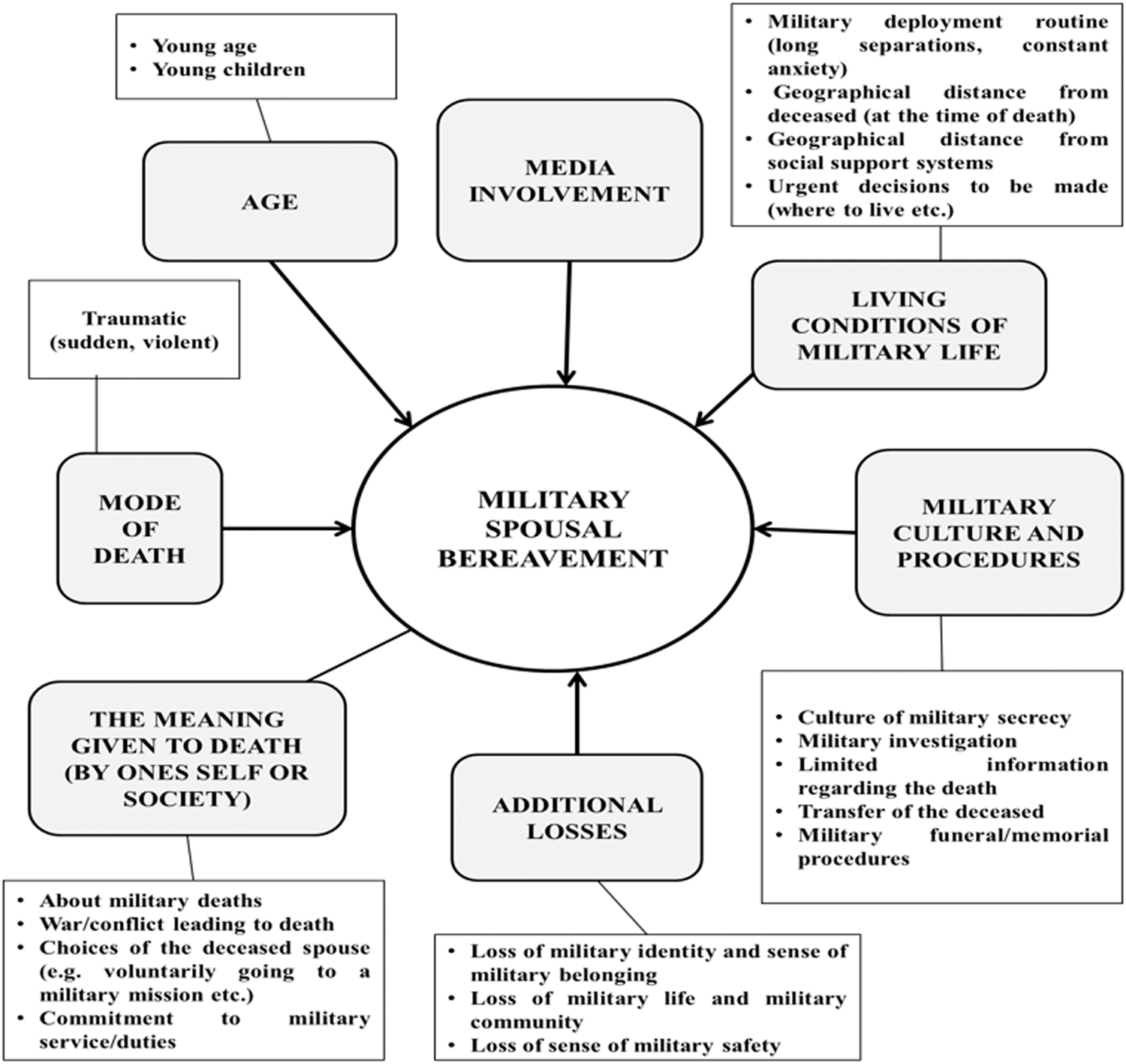
Note. This figure is developed from studies of Beder (2003); Drescher et al. (2009); Harrington-LaMorie (2011); Lehman & Cozza (2011); Rolls & Chowns (2011); Rubin et al. (1999); and Williams & Nichols (2017).
However, literature is still scant for understanding complicated military spousal bereavement, and there is a gap in the literature on bereavement experiences of martyr spouses. While related studies mainly have focused on widowhood (Atwal, 2017; Lomas, 2000; Quass, 2011; Shamgar-Handelman, 1981; Zahedi, 2006), remarriage (Ben-Asher & Lebel, 2010; Bokek-Cohen, 2014), and public policy (Cooke, 2003), the impact of military bereavement on spouses’ lives has not been adequately addressed.
Existing studies (Frye & Duchac, 2015; Golan, 1975; Sande, 1992) have only presented slight traces of the complicated nature of their bereavement process. In this context, the present study focuses on the spousal bereavement experiences of martyr spouses.
In Turkey, “martyr” is usually used to refer to soldiers who were killed in war or combat. Martyrs are recognized as people who have sacrificed themselves for the country. They are accepted sacred, just like the flag and the nation (Değirmencioğlu, 2014). There are also some folk beliefs in society, such as that martyrs spiritually never die, always help their families, and they have been chosen by God (Aslan & Türksever, 2014). At the same time, martyrdom is a symbol of heroism. It is accepted as the highest position for any deceased and the highest rank for a deceased soldier (Akseki, 1997; Dilmaç, 2018). Martyrs are glorified and respected because they have sacrificed themselves for their country’s undividable unity (Dilmaç, 2018). This sacrifice is rewarded by giving high status as well as certain benefits and privileges to their relatives.
A large number of martyred soldiers are mostly men because military service is compulsory for only male citizens, and military jobs are mostly preferred by men in Turkey. Studies concerning the relatives of martyrs and the concept of martyrdom in Turkey (Gedik, 2008; Şentürk, 2009), emphasize the influence of the patriarchal and militaristic gender regime in Turkey on the discourse of martyrdom. In this regime, men are glorified as martyrs for sacrificing their lives, while women as mothers, sisters, daughters, or wives are placed in a secondary position (Şentürk, 2009). Compared to other widows, this secondary position provides certain superiorities and privileges to martyr spouses. However, this position also comes with certain duties which the society expects from the martyr spouses, such as blessing the death, being proud, honoring the martyr, and sacrifice (Akgül, 2011). In this case, how the experiences of spousal bereavement for martyr spouses are shaped within the gender regime becomes important. The current study aims to answer this question with examples from Turkey.
Method
The current study was excerpted from a feminist qualitative doctorate research examining the life experiences of martyr spouses (Ademhan Tunaç, 2018).
In feminist research, gender is accepted as a basic variable regulating our lives. The social construction of gender and its consequences are in the center of the research (Cook & Fonow, 1986; Harding, 1983, 1987). Therefore, gender was positionally centered in this study, and it was accepted that Turkey’s gender regime affects spousal bereavement experiences of martyr spouses. The here used term “gender regime” refers to gender-based regulations in a society and includes rules and norms about gender relations (Cockburn, 2003; Sainsbury, 1999).
Data Generation
Based on the assumption that knowledge can be reached through experience in feminist standpoint epistemology (Alcoff & Potter, 1993; Harding, 2004), experiences of martyr spouses can be better understood with a qualitative approach. Therefore, in this study, the data was generated through interviews. During the interviews, a semi-structured form was used containing several open-ended questions about demographics, experiences of loss, spousal bereavement, being a martyr spouse, difficulties about loss, struggles in the bereavement process, and coping resources. The audiotaped interviews were conducted by the first author, between July 2015 and September 2016, and lasted between 1 to 3 hours (approximately 1 hour 51 minutes).
Participants
The participants of this study consisted of 21 martyr spouses living in Ankara, Turkey, whose soldier spouses were killed in combat or terrorist attacks during military service. In Turkey, the scope of martyrdom encompasses; soldiers, police officers, and other state employees. However, in this study, interviews were conducted with only military martyr spouses. Participants were recruited among martyr spouses recommended by coworkers who are part of the professional network of the first author, a social worker at the Republic of Turkey Ministry of National Defence. 43 potential participants were contacted by phone to request attendance. Participation approval was obtained by those who accepted. Participants’ general information is presented in Table 1.
Participants Information.
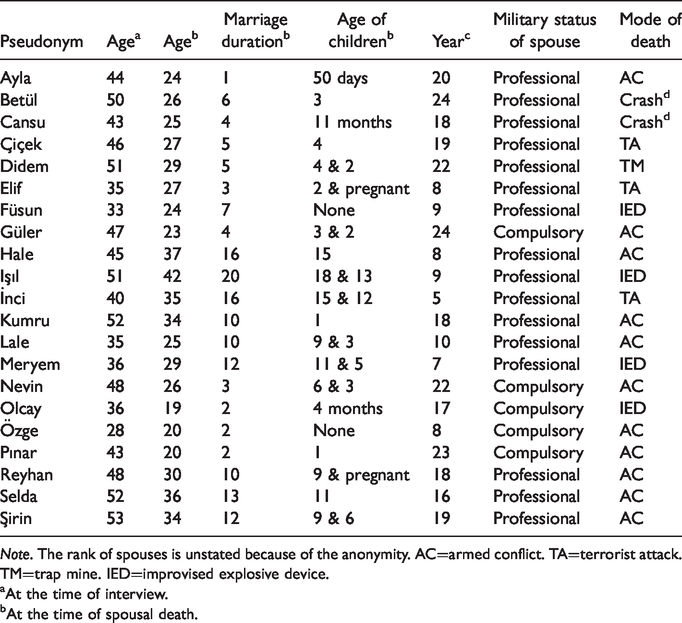
Note. The rank of spouses is unstated because of the anonymity. AC=armed conflict. TA=terrorist attack. TM=trap mine. IED=improvised explosive device.
aAt the time of interview.
bAt the time of spousal death.
cYears since spousal death at the time of interview.
dMilitary vehicle crash at operation.
Ethics
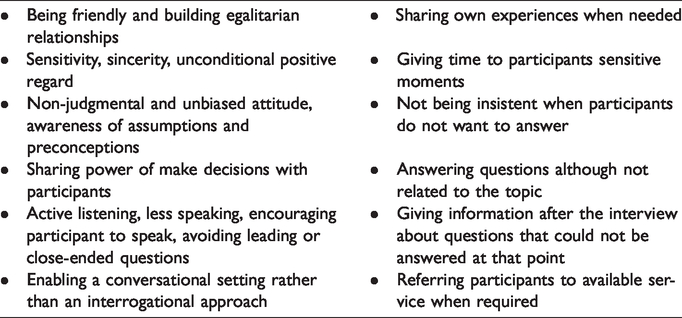
This study was approved by the Ethics Committee of Hacettepe University. Within the framework of social work and feminist research ethics, attention was paid to voluntary participation, informed consent, protection of anonymity, active participation, the establishment of a non-hierarchical relationship with the participants, and making all decisions together with the participants. As an example, the interview schedule or pseudonyms were chosen by the participants. Also, two voluntary psychologists were appointed in case the participants needed them after the interviews. Interview principles are presented in Table 2.
Interview Principles.
Analysis
Braun and Clarke (2006)six-step thematic analysis approach was conducted in data analysis using MAXQDA Analytic Pro 12 (VERBI Software, 2016). The steps of this approach are: (1) familiarizing with the data, (2) generating initial codes, (3) searching for themes, (4) reviewing themes, (5) defining and naming themes, and (6) producing the report (Braun & Clarke, 2006). The data was primarily analyzed by the first author in collaboration with the second author. The analysis focused on the spousal bereavement experiences of martyr spouses and the Turkish gender regime reflections on their bereavement process. The transcripts of each interview were analyzed to answer the question of “How the Turkish gender regime affected the martyr spouses’ spousal bereavement experiences (hereafter referred to as “the experiences”).”
Findings
The research findings consisted of three main themes: (1) conditions that complicate bereavement, (2) struggles generated by complications, and (3) resources to cope with complications. Each main theme includes themes and sub-themes. The theme map is presented in Figure 2. The quotations that most reflect the essence of the relevant theme are presented 1 in the following section.

Theme Map.
Conditions That Complicate Bereavement
Coexistence of Bereavement and Trauma
This theme shows traumatic conditions complicating spousal bereavement of martyr spouses.
Suddenness and Violence of Loss
Soldiery is an occupation with defined death risk. However, almost all participants emphasized that the death of their spouses had been sudden and unexpected. Besides the suddenness, it was also rather violent. The majority of the participants’ spouses had been harmed due to the violent nature of their deaths. Several participants mentioned that they had felt afraid or reluctant to see their spouse’s bodies as those had been harmed. At the same time, some participants were not allowed to see the body because of the damages. Meryem, who lost her husband to a trapped minefield, described this as follows: I wanted to see his body, but they didn’t advise it. Because he was unrecognizable […]. They said: It’s better if you remember him as you last saw him.
Severity of Spousal Loss
A significant number of martyr spouses defined spousal bereavement using idioms to explain rather negative, desperate, or painful situations in Turkish. Strikingly, all participants attributed a very negative meaning to their losses. Elif, who lost her spouse in a terrorist attack after three years of marriage, explained this as follows: You fall into a deep feeling of loneliness. You think you don’t have anyone left in life anymore […] I still can’t get over that horrible feeling of loneliness […] he wasn’t with me for a year and a half, but I felt his presence […] That feeling is enough to make a woman strong.
Motherhood as a Complicating Source of Loss
Motherhood is considered the most important duty given to a woman by patriarchal gender regimes, and women are expected to fulfill this duty properly. Participants’ concerns about accomplishing this duty was another complicating condition. The biggest struggle was with their kids as all participants who had children or were pregnant at the time of death as expressed as follows: I thought about what I would do, what I would tell the kids […] I had the hardest time with the kids (Lale) There was a lot of difficulty with the children, about what I should say to them […] for example at night, my daughter became very sick […] She moaned, and I cried all night (Cansu) The hardest part is to make decisions about children’s lives […] I wonder if I made the wrong decision […] this responsibility is very heavy on me (Didem)
Coexistence of Bereavement and Military Context
This theme shows military conditions complicating spousal bereavement of martyr spouses.
Concerns Before Loss
As Segal (1986) has stated, military life requires long periods of separation due to deployment. This separation period probably involves obvious and realistic concerns about spouse’s safety (Wright et al., 2006). Similar concerns also emerged in this study. Participants mentioned that they had significant apprehensions about their spouse’s health and safety prior their death.
Culture of Military Secrecy
Relevant literature has emphasized that some conditions related to military context complicate the bereavement process. These could be listed as limited or confidential information about death, military investigation, autopsy process, transfer of deceased, military funerals, and other uncontrollable military procedures. This study has limited data concerning military procedures. However, within the experiences, it is possible to see reflections of the culture of military secrecy (Hall, 2011) that led keeping death-related information confidential. Due to lack of information, almost all participants questioned for a long time how the actual death occurred. Işıl described this as follows: I wondered if it was my husband or not […] I don’t know what went on over there […] I wanted to find out what he went through […] they never told me exactly what happened.
Decisions Necessitated by Loss
After a soldier dies, the family has to make a considerable number of sudden decisions, such as choosing “where to live or the right schools” for children (Rolls & Chowns, 2011, p. 24). Almost all participants had a difficult time because of the important decisions that they had to make shortly after their loss. Kumru described this as follows: Your husband is martyred, and they come and ask you questions about maintaining your life from this point on, and there is no turning back from the decisions you make. So, these women don’t have the luxury to grieve. I didn’t even cry […] I didn’t have time to cry.
Mandatory Transition to Civilian Life
The unwilling and mandatory transition from military life to civilian was another complicating condition for martyr spouses, as expressed in the literature (Carroll et al.,1996; Harrington-LaMorie, 2011; Rolls & Chowns, 2011). Moreover, the experiences point out a connection to the gender regime. In the hierarchal gender regimes, relationships in the patriarchal order where men are authoritative, aggressive, and prone to using violence, whereas women are subordinate, supportive, and motherly is rather appropriate to the needs of the nationalist/militaristic construct (Cockburn, 2010).
From this aspect, women who marry a soldier actually marry the army/military. The military’s gender regime requires soldier spouses to give up their own identity. The most important duty given to military wives is to help their husbands perform their military service well (Enloe, 2000). Selda explained this as follows: Being a military wife is something very different. You forget your identity […] your identity only consists of being the soldier’s wife. Because while the husband is doing his duties, the family completely takes on those duties as well. When I was put somewhere as a civilian, I fell into a void with my two children, […] It wasn’t easy to transfer to civilian life after being military […] Your whole life changes at once, you are in barbed wire and suddenly you are in civilian life. It is not something to be handled easily.
Incomplete Marriage
All of the participants in this study were under the age of 45; the majority of those (71%) were aged between 20–30 at the time of loss. It is known that spousal loss at a young age is a difficult process because it requires dealing with unrealized hopes and dreams associated with the future. Compared with older people, younger people are less prepared for the death of a spouse, and there is a limited number of people with similar experiences (Lowe & McClement, 2011; Silverman, 2005). However, in this study, participants emphasized rather than the hardships caused by young age, on the briefness of the marriage. Their marriage was left incomplete for most of them, as Elif stated as follows: There is also the feeling of regret within me about a marriage that never happened, not just the loss of a spouse […] I was married for two and a half-three years, he was there half the time, and wasn’t there the rest of the time […] that pain of being incomplete suppresses the loss, why couldn’t I have him, why didn’t I do this. He never lifted his head up from his work […] you can never have a proper conversation. We got married, went there, two kids, mission in the East, it’s over. We never had the chance to spend time together.
Coexistence of Bereavement and Martyrdom
This theme shows the martyrdom context complicating spousal bereavement of martyr spouses.
Over Involvement of Media
When a soldier dies in combat or terrorist attacks, the Turkish media immediately releases the death news. This creates a risky situation that family members might find out through media about death before official notification (Lehman & Cozza, 2011). For example, Işıl had found out about her husband’s death on TV and described this as follows: Subtitles started running on television, three martyrs, one commander, one lieutenant, one soldier […] we found out he had become a martyr from the television. The media for me is horrible […] they aired it so badly […] my tears, my crying, my fainting was all aired […] they showed me in my worst possible state. That was also very painful.
Martyrdom as a Complicating Source
What martyrdom brings to the bereavement process is firstly related to the meaning attributed to death. If the martyr spouse attributed a meaningful cause to death, the adaptation process becomes easier (Harrington-LaMorie, 2011). On the contrary, if the spouse was opposed to war and combat and considered the death was for nothing; pain, bitterness, and serious anger towards the event increases (Beder, 2003). Pınar explained this as follows: If country had gone into a war, if they had fought with enemy and died, I would understand it […] but he became a martyred with the bullet of two looters. I can’t accept that. When we look at it from a religious perspective, how nice, your husband became a martyr. When you look at it from the perspective of the life he still had to live, he left early. He had so many things he needed to live through.
Family as a Complicating Source
The experiences denoted that problematic relations with the in-law family might also have complicated the bereavement process. These were related to the legacy or the financial benefits associated with martyrdom. Some participants received negative reactions from their spouse’s families because they had used their legal rights. Füsun explained this as follows: When I took out a loan, my father in law was very angry and swore, he said that they were going to use it.
Moreover, the experiences indicate that family and martyrdom also had features that make coping easier. These features are discussed under the main theme “Resources to Cope with Complications.”
Struggles Generated by Complications
Tough and Never-Ending Grief
Martyr spouses’ experiences were plentiful in showing the destructive effects of being faced with complicated bereavement. This theme shows how these effects reflect on the experiences.
The Pain of Loss
The pain and sorrow of spousal loss were rather intense for most participants, as Güler described as follows: Afterwards a very hard process began, sleeplessness, the feeling of emptiness, unhappiness, the constant fear of death. I could no longer enjoy anything, I was awful.
Impairment of Health
Complicated spousal bereavement also caused some participants health impairments, as Lale described as follows: We went through hard times; I am only now coming around this year. I became diabetic, I lost my health […] So many illnesses came up, those that would normally come up after the age of fifty.
Denial of Death
The conditions related to the military context, such as traumatic loss, military culture, military procedures, and deployment routines may make it difficult for spouses to believe and adapt to the reality of death (Harrington-LaMorie, 2011). Therefore, a vast majority of participants had a hard time accepting the reality of death. Moreover, if the body had not been seen due to being harmed, it was even harder to accept the reality as explained under theme “Suddenness and Violence of Loss.” Didem illustrated this fact clearly as follows: I couldn’t believe it; I didn’t see him because I couldn’t. […] I waited with a glimpse of hope; I mean I waited ten years for him. It’s been eight years, but my soul is still in awaiting. It’s like he is going to pop out of somewhere and come. We expected that they would call us and say that they sent him on an undercover mission and that’s why they had to say that he was death. I just wish he would show up. For some reason I believe he might come. I guess that’s because, you know, that martyrs don’t die.
Living With Grief
The experiences show that the combination of conditions that complicate bereavement led to a very long or even a life long period of grief. This fact is coherent with the idea that the grief process in military bereavement was longer and incomplete (Malkinson & Bar-Tur, 2000). A vast majority of participants denoted the never-ending grief as described by Selda and Betül as follows: Being a martyr’s spouse has this property: you are still in love with your husband; the thing that never ends is the sudden loss. (Selda) Let me say five years, that grief does not ends. So, you are always living with the image of him. (Betül) You get used to living with that pain […] you are literally dragging yourself. Look for years, eight years, I’ve been dragging myself.
Disenfranchised Grief
Doka’s (1999) concept of disenfranchised grief highlights the existence of rules that determine and legitimatize who can grieve, when, where, how, for how long, and for whom. This “can be defined as the grief experienced by those who incur a loss that is not, or cannot be, openly acknowledged, publicly mourned or socially supported” (Doka, 1999, p. 37).
If we consider jointly disenfranchised grief and military bereavement, the first thing that might come to mind is non-combat soldier deaths (such as education casualties or suicides). The grief of these types of military death might be disenfranchised because they are not considered heroic and glorious. Surprisingly, the experiences show that even if death occurred in combat and the deceased soldier had been glorified with martyrdom, it was still possible to talk about martyr spouses’ disenfranchised grief.
Social Stereotypes
In Turkey, when a soldier is martyred in combat, his relatives, especially his spouse, receive many financial benefits and privileges. According to the experiences, society has stereotypical judgments such as “benefits and privileges were enough to overcome the pain” and “the benefits made up for the loss.” These stereotypes point to how martyr spouses’ grief was disenfranchised as Selda and Işıl’s described as follows: She has a house, a car, a sweet life, what more” they said […] there were people who calculated my husband’s salary, his benefits, and people who questioned if I actually needed money. (Selda) They say, “Oh how nice, they give them houses, cars, money”. But they don’t know what we are going through. (Işıl) They are given money anyhow, they are swimming in money, they say […] This really hurts.
Being Second Priority
Being second priority was another emerging fact related to disenfranchised grief. Some participants mentioned that martyr’s parents’ grief was more supported and cared about by society. Similarly, spouses’ grief was ignored and they were not prioritized as Olcay explained as follows: The mothers are in the foreground […] the spouses are in the background […] As if the spouses don’t suffer […] Nothing happens to the spouse, it’s all about the parents. That is how people see it.
Disenfranchised Recovery
Returning to normality, after a traumatic loss, is generally explained with the concept of recovery (Joseph & Linley, 2008). According to the experiences, it was interesting to see that steps taken by participants recovery were not supported or acknowledged by society. Based on Doka’s (1999) concept of disenfranchised grief, to explain martyr spouses’ unsupported or unacknowledged recovery, we used the concept of “disenfranchised recovery” which was developed and named within the first author’s doctorate research.
The experiences related to disenfranchised recovery show that there were implicit rules on how a martyr spouse should behave and that the society expected martyr spouses to appear grieved and unhappy even many years after death. These rules and expectations seem to cause guilt and produce social oppression.
Disenfranchised Happiness
The experiences indicate that happiness for a martyr spouse after bereavement could be disenfranchised by society. This disenfranchisement concretized in Özge’s experience as follows: People feel sad when I am happy. I guess they think “she should suffer; we should feel bad for her […] Society wants the martyr spouse to cry forever. You hear things with your own two ears like “Olcay is dressed nicely, wandering around town while the guy (her husband) took the hit […] Even when I’m around a group of friends or neighbors, if we are twenty people laughing about something, I’m the only one that stands out.
Guilt
The experiences underscore how martyr spouses felt guilty when using the rights associated with martyrdom. For example, Didem stated her feelings while getting her monthly allowance, as follows: I felt like I had blood on my hands, I thought I didn’t deserve it. I couldn’t handle that money being given to me. When you dress nicely, when you put makeup on, I tell myself I am a martyr’s wife, I shouldn’t be doing these things […] It feels like disrespecting the dead, the fact that he lays while I’m alive, it creates the feeling of guilt.
Social Oppression
Disenfranchised recovery, similarly as in disenfranchised grief, oppressed martyr spouses. The experiences show that society did not acknowledge the martyr spouse’s grief recovery. For example, Füsun mentioned about an experience at the hairdresser as follows: I went to a hairdresser after two years. He said, “I know you, you are the martyr’s wife”. He didn’t say “You are a martyr’s wife, you shouldn’t come to the hairdresser”, but that’s what it felt like he said. Even when I’m buying clothes, I’m cautious so they don’t say “Look at her, she’s a martyr’s wife, she put her husband in the grave and now look at what she is doing”. (Lale) When I’m going to go somewhere, I always think if it will it be appropriate for a martyr’s family to go there. Because of this, you are put into a mold […] I feel that oppression from time to time. (Çiçek)
Moreover, we can state that martyr spouses’ disenfranchised grief is related to the invisibility of the women themselves and their suffering within the patriarchal gender regimes. Similarly, martyr spouses’ disenfranchised recovery seems related to the patriarchal/militaristic regime that describes martyr wives as sacrificial yet tearful, sad women.
Gaining Strength
Some experiences were striking as they demonstrated that struggling with complex bereavement could bring strength. These experiences are placed under this main theme to emphasize the struggle before gaining strength.
Strength Brought on By Struggle
Some martyr spouses considered that the hard period after the bereavement brings about strength. Ayla mentioned becoming stronger due to the struggle’s difficulties and spousal bereavement’s complications as follows: Struggling a lot makes you stronger, the more difficulties, the more strength. So, the more you are strained, the stronger you get.
Strength Brought on By Being Required
Some martyr spouses considered that having to do something to maintain life after complex bereavement, could bring strength as İnci described as follows: The strength brought on by having to do something: I had to stand on my own feet […] it makes a person stronger; you hold on to everything.
Strength Brought on By Being Alone
Some martyr spouses mentioned strength brought on by doing something alone or without their husband, as Nevin described as follows: When I had a husband, we shared the responsibilities. […] I had to take on all of the responsibilities […] I stood on my own two feet.
Resources to Cope With Complications
Family as a Coping Resource
The most important coping resource for almost all participants was family. Participants stated that they overcame the complex bereavement with support of their family, as Elif described as follows: My family, mom, dad, and my siblings took care of me the most […] maybe that’s why I got through it easily. Nobody, neither mine nor his family succeeded in it. […] our responsibility was too much for them; they avoided it.
Friends
Another coping resource for some participants was friends, as Betül explained as follows: They always tried to be there for me […] they supported me without getting sick and tired of it […] being able to share with them comforted me a bit.
Continuing Bonds With the Spouse
Klass et al. (1996) concept of “continuing bonds” means an ongoing relationship with the deceased. The experiences denote that the martyr spouses continued to maintain their bonds with their deceased spouse. Şirin kept her husband’s belongings long after his death, and Işıl preserved her husband’s stuff and some objects related to his death in a showcase in her house. Similarly, Cansu mentioned as follows: I made one room of the house into a martyr room. From his flags to his uniforms, everything was there […] it brought me peace. I went there and sat and told him everything, he helped me when I would go into deep depression. […] I would sit there and talk for hours […] it was really good for me.
Faith
Another resource that makes coping easier for participants was faith. A vast majority of them stated that faith had helped the most or had kept them standing in this process. Some participants stated that reading religious books, praying, and learning the Quran was quite helpful. Reyhan’s experience illustrated the faith as a coping resource briefly as follows: Faith was my biggest help […] I got psychological support from God.
Counseling/Medical Assistance
Professional assistance consisted of counseling and medication was another coping resource for some participants. Moreover, participants stated that the area where counseling was most useful was when telling their children about their father’s death as explained by Betül as follows: How can you explain death? So, one of my friends told me I should go consult with the doctor […] they told me to tell them in a way that they will know that their father is not coming back […] I acted the same way, I think it was helpful.
Work
Going back to work after bereavement leave made the coping easier for some participants, as stated by Ayla as follows: I’m glad it happened while I was working because staying at home by myself and thinking about it would have been bad.
Motherhood as a Coping Resource
The experiences show that motherhood, one of the issues linked to the gender regime, could be both complicating factor and resource of coping as seen in following İnci’s comment: It was my kids that helped me the most.
Martyrdom as a Coping Resource
The experiences point out that like motherhood, martyrdom also has aspects that complicate bereavement as well as make it easier to cope with it. Because martyrdom is a religiously and socially glorified way of death in Turkish society, it makes it easier to give meaning to death. Most of the participants considered martyrdom as something unique and not for everyone. Some participants favored martyrdom over accidental death, as explained by Lale as follows: Lucky me, my husband left as a martyr […] It’s sacred, it’s actually something that is not for everyone. God takes those he loves him as martyrs, thinking like that always comforted me.
Discussion
This feminist qualitative study was designed to reveal how spousal bereavement experiences of Turkish martyr spouses were socially constructed in the Turkish gender regime. Based on data generated through interviews with 21 spouses of Turkish martyrs, three main themes were presented: (1) conditions that complicate bereavement, (2) struggles generated by complications, and (3) resources to cope with complications.
Themes of “Conditions that Complicate Bereavement” and “Struggles Generated by Complications” are consistent with the literature on the complicated factors of military bereavement. The factors previously summarized in Figure 1 (cause of death, age, attention from the media, military culture, procedures, living conditions, other losses, attributed meaning to the loss) complicated the bereavement process of martyr spouses who participated in this study. However, this study demonstrates some new issues that have not been previously emphasized in the literature.
First, despite the complex bereavement of martyr spouses, the existence of coping resources and the possibility of gaining strength was significant. Gaining strength, especially the feeling of increased individual strength, indicates potential post-traumatic growth (Tedeschi & Calhoun, 2008).
Second, it enhances our understanding of what martyrdom brings to the bereavement process. As stated in the existing studies (Beder, 2003; Harrington-LaMorie, 2011), if it had been attributed to a negative meaning to war or combat, martyrdom became a source of struggle, whereas it became a coping resource if martyr spouses positively construed the loss. Nevertheless, there were other influential factors uniquely related to martyrdom. According to experiences, benefits and rights arising from martyrdom caused conflicts in the family and created struggle. Further, the social discourse of martyrdom led to disenfranchisement both in grief and in the recovery process.
As described on the themes of “Disenfranchised Grief” and “Disenfranchised Recovery”, the findings demonstrate that there were social stereotypes in Turkish society, such as that the material rights were enough to overcome the pain or the martyr’s parents were the most suffering relatives. These stereotypes caused martyr spouses to consider their grief was not sufficiently supported and had felt secondary to the martyrs’ parents. This fact was explained by Doka’s (1999) concept of “disenfranchised grief.” On the other hand, the findings also indicate that there were some social expectations or rules that martyr spouses should regularly demonstrate that they were mourning and their recovery after loss was not supported or acknowledged by society. These rules and expectations about martyr spouses caused guilt and produced social oppression. Based on the Doka’s (1999) concept of disenfranchised grief, to explain martyr spouses’ unsupported or unacknowledged recovery, the concept of “disenfranchised recovery” was proposed.
Third, this study also contributes to existing knowledge on military bereavement by illustrating the connection between the bereavement process with the gender regime. This study’s findings suggest that the Turkish patriarchal and militaristic gender regime influenced the spousal bereavement process of martyr spouses in two ways.
Firstly, this regime leads to the formation of conditions that complicate bereavement and struggles generated by complications. Because it intensifies the trauma by deepening the pain and destructiveness of spousal loss, increases the concerns about the transition to civilian life, and transforms motherhood and family relations into a complicating source.
Secondly, this regime also affects the formation of resources to cope with complications. Because it motivates martyr spouses to recover quickly and build-up for their children by turning motherhood to a duty and facilitates making sense of loss and accepting death by constructing martyrdom as a glorified death in society.
Conclusion
This study has significantly described the spousal bereavement experiences of martyr spouses. We believe that our study reveals that the military bereavement process has a connection with the gender regime, especially for bereaved spouses. We consider that our choice of feminist qualitative research methodology allows us to see reflections of both the gender regime and martyrdom on the experiences.
Also, we believe that we have made oppression related to martyrdom and gender regime visible by giving voice to martyr spouses. Hopefully, this study will somehow help to change oppressive structures surrounding martyr spouses and to enhance their lives.
Our feminist qualitative study has not claimed generalizability; however, it has enhanced our understandings of military bereavement experiences in different cultures. The effect of gender regime on the military bereavement process of other family members (children, parents, siblings, etc.) is an important issue for future research. It would also be interesting to compare the military bereavement experiences of individuals from different cultures in the context of gender regimes. Moreover, further research is particularly needed to better understand the concept of “disenfranchised recovery” introduced in this study.
The evidence from this study suggests that bereavement of martyr spouses should be evaluated by necessarily considering military context, effects of martyrdom, and influences of gender regime. Another important practical implication is that the complex bereavement process of martyr spouses may result in gaining strength and no matter how complex this process, there are still coping resources. The existence of strengths and coping resources may be the starting point of the empowerment of martyr spouses. We hope this study might contribute to researchers, scholars, and professionals, who work in the field of military bereavement.
Footnotes
Authors' Note
This article is based on the PHD dissertation completed by Ademhan Tunaç under supervision of Nilgün KÜÇÜKKARACA.
Declaration of Conflicting Interests
The author(s) declared no potential conflicts of interest with respect to the research, authorship, and/or publication of this article.
Funding
The author(s) received no financial support for the research, authorship, and/or publication of this article.
