



Abstract
This study examined mediatized death and emotion, specifically parasocial grieving, toward high-profile celebrity Stephen Hawking’s death from a global perspective. A thematic analysis of public tweets explored how social media mourners expressed parasocial grieving following Hawking’s death and how that shaped mediatized global flows of emotion in terms of digital affect culture. Findings showed varied forms of mediatized emotional responses associated with parasocial grievings, such as sadness, shock, confusion, love, and longing. Mourners also adopted varied coping mechanisms, including individualized tributes, reminiscing, memorializing, and advocacy. Findings suggested that Hawking’s mourners performed parasocial death rituals on Twitter as a legitimate public space of mourning. Findings contribute to parasocial grieving scholarship and mediatization of death and emotion.
The widespread evolution and adoption of new media technologies are increasingly pervading all aspects of everyday life (Walter, 2015). Social media, such as Twitter, Facebook, and Instagram have created ‘new social spaces’ (Brubaker et al., 2013, p. 153), which facilitate and shape new types of relationships regardless of social and temporal distances. Like many other social events, thanatological topics, such as death, loss, and mourning, have become part of social media practices (Sofka, 2009; Wagner, 2018). People now deal with death events online. Scholars argue that death and grief rituals have made mediated returns from private spaces to public spaces (Gibson, 2007b; Lagerkvist, 2013). Mediated death is televisual and narrative, where individuals perform death events and rituals thoroughly in and by media (Gibson, 2007b). Mediated death rituals not only enable the prompt exchange of information and opinion but also foster a globally mediatized emotional exchange through the grieving process (Döveling et al., 2018; Giaxoglou & Döveling, 2018).
Moreover, social media dynamics enable people to grief with strangers whom they have never met in person, but they form and maintain relationships through and by media—a concept described as parasocial relationships (PSRs; DeGroot & Leith, 2018; Horton & Wohl, 1956). Though traditional media provide information when a celebrity or public figure dies, social media as a coping and emotion regulation tool actively engage the audience in the mourning process and mourners can express emotions, reactions, and share memories with celebrities publicly and globally (Akhther, 2021; Moore et al., 2019; Quan-Haase, 2016; Wolfers & Schneider, 2020). The purpose of this study was to examine how the global online community displayed parasocial attachment with scientist Stephen Hawking through their grieving process after his death. Stephen Hawking, a world-renowned physicist, who suffered from motor neuron disease for over 50 years and died on March 14, 2018. When Hawking’s death was announced, people from diverse backgrounds, locations, and religions converged online to mourn him.
Previous studies examined parasocial grieving involving celebrity deaths, such as Michael Jackson (Hoe-Lian Goh & Sian Lee, 2011; Sanderson & Cheong, 2010), Robin Williams (E. L. Cohen & Hoffner, 2016), and David Bowie (Bulck & Larsson, 2017); however, mediated death and the connection between mediatization and emotion have received little research attention, especially in the context of digital affect and memorial culture. We examined the parasocial grieving process from a global perspective. Specifically, stages of parasocial grieving were analyzed guided by the mediatized emotion as digital affect culture (Döveling et al., 2018). Public tweets were analyzed to determine how macro-level flows of emotional intensity were discursively shared online to facilitate emotional alignment and connectedness among mourners (Döveling et al., 2018). This study also extends understanding of how social media facilitate the creation of communities of mourning responding to high-profile celebrity death and shape emotional communication and affective flows online.
Social Media and Mediatization of Death and Mourning
Like conventional media, social media play a crucial role in the mediatization process. The social media mediatization process has transformed human relations and behaviors and brought changes in society and culture (Giaxoglou, 2020). In the mediatization process, media serve as an independent social institution governed by its own sets of rules and shape other social and cultural institutions, and modes of interaction are changed because of the growth of media’s influence (Hjarvard, 2008; Morse, 2018). Social media logics, such as institutional function and technological affordances influence users’ actions and reactions in both institutional and everyday communication (Giaxoglou, 2020; Giaxoglou & Döveling, 2018). Technological affordances are the relational structure between technology and users that allows or constraints communicative practices or behavioral outcomes (Evans et al., 2017). Social media affordances promote textual and visual communication that enable individuals and communities to share, co-create, discuss, and modify user-generated contents with textual and visual cues, such as GIFs, memes, pictures, emoji, and hashtags (Highfield & Leaver, 2016; Rathnayake & Ntalla, 2020). Such technological affordances shape everyday social media practices and affective communication online.
The social media mediatization process substitutes many social events that previously took place in face-to-face settings, such as death, loss, and mourning (Schulz, 2004; Sofka, 2009; Wagner, 2018). Public encounters with death events through media where media serve as a social institution and create space to perform relevant death rituals. Social mediated death and mourning have made a return from the private sphere to the public sphere, in which individuals respond to death events as part of their everyday life events and relationships (Lagerkvist, 2013; Walter et al., 2012). Death images and events are now mediated by visual and digital communication technologies, in which people across the globe perform and cope with death events thoroughly in and by media (Gibson, 2007b). The technological affordance of social media shapes the mediated mourning (or grieving) process. For example, when someone dies, social media mourners express their grief and emotions by updating information, sharing pictures, posting short notes or narratives on the deceased’s social media wall (e.g., “RIP” or “I miss you”); praising the deceased’s virtues and sharing memories (Brubaker et al., 2013; Chowdhury & Akhther, 2018; Courbet et al., 2014; Islam, 2017; Moore et al., 2019; Hogan & Quan-Haase, 2010). Thus, social media logics shape mourners’ affective and commemorative practices.
Global Mediatized Emotion and Communities of Mourning on Twitter
Mediatized emotion is conceptualized as digital affect culture that is practiced and shaped by communication and influenced an individual’s communicative actions (Döveling et al., 2018). Emotion is a discursively constructed cultural practice or product “guided by implied norms of what and how individuals should feel and how they should express and ‘do emotions’ in any given relational context” (Döveling et al., 2018, p. 2). Three intersecting levels of affective culture or emotional flows are manifested through digital memorial activity, such as micro, meso, and macro-level (Döveling et al., 2018; Giaxoglou, 2020; Giaxoglou & Döveling, 2018). The micro-level manifestation occurs when people experience a personal loss and grief, or emotional intensity and attachment become shared locally. The meso level of emotional flow intersects online when groups of emotionally resonant individuals come together and grief for their loss and find social support.
On the other hand, collective or macro-level emotional flows are shared or negotiated through various discourses and imagery manifestations online. These affective intensity levels and attachments constitute three core characteristics of digital affect culture, including discourse, belonging, and alignment (Döveling et al., 2018; Giaxoglou, 2020; Giaxoglou & Döveling, 2018). As digital affect cultures are discursively constructed through emotional alignment, such alignment provides feelings of belonging or connectedness. Such cultures are multi-directional where emotional flows intersect and feed into each other and create ‘dynamics between local and global, the personal and the public’ (Döveling et al., 2018, p. 3). For example, technological affordances of Twitter, especially the use of hashtags, form commemorative communication and increase such emotional resonance (Bulck & Larsson, 2017). As structural communicative devices, hashtags can be used as a discursive marker that engages users in a conversation responding to a particular topic or event and coalesces multiple related discussions under one banner (Highfield, 2018; Highfield & Leaver, 2016). It allows discursive flexibility where the use of a single phrase makes a concise topical connection that includes users and social context.
Hashtags may be used as an affective performance and expression of emotion or reaction, in which the use of emoji combining textual elements (e.g.,  #RIPStephenHawkings, #RIPmichaeljackson) allow discursive versatility and provide personal perspective and affiliation connecting to the hashtags (Akhther, 2017; Highfield, 2018; Highfield & Leaver, 2016; Papacharissi, 2015). The discursively constructed subject position, especially shared use of context-specific hashtags connects other fellow mourners across the globe and increases the breadth and width of the messages, which, in turn, forms “communities of mourning” on Twitter (Gibson, 2007a). Some high-profile celebrity deaths have the power to create such communities of mourning or practice like Michael Jackson (Hoe-Lian Goh & Sian Lee, 2011), and these communities of practice are formed and controlled in and through social media.
Parasocial Relationship, Celebrity Death, and Parasocial Grieving
Social media have changed the dynamics by providing audiences on a global scale with powerful ways to express grief for a stranger’s loss, such as media personality and public figures with whom mourners may have never met in-person (Quan-Haase, 2016). Celebrities form and maintain parasocial relationships (PSRs) with the audience by and through media, which is one-sided and non-reciprocated (DeGroot & Leith, 2018; Horton & Wohl, 1956; Quan-Haase, 2016). Social media engage the audience actively and bond fans’ parasocial attachment with celebrities. It also facilitates access to similar others who share the parasocial attachment with the same media figure. Because of parasocial attachment, when a celebrity or fictional character dies, the fan community feels “parasocial breakup” ( Cohen, 2003) with the celebrity, and they experience grief for their parasocial loss (Sanderson & Cheong, 2010). Parasocial grieving involves a withdrawal of emotional investment for the lost celebrity, which can be comparable to losing a close or real social contact (Wong & Patlamazoglou, 2020). In such a distressful situation, social media offer space to cope with death where virtual communities come together to express emotions and share the experience with their PSRs (Sanderson & Cheong, 2010).
Though conventional media play a significant role in providing information about the death of celebrities and key public figures, social media serve as a valuable tool for parasocial grieving through which the audience can practice and express emotions, reactions, and share memories publicly and globally (Quan-Haase, 2016). For instance, after the death of pop music icon Michael Jackson, fan communities came together on social media (e.g., Twitter, Facebook, and TMZ.com) and showed varied forms of emotional responses for their parasocial loss, such as acceptance, anger, bargaining, and depression (Sanderson & Cheong, 2010). Though fans expressed anger, denial, and depression toward Jackson’s death, scholars argued that social media facilitated the acceptance of the parasocial loss (i.e., “you are now in a better place where people can no longer hurt you”; p. 333) rather than denying it. Radford and Bloch (2012) found similar stages of parasocial griefs in response to the death of race car driver Dale Earnhardt, Sr.
In addition to these stages of parasocial grieving, communities on Facebook, Twitter, and Reddit showed varied forms of parasocial attachments, including sadness, over acceptance, condolences, love, longing, shock, and confusion, after the deaths of television character Lawrence Kutner, musician David Bowie, and NBA legend Kobe Bryant (Bingaman, 2020; Bulck & Larsson, 2017; DeGroot & Leith, 2018). Fan communities released their emotional pain through the expression of sadness. Expression of love and longing showed an intense feeling of affection and admiration associated with parasocial attachments. Conversely, expressions of shock and confusion represented sudden disbelief and uncertainty towards the deaths. Besides, fan communities adopted a different mechanism to cope with their parasocial losses. They coped with grief by consuming or watching celebrities’ creations and products as well as shared memories with the deceased, and reminiscence their work and contributions. They also advocated establishing a legacy for PSRs by acknowledging their inventions and contributions. However, the adoption of such coping mechanisms may depend on the types of celebrities, deaths, and their contribution to the community. For example, in response to Robin Williams’ death, the fan community coped with their loss by sharing health information, such as clinical depression, suicide prevention, and Parkinson’s disease, and findings suggest that celebrity cancer death influence fans’ sharing of awareness messages and information, which shape their prosocial behavior (Cohen & Hoffner, 2016; Myrick, 2017).
Taken together, guided by the theory of mediatization of death and emotion, this study examined how the global online community portrayed PSRs through the grieving process toward high-profile celebrity death, which shaped global mediatized emotion as digital affect culture. To this regard, we asked the following research questions:
Method
We conducted a qualitative descriptive study analyzing public tweets related to the death of Stephen Hawking. A thematic analysis of public tweets examined how varied forms of emotional responses toward high-profile celebrity death shaped mediatized emotion globally.
Data Collection
A total of 636 public tweets were collected for this study. The data collection process includes several steps. First, the authors explored hashtags using keywords— “RIP Stephen Hawking hashtags on Twitter” into Google search engine. Then, the first seven hashtags that appeared in the search were selected for the data collection purpose. These hashtags include #ripstephenhawking, #stephenhawkingrip, #riphawking, #ripstephenhawkings, #RIPHawkings, #stephenhawkingdied, and #stephenhawkingdeath. Second, the hashtags were plugged into an official Twitter page to gather related tweets. We manually collected tweets by using selected hashtags. In so doing, we utilized Twitter’s search filter function people—from anyone and location—anywhere. All data were captured using the snipping tool in an image format. We created seven separate folders to archive tweets related to each hashtag. Finally, all image-formatted textual data were copied and pasted from the individual hashtag folder to a separate MS word document for human coding.
Tweet Inclusion-Exclusion Criteria
Only public tweets that posted between March 14th and April 3rd, 2018 were included in this study. The timeline was the day Hawking died to three weeks afterward. This timeframe was chosen to reflect the period of intense discussion of the topic on Twitter from when news about emergency events or high-profile celebrity death breaks, and public or fans community dynamically create and disseminate information by resurrecting the lives of celebrities worldwide (Bulck & Larsson, 2017; Gibson, 2007a; Hughes & Palen, 2009). After organizing all data, 17 tweets were excluded from the dataset that did not meet inclusion criteria, such as timeframe, language, duplicate tweets, and retweets. The final data set included 619 tweets that were written in English. Ethical review was not required for this study as we only used publicly available tweets (e.g., Bingaman, 2020; DeGroot & Leith, 2018; Hswen et al., 2018; Sanderson & Cheong, 2010). Also, no user-identifying information was included in this study.
Analysis
The textual data were analyzed by using a phronetic iterative approach (Tracy, 2013, 2018) to thematic analysis (Braun & Clarke, 2006). Thematic analysis is a systematic process of interpreting meaning from data (Braun & Clarke, 2006). The iterative approach allowed both theoretical and data-driven thematic analysis, where existing scholarships and theoretical constructs helped developing codes and themes. Also, back and forth readings of the data helped to identify new codes and themes (Tracy, 2013, 2018). In doing so, we developed and categorized conceptual codes and subthemes followed by DeGroot and Leith’s (2018) and Sanderson and Cheong’s (2010) parasocial expression of grief (i.e., sadness, shock, love, etc.) and coping mechanism (i.e., reminiscing, memorializing, advocacy, etc.). We theoretically analyzed the stages of parasocial grieving by employing Döveling et al.’s (2018) mediatized emotion framework.
Coding Scheme and Trustworthiness
Each textual tweet was the unit of analysis and coded independently. To begin, the first author read through all the tweets for a general understanding of the dataset. Using open coding, descriptive notes and labels for each tweet were taken in the document margin of MS word, which helped to categorize and compare the codes for thematic and theoretical analysis (Corbin & Strauss, 2008; Tracy, 2018). Line-by-line reading of the dataset and descriptive notes or labels helped to generate initial codes associated with parasocial grief. A separate MS Word document was created where exemplar tweets were copied into collated codes, including descriptive notes. The author revisited initial codes and tweets and engaged in axial coding to compare between collated tweets and formed sub-themes relating to parasocial grief and coping mechanisms. Dataset and descriptive notes were also revisited to identify new codes and sub-themes. Then, both authors closely reviewed and categorized exemplar tweets to compare and connect across sub-themes and determine the consistency. Our closing reading of the categorized data set also helped to modify and remove redundant sub-themes and exemplar tweets.
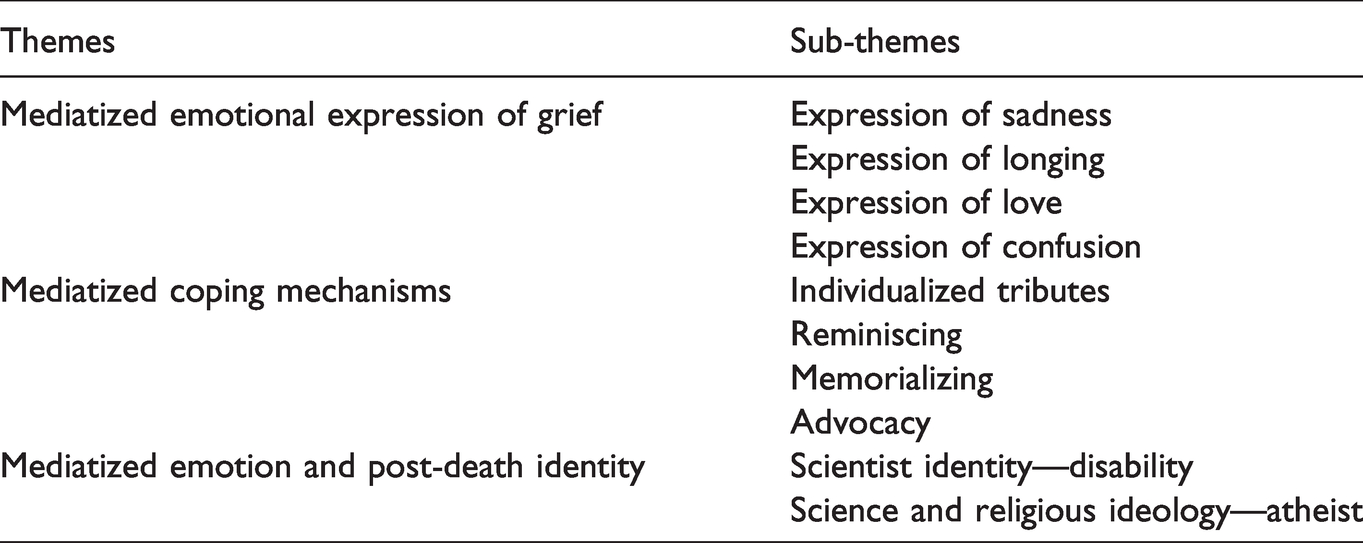
Employing mediatized emotion framework (Döveling et al., 2018), we categorized and reorganized sub-themes under broader themes for theoretical analysis. A total of eleven sub-themes was emerged and categorized into three broader themes. Table 1 includes themes and sub-themes below. Back and forth readings of the exemplar tweets, themes, and the entire data helped the authors to revise and refine sub-themes and themes (Braun & Clarke, 2006) and construct a coherent connection between parasocial grieving and mediatized emotion. Debriefing sessions between the authors helped to identify and resolve discrepancies between exemplar tweets, codes, and themes. Also, the use of exemplar tweets enhanced the credibility and trustworthiness of the findings (Corbin & Strauss, 2008; Tracy, 2013, 2018). All quotations are presented in original form.
Themes and Sub-Themes Associated With Mediatized Emotion and Parasocial Grieving.
Results
We examined how the global online community displayed parasocial grieving responding to Stephen Hawking’s death that shaped the intensity of emotion online. Findings showed that a varied form of mediatized emotional responses was discursively constructed by the mourners online and enacted as coping mechanisms toward death. Findings are illustrated with exemplar tweets, including emoji and commemorative hashtags. All quotations are presented in original form with spelling, syntax, and punctuation.
Mediatized Emotional Expression of Grief
Our findings showed that social media mourners expressed varied forms of emotion and grief following the death of Stephen Hawking, which was consistent with the parasocial grieving model (DeGroot & Leith, 2018), such as sadness, shock, confusion, love, and longing. Some emotional expressions of grief were consistently displayed and showed televisual features of the mediated death where tweet messages included images, videos, emoji, and hashtags commemorating the late Stephen Hawking. The major sub-themes are discussed.
Expression of Sadness
Social media mourners consistently displayed expressions of sadness toward Hawking’s death through verbal and visual cues (e.g., tweet texts with emoji and hashtags). Mourners expressed distress by the news of Hawking’s death, whom they considered an incredible mind and an inspiration. For example, one person stated, “I am deeply saddened by the report of Stephen Hawking’s death. He was an inspiration to me,” while another said, “How sad to lose such an incredible mind, what a brilliant man #RIPStephenHwaking.” Another mourner also stated, “waking up to the news about Stephen Hawking!  What an incredible man! Thank you for all you have done! – I am almost certain his theories will all be proven correct in years to come. In credible contribution to this earth and beyond
  #RIPStephenHawkings.” Such expressions of sadness were evident in many of the tweets and displayed parasocial attachment with the deceased. The use of emoji with hashtags was demonstrated as a visual marker of mourners’ feelings or reactions, which ultimately shaped the mediatized form of death and emotion.
Expression of Longing
Mourners also expressed longing in their responses to Hawking’s death. Longing referred to how much they missed Hawking and recognized his contribution to the universe. For example, “And for that, I say we will truly miss you #StephenHawking for you have inspired not millions but billions across the world, you were one of my favorite idols and will continue to motivate me and everyone to pursue success! We love and miss you- #RIPStephenHawking.” Other mourners also used commemorative hashtags to indicate their longing for Hawking. For example, “This world always miss you, Sir Stephen Hawking! I admired you and will always look up to you (now in heaven) for inspiration! May your soul Rest in Peace! #WeWillMissYou #WeAreDisabled #WeAreUnbreakable” and “I just heard about Stephen Hawking’s passing. He was both a genius and my favorite Simpson character. #missyou #universetoday #RIPStephenHawking.” The use of hashtags represented both personal and social context that shaped discursive versatility combining with emotional alignment.
Expression of Love
In their expressions of grief, mourners also frequently showed love and gratefulness for Hawking and his inventions and contributions to the universe. For instance, one mourner wrote: “Dear Stephen Hawking, You were true “The Theory Of Everything.” The power of your mind was incredible. Thank you sir for giving us such an extraordinary insight and the willpower to succeed no matter how hard it gets  . #RipStephenHawkings.” Affective responses also consistently cited Hawking’s inspirational quotes: “No matter how difficult life may seem, there is always something you can do & succeed at.” –Stephen Hawking
  #ripstephenhawking” and “So relatable right now such inspiring words from a legend #RIPStephenHawking.” Inclusion of emoji with grieving messages indicated how social media logics shaped the mediatized emotion as well as how much mourners admired the deceased.
Expression of Confusion
Confusion about the news of Hawking's death was also evident in the affective expression of grief. Example statements include, “I still can’t believe we got to perform for him in Spain and now I can’t believe he’s gone. #RIPStephenHawking;” “I don’t know why, but I kind of low-key assumed that he would live forever. #RIPStephenHawking;” “really sad and shocked to hear that Prof Stephen Hawking has died #RIPHawking a true hero of the intellect;” and “Still hard to believe… #RIPStephenHawking.” However, statements of confusion about his death were not more frequent than other forms of grief responses.
Mediatized Coping Mechanisms
The second theme showed how the global online community performed different death rituals to cope with Hawking’s death. Tweets demonstrated both new and traditional forms of coping strategies that mourners adopted to alleviate their grief, such as creating individualized tributes, reminiscing, or discussing memories, and celebrating Hawking’s accomplishments and contribution to the universe. The major sub-themes are discussed with illustrative tweets.
Individualized Tributes
To cope with Hawking’s death, mourners’ tweet messages included symbols of artworks, paintings, and sculptures they created to pay tribute to Hawking and his contribution. For example, one tweet described a sand art an Indian artist made to honor Hawking. The tweet said, “Sand Art of #RIPStephenHawking Indian Sand artist Sudarshan Patnaik gives final touches to a sculpture in honor Sand of British physicists and award-wining authors Stephen Hawking at Puri beach Odisha.” Another mourner also said they “Just painted this personal tribute in inks. You were made of better stuff and mainly stardust.” Other mourners also shared audiovisual content they produced to celebrate Hawking’s contributions and work. For instance, one tweet said, “A blog celebrating #StephenHawkings, a hero of mine. He showed me that “however difficult life may seem, there is always something you can do and succeed at #Hawking #hero #inspiration.” These examples showed how social media facilitated to lessen grief for the parasocial loss by allowing the mediatized form of death rituals and actively engaging fans in the mourning practices.
Reminiscing
Other mourners coped with Hawking’s death by sharing and consuming his creation, including his inspirational quotes. Some of Hawking’s quotes shared in tweets include, “Remember to look up at the stars and not down at your feet” and “If you ever find yourself heading for your own personal black hole, keep an open mind, and take your chances. You will find a way out of it in the end.” Fans also shared that they watched Hawking’s movies and read his books to cope with his death. For example, “Just received my DVD of “Hawking’ with Benedict Cumberbatch and I will watch it in remembrance of Stephen Hawking” and “Watching #TheoryOfEverything. Such an amazing film! #RIPStephenHawking you were pretty brilliant. #aBriefHisotryOfTime #inspirational #universe.” Other mourners also shared personal memories and pictures with Hawking. One person tweeted a picture and said, “My uncle and Stephen Hawking in 1992. #RIPStephenHawking #ALS.”
Memorializing
Another strategy mourners employed to cope with Hawking’s death was to highlight remarkable things about his life and death. One tweet, for example, highlighted some of the things Hawking stood for and the health challenges he endured. It noted, “#OnThisDay 14 March 2018 #StephenHawking, a man of great humor, an ambassador for #science & one of the most respected and well-known scientists of his age died age 76. He had battled #MotorNeuroneDisease the majority of his life.” Other mourners memorialized Hawking’s legacy by recognizing other great scientists, such as Albert Einstein (as it was Einstein’s birthday) and Galileo Galilei. For example, “Stephen Hawking was born January 8, 1942, on the 300th anniversary of Galileo’s death. He died today, March 14th, on the anniversary of Einstein’s birth. Time is circular- no beginning, no end. RIP GENIUS.” Memorial tweets also frequently displayed visual contents, including images and videos. One tweet said a video and said, “In memory of #StephenHawking, here’s a short video on how he started his journey to limelight….”
Advocacy
Another coping mechanism employed by mourners was a recognition of his advocacy work. For example, one tweet mentioned, “#StephenHawkings was not only a legendary scientist but a staunch humanitarian. He stood firmly with the academic and cultural boycott against Israel. He said he did it “on the advice of Palestine’s”. If only everyone could learn from him. #RIPStephenHawkings #FreePalestine.” Mourners also consistently praised Hawking for his innovation and brilliance. Commemorative responses include: “Intelligence is the ability to adapt to change.” -Stephen Hawking. You enlightened an entire world with your work in modern cosmology & science. Thank you #RipStephenHawkings.”
Mediatized Emotion and Post-Death Identity
The third theme showed how mourners’ affective communication discursively constructed a post-death identity where they recognized Hawking as a scientist connecting with his physical condition (i.e., disability) and religious ideology (i.e., atheist).
Scientist Identity—Disability
Though mourners recognized Hawking as a hero, legend, greatest scientist, and source of inspiration, they also frequently shared pictures of the wheelchair as a symbol of Hawking. Tweets delineated disability issues and Hawking’s identity as a scientist. Mourners also considered Hawking’s disability as an inspiration for others. Tweets noted: “The world has lost a great mind today. He was diagnosed with ALS at 22 and was wheelchair-bound. But Stephen Hawking is someone who will inspire all of us to live beyond the physical world and do something for the universe!” and “A man who proved we should focus on our ability no disability #RIPStephenHawkings.”
Science and Religious Ideology—Atheist
Further, mourners discursively shaped Hawking’s religious identity as an atheist through their affective communication online. Some mourners debated the final resting place of Hawking’s soul as they brought his atheist identity to the fore. For example, one tweet asked, “will he discover God now as well as why people are tweeting ‘RIPStephenHawking” and another said, “he isn’t resting and has no peace whatsoever.” Others also noted, “Atheist keeps telling Stephen Hawking to rest in peace. What else do they expect?;” “So Stephen Hawking’s finally met the God which he claimed that never existed;” and “I wonder if everyone that is tweeting #RIPStephenHawking understands that he as an atheist…? So no, he isn’t resting and has no peace whatsoever #TheMoreYouKnow.”
Discussion
This study highlighted social media as a promising tool that allowed users to grieve and cope with parasocial loss. Social media make it possible for people to construct and express emotions after the death of public figures that helps to bridge the real and symbolic distance between celebrities, media, and audiences. This study analyzed how social media mourners expressed parasocial grieving following Stephen Hawking’s death and how that shaped mediatized global flows of emotion in terms of digital affect culture. Findings indicated that technological affordances and features of social media allowed mourners to perform traditional death rituals and create varied forms of web-based content with new visual cues (i.e., emoji) that mold the digital grieving process (Giaxoglou, 2020; Giaxoglou & Döveling, 2018; Highfield, 2018). The commemorative use of hashtags shaped affective communication online where mourners connected with similar others across diverse geographic, ethnic, and religious backgrounds to promote the celebrity’s legacy (Döveling et al., 2018). Such commemorative use of hashtags helped engage diverse mourners across the globe who formed communities of mourning online. Hawking’s mourners performed parasocial death rituals on Twitter as a legitimate public space of mourning and adopted different coping mechanisms to alleviate their grief. The narratives of mediatized emotions also constructed various discourses concerning Hawking’s identity.
First, social media mediatization shaped the parasocial grieving process through its own media logic and rules. Mourners performed parasocial death rituals on Twitter as part of their everyday social media practices. Mourners actively engaged with the parasocial grieving process and expressed all stages of grieving toward Hawking’s death, such as sadness, confusion, love, and longing. However, mourners expressed less shock and confusion or disbelief about Hawking’s death compared with other parasocial losses like Michael Jackson, David Bowie (Bulck & Larsson, 2017; Sanderson & Cheong, 2010). This could be because Hawking suffered from neuron disease for a long time thus, mourners accepted his death and did not show the anger, fear, and disbelief that were found in previous parasocial grieving research (Cohen & Hoffner, 2016; Radford & Bloch, 2012). Also, because of Hawking’s contributions to the universe, the global mourning community demonstrated intense love and respect through tweet messages, such as emojis— . The use of these emojis with textual elements showed the way mourners felt about their parasocial loss and displayed it as a visual marker of emotions that influenced the meaning-making process (Highfield, 2018). Though this study did not include videos and images relating to Hawking’s memories, tweet messages frequently displayed these televisual features of the mediated death and emotion. Such affective communication is not possible through traditional media like television and newspapers (Hogan & Quan-Haase, 2010). Social media logics actively engaged mourning communities where they expressed varied forms of emotional responses to coping with their parasocial loss and shaped emotional flows online (Döveling et al., 2018; Giaxoglou & Döveling, 2018).
Second, mediatized death rituals were practiced as part of an everyday social media culture where mourners employed different coping mechanisms, such as reminiscing, memorializing, and advocacy (Bingaman, 2020; DeGroot & Leith, 2018). These coping strategies helped mourners accept their parasocial loss rather than deny it. The coping mechanism included individualized tributes, reminiscence, or discuss memories, and advocacy for Hawking’s accomplishments and contributions to the universe. Mourners created and shared personalized tributes that reflected parasocial attachments with Hawking. Varied forms of tribute were displayed through fans’ tweets, such as artworks, paintings, and sculptures. Tweet narratives also constructed various discourses concerning Hawking’s creations and contributions to the world. Mourners consistently expressed gratefulness (“Thank you #RipStephenHawkings”) toward Hawking’s accomplishments. Parasocial attachments were displayed through the consumption of Hawking creations (i.e., “Watching #TheoryOfEverything, #aBriefHisotryOfTime”) and sharing memories with Hawking. Thus, mourners resurrected the life of Stephen Hawking worldwide by sharing his memories and accomplishments.
Third, various discourses relating to Hawking identity were intersected through fans’ emotional interaction chains online. Tweet messages frequently contained wheelchair images as a symbol of Hawking; some mourners also praised Hawking for his intellectual capability and recognized him as a hero and legendary scientist. Further, mourners’ affective narratives discursively constructed Hawking’s physical disability identity and religious ideology as an atheist. As Hawking did not believe in God, some mourners raised questions about his spiritual identity as an atheist, and others also asked why people are “tweeting #RIPStephenHawking” or “telling Stephen Hawking to rest in peace”. Therefore, mourners’ affective communication discursively constructed a deceased post-death identity.
As stated earlier, Stephen Hawking’s death had the power to create global communities of mourning. Mourners used varied forms of emotional responses to resurrect the legacy of Hawking globally. Technological affordances of Twitter played a significant role in shaping mediatized emotional flows online as it linked emotionally resonant individuals to grieve their parasocial loss and provided space for mourners to support each other. Social media dynamics influenced an individual’s communication action and shaped grief communication (Döveling et al., 2018; Giaxoglou & Döveling, 2018; Hoe-Lian Goh & Sian Lee, 2011). For instance, Stephen Hawking’s mourners discursively constructed subject position, especially the use of commemorative hashtags (such as “#RIPStephenHawkings, #RIPHawking, and #TheoryOfEverything”), which brought together similar other mourners across the globe who had a parasocial relationship with Hawking. Hashtags use also reflected various discourses about Hawking’s accomplishments, physical conditions, and shaped fan community’s emotional intensity (e.g., sadness, shock, love, etc.), such as “#MotorNeuroneDisease, #ALS, #TheoryOfEverything, #aBriefHisotryOfTime, #inspirational, #universe, #life, #time, #neveracceptyourlimitations, #WeWillMissYou, #WeAreDisabled, #WeAreUnbreakable, #NASA, and #BIGBANG”. Therefore, fans’ expressions of parasocial grieving are associated with types of celebrities, death, identities, and the impact of creations and contributions that established celebrity’s legacy among the community.
Implications and Future Directions
This study has significant theoretical implications in the mediatization of emotion through social media. Findings provide support for the connection between the mediatization of death and emotion. In the online mediatization process, social media logics (e. g., institutional function and technological affordability of media) shape individuals’ grief and affective communication where memorial cultures are practiced as part of everyday social life (Giaxoglou, 2020; Hjarvard, 2008; Morse, 2018). Findings suggested that the technological affordability of social media facilitate engaging geographically dispersed mourners in a symbolic space to perform death events thoroughly in and by media (Gibson, 2007b). This study analyzed parasocial grieving concerning Stephen Hawking’s death and determined how media shaped global flows of emotion in terms of digital affect culture (Döveling et al., 2018). In this case, the use of hashtags and emojis  with text served as a visual marker of emotion and allowed discursive versatility that ultimately shaped mediated emotion as affect culture. Additionally, this study highlighted the role of social media as a coping and mood management and emotion regulation tool, which brought insight into the media use for coping research (Akhther, 2021; Wolfers & Schneider, 2020). However, more research on the mediatization of emotion in the context of celebrity mourning will help to develop and extend the theoretical arguments. Research on highly publicized death will contribute to bringing new insights into the mediatized emotion as digital affect culture.
In addition to theoretical contributions, this study has important practical implications. Results showed how digital mourning communities practiced death events online as well as how social media logics shaped individuals’ communication actions and behaviors. Though digital mourning culture facilitates to perform of the traditional forms of death rituals, it creates challenges as users do not know how they should express emotions and what content they should share with the global online community. Future research should examine how to practice and engage in digital affect culture and how to react toward expressions of grief and mourning. Further, future studies can compare mourning practice between micro-level—grieving for personal loss or community members, and macro or mass level—a public figure to help to examine how forms and norms vary from the expansion of death.
Limitations
There are some limitations to this study. First, the study only analyzed Tweet data that were written in English. Adding other social media platforms may provide more in-depth knowledge about the mediatized emotion in terms of digital affect culture. Second, data were collected one year after Stephen Hawking’s death; thus, some tweet responses might have been missed. Data were collected manually by using some specific hashtags. Future research could use software tools to allow a large amount of data to be collected. Third, only one case—Stephen Hawking—was considered for this study, which may limit the arguments of the study. Future research can be conducted to explore how mediatized death and emotion varies from celebrity to high-profile public figure. Despite these limitations, this study has significant theoretical implications in the mediatized emotion as digital affect culture.
Conclusion
Thematic analysis of public tweets determined how varied forms of affective responses shaped global flows of emotion. Findings showed that social media logics allowed mourners to perform traditional death rituals and create web-based content with new verbal cues (i.e., emoji, images, videos, and hashtags), which shaped mediatized death and emotion. The mourning narratives and commemorative use of hashtags also discursively shaped affective communication online. Stephen Hawking’s death had the power to create communities of mourning on Twitter where fans came together to express their grief and thus, facilitated global flows of emotion as a cultural practice. Mourning-related information intertwined experiences of grief and loss with everyday social media practices, ultimately resurrecting the legacy of Stephen Hawking globally. Findings suggest that social media shape mourning-related interactions and norms, in which parasocial grieving occur online as a legitimate public space of mourning. Results have contributed to the mediatized emotion, parasocial grieving, and social mediatization in general.
Footnotes
Authors’ Note
The article was presented at the 2020 National Communication Association convention held virtually.
Declaration of Conflicting Interests
The author(s) declared no potential conflicts of interest with respect to the research, authorship, and/or publication of this article.
Funding
The author(s) received no financial support for the research, authorship, and/or publication of this article.
